INDUSTRY PROFILE #16
DIMENSION HARDWOOD
Prepared By
Nicolas Engalidiev
Reviewed By
Henry Huber
Jeffrey Wartluft
Eugene Wengert
VITA
Published By
VOLUNTEERS IN TECHNICAL ASSISTANCE
1600 Wilson Boulevard, Suite 500, Arlington, Virginia 22209 USA
Telephone: (703) 276-1800, Fax: (703) 243-1865
Telex 440192 VITAUI, Cable: VITAINC
Internet. vita@gmuvax.gmu.edu, Bitnet vita@gmuvax
Dimension Hardwood
ISBN: 0-86619-303-3
[C]1989, Volunteers in Technical Assistance
INDUSTRY PROFILES
Introduction
This Industry Profile is one of a series briefly describing small or medium-sized industries. The
Profiles provide basic information for starting manufacturing plants in developing nations.
Specifically, they provide general plant descriptions, financial, and technical factors fox their
operation, and sources of information and expertise. The series is intended to be useful in
determining whether the industries described warrant further inquiry either to rule out or to
decide upon investment. The underlying assumption of these Profiles is that the individual
making use of them already has some knowledge and experience in industrial development.
Dollar values are listed only for machinery and equipment costs, and are primarily based on
equipment in the United States. The price does not include shipping costs or import-export taxes,
which must be considered and will vary greatly from country to country. No other investment
costs are included (such as land value, building rental, labor, etc. as those prices also vary.
These items are mentioned to provide the investor with a general checklist of considerations for
setting up a business.
IMPORTANT
These profiles should not be substituted for feasibility studies. Before an investment is made in
a plant, a feasibility study should be conducted. This may require skilled economic and
engineering expertise. The following illustrates the range of questions to which answers must
be obtained:
* What is the extent of the present demand for the product, and how is it now being
satisfied?
* Will the estimated price and quality of the product make it competitive.
* What is the marketing and distribution plan and to whom will the product be
sold?
* How will the plant be financed?
* Has a realistic time schedule for construction, equipment, delivery, obtaining
materials and supplies, training of personnel, and the start-up time for the plant
been developed?
* How are needed materials and supplies to be procured and machinery and
equipment to be maintained and repaired?
* Are trained personnel available?
* Do adequate transportation, storage, power, communication, fuel, water, and
other facilities exist?
* What management controls for design, production, quality control, and other
factors have been included?
* Will the industry complement or interfere with development plans for the area?
* What social, cultural, environmental, and technological considerations must be
addressed regarding manufacture and use of this product?
Fully documented information responding to these and many other questions should be
determined before proceeding with implementation of an industrial project.
Equipment Suppliers, Engineering Companies
The services of professional engineers are desirable in the design of industrial plants even though
the proposed plant may be small. A correct design is one that provides the greatest economy in
the investment of funds and establishes the basis of operation that will be most profitable in the
beginning and will also be capable of expansion without expensive alteration.
Professional engineers who specialize in industrial design can be found be referring to the
published cards in various engineering magazines. They may also be reached through their
national organizations.
Manufacturers of industrial equipment employ engineers familiar with the design and installation
of their specialized products. These manufacturers are usually willing to give prospective
customers the benefit of technical advice by those engineers in determining the suitability of their
equipment in any proposed project.
VITA
Volunteers in Technical Assistance (VITA) is a private, non-profit, volunteer organization
engaged in international development. Through its varied activities and services, VITA fosters
self-sufficiency by promoting increased economic productivity. Supported by a volunteer roster
of over 5,000 experts in a wide variety of fields, VITA is able to provide high quality technical
information to requesters. This information is increasingly conveyed through low-cost advanced
communication technologies, including terrestrial packet radio and low-earth-orbiting satellite.
VITA also implements both long- and short-term projects to promote enterprise development an
transfer technology.
DIMENSION HARDWOOD
PREPARED BY: Nicholas Engalichev
REVIEWED BY: Henry Huber
Jeffrey Wartluft
Eugene Wengert
GENERAL DESCRIPTION
The Product
The product is hardwood, kiln dried and machined to dimensions
required by customers. Products of the mill may include cut-to-size
rectangular pieces, edge-glued panels, moldings, turnings,
cabinet parts, stair treads and risers, and shaped pieces, as
well as by-products useful as fuel. Most customers are manufacturers
of furniture, cabinetwork, doorframes and windowframes,
toys, boxes, and decorative or display items. Products vary
greatly among mills; some mills may produce finished articles for
the consumer market.
The Facility
To illustrate costs, this Profile describes a medium-sized mill
operating with one shift that produces 4,500 cubic meters of
dimension hardwood per year. Some information is also provided
for a mill twice as large. The annual production for a mill in a
developing country is often less than 2,000 cu m; some are designed
to produce more than 20,000 cu m. Some hardwood mills
produce sawn lumber, which is the raw material; some grow timber
to replenish this valuable natural resource.
The raw material and the product are heavy and bulky. Thus, the
mill should be located on a railroad or waterway, or near an
all-weather road that can be used for motor transport.
GENERAL EVALUATION
Prospects for development are good if the source of rough lumber
is far from the mill's customers (assembly plants) and the transportation
facilities are average. Then the customers profit from
reduced shipping costs from the mill, because kiln drying and
sawing to size usually involve a weight loss of up to two thirds.
In addition, the lumber is delivered in needed sizes, kiln dried
and ready for use; users need not stockpile lumber or dispose of
large amounts of waste. Prospects are favorable if the cost of
labor near the source of raw material is low relative to its cost
in the customers' area.
Outlook
Economic. The market should be analyzed to determine whether
existing conditions will produce sufficient sales in the target
area. The economic outlook is good if the trend is toward the use
of dimension hardwood by assembly plants to take advantage of
lower labor or transportation costs.
Technical. Sound, nonbrittle hardwood must be available. In
tropical areas, the characteristics of some wood species may have
to be learned by experience. The mill manager must be thoroughly
experienced. Once the plant has started operating, the manager
and three skilled workers should be able to train the other
workers and reach full production in several months. A mill can
readily. meet its training and management requirements under
conditions that prevail in most developing countries.
Manufacturing Equipment Flexibility
The machinery is versatile. A few machines can produce a wide
range of lumber sizes and a variety of products for which there
is a market.
Knowledge Base
Personnel should have or acquire knowledge of species characteristics;
operation and maintenance of woodworking machinery,
including saw sharpening and tensioning; wood-moisture relationships
(drying); storage, packing, and shipping; and, especially,
plant safety and quality control at every stage.
Quality Control
Product concerns include size tolerances, moisture content of the
wood (measured with a meter), and consistent visual quality to
meet customer specifications. Process concerns include giving
high priority to preventive maintenance of tools and machinery,
and to proper wood handling, stacking, storing, and shipping.
Constraints and Limitations
Marketing, the key to success, must be budgeted into the operations
from the start; otherwise the enterprise will fail. Efficient
utilization of capacity is also important to success.
Formal training in mill safety and attention to hazardous conditions
are essential to guard against serious accidents and injuries.
Hazards include inadequate preventive maintenance of
tools, improper disposal of wastes, inhalation of sawdust and of
formaldehyde used in glues, insufficient protection of eyes and
ears, and incorrect handling of lumber and sharp tools.
MARKET ASPECTS
Users
A market potential exists only where there is developed manufacturing
sector or an export prospect. Marketing effort is
usually needed in order to reach builders, as well as assemblers
and marketers of furniture, cabinetwork, and other items that use
wood components.
Suppliers
Sawmills produce the raw material, which is sawn lumber that may
be air dried or kiln dried. Knowledgeable persons from the dimension
plant must be prepared to visit the sawmill at the time of
purchase. The cost of raw lumber transport to the dimension mill
helps to set the selling price of the finished dimension product.
All needed materials and supplies are expected to be available
locally. If the rough-sawn lumber has been dried before delivery,
it is then cut to size.
Sales Channels and Methods
Sales generally are directly to manufacturing industries according
to their specifications of dimensions, moisture content, and
degree of machining. Such standard items as moldings may be
marketed through brokers.
Geographic Extent of Market
Markets, including export markets, depend on strong consumer
acceptance of the processed species of wood.
Competition
For several decades there has been a slow increase in the substitution
of softwood for hardwood for many applications. The substitution
has not overtaken the absolute growth in hardwood
demand. Success in meeting all forms of competition requires, the
following capabilities:
o Delivering commercial volumes of product.
o Delivering quality to meet commercial specifications.
o Meeting delivery dates.
o Maintaining competitive prices.
o Customer service.
PRODUCTION AND PLANT REQUIREMENTS
Requirements are given for a medium plant. If planning for a
larger plant, merely scale up the version of the medium plant.
However, equipment, supplies, and labor requirements of the
larger plant vary greatly according to the degree of product
diversification.
Medium Plant
Annual Output: 4,500 cu m
REQUIREMENTS
Infrastructure, Utilities
Land 0.8 ha
Building 432 sq m
Electric Power (local) 35 kW
Fuel (can be scrap wood)
Water (sanitation, fire)
Dry kiln(s), capacity . . . 240 cu m
dimensions . . . 6 m by 12 m
Major Equipment & Machinery
Tools Machinery
Cutoff saw 1
Ripsaw 1
Molder 1 $175,000
3-drum sander 1
Trim saw 1
Planer 1
Boiler (for dry kiln, 20 kW;
can be oil fired) 25,000
Support equipment parts
Factory truck 2,000
Forklift 25,000
Estimated Costs:
Equipment and machinery $227,000
Dry kiln 350,000
*TOTAL ESTIMATED COSTS $577,000
Materials & Supplies
Raw Materials
Hardwood lumber 5,700 cu m
Supplies
Lubricants & hand tools
Cutting tools & abrasives
Maintenance & spare parts
office supplies
Gas (petrol), oil & maintenance
of truck
Packaging
pallets, boxes, cartons
strapping, tarps
Labor
Skilled, direct
Machine operators 3
Semiskilled 3
Unskilled 3
Indirect Labor
Manager/sales 1
office
Maintenance/set-up mechanic 1
Truck Driver 1
Distribution/Supply Flow
Amount in per day 24 cu m
Amount out per day 12 cu m
(+ 8-10 tons of residue)
Market Requirements
The medium plant could supply 100 family furniture enterprises or
fewer larger companies.
*Based on $US 1987 prices. These are guidelines to equipment
costs; they are not intended to be used for budgeting. Actual
costs must be determined for the time and place of purchase.
Remarks
The Diagram shows a sample layout approximately 18 by 24 meters,
dhx6.gif (600x600)
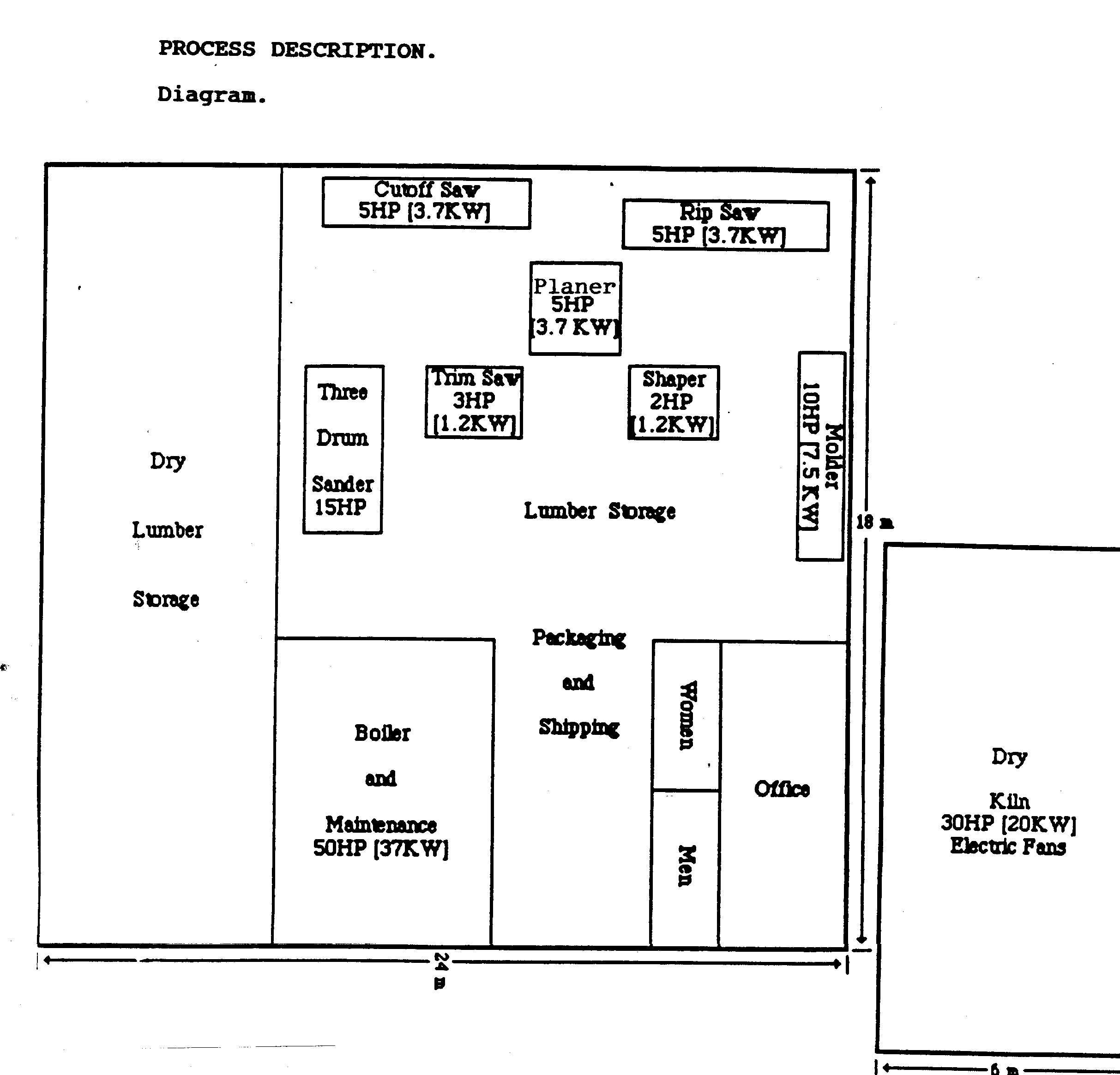
not including the dry kiln. The general workflow in the main area
is from dry lumber storage to processing to shipping. Management
and maintenance space are also shown.
REFERENCES
Unless otherwise stated, addresses are in the United States. In
U.S. publications, lumber volume is expressed in board feet (foot
board measure, fbm, or bd. ft. The abbreviation mbf usually means
thousands of board feet). 1,000 fbm = 2.3598 cu m; 1 cu m =
423.76 fbm.
Technical Manuals and Textbooks
Brown, W. H., 1978. Timbers of the World (9 regional volumes,
paperback). Timber Research and Development Association (TRADA),
Hughendon Valley, High Wycombe, Buckinghamshire HP14 4ND, United
Kingdom
Groneman, C. H., 1981. General Woodworking. 6th ed. 344 pp.
McGraw-Hill, Inc., 330 West 42nd Street, New York, New York
10036 USA.
Noltmeyer, V. E., et al., 1967. Safety Accounting and Cost Controls
Manual in the Hardwood Conversion Industry. National Dimension
Manufacturers Association, 1000 Johnson Ferry Road, Suite
A-130, Marietta, Georgia 30068 USA.
Pepke, E. K., and M. J. Kroon, 1981. Rough-Mill Overator's Guide
to Better Cutting Practices (Publ. NA-TP-4). U.S. Department of
Agriculture, Forest Service, Northeastern Area State and Private
Forestry, Broomall, Pennsylvania 19008 USA.
Periodicals
Furniture Dimension Stock Report. Industrial Extension Service,
School of Engineering, North Carolina State University at
Raleigh, Raleigh, North Carolina 27695 USA.
Wood and Wood Products. Vance Publishing Co., 400 Knightsbridge
Parkway, Lincolnshire, Illinois 60069 USA.
Woodworking Digest. Hitchcock Publishing Co., Wheaton, Illinois
60188 USA.
Trade Associations
Association Technique des Bois Tropicaux, 8 rue de Colonel Moll,
F-75017 Paris, France
International Hardwood Products Association, Inc., P.O. Box 1308,
Alexandria, Virginia 22313 USA.
Woodworking Machinery Manufacturers Association, 1900 Arch
Street, Philadelphia, Pennsylvania 19103 USA.
Directories
Directory of the Forest Products Industry. Annual. Miller-Freeman
Publications, Inc., 500 Howard Street, San Francisco, California
94105 USA.
Hitchcock's Woodworking Directory and Handbook. Annual. Hitchcock
Publishing Co., Wheaton, Illinois 60188 USA.
VITA Resources
VITA has volunteer specialists available in wood products, as
well as documents on file and in microfiche dealing with the wood
industries.
VITA Venture Services
VITA Venture Services, a subsidiary of VITA, provides commercial
services for industrial development. This service-for-fee includes
the following: technology and financial information,
technical assistance, location and brokerage of used manufacturing
equipment, marketing, and joint ventures. For further information,
contact VITA.
========================================
========================================