ENVIRONMENTALLY SOUND
SMALL-SCALE
ENERGY PROJECTS
GUIDELINES FOR PLANNING
by
Elizabeth Ann Bassan
Timothy S. Wood, Ph. D.
Technical Editor
Coordination in Development (CODEL)
Volunteers in Technical Assistance (VITA)
VITA
1600 Wilson Boulevard, Suite 500
Arlington, Virgnia 22209 USA
Tel: 703/276-1800 . Fax: 703/243-1865
Internet: pr-info@vita.org
CODEL
Environment and Development Program
79 Madison Avenue
New York, New York 10016
Illustrations by Linda Jacobs
Cover Design by Susann Foster Brown
CODEL/VITA 1985
ISBN No. 0-86619-171-2
TABLE OF CONTENTS
Preface
Chapter I
USES AND USERS OF THIS MANUAL
What is the purpose of this manual?
What does the manual provide?
Who should use this manual?
Chapter II
ECOLOGY FOR SUSTAINABLE ENERGY DEVELOPMENT
What are ecosystems and biological communities?
How does an ecosystem work?
Producers
Consumers
Decomposers
Non-living environment
How are energy and the environment related?
What is energy flow?
What is a nutrient cycle?
What is the hydrologic (water) cycle?
What are limiting factors?
What is renewability?
Energy, ecology, and the tropics
What are environmental effects?
Chapter III
SOCIOECONOMIC CONSIDERATIONS OF ENERGY USE
Energy use in developing countries
Reaching participant groups
Social, cultural, and economic aspects of energy
What is the role of women in energy production?
Energy and general welfare
Factors affecting the adoption of energy technologies
Who pays for environmental problems?
Chapter IV
ENERGY PLANNING FOR SUSTAINABLE DEVELOPMENT
Why plan?
Special considerations in meeting energy needs
What is end use?
How efficiently is energy used?
Measuring energy output
Wind
Solar
Water
Forests and vegetation
Crop residues
Animal residues
Chapter V
ULIPUR, BANGLADESH: A CASE STUDY
How were socioeconomic data collected?
How were data collected on energy use?
How to use the energy flow diagram
Summing up
Chapter VI
A PROCESS FOR PLANNING ENERGY PROJECTS
Community participation
Environmental and socioeconomic guidelines
Steps in the planning process
1 Collect information
Community profile--socioeconomic
characteristics
Natural resources--ecological
characteristics
Energy use patterns
2 Identify energy needs and constraints
3 Define project objectives
4 Develop alternative designs
5 Compare alternatives and select one alternative
6 Implement project
7 Monitor project
8 Evaluate project
Chapter VII
ENERGY SOURCES AND ENVIRONMENTAL
CONSIDERATIONS
Solar energy
Drying
Cooking
Electricity generation
Solar ponds
Wind
Water (Hydropower)
Biomass - Fuelwood
- Biogas
- Ethanol
Animal traction
Chapter VIII
MATCHING ENERGY SOURCES WITH ENERGY USES
Household energy
Cooking
Heating
Lighting
Food processing
Energy for agriculture
Irrigation
Land preparation, crop management,
and harvesting
Chapter IX
SUMMARY
Appendixes
A. ENERGY CONVERSION TABLE
B. ECOLOGICAL MINI GUIDELINES
C. TROPICAL CLIMATES
D. BIBLIOGRAPHY
E. SOURCES OF
GUIDELINES FOR PLANNING SERIES
Environmentally Sound Small-Scale Agricultural Projects, 1979
(Also in Spanish and French)
Environmentally Sound Small-Scale Water Projects, 1981
(Also in Spanish)
Environmentally Sound Small-Scale Forestry Projects, 1983
(Translations in Spanish and French in process)
Can be ordered from:
VITA Publications
1815 North Lynn Street, Suite 200
Arlington, Virginia 22209 USA
Preface
This manual is the fourth volume of the Guidelines for
Planning Series. The series was originally suggested by
representatives of private development agencies to provide
paratechnical information for their field staff and counterpart
personnel in Third World countries for use in planning
environmentally sound small-scale projects. Titles of other
volumes in the series are listed on the opposite page.
The CODEL Environment and Development Committee has
guided the development of the Guidelines for Planning Series.
CODEL acknowledges the contribution of the Committee to this
volume. Those members who reviewed drafts of the manual are
indicated by an asterisk.
Sr. Jean Marie O'Meara, S.H.C.J., Chairperson
* Ms. Elizabeth Enloe, Church World Service
Mr. George Gerardi, Hermandad
* Rev. John L. Ostdiek, O.F.M., Franciscan Missionary
Union of Chicago
Mr. Ragnar Overby, The World Bank
Ms. Agnes Pall, International Division, YMCA(**)
Mr. C. Anthony Pryor, U.S. Agency for International
Development
* Sr. Renee Roach, Medical Mission Sisters
Mr. A. Keith Smiley, Mohonk Consultations on the
Earth's Ecosystem
In addition, a number of reviewers offered substantive
comments, which assisted with the preparation of the final copy:
Mr. Thomas Carouso, Partnership for Productivity
Ing. Guillermo Duarte-Monroy, Sistemas
Agroenergeticos Integrados
Mr. Gary Eilerts, formerly Appropriate Technology
International
(**) Deceased August, 1983
Dr. Peter Ffolliott, University of Arizona
Mr. Jack Fritz, National Academy of Sciences
Dr. Gary Garriott, Volunteers in Technical Assistance
Ms. Marilyn Hoskins, Virginia Polytechnic Institute
and State University
Dr. Clarence Kooi, US Agency for International
Development/West Africa
Sr. Caroline Mbonu, Handmaids of the Holy Child
Mr. Mark Ward, Africa Bureau, US Agency for
International Development (AID)
Margaret Crouch, VITA publications office, has served as
liaison with CODEL and technical adviser to CODEL for several
of the volumes in the series. CODEL takes this opportunity to
thank Ms. Crouch for her past assistance and special contributions
to this volume.
Ms. Molly Kux, AID Office of Forestry, Environment, and
Natural Resources, has encouraged and supported the preparation
of each of the volumes in the series. She has played an important
role in assisting with identifying authors and reviewers and personally
reviewing the books. Mr. Albert Printz, AID Environmental
Coordinator, reviewed and commented on the text.
CODEL acknowledges with thanks the continued support and
encouragement for the Environment and Development Program
from both Ms. Kux and Mr. Printz.
The AID Office of Private and Voluntary Cooperation has
supported the development of the CODEL Environment and
Development Program. CODEL gratefully acknowledges the
contribution of that office and the support of Mr. Paul Bisek,
Project Officer, for the Program as a whole.
CODEL is pleased to publish this booklet written by Elizabeth
Bessan in collaboration with Dr. Timothy Wood, Technical Editor.
During the preparation of this volume Ms. Bassan served with the
Sierra Club International Earth Care Center and subsequently
with the American Council of Voluntary Agencies in Foreign
Service. Dr. Timothy Wood recently spent two years in West
Africa as a consultant for VITA, returning to his former position
as Director of Environmental Studies, Wright State University,
Dayton, Ohio. Brief biographies of the author and technical
editor can be found at the end of the book.
Ms. Wynta Boynes, American Council of Voluntary Agencies
in Foreign Service, did an excellent job of editing the text.
Finally, CODEL acknowledges with thanks the cooperative
services of Ms. Rosa Marsala, Ms. Gwen Dantzler, and Ms. Betty
Wynn of the Unified Information System, of the Support Agency
of the Presbyterian Church (U.S.A.).
We welcome comments from readers of the book. A questionnaire
is enclosed for your convenience. Please share your
reactions with us.
Rev. Boyd Lowry, Executive Director, CODEL
Ms. Helen L. Vukasin and Sr. Mary Ann Smith
Environment and Development Program, CODEL
ABOUT CODEL
Coordination in Development (CODEL) is a private, not-for-profit
consortium of 38 development agencies working in developing
countries. CODEL funds community development activities that
are locally initiated and ecumenically implemented. These
activities include health, agriculture, water, appropriate
technology, and training projects, among others.
The Environment and Development Program of CODEL serves the
private and voluntary development community by providing
workshops, information, and materials designed to document the
urgency, feasibility, and potential of an approach to small-scale
development that stresses the interdependence of human and
natural resources. This manual is one of several materials
developed under the Program to assist development workers in
taking the physical environment into account during project
planning, implementation, and evaluation. For more information,
contact CODEL Environment and Development Program at
79 Madison Avenue, New York, New York 10016 USA.
ABOUT VITA
Volunteers in Technical Assistance (VITA) is a private nonprofit
international development organization. It makes available to
individuals and groups in developing countries a variety of
information and technical resources aimed at fostering self-sufficiency:
needs assessment and program development support;
by-mail and on-site consulting services; information systems
training; and management of field projects. VITA promotes the
use of appropriate small-scale technologies, especially in the area
of renewable energy. VITA's extensive documentation center and
worldwide roster of volunteer technical experts enable it to
respond to thousands of technical inquiries each year. It also
publishes a quarterly newsletter and a variety of technical
manuals and bulletins. For more information, contact VITA at
1815 N. Lynn Street Suite 200, Arlington, Virginia 22209 USA.
Chapter I
USES AND USERS OF THIS MANUAL
What is the purpose of this manual?
The purpose of this manual is to help development workers
and others to become aware of the environmental factors that
should be considered in planning small-scale energy projects that
are environmentally sound and therefore more likely to be
sustained.
Environmentally sound planning includes the physical environmental
factors as well as the socioeconomic and cultural factors.
This approach helps assure the protection of the renewable
natural resources that supply most of the energy used in the Third
World.
Traditional sources--dung, crop and forest residues, fuelwood,
and human and animal energy--make up a very significant amount
of the energy used in developing countries. Estimates of how
much traditional fuels are used vary, largely because of the
difficulty in measuring non-commercial fuel use. Recent
estimates indicate that in Asia these fuels account for about 65
percent of total energy use, in Africa, about 85 percent, and in
Latin America, about 20 percent. This masks the enormous
variation both between and within countries.
It is not likely that the situation will change dramatically in
the near future. Because of supply and cost factors many energy
specialists doubt that developing countries will make the
transition to fossil fuels as has occurred in developed countries.
From an environmental point of view, this may be good. For
development, the challenge is to provide energy essential for
socioeconomic development, and to promote resource use that
will allow for sustainable, reliable supplies of energy.
Traditional, renewable fuels have long been considered the
most environmentally sound. Practice has shown that this is true
if they are not used beyond their ability to replace themselves.
Environmental damage occurs when "renewable" resources are
treated as a product that is used faster than it can be replaced.
This can damage the ecological system, leading to soil erosion and
degradation, loss of watersheds, increased flooding, and desertification.
This destroys the ability of the land to produce.
Agricultural productivity and energy availability--that is, having
food to cook and fuel with which to cook--depend on the ecological
well-being of the physical environment.
Energy is critical to development. Energy is necessary for
cooking and for pursuing productive activities that generate
income and provide employment. This is as true of the twigs and
leaves for village fires as for the relatively small amounts of
fossil fuels that represent the life-blood of market town activities.
Energy can improve the quality of life by providing drinking
water, light, and heat. It can be used in devices that lead directly
to added income, or free up time that can be used for other
purposes.
When planning projects that involve the use of energy, there
is a tendency to deal with energy and environmental questions in
isolation and so to ignore their relationships to other issues. In
examining these questions, planners must consider the relevant
social and economic factors as well as the technical. Finally,
they should appraise administrative and/or implementing
capabilities. For regardless of the size of the effort, good energy
planning requires more than merely a technology, a source of
funds, and sound development intentions. The purpose of this
manual then, is to aid development workers in thinking through
how to use natural resources for energy in a way that maintains
ecological well-being--the lifeline for survival.
What does the manual provide?
It provides:
* an introduction to ecological concepts, their relevance to
energy development, and their interaction with the
broader socioeconomic environment in which energy
development takes place
* a guide to planning small-scale energy projects in which
environmental costs and benefits are incorporated
* guidelines for making an informed decision on the most
enviroamentally sound energy project alternative
* an overview of the environmental considerations in using
various energy sources
* background information for choosing an environmentally
sound strategy to provide for specific energy end-uses, in
households, agriculture, small-scale industry, and
transportation
* a useful reference to commonly used energy and
environmental terms
* a look at alternative solutions to addressing energy
development within the broader framework of environmental
and economic considerations.
Who should use this manual?
This manual was prepared for development workers and
project planners in Third World countries who are assisting the
urban and rural poor to plan and implement small-scale energy
projects. It has been written for those who lack technical training
in the area of energy, but require some general guidelines for
planning projects that will help to meet pressing energy needs and
at the same time protect and even increase the renewable
resources.
Chapter II
ECOLOGY FOR SUSTAINABLE ENERGY DEVELOPMENT
Ecology is the study of the relationships among all living
things and their surroundings, or environment. Generally the
environment is thought to include such things as land, vegetation,
climate, shelter and animals. In this manual a concept of human
environment is expanded to include cultural, economic, social, and
political factors.
This chapter will introduce a few ecological principles that
are important to the planning of sound energy projects. A more
detailed treatment of ecological processes can be found in any
basic ecology text.
What are ecosystems and biological communities?
A central theme of ecology is the concept of an ecosystem.
Common examples include forests, mangrove swamps, grasslands,
and oceans. The plants and animals in an ecosystem form biological
communities. Members of the communities are like interwoven
threads of a fabric, each performing an important role that
helps the whole community to function. Some of the "threads"
may be energy and minerals that combine in complex ways to
form a "food web." Other "threads" may involve activities that
aerate and fertilize the soil, help the soil retain moisture,
pollinate flowers, and aid in seed dispersal, to name just a few.
Although no two ecosystems are identical, all have the same
fundamental structure. Two basic processes of all ecosystems
are: (1) the one-way flow of energy, and (2) the cyclical flow of
mineral nutrients. These processes are strongly influenced by
such physical factors as sunlight, water, and temperature. Energy
is expended and nutrients are recycled through eating. Eating
links all plants and animals to each other. The way in which the
linking takes place is called a "food chain."
How does an ecosystem work?
Ecosystems tend to be self-regulating. In well-functioning
ecosystems processes of growth and decomposition occur at a rate
and in a manner to maintain a balance or equilibrium. A
development project that introduces a new component to the
ecosystem (for example, waterpower) or diverts resources useful
to the ecosystem (for example, organic wastes) may change the
balance or equilibrium. Sometimes a new equilibrium can be
quickly achieved. In other cases, the ability of the ecosystem to
foster growth is changed.
There are four "actors" in any ecosystem through which
energy and nutrients flow:
1. Producers -- green plants such as algae in a pond, grass in
a field, or trees and undergrowth in a forest. The
producers make life possible through their ability to
convert radiant energy from the sun to chemical energy
using carbon dioxide and water. The process is called
photosynthesis. Other living things, including people, can
use this energy for food and fuel. About 100 billion tons
of organic matter are produced annually through
photosynthesis. Eventually, most of this is changed back
to carbon dioxide and water. Some is left temporarily in
vegetation, and some becomes cell tissue in people and
other animals.
2. Consumers--animals (including people) that eat plants
and/or other animals. Part of what is eaten becomes
energy stored in cell tissue. The energy is used for
growth, movement, reproduction, and the maintenance of
the body (respiration, digestion, etc.).
3. Decomposers--bacteria and fungi. These produce
enzymes that break down dead plant and animal material.
This releases essential nutrients, which may be reused by
producers. It may also provide organic materials that
bind soil particles and thus help protect the soil from
erosion.
4. Non-Living Environment--basic elements, combinations of
elements, and climate. Basic elements include carbon,
phosphorus, nitrogen, and sulphur, among others. Combinations
of elements include proteins, carbohydrates, and
fats. The climate, which affects the rate of growth and
decomposition, includes temperature, moisture, and
sunlight.
As noted, the components of an ecosystem are complex and
interwoven. Each performs an essential role that fosters the
growth of the living parts and maintains the entire system. And
changes in one component will affect not only its own functions,
but also its relationship with the others--and the functioning of
the system as a whole.
How are energy and the environment related?
In less advantaged countries much of the energy consumed is
derived from organic matter, such as crop residues, animal dung,
trees, and shrubs. These same materials may also be used for
fertilizer or construction. They may be needed by plants and
animals for food, nutrients, and shelter. Such competition for
resources can have a far-reaching impact that may not be
apparent immediately.
A more obvious environmental impact occurs whenever any
energy resources are exploited and used by man. Inevitably,
water, air, and soil pollution are the result. Currently in many
developing countries, for example, wood for charcoal is being cut
faster than it can be replaced. Proper management techniques,
such as timely replanting, more efficient charcoal production
methods, and controlled harvest rates, are not being adequately
practiced. Exploiting the wood energy resource can become an
important contributing cause of deforestation.
The results of deforestation include exposing soils to direct
sunlight, heavy rains, and nutrient loss. Soils become dry, compacted,
and unproductive. Soil erosion leads to huge silt deposits
in streams, creating dry stream beds and reducing the effectiveness
of dams and irrigation channels. As the wood supply diminishes,
the price of fuelwood increases, either in cash amounts or
in the time and effort required to bring it in from more distant
areas. Eventually, people may begin to use alternative fuels such
as cow dung, which precludes its use as an important soil
conditioner and fertilizer.
The purpose of understanding ecology in relation to development
projects is to project the effect a proposed project may
have on an ecosystem, to learn what mitigating measures may be
required, and to monitor changes in the ecosystem as the project
is implemented.
This manual addresses the conflicts between the uses of
energy and the natural resources that provide energy. We are as
concerned with the impact energy use may have on the environment
as with the impact that environmental degradation may
have on the potential energy supply. Development planners who
can see beyond the technical limitations of energy technologies to
view the relationship between economic development and
resource management will have developed one additional method
for assessing project feasibility and promoting economically
viable, sustainable projects.
What is energy flow?
All life depends on energy to grow and reproduce. The
ultimate source of energy on earth is the sun, which transmits its
energy in the form of radiation. Green plants make life possible
because they are able to convert radiant solar energy to a
chemical form, using carbon dioxide and water. This process is
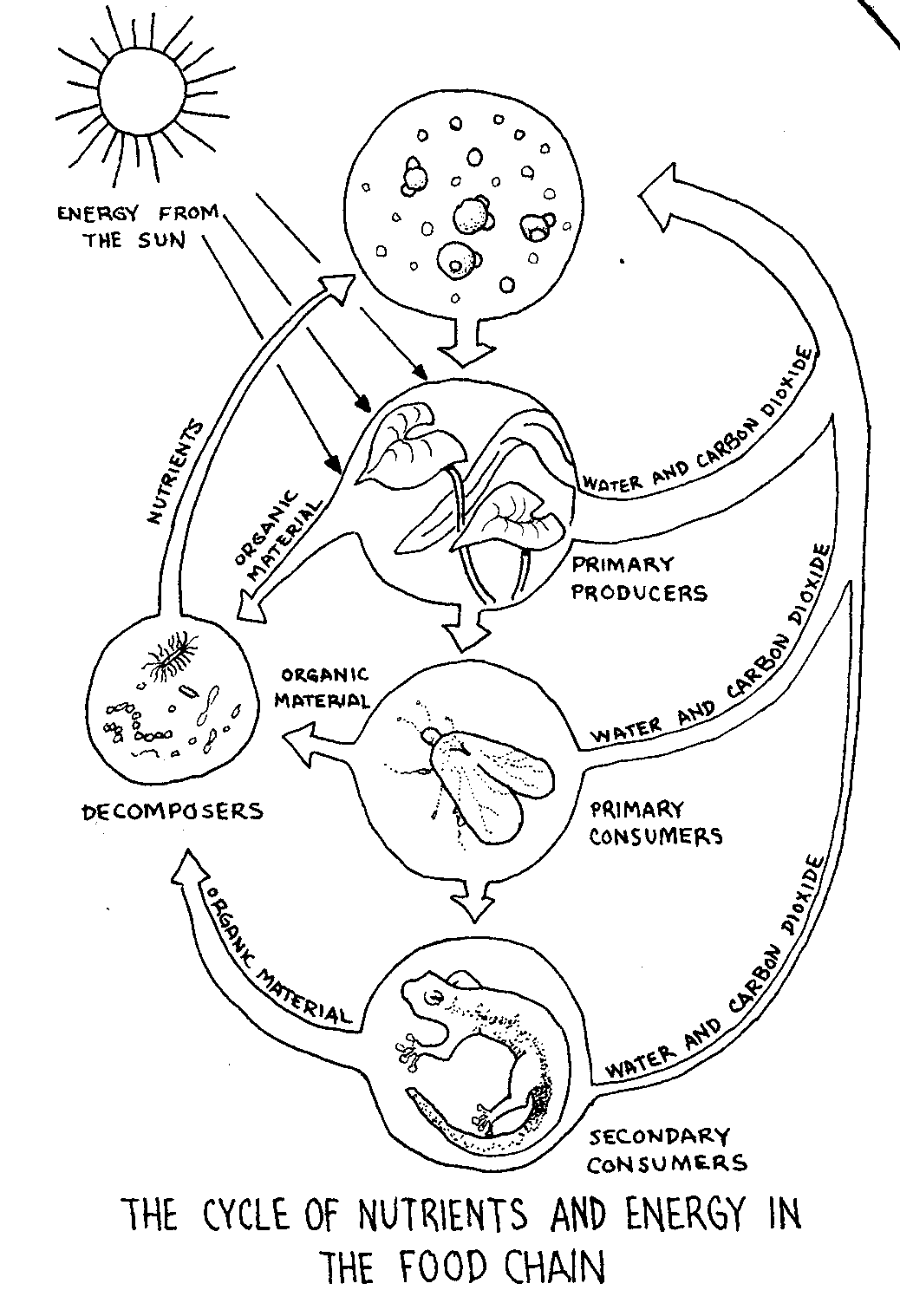
called photosynthesis. Chemical energy is passed along as food to
plant-eating animals, such as some insects, birds, rodents, wild
and domestic animals, and people. These animals use much of the
energy for their own activities, then transfer the rest--again as
food--to predators or to decomposing bacteria and fungi. (See
diagram page 8.)
esed1x8.gif (540x540)
The diagrams on the following pages show how solar energy is
esed2110.gif (486x486)
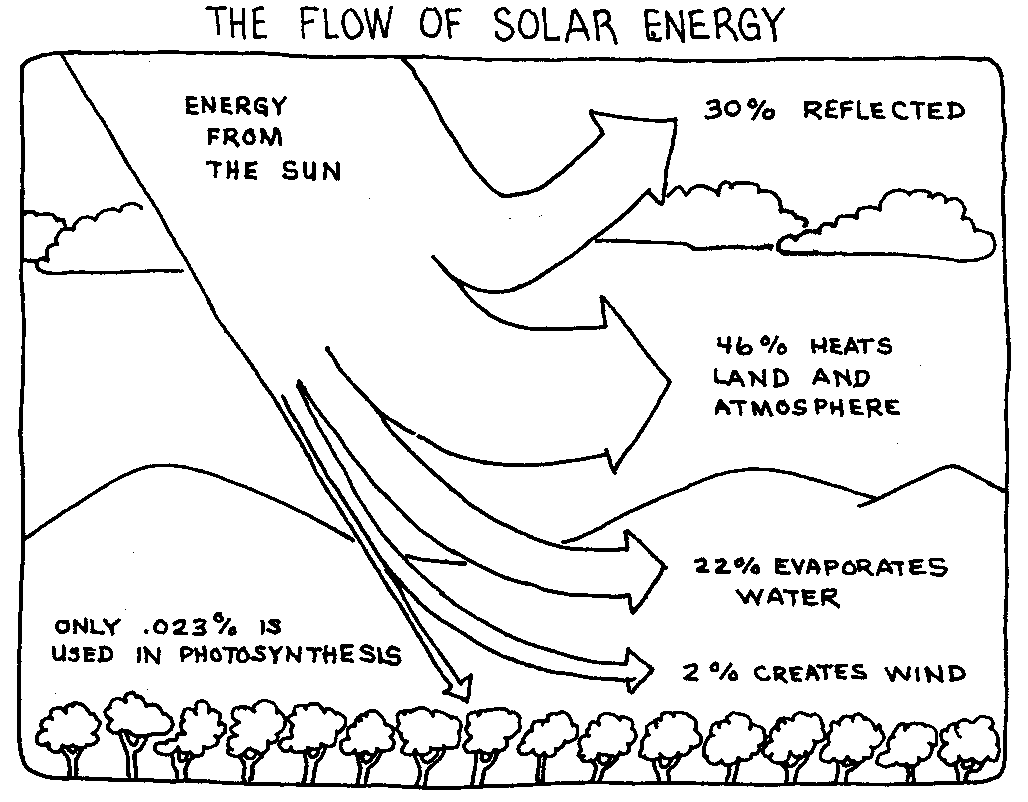
photosynthesis. Smaller and smaller amounts of energy are passed
along from the plants to others in the food chain. This is because
a lot of food energy is used in heat-producing activities, and this
heat energy is dissipated into space. Only a small amount of the
initial energy is stored in chemical form, which becomes food in
the food chain.
All forms of energy undergo the processes of conversion and
dissipation like that just described for solar energy. These two
characteristics of energy are the first and second laws of
thermodynamics: (1) energy cannot be created nor destroyed, but
only converted to other forms, and (2) as energy flows through an
ecosystem, it is degraded and eventually dissipated into heat, a
non-usable form. This means that a continuous supply of solar
energy is required to support life.
What is a nutrient cycle?
The cyclic flow of nutrients involves both living and nonliving
parts of ecosystems. (See diagram on page 8.) The decomposers
play a major role in recycling nutrients by breaking down
dead plant and animal material. This makes essential elements
available to the soil and to plants. Such elements as carbon,
calcium, nitrogen, phosphorus, and sulfur are passed in this way.
No living thing can survive without the basic elements.
Removing plant material takes away an important source of
nutrients, and will eventually decrease the fertility of the soil.
Care must be taken to assure that sufficient ground cover is left.
Unlike energy, the minerals essential to life may be used over
and over, constantly recycled within the ecosystem. In land-based
ecosystems, minerals are taken from the soil by plant roots.
Later they may be passed from plants to grazing animals and then
to a chain of predators or parasites. Eventually they are returned
to the soil through the action of decomposers, such as bacteria
and fungi.
Mineral recycling is seldom perfect, and in fact can be
seriously disrupted. For example, wood or cow dung will
eventually decompose if left alone, and the nutrients they contain
will return to the soil. When wood or cow dung is collected and
burned for fuel, however, all of the minerals are released in
smoke or ashes. This represents a net loss of nutrients from areas
where the fuel was taken, and the soil there may become less
fertile. With the nutrient cycle thus broken, the ability of the soil
to support plant and animal life is reduced.
What is the hydrologic (water) cycle?
Another important ecological cycle is the water, or
hydrologic, cycle. Not only is water necessary for life, it also
helps distribute nutrients. Powered by solar energy, the
hydrologic cycle is the movement of water from the surface of
the earth to the atmosphere and back to the earth again.
As can be seen from the diagram below, forests and other
esed4x13.gif (486x486)

vegetation play very important roles in the hydrologic cycle.
Vegetation acts to help slow down and control the flow of water
to an open body of water. This keeps nutrients within an area,
and prevents flooding and soil erosion. Land clearing can
significantly affect the process, and may eventually decrease
agricultural productivity.
What are limiting factors?
To thrive in any given situation, plants and animals must have
the basic materials for reproduction and growth. These include
sunlight, water, a wide variety of minerals, shelter, and protection
from parasites and predators. When any one of these factors
is present only in amounts approaching the minimum needed for
survival, it is known as a limiting factor.
For example, the number of plants and animals that can be
supported in a fertile flood plain is greater than in an arid upland
of the same area because more water, nutrients, and better soils
are available. Nutrients are continually brought into flood plains
from upland regions, and flood plain farmers benefit from this
transfer of resources. <see image>
esed5x15.gif (486x486)

However, if the amount of any particular nutrient were
reduced below a critical level, the productivity of the flood plain
would suffer, even if all other conditions remained the same. This
nutrient would be the limiting factor.
Limiting factors will vary from one place to another and
from year to year. Temperature, the amount and intensity of
rainfall, soil characteristics, sunlight, and availability of nutrients
vary constantly. These variations determine the types of species
and number of individual plants and animals that can live in a
given area.
The amount of living material an ecosystem produces can be
altered, by natural and human interventions. Natural causes
include things like violent storms, earthquakes, or drought.
Humans can supplement a limiting material, for example, by
adding water or fertilizer. However, unintended or unavoidable
human interventions also can decrease the amount an ecosystem
can produce. For instance, if plant materials that normally fall to
the ground and decompose to enrich the soil are instead gathered
for fuel, soil fertility will decline.
Often, biological potential and productivity can be improved
by adjusting the availability of limiting factors. For example,
agricultural production can often be increased by adding whatever
is missing or in limited supply to the area. This addition might be
fertilizers, organic matter, water, or pest management.
The limiting factors should be considered in any project in
which energy may be derived from biomass sources that may have
agricultural uses. For example, obtaining energy by burning
agricultural residues diverts the amount of nutrients that can be
returned to the soils. When nutrients are the limiting factor, this
practice may have serious effects on long-term agricultural
productivity. However, if these nutrients are not a limiting
factor because agricultural productivity is relatively high and
there is an excess of agricultural residues, then use of these
residues for energy can be extremely beneficial to people who
need fuel.
When considering limiting factors, remember:
* Satisfying the most obvious limiting factor may not solve
the problem. In fact, satisfying one limiting factor may
reveal yet another. For example, when nitrogen is lacking
in a corn field, farmers may add a nitrogenous fertilizer.
They may find that crop growth then is limited by a lack
of phosphorus.
* Changing existing conditions by altering the limiting
factors may upset the relationships among organisms.
Changes in the system may favor organisms that
previously were less competitive. These changes can be
beneficial for energy production. The degree of adverse
impact can be affected by the natural resource
management planning in the original project design.
What is renewability?
Resources are renewable if they can reproduce themselves
(for example, plants) or if they are unlimited in supply (for
example, wind and sunlight). All plant-based resources have the
ability to reproduce. However, their reproduction depends on the
presence of suitable soil, sunlight, water, and favorable temperature.
These limiting factors must be maintained if the resource
is to remain renewable.
An ecosystem can be degraded in several ways that will
hinder its ability to provide the conditions necessary for its parts
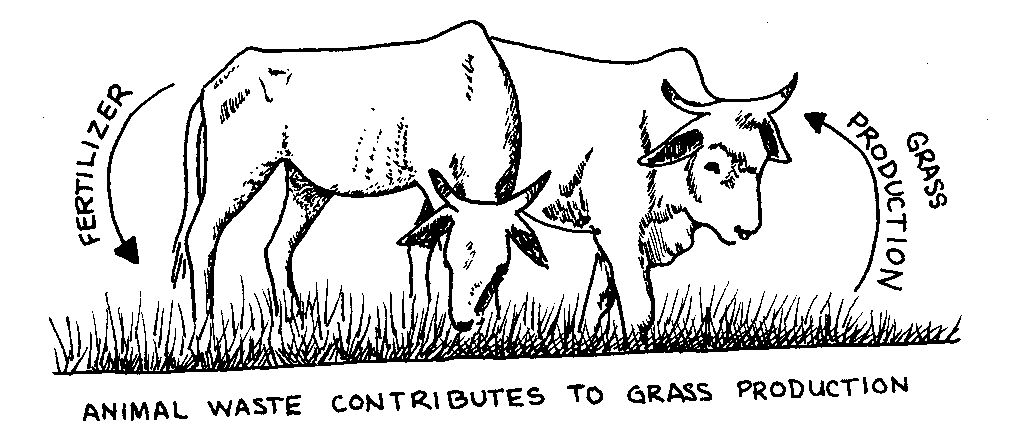
to reproduce. For example, dung plays a major role in recycling
nutrients when left on the soil. When burned as dung cakes for
fuel, many of its nutrients are lost. Although dung is renewable,
its use as energy may affect its alternative use to improve soil
fertility. If the soil is less fertile, less fodder will be produced.
This will eventually also reduce the production of dung.
One way to avoid this would be to use the dung in biogas
digesters, where sludge by-product can be an excellent fertilizer.
The availability of other renewable energy sources should also be
investigated. Perhaps another energy source would relieve the
need to use as much dung for fuel. <see image>
esed6x18.gif (393x540)
Renewability also depends on how much time one has for
planning.
For example, population growth and development pressures
may require that the natural capacity for renewability of trees be
supplemented with forest management practices. The time for
planning must be sufficient for forest growth.
Energy, ecology, and the tropics
Ecological differences occur among tropical arid, tropical
moist, temperate, or other types of climate. These variations
affect the availability of energy resources and the environmental
impact of their use. We cannot cover the range of possible
variations of ecosystems and energy resources in this manual.
Some of the major regional systems that might affect tailoring
the discussion in this manual to your particular surroundings are
examined in Appendix C.
In general, solar radiation in the tropics is more abundant and
harsh. Rainfall is usually more variable and concentrated.
Natural rates of soil erosion are higher. The growth of plants is
faster (except in the more arid areas) and often not interrupted
seasonally. Differences [within the tropics are due to: the quantity
and seasonal variation of rainfall; soil characteristics and
erosion potential; insolation (the rate of delivery of solar radiation);
and wind patterns. These characteristics of the tropics as
related to the subject matter of this manual are further explored
in Appendix C.
What are environmental effects?
Environmental effects are changes in the environment caused
by human activities or natural processes. Determining the potential
effects of a particular project requires looking at economic,
cultural, and social factors, in addition to those factors that make
up the natural environment. Some of these factors are explored
in Chapter VI. The development planner as well as the ecologist
needs to be concerned with determining the amount of pressure
that populations, communites, and ecosystems can withstand
without being seriously damaged.
Small-scale energy projects can have both positive and
negative effects. The impact of any project may be smaller or
much larger than the scope of the project itself. Changes caused
by a project may not be seen for several years. It is important to
know current energy use patterns in an area to determine how
development projects may help solve the problems of acquiring
and using energy. It is also important to find the relationships
between current energy sources and the natural resource base of
the project area. Once those linkages are known the planner must
decide whether:
* small-scale energy projects will relieve shortages in local
energy supply
* the potential source of energy (flowing streams, fuelwood,
etc.) has other uses that would compete with energy
production
* the uses competing with energy production can be
provided for in some other way without additional
pressure on the ecosystem
* small-scale energy projects in the area will have negative
environmental effects
* environmental damage that may limit energy supply can
be halted by developing projects that improve the
management of natural resources
Charcoal production provides a useful example of the way
energy production can adversely affect the environment, and the
way environmental quality can affect energy production. The
increased use of charcoal, especially in urban areas, is often one
of the few ways that large numbers of people can cope with rising
petroleum prices.
In many places (Haiti, for example), wood for charcoal is
being culled beyond a sustainable point. Trees are being cut down
faster than they can grow back. The result is fewer trees, and
therefore less wood for charcoal-making.
At the same time, deforestation leaves the soil unprotected
from hard rain, leading to nutrient loss and soil erosion. As the
environmental quality declines, the ability of the ecosystem to
grow trees at all is undermined, further reducing the wood
available for charcoal-making.
This illustrates the interrelationship between the effects on
the environment and the balance of the ecosystem as energy is
produced and used.
The link between the well-being of people and the availability
of energy is very strong. This is especially evident in places
where energy is scarce and great efforts or large proportions of
income are spent to obtain it. Examination of the relationships
between natural resources, energy, and economics will help to
find the options for dealing with shortages. Increasing energy
sources is only one possible solution. Others may include
institutional changes, improvements in marketing, or the
promotion of soil and water conservation practices. In all cases,
however, natural resource implications must be realized and
provisions made for careful advance planning and long-term
subsequent monitoring.
Chapter III
SOCIOECONOMIC CONSIDERATIONS OF ENERGY USE
Energy, the capacity to do work, is the motive force underlying
all activity. Like a tool, it is always used to do something
else--to cook food, light a room, supply power to a piece of
equipment, operate a factory. Like any tool, it has little value
except when in use.
How energy is used by people and communities and for what
it is used vary by region, culture, and income group. Determining
how and for what energy is used, as well as what it could be used
for, and who controls the sources are critical steps in energy
planning. In most communities, women can play a central role in
developing answers to these questions.
There is also a whole range of variables that need to be
recognized. Some of these are:
-- who determines access to energy
-- where energy is produced
-- where energy is consumed
-- use patterns to which people presently conform
-- myths
-- demographic trends
This chapter will explore some of these issues.
Energy use in developing countries
Developing countries produce and use energy, especially from
renewable energy resources, in different ways. <see image> Some villages
esed7x23.gif (437x437)
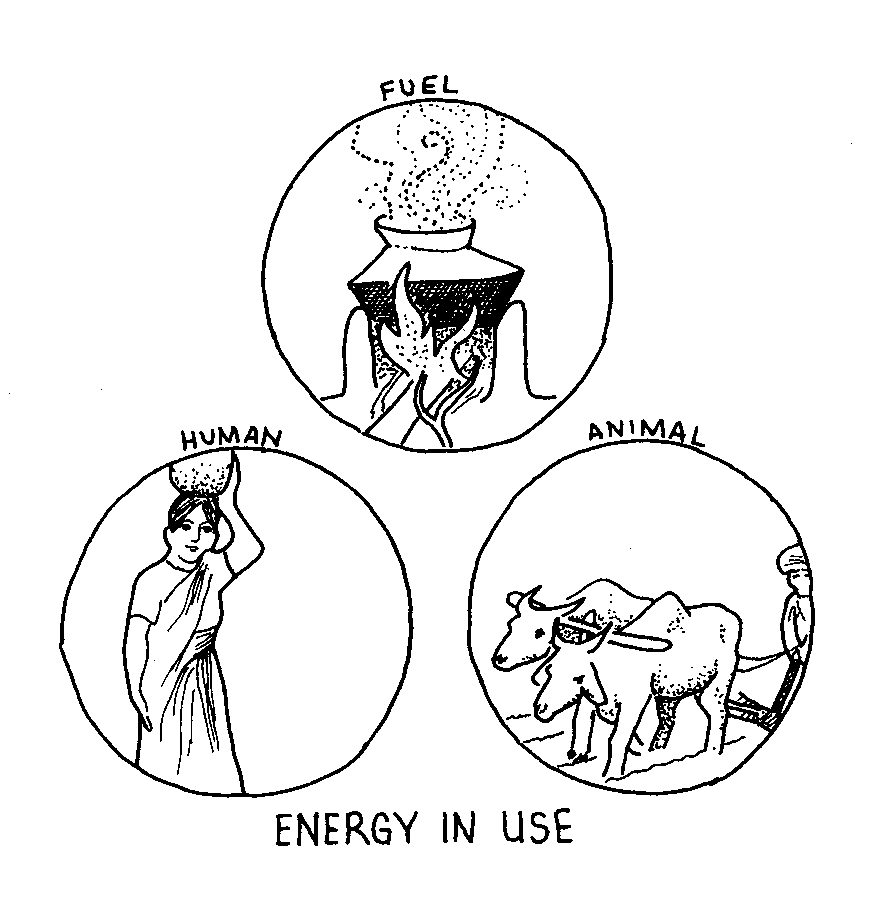
mostly use crop residues. Other villages are more dependent on
fuelwood. Still other villages depend heavily on dung, charcoal,
and biogas. This is because the resources that provide energy are
available in different amounts around the world. Also, because
the resources that provide energy can be used for a variety of
other purposes, people may choose differently on the final use of
a resource.
DAILY ENERGY USE PER CAPITA: AN INDIAN VILLAGE (population, 500)
Activities (Kilocalories/per capita/day)
Energy Agriculture Domestic Lighting Transport Manufacturing Total
Sources (mostly
cooking)
Human Labor 370 250 -- 50 10 670
Animal Power 840 0 0 160 0 1000
Fuelwood, Dung 0 4220 0 0 470 4690
Agric. Wastes ___ ____ ___ ___ ___ ____
Total
Non-Commercial 1210 4470 0 210 480 6360
Oil 50 0 260 0 0 310
Coal 0 90 0 0 0 90
Electricity 90 0 40 0 0 130
___ ___ ___ ___ ___ ____
Total
Commercial Energy 140 90 300 0 0 530
Total 1350 4560 300 210 480 6890
Percentage that is
Non-commercial 89% 98% 0% 100% 100% 92%
Source: Holland, et al (1980).
In general, however, energy use in developing countries,
especially in rural areas, relies heavily on `traditional'
sources--human and animal energy, fuelwood and wood scraps,
charcoal, dung, and crop residues. This is true for about 200
million people.
The table opposite shows energy use in an Indian village,
which is one example of how energy is used in the developing
world. In this village, human labor, animal power, fuelwood, dung,
and agricultural wastes provide 92 percent of the energy. The
bulk of this, or 70 percent, is for cooking.
Reaching participant groups
The table opposite does not show how energy is distributed
among income groups. Since energy projects affect particular
groups in different ways, this is important information for helping
the group with which you are working--the participant group--and
for ensuring that other groups are not adversely affected. This
information will also help avoid environmental damage, since
groups that are hurt might be forced to collect energy sources
beyond a sustainable point.
For example, when biogas digesters were widely distributed
in India, middle-income groups benefited, but poorer groups were
often worse off than before. The poorer families did not own
enough cattle to produce the dung necessary for the digesters.
These same families had relied on free dung for fuel. When the
biogas digesters were introduced, dung suddenly became valuable
and could no longer be collected for free. This forced the poor to
find other energy sources or to reduce their energy consumption.
Finding other sources of energy often resulted in the over
utilization of resources. Making do with less energy can also
result in nutritional and health problems.
Information on the use of energy by families and income
groups was collected in a study of the village of Ulipur, in
Bangladesh (Briscoe, 1979). This study (discussed in detail in
Chapter V) illustrates that when the socioeconomic structure of a
community leaves some families in poverty, those families may
create environmental problems in the struggle to survive.
Social, cultural, and economic aspects of energy
The way energy is obtained and used in households, for
farming, and in small-scale industries is related to social,
cultural, and economic considerations. There is often an
imbalance among these considerations. For instance, the use of
human waste in biogas digesters often depends more on cultural
traditions, social organization, and living patterns than economic
considerations. There may be taboos against using human wastes,
in which case a central latrine or carting human wastes to a
central point may be unacceptable.
Cultural habits affecting the use of energy are sometimes
related to environmental factors. In some places, especially hot,
humid areas, smoke from indoor cookstoves is perceived to be a
good thing because it discourages harmful insects. In such areas,
stoves with chimneys should be coupled with housing improvements
or stove adaptations to keep insects away. In other places,
especially in highland areas, where respiratory ailments and eye
inflammation from smoke are more of a problem than insects,
stoves with chimneys can be an improvement.
The value of a new technology is often closely related to its
ability to suit or adapt to sociocultural habits. For instance,
Lorena (sand and clay) stoves in some parts of Honduras were
altered to suit particular cooking styles and fuelwood lengths to
the point of sacrificing energy efficiency. (NAS, 1982) The
economic and environmental benefits--using less wood--were less
important to the users than maintaining customary cooking
styles. Apparently, even the most efficient wood-burning stoves
can be rejected (and environmentally problematic) if they cannot
be adapted to local cooking practices.
Similarly, social, cultural, and economic factors may help
explain the differences in experience with biogas in China and
India. The rural Chinese are more willing to sacrifice private gain
for the good of the community. Technology is viewed as useful
when it serves community needs. Consequently, biogas digesters
are widely used in a collective way, thereby benefiting the whole
community.
In contrast, where a rigid caste system still exists in parts of
India, and energy-producing resources are controlled by a small
group, individuals work for private gain. Technical solutions are
sometimes given high priority even when benefits are marginal
In this case, biogas digesters are acquired by a few wealthy
families for private use partly for the satisfaction of using
something new and "modern."
The social, cultural, and economic factors create boundaries
within which energy technologies and projects must be developed.
For example, stoves need to be adapted to the requirements of
cooking styles (e.g., frying, simmering, and boiling), and to
accommodate to the kind of fuel used. Where new charcoal
stoves were introduced in Upper Volta, women used these stoves
for cooking small amounts of food quickly, but for large amounts
of slow-cooked foods the women continued to use the traditional
three-stone fire (NAS, 1982). This may have been to obtain the
right kind of heat, or because charcoal is too expensive for
extended usage. Both considerations would be important in
designing an acceptable energy project.
What is the role of women in energy production?
Women are key people in the collection and use of energy in
developing countries. However, this does not mean that women
are therefore in control of the sources of energy. Up to 85
percent of non-commercial energy sources in developing countries
are used in households for cooking, heating, and lighting. It is the
women who usually fetch water, collect wood, prepare grains and
vegetables, make the fire, and cook the food.
Recent surveys have been made of the expenditure of energy
by men as compared with women in various parts of the world.
The following table indicates that in subsistence economies
women work longer hours than men, and, in most cases, spend a
substantial amount of their working hours on processing and
preparation of food, gathering fuel, and carrying water.
Introducing energy projects to reduce the use of human energy in
these activities will have a substantial impact but will affect men
and women differently.
The greater contribution of women to survival tasks that
draw directly on local resources means that women have a special
understanding of the extent, potential, and changes in the natural
resources in their area. Other activities that bring women into
constant contact with their environment include raising
vegetables and fruit in home gardens, raising small animals that
graze nearby, assisting in home construction, preparing a variety
of medicines, as well as fashioning tools, handicrafts, cloth, and
dyes from local vegetation and other local materials. Where
fertile land has been replaced by deserts or where soil has been
degraded in both semi-arid and humid regions, there is a serious
shortage of resources to sustain these activities.
TIME SPENT ON RURAL ACTIVITIES BY WOMEN AND MEN
Country Average hours of Food for human Firewood Water
work/day (in hrs.) consumption
Female Male Female Male Female Male Female Male
(in hours) (in hrs) (in hrs) (in minutes) (in minutes) (in minutes)
JAVA 11.1 8.7 2.7 hrs. 6.26 min. 5.25 12.5 - -
NEPAL 10.8 7.5 3.0 27 minutes 22.8 14.4 40.2 4.2
hours
UPPER
VOLTA 9.8 7.55 2.2 10.0 6.0 2.0 38.0 -
hours minutes
INDIA 9.69 5.68 3.65 18.0 39 34 74 2.4
hours minutes
Source: Tinker (1982) based on time-budget studies by following: Java: White, 1976; Nepal:
Achrya and Bennett, 1981; Upper Volta: McSweeney, 1980; India: A. K. Reddy, 1980.
Tinker provides additional data based on fuelwood-gathering studies, which frequently
indicate longer times due to shorter period, seasonality, and other factors.
South India - daily - men .72, women .84, children .6 = 2.16 hours/day
Tanzania - weekly - 12 hours on the average
Kenya - daily - 1/2 - 1 hour/day
Tinker has observed the critical fuel crisis is in urban not rural areas.
A social forester described the situation in a Senegalese
village where much of the surrounding wood was cleared for
raising groundnuts, a cash crop (Hoskins, 1979). The distance and
time required to collect wood increased. More people were drawn
into the activity to decrease the number of trips and leave enough
time for all the other household work. Women began to use other
fuels and more crop residues. They used green wood even though
they knew it gave less heat and would damage the forest resource
over time. They began to use dung even though they were aware
that it was needed to fertilize their gardens. They were also
forced to purchase wood.
Clearing land for cash crops forced a change in fuel sources
and uses that affected many aspects of daily living in the
Senegalese village. Less fuel and more time spent gathering
meant that the quality and quantity of food changed. To save
fuel, women switched from cooking two hot meals a day to one a
day, or one every other day. They also turned to rapidly-cooked
foods and to serving raw food. Fewer vegetables were served
because the women had less time to tend their gardens and also
found that their gardens grew less food--they complained of loss
of ground cover that had provided natural fertilizers. Buying
fuelwood left less money to buy food. Changes in diet affect
health and nutrition, which affect the life-long productivity of
people.
When developing energy projects, it is important that women
participate from beginning to end. Their unique knowledge of the
available natural resources is essential to a good project. Only
they truly know their needs, the time they can devote to a
project, whether it will benefit them (an absolute necessity for
continued participation), and whether project ideas are
compatible with environmental, social, cultural, and ownership
conditions in their community.
Energy and general welfare
Fuel availability affects many other facets of life, such as
education and employment. Children may be kept home from
school because mothers cannot both travel the longer distances
necessary to collect fuel and also take care of other household
tasks. Income-producing activities such as pottery-making and
processing food for sale must be abandoned where fuel becomes
too expensive. As land becomes cleared of vegetation, soils
degrade, ponds silt up, and valuable plants are lost. When plants
are lost, traditional medicines based on this vegetation are lost.
When the soil is less fertile, home gardens have lower yields.
When ponds and lakes silt up, fish do not reproduce. Without
nearby forage, small animals cannot be raised. All of these
factors affect the ability of an area to sustain life.
Factors affecting the adoption of energy technologies
The political as well as the social, economic, and cultural
characteristics of a society affect whether new energy technologies
are feasible and will be accepted. These characteristics are
often more influential in the adoption or rejection of an energy
technology than technical soundness.
A National Academy of Sciences study of the primary factors
affecting the acceptance of biomass-related technologies found
the following conditions to be most important (NAS, 1982):
How well the technology adjusts to the economic and financial
structures in a society:
* Who owns the resources the technology will use?
* What are the sources of capital for financing a
technology and who has access to them, either directly
or indirectly?
* What is the economic rate of return?
* Is the economic rate of return greater for this use
than for alternative uses of this resource?
* What are attitudes toward risk and how can the risk
involved in adopting a technology be minimized?
Even if a technology is "given" to project participants as
part of the project, a long-term commitment to use the
technology depends on the availability of natural resources to
fuel the technology, financing to maintain and repair it, and
the amount of risk involved in changing. (See also French,
1979.) The economic rate of return for the use as compared
with alternative uses should be considered, although other
factors such as social value may outweigh the economics.
How compatible the technology is to the existing organization of
work:
* What is the division of labor within the family or
social unit (by age, sex, ethnic group, etc.) affected?
* How will the division of labor be affected by a
proposed technology?
These factors affect whether the people who presently
perform the task involved will be likely to find the
technology beneficial in terms of its effect on time, the
patterns and pace of work, and the social organization
related to this work. A technology that disrupts the division
of labor among men, women, and children is likely to be
resisted, especially if it changes the access of sex or income
groups to productive resources.
How well the technology can be integrated with the existing social
structure and value system:
* What social customs, moral values, and religious
beliefs determine the way energy is used?
* How can change accommodate these customs?
Traditional lifestyles and ways of thinking can be
threatened by new energy technologies. For example,
displacing the traditional three-stone stove in the Sahel
requires sensitivity to it as a symbol of harmony between a
husband and wife.
How well the technology adapts to the local political system and the
decision-making process:
* How are decisions made and enforced in the
community?
* How are disputes settled?
Obviously, the answers to these questions will define a
hierarchy in the community that in itself may reinforce the
poverty of a participant group. Knowledge of the system may for
this reason be all the more important, because open conflict
between a participant group and the local political structure may
be too great a risk for the participant group. Minimizing the
conflict will help mobilize the support of participants.
There are many examples of the relevance to the political
structure of an energy project. A successful agroforestry project
depends on the structure that assures the land-tenure system; a
charcoal project depends on those who set prices and regulate
distribution. Those that control the credit structure will affect
the viability of almost all energy projects.
This is not an exhaustive list of the various factors that
influence the adoption of an energy technology, nor are each of
the factors listed necessarily of equal importance. You may find
other factors in your community and some may be more important
than others. (This discussion has not included the environmental
factors that affect the adoption of energy technologies since t his
is covered elsewhere in the booklet.)
Who pays for environmental problems?
Individuals or groups that misuse resources may not be those
that experience the consequences. Some individuals may realize
that they are engaged in practices that lead to degradation of
resources that will directly or indirectly decrease land productivity
over a period of time, but continue with the same practices
in order to survive from day to day. When degradation of
resources does not affect the people who cause this degradation
or when poverty allows no other alternative, it is difficult to
modify environmentally unsound practices.
In many areas, energy resources are collected free of charge,
often on public lands. This includes crop residues, twigs, wood
scraps, and dung. When this collection adversely affects
resources, it is the community as a whole that bears the cost, not
the individual. A charcoal-production example illustrates this.
Charcoal-makers often use inefficient, inexpensive kilns, and
migrate in search of wood. The incentive for them to invest in
more efficient kilns is minimal because they do not bear the costs
of the deforestation they may be causing.
Environmental problems or benefits generated by one group
may be experienced by another group. For example, siltation
results from the dispersal of topsoil and nutrients from land (often
due to deforestation). The most direct and dramatic effect is to
alter downstream watersheds. Reforestation to remedy that
problem may be perceived locally as loss of land, but it can result
in benefits to downstream farmers.
The interrelationships within and between ecosystems are
responsible for the fact that those who cause environmental
degradation may be different from those affected. Remedies,
however, usually require a change in the practices of people who
initiate the act that triggers a chain reaction in the ecological
setting. It is important to develop acceptable incentives for
change. When the poor are forced by socioeconomic circumstances
both to cause and suffer from environmental degradation,
income-producing activities are needed to modify practices.
One example of a project that is providing income-producing
activities is located in the Horn of Africa. Training, seeds, and
materials are offered to individual refugees to encourage them to
grow tree seedlings. The seedlings of a prescribed height are
purchased from the trainees. Thus the project provides both
income potential and the opportunity to assist in reducing the
environmental degradation to which the large numbers of refugees
are inadvertently contributing.
Chapter IV
ENERGY PLANNING FOR SUSTAINABLE DEVELOPMENT
Energy planning for sustainable development is a process for
devising projects that use natural resources to meet local energy
needs in a way that is socially and culturally acceptable, environmentally
sound, and economically feasible. The purpose of such
planning is to avoid the pitfalls of energy projects that are not accepted
by the people meant to benefit from them, that use inappropriate
technologies, that ignore the environmental constraints
of the natural resource base to provide energy and other resources
in the future, and that are not economically feasible.
Why plan?
The planning process can serve a variety of purposes:
* Identify potential community problems.
* Help community develop solutions.
* Uncover difficulties and benefits that might arise through
a given solution.
* Set up a system for adjusting to unforeseen effects that
may occur.
Good planning creates a consensus among those affected by
the problem and the solution--the participant group. It is
essential that this group participate in the entire planning
process. This is particularly critical for small-scale energy
projects since they are very localized and draw upon resources
that local people use and know intimately, and that directly
affect their day-to-day survival. Because the value of energy is
in the work it can perform, the tasks must be defined by those
who will benefit from the work to be done.
Ineffective planning may cause environmental problems by
not taking into account new pressures on resources that the
project itself can create. For example, dung used for fuel may be
diverted from its use as fertilizer and deprive the soil of nutrients.
Energy diverted from other uses for an income-generating
project such as food processing may require gathering more
energy resources than are locally available on a sustainable basis.
Poor planning may also hurt the poorer groups, by reducing their
access to various energy sources.
Special considerations in meeting energy needs
Energy needs are for heat, light, and mechanical power.
Supplying these needs can be accomplished in several ways:
* Managing and increasing the supply of energy sources.
This can be accomplished by tree planting on marginal
lands, managing or creating village woodlots, or introducing
integrated home gardening approaches to farmers.
Additional energy based on the wind, the sun, and water
can be developed. In situations where the supply of a
resource is being depleted by non-energy use activities,
the planner could attempt to introduce actions that
reduce this loss. Deforestation losses as a result of
agricultural expansion are an example. <see image>
esed8x37.gif (437x437)
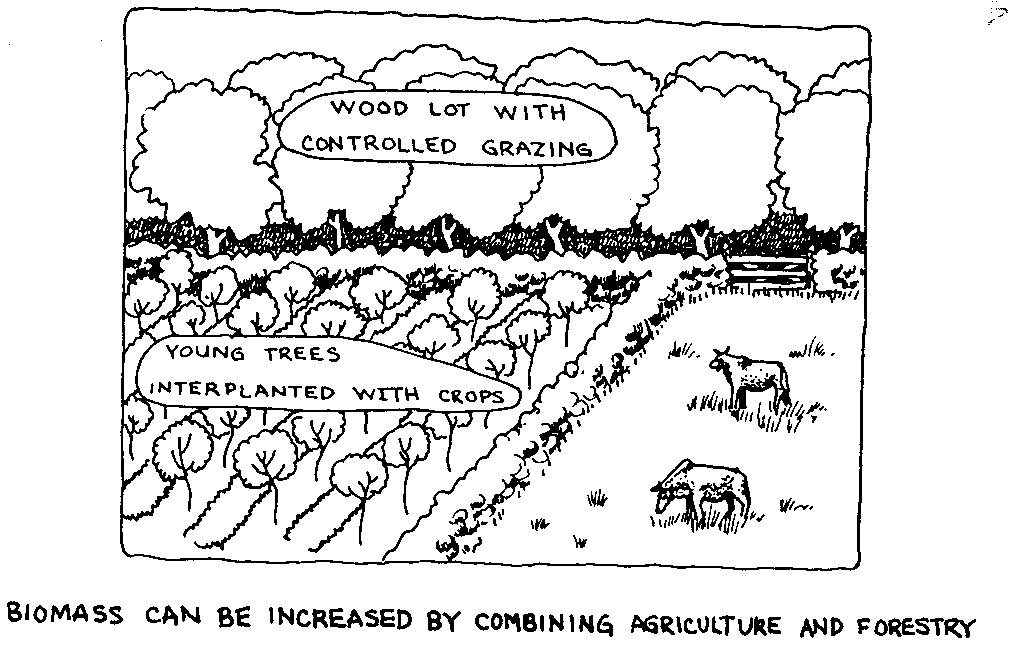
* Developing new conversion technologies: Conversion
technologies include solar and wind devices, small-scale
hydro installations, and biogas digesters. These
technologies can open up new sources of energy or
increase the efficiency of tapping existing sources.
* Improving the efficiency of end-use devices: The
efficiency of devices that utilize energy can often be
improved substantially. Cookstoves are a good example.
esed9x38.gif (393x437)

By developing more efficient designs, less energy is
required. The overall impact on energy consumption from
the introduction of more efficient stoves and which
models are more efficient are still being studied. This
will be discussed more fully in a later chapter.
Simple improvements in household and agricultural
implements also fall into this category. While often
overlooked, such improvements can greatly decrease the
amount of time and human energy used.
* Reducing energy losses and economic costs that result
from transporting and transmitting energy supplies. In
many cases the energy is consumed in the process of
converting the energy source to its end use.
The diagram on the following page indicates the relationship
ese10390.gif (486x486)
Which ways are chosen to meet energy needs depends on a number
of factors. In the planning process, development workers and
communities can collaborate to assess present energy needs and
supply resources available for development, and suitable technologies.
Decisions will be influenced by what is socially and economically
feasible, environmentally sound, and culturally acceptable.
In planning, the different uses of potential energy sources
should be examined carefully. This will bring to light whether
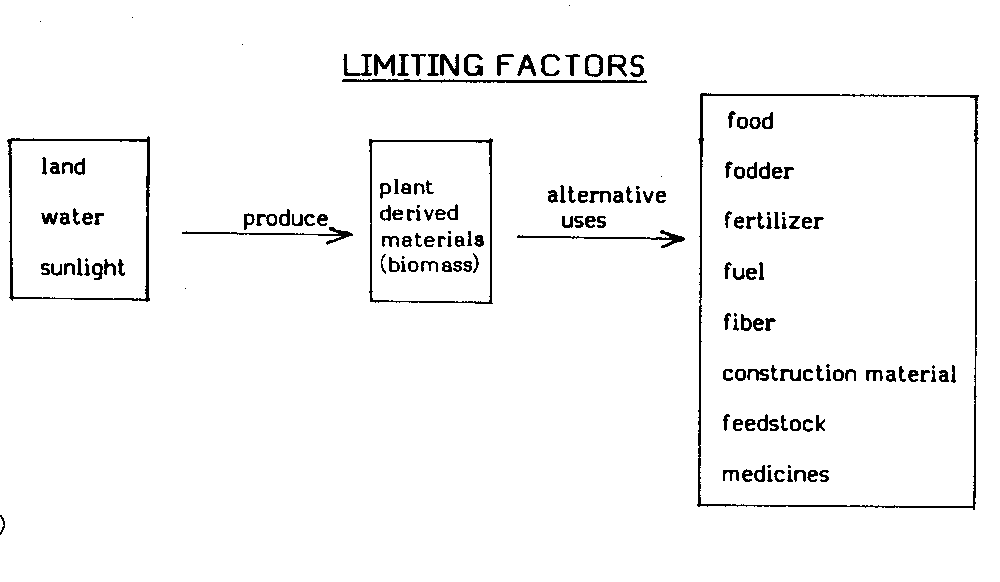
shortages will be created in using a resource for energy. The following
diagram and set of questions summarize this process for
one important source of energy, plant derived materials, commonly
called biomass.
* What biomass resources are available in your community?
* How much biomass is used?
* Flow is biomass allocated for these different uses?
* What are the competing uses for the resource?
* How will increasing its use as fuel affect competing uses?
* Will increasing its use as fuel mean that the supply of
biomass will be collected beyond its ability to regenerate,
and thus create environmental problems?
* What social or economic groups will be affected by
changes in the supply or price of energy?
* Are there ways to overcome the environmental and social
problems of using more biomass for fuel by creating
additional sources, developing appropriate conversion
technologies, and/or improving end-use devices? Should
other alternatives be considered?
Clearly, the answers to many of these questions can only be
found by talking with people in the community, especially the
women and the poor.
What is end use?
Energy is a means to a specific end: to pump water, cook
meals, move material. Such tasks are called end uses. Devices
that utilize energy are called end-use devices.
One energy source may be able to provide for several end
uses. For example, wood can be used to cook a meal, to fire a
brick kiln, or to provide light. Each activity involves different
costs that determine whether the use of wood is economically
feasible. Each use may have different impacts on the
environment, if the quantity of wood required or the manner of
collection differs. The precise environmental impact will vary
with the availability of wood and the condition of the forest
ecosystem. It must be viewed within the broader context of all
the activities which affect the natural resource base. <see image>
ese11x42.gif (600x600)
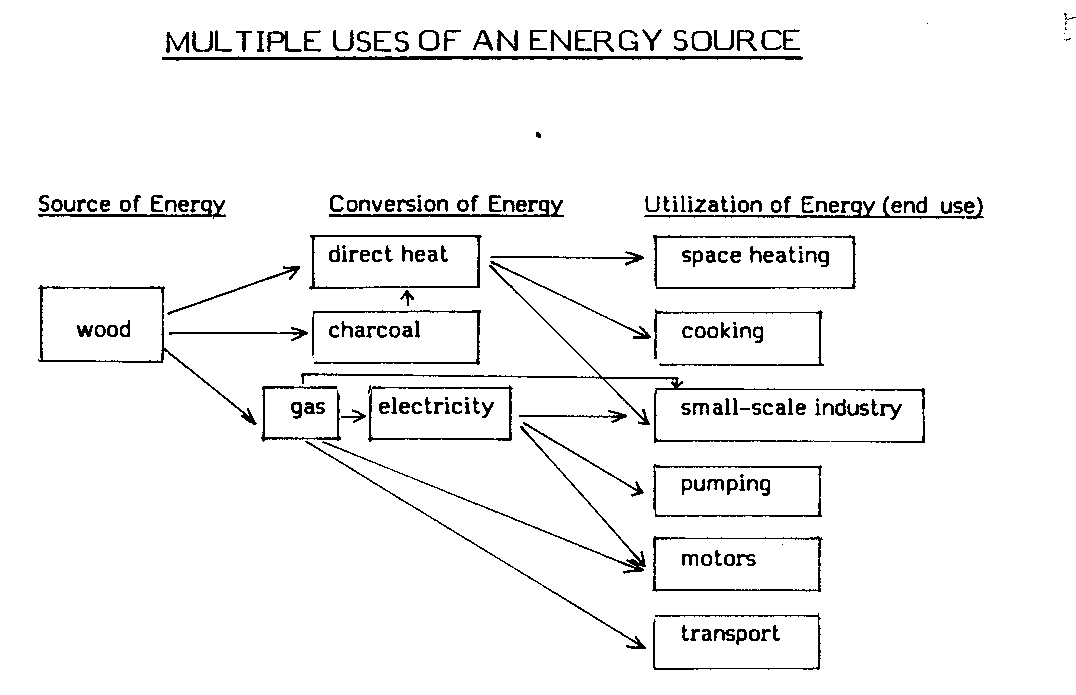
One end use may be powered by a number of energy sources.
For instance, transportation can be obtained from vehicles
powered by animals, petroleum-based liquid fuels, electricity, or
even gasifiers. Each alternative energy source has different
costs, and its use has different impacts on the natural resource
base. While similar work can be accomplished, vehicles--and the
quality of transportation provided--will vary with the different
energy sources. <see image>
ese12x43.gif (600x600)

How efficiently is energy used?
When one form of energy is converted to another form there
is always some energy lost as heat. The relative amount of
energy loss may be expressed as a "conversion efficiency," in
which the smaller the loss, the greater the efficiency.
Technically, the efficiency of energy conversion can be
measured by comparing the amount of useful work done by the
amount of energy required to do it. Stated differently,
Energy Efficiency = Useful Energy Output
--------------------
Energy Input
Since output is never as great as input, this value will always be
less than 1 (a fraction).
One of the main reasons to measure energy efficiency is to
determine areas where research can be done to increase the
effective use of energy from a fuel source. It also permits the
planner to measure the effectiveness of alternative technologies
if and only if those measurements reflect actual use in the home
or industry.
Large losses always occur when heat is transformed into
mechanical energy. This happens, for example, in the internal
combustion engine or when hot steam is used to turn an electric
generator. On the other hand, moving water to generate electricity
involves little heat so overall conversion losses are relatively
small.
Matching energy sources and technologies with their use (that
is, being energy efficient) is economically and environmentally
sound. Mismatching energy sources and uses is not only energy
inefficient, but if the resource is essential to the ecosystems, the
use of an inappropriate source may have a negative effect.
Energy efficiency is only one factor in the selection of
energy technologies. The ease of transport, storage and use of
the resource; the availability and cost of the end-use devices
needed to use the fuel; the amount of government subsidy;
cultural taboos; and considerations of cleanliness, smoke content,
or other factors all help determine the final selection.
Unfortunately, these other factors often overwhelm any
consideration of energy efficiency. This has encouraged, for
example, the use of electricity for heating water, or the use of
diesel fuel to power irrigation pumps when lower quality and less
costly (both to the environment and the consumer) energy sources,
such as solar water heaters or windmills, may have been more
appropriate.
In matching energy sources with uses, there may still be
negative effects on the environment. For example, while
methane from a biogas digester is a good source of cooking fuel,
methane production has a by-product that is difficult to dispose of
and that may cause environmental problems.
Measuring energy output
How does one measure energy? How does one measure
different kinds of energy so that they can be compared? Can the
energy stored in a tree be measured in the same way as the
energy available from a water mill? It is a very important
problem, because understanding the linkages between energy,
natural resources, and utilization requires that energy be
measured and evaluated correctly.
Several energy sources can be compared by converting them
into common units such as Btu's and joules (See Appendix A
Energy Conversion Table). For example, it is relatively easy to
compare gasoline with natural gas with vegetable oil.
Technologies like hydroelectric generators or photovoltaic cells
can also be compared.
It is difficult, however, to measure sources of energy that are
not readily converted into standard units of measurement, such as
biomass or human and animal energy. Clearly, there will also be
problems in comparing these sources with conventional sources.
This poses a real problem at the community level where one is
looking at all kinds of energy sources and uses in a community and
trying to compare dissimilar things. For example, some produce
heat, some produce mechanical energy, and some produce electricity.
In some situations measurement can more appropriately be
made in terms of the time required to perform certain tasks.
What type of energy data and what level of data should the
community planner collect? Following are some general points to
help make such decisions:
1. It is constructive to be as thorough as possible. Find out
what data already exist. Data from other surveys on
agriculture, public health, forestry, or transport might
help to fill in some of the gaps. There is no universal
standard regarding what constitutes sufficient data. The
best standard is to ask yourself continually whether these
data are useful for the purpose at hand.
2. Collect information that allows the planner to:
-- identify the supply or sources of energy
-- quantify the interrelations between the energy
sources, the people who use those energy supplies and
the environment they live within
-- determine how the energy is being used, the pattern of
energy use, pathways of energy flow in the
community, and factors that affect present and future
energy use.
3. Try to use measurements that allow comparison between
energy sources that might substitute for one another, or
between end uses that employ similar energy sources. For
instance, in comparing the use of charcoal as a replacement
for fuelwood, try to calculate both in terms of the
amount of wood involved.
4. Testing the efficiency of end-use devices such as
cookstoves requires considerable planning and attention to
detail. An international committee of woodstove
technicians has recently formulated a series of three
provisional standard testing methods for wood-burning
cookstoves, including water-boiling, controlled cooking,
and actual field performance tests. Copies of the test
procedures are available from VITA (See Appendix E,
Sources of Information).
In all cases, testing should take place under the conditions
in which the device will be used, as well as in the
laboratory. This should include testing with the kind of
fuel to be used, along with the people who will use it and
the uses for which it will be required. Testing under
laboratory conditions alone may have little practical
relevance. For example, wood cut and prepared in ways
people who use a device are unlikely to follow may not
indicate the same efficiency as a cookstove tested under
field conditions.
The following section outlines some of the problems in
measuring particular sources and offers some suggestions on how
to avoid mistakes that are often made.
Wind: Wind is extremely site-specific and varies with the
terrain, season, and range of wind force. Data should be collected
at the potential project sites, particularly for electricity generating
applications. General data for a region, (for example,
information collected at a local airport or weather station) may
be helpful but should be supported by site-specific information.
Solar: Seasonal variation caused by cloud cover should be
noted. Data should be collected during the season when the
energy will be required for the end use. It is not necessary to
gather data directly on the project site, as with wind. General
data for the area are sufficient.
Water: Three mistakes are commonly made in gathering
information on water availability for hydropower:
* gathering data only for part of the season (even if the site
has reasonably even rainfall, the river or stream's watershed
may not)
* not calculating alternative demand for the water adequately,
particularly where, as with irrigation, it is an
intermittent but critically important demand
* not estimating sedimentation rates accurately (sedimentation
quickly cuts hydro capacity, and therefore blocks its
renewability).
Forests and vegetation: Be careful not to equate fuelwood
with logs. In rural areas, most wood that is burned is scrap, twigs,
or dead wood. Estimates of wood resources and cookstove
efficiencies based on tree trunks and large limbs have resulted in
grossly inaccurate estimates of wood resources and the potential
savings of wood from improved cookstoves.
Similarly, the word "forest" should be used with care.
Fuelwood often comes not from forests but from the borders of
farmers' fields, from grazing land, shrubs, and from pruned
high-value trees in fields around garden plots.
Estimating the rate of fuelwood consumption can be
difficult. In urban areas, where wood is purchased, it may be
sufficient to find out how much money various families spend for
a bundle of wood, and how often they must purchase it. It would
then be necessary to measure the average weight of such bundles.
In regions where fuelwood is gathered freely, consumption
estimates may be made by weighing the wood supply at the
beginning and end of each day. Naturally, it is important always
to measure fuelwood use from families representative of the
regional population, allowing for market days, religious
observances, and any other events that can affect the daily
amount of wood consumed. Other useful information includes
other uses for fuelwood besides cooking daily meals. When the
results are expressed in terms of weight of wood consumed, it is
important also to note the species composition, relative age of
the tree, whether the tree was cut live or fallen, and average
moisture content.
Crop residues: Estimates of crop residues should include a
careful calculation of seasonal variation. In some areas of West
Africa, for instance, fuelwood surveys were inaccurate because
the method of data collection ignored the four to five months of
the year when rice straw and other crop residues were substituted
for wood. If possible, the net flow of crop residues should be
estimated, and some determination made of the present use of
these materials in recycling nutrients back to the soil.
Animal residues: Dung supply can be crudely estimated by
calculating the number of animals owned, or available, near the
project site. However, there may be considerable differences
depending on the health of the animals, the feed, and other
variables. Some observation and data collection are essential,
especially on the location of the dung (is it distributed over a wide
area, are the animals kept in a closed pen, are they brought in at
night?)
For information regarding specific questions about data
collection write to VITA (See Appendix E, Sources of Information.)
Chapter V
ULIPUR, BANGLADESH: A CASE STUDY(*)
This study shows how energy uses and sources by different
income groups in a village setting are interrelated. The way the
study was put together may prove useful to planners in thinking
through how to present an accurate picture of energy production
and use in a dynamic situation. This is an important part of the
energy planning process, because it provides the basis for seeing
how an energy project may affect the local ecosystem and
different income groups.
Of the 2,300 people in Ulipur, 330 were selected for a
detailed review of their energy use. Two kinds of information
were collected:
* Socioeconomic data: The family structure, resource
ownership patterns, and productivity of the land and
animals.
* Energy use data: What energy is available, and how it is
used by different income groups.
How were socioeconomic data collected?
Field workers talked to families to learn the relationships in
the household, the names and ages of family members, their
sources of employment, and how much they earned.
The field workers asked about the families' animals: how
many they owned and the size of their animals. The researchers
(*) See Briscoe, 1979 and deLucia, 1982.
measured the amount of land owned by each family, and found out
how much was farmed by the family itself, how much was farmed
by non-family members, and how this was arranged. They also
asked how a family was compensated for letting their land be used
by someone else. <see image>
ese15x51.gif (486x486)
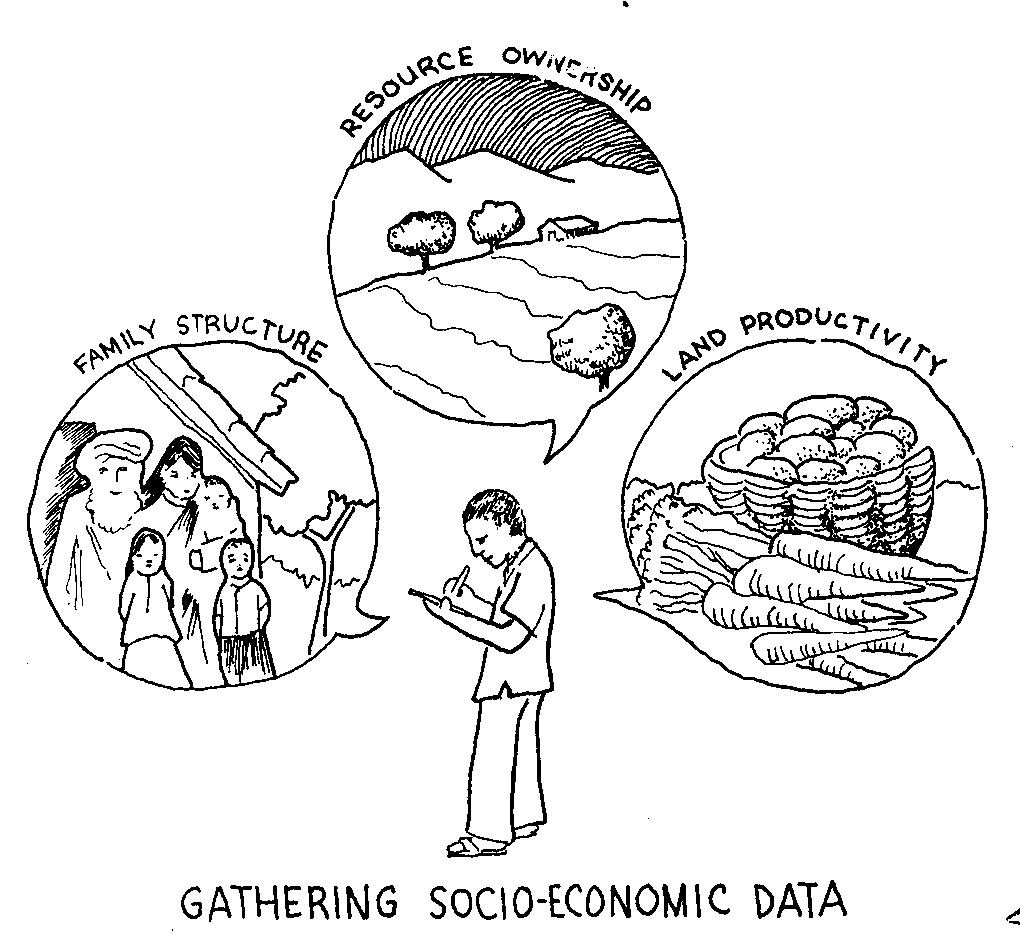
The field workers talked to families about what crops were
produced on their land, crop yields, and whether the crops grown
were used for themselves, sold, and/or given to other families.
They asked families the quantity of crop residues and how they
were used.
* Did the family collect them?
* Did they allow others to collect them?
* Did they use them or give them away and to whom?
This information was then analyzed. The villagers were
classified as to whether they were landless, poor, middle-income,
or rich. The field workers found that the rich, comprising only 16
percent of the families, owned 83 percent of the trees, 58 percent
of the crop land, and 47 percent of the cattle (see the table
below). They also found that while families of different income
groups used the same quantity of fuel per person for cooking food,
different types of fuels were used by different income groups.
OWNERSHIP OF FUEL PRODUCING RESOURCES
Families Land Tree Cattle
Number % % % %
Landless 22 45 2 5 5
Poor 11 23 13 5 24
Middle-Income 8 16 27 7 24
Rich 8 16 58 83 47
Total 49 100.0 100.0 100.0 100.0
How were data collected on energy use?
Every two weeks, the field workers went to see the families
to get information about the previous day. They weighed the
cattle dung and talked with the farmer about the use of the
animal on the day before and how much dung was produced during
that activity. They asked how the dung was used or would be
used. They also discussed the type, source, and amount of cattle
fodder used; how much milk the cattle produced; and how much
time was given to care of the cattle.
At the same time, the field workers tried to estimate the
amount of human and animal energy expended during a day. They
talked with the family about the previous day's work. What kind
of work was done and how long did it take? How many people
were involved and how many animals? Was the work done for
their own fields, or did they also spend time working in some
other family's fields? Did they have non-family members working
in their fields?
When they worked for another family, or another family
worked for them, how were the people paid? Did they get cash,
food, or fuel, and how much?
It was also important to determine crop yield. Families were
asked about what had been planted over the last two weeks. They
discussed the use of fertilizers:
* What fertilizers were used?
* Where were the fertilizers obtained?
* How much was used and for which crops?
Together, the farmers and field workers estimated how many
crops were harvested, and talked about how the harvested crops
were used. Were they eaten by the family itself, were some sold,
were some given to non-family members for work or some other
service? The farmers and field workers discussed crop residue use
as well:
* How much did the family use?
* How much was gathered for use by non-family members?
* How much was left in the field or just burned?
Each few months, the field workers spent the whole day with
a family to observe the use of fuel in cooking all the meals of the
day. They weighed the fuel used for each meal, estimated the
amount of food cooked, and counted the people fed.
Other sources of energy and their use were also discussed and
noted. From these pieces of information a picture of the energy
sources available and their use began to emerge, and a table of
annual fuel use in Ulipur could be constructed.
ANNUAL FUEL USE IN ULIPUR
Percent
Crop Residues (from ten crops) 59.2
Animal Residues 2.7
Firewood (including twigs and branches)
From village trees 10.8
From the river 4.4
Purchased 5.2
Subtotal 20.4
Other Fuels
Doinshah (legume) 4.9
Bamboo 3.6
Water Hyacinth 1.6
Other crop residues and leaves 7.6
Subtotal 17.7
TOTAL 100.0
The information collected showed that the rich had access to
almost twice the amount of energy (straw after livestock feed,
jute, dung, and firewood, leaves and twigs) that they needed for
cooking. The landless had access to only about 15 percent of their
fuel needs for cooking. The rest of the energy they needed came
from foraging for firewood, leaves, and twigs on public lands or on
land owned by others. The landless were dependent on the rich
for fuel and food in exchange for labor.
The landed poor, who required all the dung produced by their
cattle (and more) for fertilizer, relied for cooking mostly on rice
straw left over after the livestock were fed. Since the rice straw
did not meet their needs for cooking fuel by about 13 percent, the
poor were forced to bridge this deficit by spending valuable time
foraging for twigs, leaves, and firewood and selling their labor
during peak agricultural periods to the rich in exchange for fuel
and food. They, along with the landless, were dependent on the
rich. Of ten, their own crops suffered.
By looking carefully at the information on the sources of
energy available in Ulipur and the uses they are put to for both
energy and other purposes, the field workers constructed an
energy flow diagram of Ulipur. This diagram masks the seasonal
variation in energy availability, but shows the complex
interrelations among resources as well as many uses each provides.
How to use the energy flow diagram
The energy flow diagram brings out the multiple and competing
uses for particular resources. One is thus able to predict
the effect on the ecological, social, and economic system of the
village of using more of a particular resource for energy.
Suppose that the villagers expressed a need for night-time
lighting and a more efficient cooking system. Suppose also that a
biogas system based on animal waste is proposed. The energy
flow diagram, along with the data on energy use by income, can
help in thinking through the implications of biogas for the
resourse system prior to project design and implementation.
Let's think this through together. <see images>
ese16x56.gif (486x486)
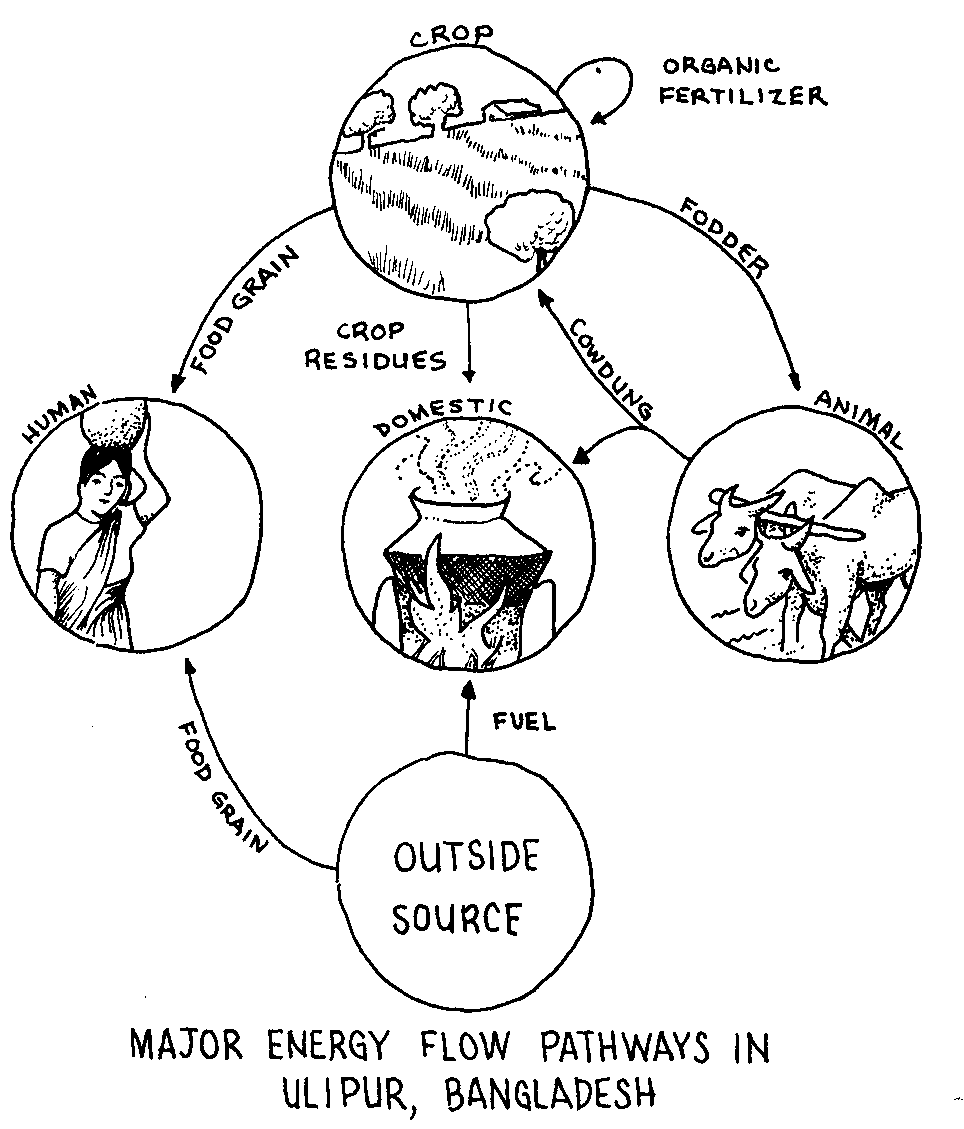
In Ulipur, 62 percent of dung is used for fertilizer, 13 percent
for fuel, and 25 percent is uncollected and probably
uncollectable. The dung used as fertilizer has probably shown
itself over time to be the amount needed to condition and enrich
the soil; using any of this 62 percent of the dung would be likely
to jeopardize agricultural yields. The rich have the use of almost
all of the dung used as fuel.
The distribution of resources implies that the rich would
benefit most from a village biogas digester. They are the primary
group using dung for fuel and so they already have the necessary
raw material. Middle-income and poor families would need to
divert some of the dung presently being used for fertilizer to the
biogas digester. This could diminish crop yield for these two
groups. Also, the use of dung for the biogas digester would
increase the value for what was previously a free or low-cost
good. This would hurt the poor who depend on its being freely
accessible.
The ecological effects could be serious. If the poorer people
decide to use dung for fuel rather than fertilizer, the fertility of
their land could be reduced. A decline in rice production would
reduce other fuel sources since rice straw provides about 75 percent
of cooking fuel and jute stick provides about 15 percent of
it. Less rice straw and jute stick would intensify competition
between using them for energy and for other purposes, since jute
stick is also used for construction, and rice straw to feed livestock.
If livestock are fed less, they produce less dung for use as
fuel or fertilizer, further decreasing crop productivity. The
landless and very small land holders might be forced to get more
firewood, which generates another set of environmental problems.
To address some of these problems at the beginning of a
biogas project, one should ask:
* Would the poorer parts of the community get enough
energy from the biogas digester so that they would not
use for energy dung that is required as fertilizer, or use
crop wastes that can have uses other than energy?
* Would the poor have access to the sludge by-product
produced by the digester that can be used for fertilizer?
* Could the digester, by supporting an income-generating
activity, provide enough income so that there would be
other ways to obtain energy and fertilizer?
Summing up
The work described above in Ulipur was undertaken over the
course of a year. Any village energy project must be preceded by
study or collected knowledge of annual cycles and seasonal
variations that can influence the demand for energy and
availability of resources. The process of talking with community
members in order to gather relevant data about socioeconomic
relationships and resource distribution and use is a necessary one.
Making use of existing data and consulting with others can often
shorten the process but it should never be solely relied on for
information.
Chapter VI
A PROCESS FOR PLANNING ENERGY PROJECTS
Ideally, a planning process follows a logical sequence of
activities, each of which builds on another. It begins with
information gathering and discussions with the participating
community. As community workers and the community interact,
needs, general goals, constraints, and options emerge. Projects
develop as community workers and the community think through
needs and goals, and how to attain them.
It is essential that community workers and local people
devise a variety of approaches that will suit their goals and deal
effectively with any anticipated constraints. From these
alternatives the most suitable one can be selected as the project.
During implementation and operation, the project can be
monitored to ensure it continues to meet its goals and to enable
the community to resolve any problems that may arise. Finally,
once the project is complete, it should be evaluated to determine
if it was successful and to aid in the planning of future projects.
The diagram on page 64 shows the steps involved in the
ese18x64.gif (540x540)
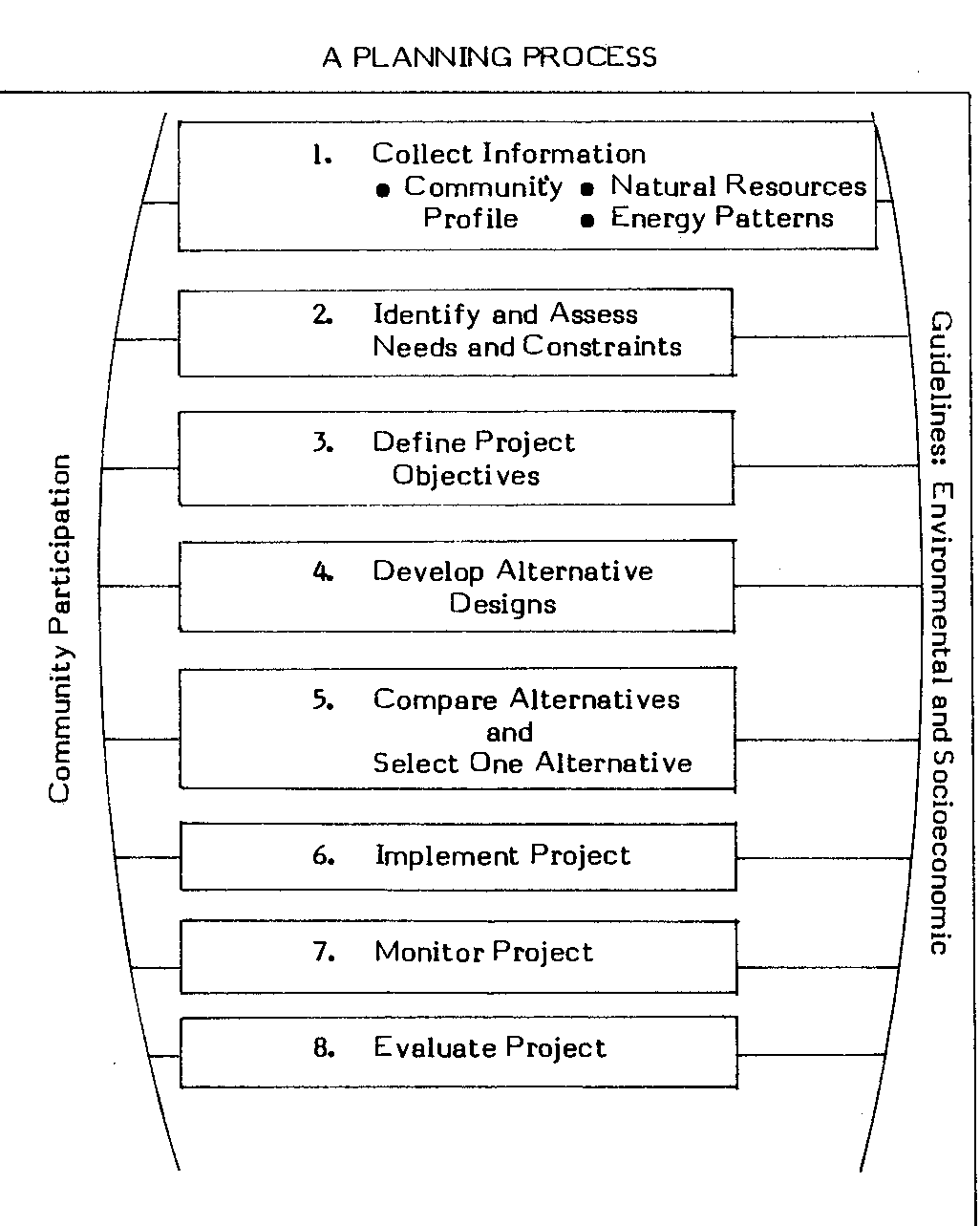
planning process. Each part of the process will be examined in
detail in this chapter, especially as it applies to energy projects.
Community participation and environmental and socioeconomic
guidelines are integral parts of each step in the process and will
be considered first.
Community participation
To establish a successful energy project, the community must
participate fully in all aspects of the project. The project must
address the needs of the community. As a source of invaluable
information about the environment and local practices, the
members of the community must be consulted. If the project is
endorsed by the community it is more likely to meet the needs
and to be adopted.
Communities, however,
ese17x60.gif (353x285)
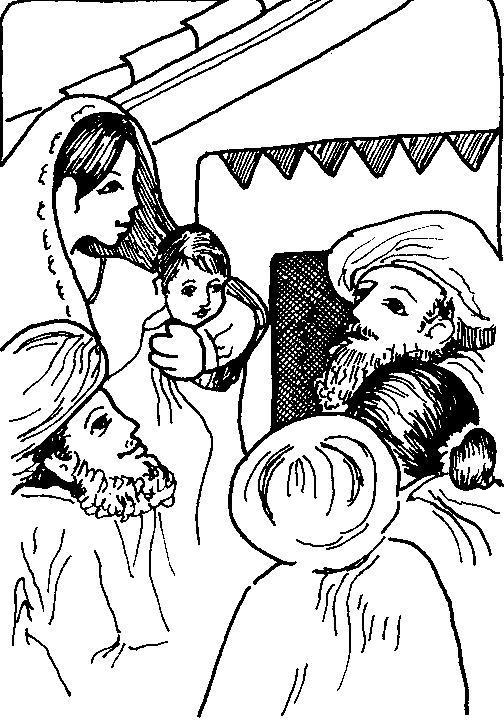
are groups of individuals,
some of whom may have
conflicting goals. Projects
that address the goals of
those with similar or at
least non-conflicting goals,
should also take into
account the interests of
non-participants in order
to achieve equity.
During the initial
discussions with the community,
local issues of greatest concern will become apparent.
Energy may emerge as a priority, it may be only indirectly related
to the central problem, or it may not be an issue at all. Often
projects fail because they are not directed to local priorities.
For example, a project to prevent desertification and provide
fuelwood in Senegal was devised by foresters without talking with
the villagers. The villagers were asked to plant trees around
their gardens. When no one planted trees, forestry officials
thought the villagers were lazy and ignorant. In later discussions,
it was discovered that the villagers thought the gardens were not
worth additional time because there was not a way to get the
produce to market. To generate interest in improving the
gardens, the need for roads and marketing infrastructure should
also have been considered. One should establish that energy is a
local priority before proceeding to plan an energy project.
Environmental and socioeconomic guidelines
Guidelines suggest those things that should be considered in
designing, implementing, monitoring, and evaluating a project.
Guidelines raise questions that will assist the planner to avoid
pitfalls and to maximize possibilities. Guidelines are different
from goals. For example, a goal might be to provide energy for
lighting a school; a guideline would be to make use of local
resources in providing energy for lighting.
Social, economic, and environmental factors may need to be
weighed against each other to balance the advantages and disadvantages
in these areas. A useful tool for examining relevant
factors in relation to the project is Fred Weber's Ecological Mini
Guidelines, which is included as Appendix B.
For example, economics may determine an energy project's
feasibility, and the environmental benefits it will produce may
make it attractive to development workers. But if the project
does not grow out of community-voiced decisions, or if it cannot
be operated, maintained, and monitored by the community, the
social guidelines may dictate that the project should not be
undertaken.
Below is a short list of some of the environmental and
socioeconomic guidelines for energy planners. The list is not
exhaustive but offers a general framework of the types of
guidelines that may need to be considered in designing a project
that best serves the needs of the community involved.
Environmental Guidelines - Environmental guidelines evaluate the
community energy needs as they relate to the natural resource
system.
* Identify the competing uses for the community's natural
resources. Determine the appropriateness of using each
resource, while considering the effects of its use.
* Use an integrated planning approach that places a high
value on natural resource management. This will allow
the planner the opportunity to develop energy projects
that manage resources rather than simply consume them.
* Consider how the project will maintain or enhance the
ecological productivity of the natural resource base used
to produce energy.
* Consider the need to use natural resources on a long-term,
sustainable basis.
* Think of energy in terms of the purposes for which it will
be used. Integrate energy planning with agricultural
projects when appropriate because the natural resource
system must provide both food and energy.
* Develop energy projects that reduce erosion, maintain soil
fertility, and protect watersheds.
* Develop energy projects that take into account the
seasonal availability of and demand for water, crop
residues, and wood so that use does not exceed supply.
* Maintain or enhance water supply and quality by, for
example, maintaining watersheds or taking care in the
disposal of waste materials.
* Build into the project the length of time necessary to
replenish the resource used for energy, being careful to
consider the demands other than energy that are being
placed on the resource.
* Identify the ecological values in traditional practices and
apply them where possible.
Socioeconomic Guidelines - Socioeconomic guidelines help to
incorporate the energy project into the local cultural and
institutional structure to help ensure proper operation and
maintenance.
* Involve all people who will be affected in all stages of
energy project development.
* Make sure that the use of a natural resource for energy
does not affect its use by the landless and very poor, who
will be worse off and forced to over use other resources
to meet their energy needs.
* Build upon the existing social organization and customs
for environmental rehabilitation and conservation.
* Develop land use strategies that minimize conflicts
between energy and agricultural goals. Integrating energy
projects and food production projects will help.
* Develop energy technologies that provide multiple uses
(such as a biogas system for energy, fertilizer, and waste
management), so that maximum use is made of the
investment and the resources.
* Develop energy sources that are most suited to the task
both in terms of cost and energy quality so that resources
are used efficiently.
* Balance health problems with other benefits in designing
energy conversion devices; for example, smoke from
cookstoves may create respiratory problems but it may
also kill problem insects.
* Design projects that guarantee that the target population
will have control of the energy source or energy end use.
As noted earlier these guidelines are not exhaustive. You
may think of others to add to the list appropriate for project
planning in your area.
Steps in the planning process
1 Collect information
The profile of the community consists of the socioeconomic
organization, the way it produces and consumes energy, and the
status of its natural resources. This information can be a very
helpful planning aid. It should be designed to provide easy-to-use
data on key social, cultural, ecological, and economic characteristics.
The data should be carefully selected and the rationale
for gathering them should be made explicit. Local people are
extremely important in helping to identify relevant energy
relationships as well as in helping to gather and analyze information.
Early discussion with community members will serve to
direct the planner to certain problems, but a good planner will not
form any conclusions regarding needs at this point.
There are two purposes to this step in the planning process.
One is to determine the existing conditions. The second is to
collect information that will permit the planner to quantify the
relationships among energy use, natural resources, and the people
who use the resources.
Often, local people prove to be an invaluable source for such
information. In other cases, however, it may be necessary to
consult technical documents to obtain data on characteristics
such as to the amount of insolation (soler radiation) in an area or
imported energy use. When properly collected, this information
can help save extra project costs.
The data should be organized to provide easy-to-use
information on key social, cultural, ecological, and energy
characteristics. Several types of information that should be
collected are outlined below.
* Community profile--socioeconomic characteristics
-- Who are the people using the resource?
Examples:
Population size, growth rate, diversity, and age
groups
Number of households
-- Who or what affects/controls access to the resource?
Examples:
Land ownership and land tenure system
Indicators of average income per household
(roofing materials, painted or white -- washed
building, number of animals)
Employment information, specifically in-house
and rural industry sources
Available credit mechanisms for energy projects
(credit mechanisms may only be available for
agriculture, check to see if these can be applied
to energy)
-- What is the local management system (actual and potential)?
Examples:
Community structure including leaders, economic
status, etc.
Cultural traditions, attitudes, and perceptions
related to energy sources and natural resources,
and their uses
-- What are the outside forces affecting local resource management?
Examples:
National, regional, and local policies that affect
energy use and supply (laws, taxes, subsidies)
Regional and national energy markets, population
centers
-- What factors affect the energy supply?
Example:
Agricultural practices
-- What are the public health considerations?
* Natural resources--ecological characteristics
-- What are existing uses of natural resources?
Example:
Land use patterns, particularly agricultural land
and forested areas
-- What is the physical environment?
Examples:
Soil: composition, organic content, ground cover,
erosion, use of local fertilizers, and steepness of
slope
Water: local sources, quality, amount and
seasonal variability of rainfall and stream flow,
condition of watersheds, ground water supplies,
and use
Climate: annual temperatures, seasonal floods
and droughts, amount and seasonal variability of
solar insolation (energy that reaches the earth),
maximum and minimum wind velocities, and
seasonal variations
-- What is the biological environment?
Examples:
Flora and fauna: vegetation (stable, changing,
balanced, requirements, and limiting factors for
regeneration), feed and water requirements of
animals
Biological communities in the area: composition,
diversity, stability
Biomass: amount of natural standing forests and
forest residues; amount of trees and shrubs outside
of forests, in open rangelands, around agricultural
fields, in home gardens, along roads;
types of crops grown; crop residues and seasonal
availability
-- How are the natural resources being used or managed?
* Energy Use Patterns
-- What are the energy characteristics of this community?
Examples:
Energy sources: present and future energy
sources in terms of quantity, price, location, and
variability of supply of biomass, biogas, hydro,
organic wastes, agricultural residue
Energy conversion/process pathways: i.e., what
happens to the energy between the source and the
final end use, how is it transported, transmitted,
or converted, etc.
Energy end-use patterns: how is energy being
used, how much is used for cooking, heating,
lighting, rural industrial use, household use, etc.
Organize this information by both cost and the
social classifications (household/industry use,
income, geographic location) identified above
Imported energy: amount, prices, and variability
in supply of electricity, liquid fuels (e.g., gasoline,
kerosene, diesel), gaseous fuels (e.g., propane),
and coal. Measure the time required for energy
collection; Identify the producers and middlemen
for energy and their role in the community
It may not be essential to collect all of these data. The
specific data that are important to the development of an energy
project will often be determined as the development worker and
the community jointly assess community needs.
2 Identify energy needs and constraints
After examining the information identified and collected for
the profile of energy patterns, some further refinements may be
needed before determining the needs of this community and the
constraints on those needs.
The following should be explored about each energy source:
* how much energy is used directly and how much is
converted for use in households, agriculture, small-scale
industry, and transportation (including where the resource
comes from and whether there are seasonal variations in
type and quantity)
* trends in energy consumption patterns, costs/benefits
pricing, energy intensity for particular end-use functions,
and energy-economy relationships
* energy efficiency in key end-use devices
* competing non-energy uses of the natural resources used
for energy: how much is used for food, fodder, fertilizer,
fiber, or construction; by whom
* changes in the demand for, availability of, or access to
resources.
The assessment should also provide information on what
groups of people are using the various energy types, how they are
using it, where the sources are, what the seasonal patterns of
supply and use are, and how much it is costing.
It is essential to determine the factors that are or will affect
future availability of sources. For example, predictions of future
energy needs may be based on observations of declining supply or
increasing costs.
Analysis of the relationships between the energy source,
competing uses of that resource, and the overall stability of
natural resources is often ignored. An adequate analysis of
fuelwood supplies might indicate that the effects of using land for
agriculture would deplete fuelwood sources. And the situation
would grow worse as population increased. Analysis would allow
energy planners to focus on the causes of the problem rather than
designing solutions that address the results of trends.
It is essential to remember that current energy use occurs in
the midst of several interrelated and dynamic socioeconomic and
environmental processes. Too often solutions for energy problems
are based on technological perceptions. This can be avoided by
planning projects that match the management of resources with
the demand for energy that promotes development. The planner
and the community must look at energy needs in this broader
context.
The information will help the community to identify specific
energy problems that can be remedied through small-scale
projects. During the identification process, the community may
find that potential energy sources are not being used for energy or
that certain resources are being over used, which in turn is
resulting in environmental problems.
The socioeconomic analysis will help the development worker
identify the groups that exist in the community, which of them
control access to resources, what outside factors affect access
to those resources, and the costs of those resources. This will
allow the planner and the community to compare the energy needs
of different socioeconomic groups and to predict which group of
people will likely benefit from a proposed project.
An important part of assessing needs is identifying
constraints -- the technical, economic, social, and environmental
factors that restrict efforts to meet local energy needs. This will
allow the planner to identify the factors that will impede or
promote future development efforts in general. For example, if
energy is not available or is inadequate for water lifting for
irrigation, this might be considered a technical constraint.
In Indonesia, subsidies on kerosene acted as an economic constraint
to fuelwood management. As a result of the low price of
kerosene, demand for biomass declined, which in turn contributed
to a lack of management of fuelwood supplies. When the subsidy
was removed, an increase in the demand for biomass led to
increased prices for those resources. Because other fuelwood
supplies were not available, the consumption of crop residues
increased dramatically. People did not begin to plant fuelwood
species to meet the growing demand until the price of fuelwood
increased. Efforts to increase the fuelwood supply while kerosene
was being subsidized would not have succeeded because the
government pricing policy was acting as an economic constraint.
An example of a social constraint can be found in Sri Lanka.
For religious and cultural reasons, dung is not considered acceptable
for use as fuel. And in other countries, researchers have
found that a lack of access to or control of a resource may be a
constraint to efforts to provide energy supplies by encouraging
tree planting. Where villagers do not own the land they farm or
the trees that are on their farms, they have little or no incentive
to manage what they may not be able to use.
Environmental factors can also act as a constraint to energy
supplies. For example, cultivation of marginal lands often uses
the same farming practices that were used on productive soils.
And often, these farming practices are inappropriate for the site.
The clearing of land results in a reduction of potential biomass
energy supplies, increased rates of soil erosion as a result of the
lack of ground cover, and a depletion of nutrients in the soil. This
reduces the amount of water that can be stored in the soil and
increased flooding frequently occurs. The subsequent degradation
of the watershed then seriously threatens the water supplies in
the area, constraining the successful introduction of a hydro
project.
Additional examples of constraints include a poor match of
an energy supply with an end use. This may occur when rural
electrification is proposed for an area where the major energy
need is for cooking. Inadequate supplies of water or wind for
hydro or wind energy projects are examples of technical
constraints. The cost of technologies, pricing policies, and
subsidies can all act as economic constraints to energy supply.
Planners must be aware of the wide range of factors that may
constrain the supply, use, development, and management of
energy resources before they can successfully propose solutions to
alleviate local problems.
3 Define project objectives
The next step is to formulate objectives for a project that
will be undertaken to meet the needs given the highest priority.
Project objectives should serve the needs of the community for
improving the quality of life. Technological solutions should be
secondary in determining objectives. Combining energy development
with natural resource management can contribute to
effective local and regional development. Supplying the energy
needs of a community can have several components and a single
project may be only one of those components. Objectives may be
defined that help solve several problems in a region. For example,
a project that provides electrical energy to a community may
also provide employment, and thus, a guaranteed market for energy
from biomass. This energy could be supplied from fuelwood,
agricultural wastes such as sugar cane by products, industrial
wastes from milling operations such as wood chips and fiber, etc.
Such a project could promote management of biomass sources
that were previously neglected by providing a needed economic
incentive.
Project objectives must be clearly defined: for instance, if
the goal is to increase energy supply, one specific objective may
be to provide seedlings of fast-growing tree species to 123
families. This objective may be further defined by indicating a
plan for training 10 farmers to grow these seedlings. Thus, a
clearly-defined objective not only sets the task precisely but also
provides a standard by which the project can later be eveluated.
The guidelines at the beginning of this chapter can help
determine the requirements for meeting the project's objectives.
For example, if a guideline for developing energy technologies
that provide multiple uses is adopted, the project might include
growing trees that can be used for livestock feed and construction
materials in addition to supplying energy. Such a project might
also have associated environmental benefits by providing erosion
control on steep hillsides.
In another example, community members may voice strong
concern over the need for both erosion control and more fuelwood
while the development worker's assessment of the resource and
climatic conditions may indicate a need for watershed management.
The community and development worker must then decide
which need has a higher priority, given the range of technical,
social, and economic conditions present.
4 Develop alternative designs
Once objectives are defined, alternative designs for implementing
the project can be considered. One of the first steps in
developing designs is to examine each identified need in terms of
the effort required and the kinds of resources necessary to meet
it. In many cases, the development worker may want to seek
some additional assistance if the problems indicate a need for
special knowledge. If one of the alternative designs includes a
small-scale water installation, for example, consultation with
hydropower specialists, water resource managers, and health
specialists may be necessary. In general, a variety of opinions is
always helpful in reviewing decisions in order to identify and deal
with possible problems.
The design of the alternatives should be based on the
community's identified needs. It should be consistent with the
environmental, social, technical, and economic guidelines, as well
as technically feasible or appropriate. Consideration of the
constraints will help to identify conditions that restrict the
present energy situation or may limit the effectiveness of the
project.
5 Compare alternatives and select one alternative
Evaluations of possible projects can be made at various
stages in the planning process. In the early phases of designing a
project, an inventory of local and non-energy technologies that
meet identified needs can be matched against the technical
resources available at the project site. Many inappropriate
technical solutions can be eliminated at this planning stage based
on the constraints already identified. These might include an
inadequate supply of a resource (wind, water), excessive costs,
lack of technical skills, etc. For those solutions that are feasible,
an analysis of the benefits and costs of a project should be made.
The analysis is based on a comparison of the alternative designs
and uses criteria derived from the previously-mentioned
guidelines. These can be summarized as:
* Economic and financial analysis: a thorough evaluation of
the costs and benefits of a project from the viewpoint of
the community and its individuals should be conducted.
This should address the long term concerns of a project's
ability to be sustained: will the project succeed in the
absence of economic support from outside the community?
* Analysis of technical feasibility: a thorough evaluation of
the technical application of a given technology must be
conducted at this stage. The most critical question to be
asked at this stage is whether or not the alternative
energy solutions are appropriate to meet project
objectives. Additional questions include whether the
technology is proven or if it is still experimental, can it
be adapted to the local conditions, are the raw materials
available, can parts be located if needed, etc.
* Assessment of social and cultural impacts: technologies
that require substantial changes in the social, legal, and
cultural institutions in a project area will often be found
unacceptable and end in failure. However, the planner
should not assume that a new technology will not be
readily adapted because of social and cultural reasons.
SAMPLE BENEFITS/COSTS
DATE___________ ANALYSIS CRITERIA PROJECT DESCRIPTION________
ECONOMIC RETURNS
Self-Sufficiency. Rank high a project which can be shown to lead
to jobs, skills, training, improved markets or other economic gains which
are returned directly to the community and can be shown to increase local
self-sufficiency. Move toward the lower end of the scale if a project must
rely on continued subsidy and/or it becomes less clear that the economic
gains will be returned to the community.
Funding Availability. Rank high a project where funds are available
quickly and easily (perhaps from local sources). Move toward the middle for
projects where some funding is available but additional funds must be
sought. Use the lower end of the scale in cases where funding is not
readily available and a long time lag seems likely.
Net Profit. Rank high a project where careful calculation of
economic factors indicates that the product or project will bring in more
than it cost. Move lower on the scale as the project's economic
profitability appear less clear.
TECHNICAL RESOURCES
Local Techical Support. If the project requires involvement of
change agents, technical support groups, extension services, and these are
available, rank high. Move toward the opposite end of the scale as
availability and access to such support becomes less clear and/or difficult.
Technology Availability. Rank as high a situation where the
technology exists and seems adaptable to the situation. Move toward the
lower (costs) end as the technology requires more extensive commitments to
research and development. Rank high situations where technology makes
maximum use of local human and material resources. Move lower toward the
opposite end as resources must be obtained from outside sources and this
could cause delays and/or failure to use local resources adequately.
Technical Impact. Rank high a project in which the technology or
project once launched can be maintained by local residents--this implies
training in upkeep and repair and arrangements for replication. Move lower
on the scale in situations where provision for these activities has not
been made. Rank high a project which introduces a technology which seems
to require little change in everyday life. Move toward the lower end as
the technology seems to require alterations in lifestyles, culture,
traditional patterns, etc.
SOCIAL AND CULTURAL ENVIRONMENT
Community-expressed Need. Rank high a project based on
community-expressed need. Move toward the opposite end as community
involvement in need identification becomes less clear.
Social Returns. Rank high projects which can be shown to bring
cultural and social gains to the community. Move toward lower end as social
and cultural gains become less clear and/or the effects of the effort seem
likely to be socially or culturally descriptive. Rank high a project which
enables residents to participate with least risk. Move toward the lower end
of the scale as it becomes clear that participants run more risk, i.e., as
their investment demands a level of commitment which would have serious
consequences were the project to fail. Assume for project feasibility that
the smaller the degree of change required in local custom, the easier it
will be to get the project underway. Rank as high projects which require
little change; move lower as more change is required.
NATURAL ENVIRONMENT
Relevance to Guidelines. Rank as high a project which meets all or
most of the guidelines for an ecologically sustainable
activity. Move lower as the project fails to meet these guidelines.
Use of Alternative Control Methods. Rank high a project which makes
maximum use of biologically sound control measures; move lower as the
project must rely on chemical control methods.
Alternative Design #1 (Costs) 1 2 3 4 5 6 7 8 9 10 (Benefits)
- +
economic returns ___________________________________________
technical resources ___________________________________________
social/cultural ___________________________________________
physical environment ___________________________________________
Alternative Design #2
economic returns ___________________________________________
technical resources ___________________________________________
social/cultural ___________________________________________
physical environment ___________________________________________
* Assessment of environmental impacts: the proposed
alternatives should be evaluated to determine if they will
have any direct negative impacts on the environment.
Will the projects have negative secondary effects? Often
indirect effects can be far greater than primary ones.
Extensive checklists exist that the planner should use to
determine actual impacts. Few projects properly
estimate the economic costs of environmental damage
and this should be done at this stage. Projects should also
contain a plan to mitigate such damages. Properly
planned projects may result in improved management of
natural resources, which will have significant long-term
benefits to the community.
Each of these criteria should be considered in relation to
each of the project designs. In addition, there are some general
points that should be considered:
* What are both the long-term and the short-term effects
of the project?
* Will meeting one criterion mean that another cannot be
met, thus making the project infeasible (e.g., will making
the project economically viable have negative effects on
the environment).
* Is another viable alternative for meeting the community's
needs lacking?
* What would be the effects if no action were taken?
Consideration of all of the above will assist in making a
choice among alternative designs.
A sample benefit/cost analysis is offered on the preceding
pages. It is intended to help project planners compare alternatives
according to the four basic criteria: economic returns,
technical resources, social and cultural, considerations, and
environmental concerns.
The alternative designs are evaluated and measured for each
of the four criteria by using a simple scale numbered from 1 to
10. The lower end (left) of the scale represents costs or negative
effects; the upper end (right) represents benefits or positive
effects. The five-point mark in the middle of the scale represents
a situation where benefits and costs are evenly balanced. The
four ratings are then averaged to give a total average for the
design. Alternative designs can then be compared to select the
design that appears most beneficial.
There is no magic about this measuring system. It is
relatively easy to use. It allows alternatives to be reviewed: Will
modifying parts of an alternative change its rating? Development
workers will probably want to adapt the system to fit a particular
situation
6 Implement project
Community participation should be an integral part of
implementing a project. Whenever possible, the use of local
materials and local technicians and craftspeople should be
encouraged. In this way, future maintenance is not likely to be
beyond the community's resources. Community pride, developed
through commitment to the project, successful participation by
individual community members, and receipt of valued benefits, is
the best guarantee for continued maintenance and long-term
benefits.
7 Monitor project
A plan to monitor the project should be incorporated into the
original design. This will allow the development worker and the
community to make any needed corrections in the project design
and assist project implementation. Furthermore, projects may
have environmental effects that must be monitored. It is difficult
to predict all effects because environmental interactions are
often more complex than anticipated. For example, the changes
brought about by an energy project may not be immediately
apparent; the successful achievement of a project's energy
objectives may mask environmental degradation or other negative
effects. Therefore, it is important to continue to monitor the
project after it has been implemented.
A simple program of measuring change can be set up to
identify trends that may be harmful First, it is necessary to
collect and maintain relevant data for evaluating and monitoring
the effects of a project. For example, for a hydroelectric
project, it would be necessary to keep information on such factors
as water quality, flooding, siltation, land displacement, aquatic
life, etc. Such data can then be used to help identify the maintenance
procedures necessary for the project's continued
operation. Unforseen benefits may be encouraged, such as
improved health conditions from flood control measures. Negative
trends may be corrected before the problems become too
severe, such as the planting of trees around the project site that
cannot be used for fodder and whose planting would decrease the
food available to livestock.
8 Evaluate project
Evaluating the project provides information about what the
project achieved and, in particular, whether it met the objectives
and needs initially established by the community and the development
planner. These evaluations also allow development workers
to share experiences with each other and provide much-needed
information on the activities of private voluntary agencies.
Examining, analyzing, and reporting on the environmental,
technical, economic, social and other causes of success and
failure foster improved future planning and programming
decisions. This is particularly important in a new field of work
such as energy development.
The special character of the activities of private
development organizations requires complementary evaluation
techniques that are appropriate for projects involving the poor.
These projects are usually low-cost, highly participatory,
innovative and place particular emphasis on process as well as
quantitative results. In tailoring an evaluation to fit your
particular circumstances, the Evaluation Sourcebook (Santo
Pietro, ed., 1982) could be very helpful.
VITA is a repository for information that may be helpful for
your needs. Through VITA you may make information on your
projects available to others.
Chapter VII
ENERGY SOURCES AND ENVIRONMENTAL CONSIDERATIONS
The environmental concerns associated with a variety of
small-scale energy sources are discussed here. The points made
are intended only as guidelines, since specific environmental
benefits and costs depend largely on local conditions.
Although human energy is not discussed directly in this
section, the substantial contribution of human energy has been
stressed throughout this manual Specific energy technologies
may affect human health, use of time, and income as well as
cultural and behavioral patterns. Perhaps the greatest challenge
is to find technologies that reduce the time needed to complete a
task, maintain or increase income, and are adaptable to
socio-cultural norms. Women's needs and chores are a special
case. The nutritional and health status of people will directly
affect the amount of work they can accomplish. Since natural
resource degradation reduces agricultural productivity and
therefore the amount of food available to fuel human energy, the
uses of specific sources of energy should be carefully evaluated in
terms of their impact throughout the agricultural resource system.
Solar energy
The sun is the ultimate source of clean and abundant energy.
For thousands of years it has been used directly by people to dry
food and clothes, to warm homes and courtyards, or to evaporate
water from salt ponds. <see image>
ese19x83.gif (437x437)

Indirectly, solar energy makes the wind and water move.
Intercepted by green plants on land and sea, it becomes the source
of energy for all life on earth. This energy is released whenever
people burn wood, coal, or petroleum products.
Solar energy has the potential for providing even more than
this. Converted to electricity by photovoltaic cell, it can be
used to supply power to motors, refrigerators, lights,
communications equipment, and the like. When concentrated or
"trapped," solar rays can generate high temperatures for rapid
drying, cooking, and baking.
Most developing countries lie in a belt between 30[degrees]N and 30[degrees]S
of the equator, where the average solar power is 700-800 watts
per square meter, or six kilowatt-hours per day with eight hours
of sunshine. If it were possible to capture even half of the energy
falling in one day on one square meter of surface, it would be
sufficient to cook food for an entire family plus do the work of
three adults.
However, the great abundance and versatility of solar energy
carry certain limitations. The most obvious is that solar energy is
directly available only during daylight hours when skies are not
overcast. For use at other times, the energy must be stored,
either in chemical form in batteries, or as retained heat in water,
rocks, or other such materials.
Another limitation of solar energy is that by the time it
reaches the earth, it is very diffuse and must be trapped or
concentrated. Usually this can be done by using durable
transparent or highly reflective surfaces and a certain amount of
space. Even with the most efficient photoelectric cells it would
take over 10 square meters of collector surface to power a small
water pump or grain mill. If the energy is to be used for cooking
or baking, a minimum area of 1.5 square meters may be required.
The use of solar energy generally has no adverse impact on
the environment at the local community level. To the extent that
solar devices may reduce the consumption of fossil fuels, dung, or
fuelwood their use has measurable environmental benefits.
However, since solar energy can be used in so many different
ways, it may be helpful to consider briefly some of its possible
functions.
Drying: Low-frequency heat radiation from the sun passes
easily through a transparent window of a box. Once inside,
however, the heat rays change and are unable to pass back out of
the same window. This is how solar heat energy is "captured."
A solar food dryer is essentially a box with at least one
ese20x85.gif (437x437)

transparent side where solar energy raises the inside temperature
and sets up a ventilating convection current of air. Fruit, grain,
vegetables, and fish can be dried inside. Food is traditionally
dried by exposing it directly to the sunlight in the open air. A
solar food dryer will do the same job more rapidly, using less
space, and with much less spoilage. Moreover, there is less
interference from flies, birds, and other animals.
A solar dryer requires a large amount of transparent glazing
material. Plastic sheeting stretched over wooden frames is probably
the least expensive and most adaptable material. However,
most plastics eventually lose much of their transparency and
become yellow and brittle under long exposure to the sun's rays.
Glass does not yellow with age, of course, but it is often very
expensive in poor countries. Glass is also heavy and fragile. <see image>
ese21x86.gif (437x437)
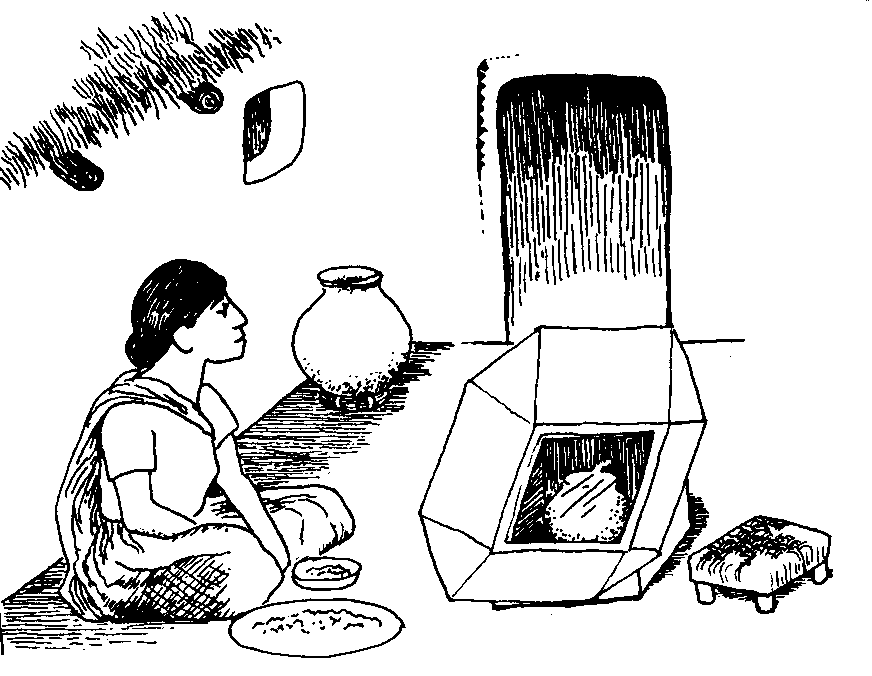
Cooking: At present, cooking with solar energy appears
suitable only for food that can be baked or simmered for long
periods without much attention. Breads, beans, rice, many
sauces, and cereals may be adapted readily to solar cooking. Most
disc reflector stoves (not solar ovens) require frequent adjustment
of focus throughout the day. Foods that require frying, stirring,
or other manipulation are difficult to prepare with solar heat.
The use of solar energy for cooking has not been widely
accepted by women in poor countries. There are many reasons for
this:
* Unwillingness to cook in the hot sun with the bright glare
of a reflector.
* Fear of the intense heat at the focal point, which can
cause burns and eye damage.
* Restriction of cooking time to bright daylight hours.
* Stove designs that limit pot size and make it awkward to
stir or manipulate the pot contents.
* Stoves that are unstable and easily damaged by winds,
domestic animals, and curious children.
* Lack of replacement parts, repair skills, and facilities.
* Initial cost of solar appliances.
Electricity generation: The technology for converting solar
energy to electricity continues to make rapid progress.
Photovoltaic cells are now available with conversion efficiencies
of 18 percent at a price that continues to decline.
Maintenance of a photovoltaic system is limited to regular
cleaning of the panel surfaces. However, the cleaning must be
carried out by trained individuals designated to maintain the
system.
A National Aeronautics and Space Administration (NASA)
pilot project in Upper Volta demonstrates the benefits of
photovoltaics to a rural village. The system was installed in 1975
and later expanded. Early technical and design problems have
been resolved, and the village now has a reliable source of
electricity. The use of this energy is governed by a local
cooperative organization The power runs a grain mill, water
pump, small refrigerator, and (with rechargeable batteries) a few
electric lights.
Income from the mill is sufficient to acquire spare parts and
maintain the system. One indirect benefit has been evening
reading instruction made possible by the electric lights.
The NASA project was quite expensive, but, as a pilot
project, shows the potential for photovoltaics in a rural setting
when they become more economically feasible. However, rural
electrification through photovoltaics is still several decades
away. The advantages of simplicity and reliability must be
matched with further improvements in conversion efficiency, a
longer functional life of the solar cells, and above all reduced
costs.
According to one source, there have been some negative
environmental effects of this project. Due to the ease of lifting
water for animals, herders tended to remain in the village for
longer periods. This change in herding practices resulted in some
overgrazing. With less fodder available around the village, the
raising of small animals by some women was negatively affected.
More cattle damage to crops was also reported. Because the
water system installed was a lifting rather than a delivery system,
women spent as much time carrying water as before the system
was installed, but, with the new system, had to wait in line behind
the herders.
Solar ponds: A solar pond is a very large solar heat collector
that operates on the same principle as the solar food dryer.
However, instead of trapping heat rays under a transparent
window, the heat is trapped under several layers of salt water.
The pond has fresh water on the surf ace and very salty water at
the bottom, with a salinity gradient in between.
This system can generate heat to temperatures as high as
100[degrees], which is high enough to be used directly (water heating, for
example). In some parts of the Middle East the energy is often
used with a special engine (Rankine cycle) for pumping water or
generating electricity.
Solar ponds can create serious environmental damage; their
design and construction require assistance from those skilled and
experienced in this technology. Large amounts of salt are
required, and a leak in the bottom of the pond could seriously
contaminate ground water supplies. Also, the steeply sloping
sides could lead to accidental drownings of people and animals.
Because of the high temperatures, objects sinking to the bottom
cannot be easily retrieved without special equipment. The hot
brine of a solar pond corrodes many metals. Finally, water
evaporated from the pond surface must be replaced by water from
other sources.
Wind
There is nothing new about harnessing the energy of the
winds. Since ancient times wind has been used for sailing boats,
lifting water, and threshing grain. More recently, it has been used
to generate electricity. Properly designed, maintained and
located to match specific tasks, wind machines can provide years
of reasonably reliable service.
In developing countries a water-pumping wind machine is
ese22x90.gif (437x437)
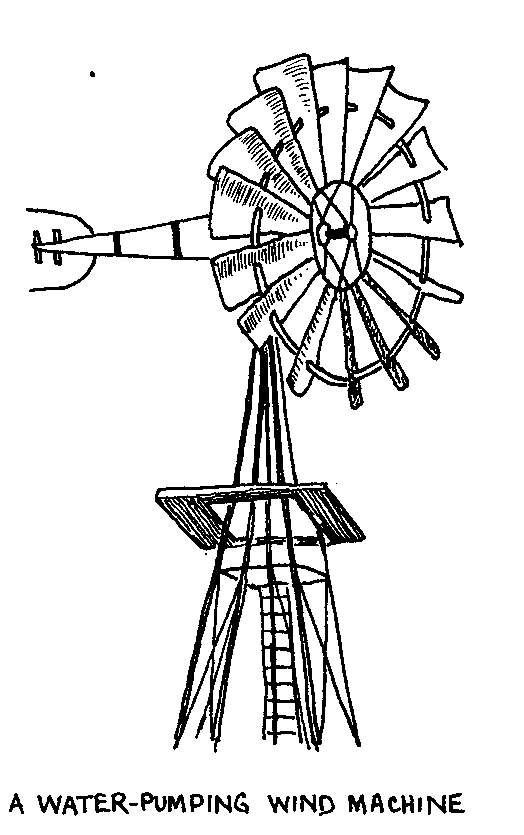
particularly suitable, both for irrigation pumping and for supplying
potable water. When water is pumped from the ground, the well
can be closed and protected from contamination. On the
Philippine island of Higatangan, 1,600 people depend on water
pumped by two wind machines, each with rotors three meters in
diameter. In Africa, several Malian fishing villages use wind
irrigation systems to increase yields in vegetable gardens,
providing a diversity of income and food supply sources.
One limitation to any
wind machine is that it
runs only when the wind is
blowing. A steady breeze
day after day is uncommon
in most parts of the world.
Before considering wind
power at a particular site,
it is important to know the
short- and long-term patterns
of local winds. A
wind-powered irrigation
system has little value if
the air is calm when water
is needed most. The same
is true of grain mills and
any other wind-powered
device.
Compared to other renewable energy systems, wind machines
have more moving parts, which are exposed to much stress, not to
mention rain and dust. Months of spinning and vibrating can
loosen important components or cause parts to become worn. A
regular program of surveillance and maintenance is essential to
keep the machine operating well. Spare parts must be on hand,
along with someone who knows how to make necessary repairs.
The Third World is littered with the relics of wind machines that
have failed simply for lack of replacement parts and maintenance.
Certain precautions are important to avoid possible
environmental effects from wind machines. For example:
* There is a danger with wind-driven water pumps of
pumping more water than is needed for irrigation,
livestock, or domestic uses. This wastes water and may
also create an unhealthy situation around the pump. An
automatic shut-off mechanism solves the problem.
Moreover, as with any newly installed water system,
overgrazing near the water supply can be a serious
problem.
* In most cases, wind machines should be mounted on a
tower at least 40 feet off the ground and 15-20 feet above
any nearby obstruction, such as a building or tree. This
makes the mechanism highly visible, difficult to service,
and dangerous if it topples. Mounting the machine on a
roof is likely to cause vibration noise and apply unwanted
stress to the roof.
* The rotor must be equipped with an automatic feathering
device to protect the machine from winds exceeding its
design capacity. There should also be protection from
lightning damage.
* Vertical-axis machines generally require a larger site than
comparably sized horizontal-axis devices because of the
wider spread of supporting guy wires.
* When using lead-acid batteries for storing excess
electricity, it is important to keep them well ventilated
to avoid the accumulation of explosive hydrogen and
oxygen gases.
Water (Hydropower)
Under certain conditions it is possible to gain useful energy
from flowing water. Hydropower for mechanical or electrical
energy is produced when the pressure of flowing water is directed
at a waterwheel, turbine, or hydraulic ram. Waterwheels, which
produce powerful mechanical energy at slow speeds, are best
suited for applications such as grinding grain or lifting water.
Water used to produce electrical power is generally applied at
high pressure to a specially-made turbine, which can be as small
as 10 centimeters in diameter. Hydraulic rams are essentially
automated water pumping devices that use the kinetic energy of
water flowing in a pipe to lift the water higher than the source.
Small rivers and streams can provide the energy source for
small-scale applications. Called micro- or mini-hydro, depending
on the amount of power generated, such applications function
either with or without a dam, depending on local topography. The
most environmentally sound way to tap this resource is to take
advantage of naturally occurring gradients that do not require
construction of a dam. This will also be the cheapest option. It
requires a relatively steep stream gradient and good year-round
flow.
No-dam hydropower production requires diverting some water
ese23x93.gif (540x540)
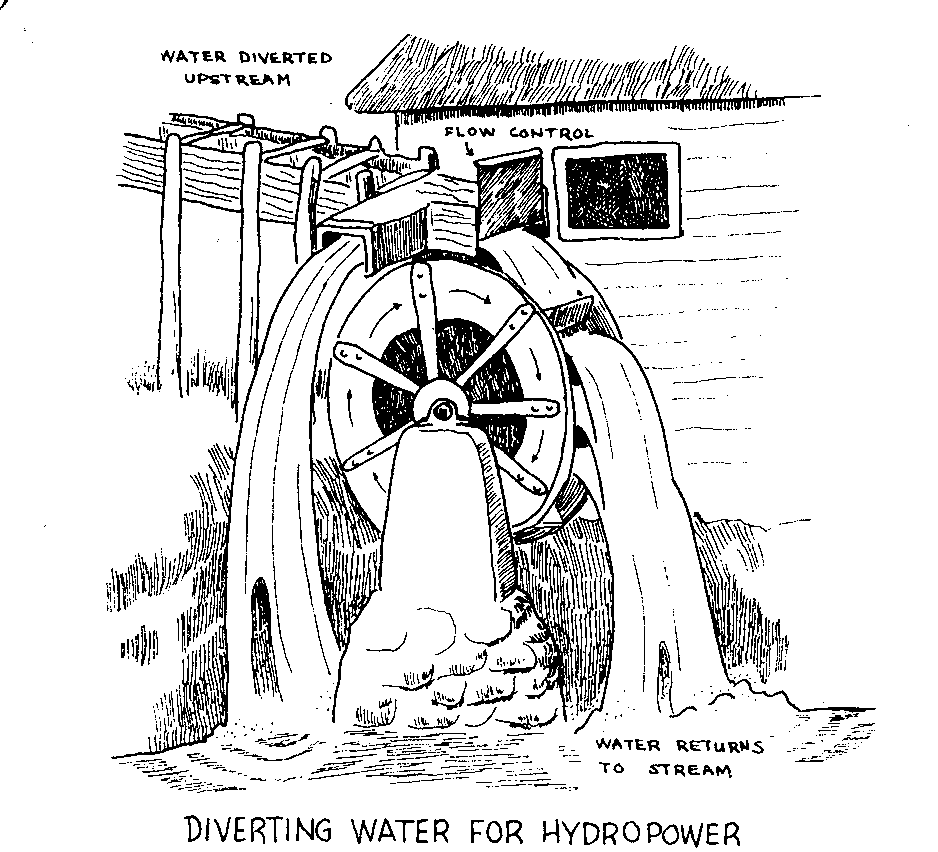
from the stream and passing it through a channel to the power
converting device. This channel may be open, as in the case of
most water wheels, or it may be a closed pipe, which is typical for
hydraulic turbines. The channel does not slope downward as much
as the stream, so that after a short distance the water level in the
channel is higher than that in the corresponding section of stream.
This difference in height is called the "head". The maximum
power to be derived from the water depends on the size of the
head and on the maximum rate of flow through the channel
No-dam hydro projects have a minimum of environmental drawbacks,
since they divert water flow along short sections of the
stream and do not flood the land.
In areas where the stream flows gently and a long channel is
not practical, it is tempting to create a head over a short distance
by constructing a dam across the stream. This creates a reservoir
of water that may have many beneficial uses, such as for
irrigation.
However, dams both large and small are widely viewed as
environmentally problematic. They should be undertaken only
with skilled professional help. Even with such assistance all the
problems will not be immediately apparent. Some of the problems
that may be encountered include:
* Inundation, or flooding, of the land behind the dam may
cause loss of plant and animal life, increase in soil erosion
around the reservoir, reduced land available for food
production; changes in water temperature that can affect
quality of the water.
* Alteration of the normal flow of the stream will reduce
availability of nutrients and sediment downstream for
crops and for fish life. It can also threaten fish
migrations and hinder navigation.
* Increased incidence of water-borne diseases is a common
effect of the creation of a large body of still water that
creates a vector for disease.
* Insufficient attention to geology and topography of the
area may result in a real threat to public safety as the
dam may not be able to withstand the force of the moving
water.
A special note is appropriate concerning the environmental
impact of hydraulic rams. With few moving parts, hydraulic rams
are generally reliable and effective. However, they are also very
noisy, sounding a loud "Clack!" every 1-2 seconds. This can be
extremely annoying to people living close by.
Biomass
The importance of biomass (fuels derived from organic
materials such as trees, crop residue, and dung) as a staple fuel in
developing countries can hardly be overstated. More than 200
million people depend on wood to meet their basic energy needs,
mostly for cooking and heating. <see image> The only other reasonable, i.e.,
ese24x95.gif (437x437)

less costly, alternative for them is to burn animal dung, straw, or
other agricultural wastes.
Fuelwood: With the population of the Third World increasing
by over three percent per year, the consumption of fuelwood has
never been greater. At the same time, overgrazing, heavy
timbering, climatic changes, and the expanding demands of
agriculture are rapidly destroying the world's remaining forests.
Fuelwood, which in the past had always been considered
"renewable," is now being consumed as a finite resource.
The increasing scarcity of fuelwood causes much hardship
among the poor. In the capital cities of the Sahel, for example,
people often pay more for wood than for the food they cook. In
rural areas the cost of wood is measured in the time and effort it
takes to collect it. For the most part, wood is seen as a public
resource that anyone may take, and yet no one is responsible for
its replacement. This is a familiar dilemma wherever the earth's
resources are involved.
Most people burn wood by necessity rather then by choice.
While smoke from the fire may repel unwanted insects, it also
irritates the eyes and damages the lungs. It blackens pots,
utensils, and whole kitchen interiors. The burning characteristics
of wood include distinct "flaming" and "coaling" phases that
complicate attempts to use the heat efficiently. These disadvantages
are made even worse whenever dry wood becomes damp.
The practice of burning charcoal for domestic energy is often
seen as an unnecessary squandering of fuelwood. Converting wood
to charcoal sacrifices as much as 80 percent of the original
energy. On the other hand, where long distances are involved, it
may actually be more energy efficient to make and transport
charcoal than to haul the original quantity of wood. Moreover,
when cooking, it is possible to use heat more efficiently from
glowing charcoal than from a flaming wood fire. So, whether it is
better to use charcoal or raw wood depends on at least three
factors: where the fuel comes from, how it is transported, and
how it is used.
For many people in rural areas, trees and shrubs have other
uses besides providing energy. They are a source of fodder for
domestic animals, especially in dry seasons when grasses are less
available. Often leaves are a staple in local foods, or they are
important ingredients of medicinal teas and drugs. Fibers for
basketry and cord, large fronds for roofing, and straight poles for
construction are also derived from trees.
Trees and shrubs play a dominant role in land-based
ecosystems in land-based ecosystems. Their leaves and branches
shade the soil and cushion the impact of heavy rain. Roots hold
the soil and help retain water. Roots and leaves provide the soil
with important organic material and scarce minerals. Decaying
organic material creates a favorable soil structure that helps
absorb water and resist erosion. Trees and shrubs can create
windbreaks, reducing wind velocity at ground level and helping
retain soil moisture.
With widespread deforestation these important functions are
ese25x97.gif (437x437)
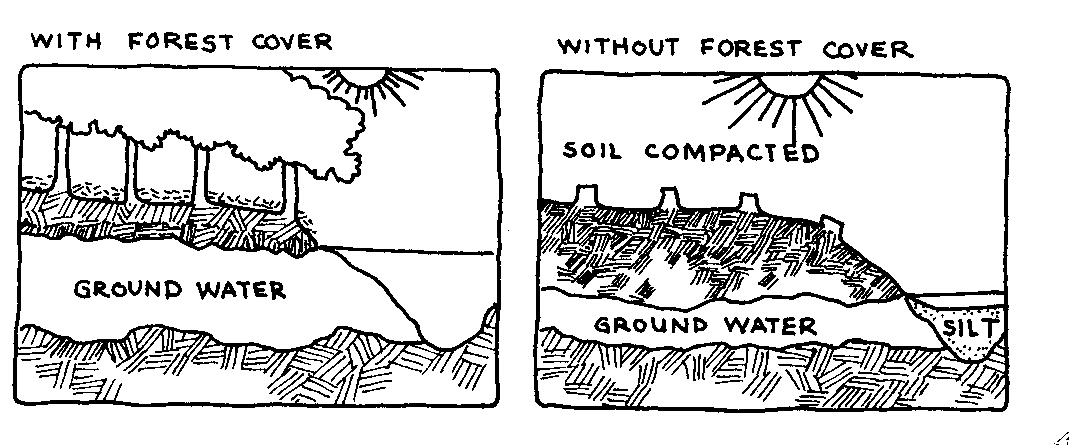
lost. The changes this brings vary according to local climate,
topography, and other factors. In general, the results include an
increasingly harsh environment, with increased soil erosion,
degraded soils, silted waterways, and possibly lowered water
tables. Especially alarming is the loss of soil fertility and reduced
food production.
One long-term solution to deforestation is an intensive
program of forest management. Many local species, when
properly cultivated, can develop sustained yields much greater
than unmanaged forests. Village woodlots and large-scale tree
plantations using fast-growing species are other possible methods
of increasing wood supplies and maintaining the ecosystem.
Additional benefits of new trees may include forage for domestic
animals, nectar for bees, nitrogen fixation for increasing soil
fertility, and the full range of soil and water conservation
functions. Information on sustainable forestry projects can be
found in Environmentally Sound Small-Scale Forestry Projects by
Peter Ffolliott (published by Codel/VITA, 1983).
On a short-term basis, much can be done to reduce the rate
of domestic fuelwood consumption. Cooking over an open fire or
on a poorly designed stove can waste energy. Reductions in
fuelwood consumption can be achieved in a number of ways:
* Shield the open fire from drafts and breezes so that the
flames will lick the pot directly.
* Protect fuelwood from moisture so that it burns dry and
yields the highest possible heat energy.
* Cover all cooking pots with well-fitting lids.
* Arrange to have pots seated at the proper distance from
the fuel bed (that distance being roughly equivalent to
half the maximum pot diameter).
* Where possible regulate the draft if using a stove.
* Soak dry beans or grains overnight to reduce cooking
time. Even better, soak them in a tenderizing solution,
such as that derived from papaya fruit.
* Use a haybox (an insulated, heat-retaining box) to cook
foods requiring long simmering. Or use a haybox to keep
noon leftovers hot so no reheating is needed in the
evening.
* Extinguish the fire the moment the food is cooked.
* Take advantage of retained heat by cooking over a simple,
enclosed stove for warming water, drying wood, or
keeping food hot after the fire is out. For more
discussion on fuelwoods see Ffolliott, 1983.
Biogas: Using plant and organic wastes to generate clean,
combustible gas can be an attractive prospect in some situations.
Biogas production can also yield a quality fertilizer and soil
conditioner, which the Chinese report has boosted crop production
as much as 130 percent. In some areas biogas production has
reduced the incidence of hookworm and other parasites by
providing safe disposal of human feces. <see image> Finally, the substitution
ese26x99.gif (540x540)

of biogas for wood or dung fuels may have other valuable health
and environmental benefits.
Biogas is a mixture of 60-70 percent methane plus carbon
dioxide, water, and often hydrogen sulfide gas. One popular use is
for night-time lighting, where a bright lantern may consume only
0.7 cubic meters (2.5 cubic feet) of gas per hour. For cooking, a
single 5-10 centimeter (2-4 inch) burner consumes 0.2-0.4 cubic
meters (8-16 cubic feet) per hour. Refrigeration consumes
slightly over one unit volume of biogas per unit volume of
refrigerated space per hour. When substituted for diesel fuel,
biogas burns very cleanly, with 7 cubic meters providing the
energy equivalent of 4 liters of fuel (250 cubic feet per gallon
fuel). In China, a fuel of 70 percent biogas and 30 percent diesel
oil is said to provide power to some 150 small-scale electrical
generators.
Like wind and hydropower, biogas production is practical only
when certain conditions are met. In addition to a proper digester,
there must be:
* A steady, year-round supply of organic material that
provides the proper balance of carbon and nitrogeru Fresh
manure from one cow can yield 0.17 cubic meters (6 cubic
feet) of gas per day. The same amount of gas can be
generated from the fecal wastes of nine adult people or
30 large chickens.
* An adequate supply of water sufficient for a 6:1 ratio
with dry organic solids fed into the digester. A biogas
unit using cow manure, for example, initially requires at
least 3.5 liters of water for every 0.1 cubic meter of gas
produced (1 gallon per cubic foot). Once the digester is
operating effectively, much of the liquid overflow
(supernatant) can be recycled in place of fresh water.
* The daily services of a responsible person knowledgeable
in digester operation. There are two types of digesters:
those able to accept a small continuous flow of input and
those requiring a single large quantity of material (batch
loaded). A continuous--feed system requires monitoring
digester performance, preparing and adding raw
materials, and disposing of the supernatant and sludge. A
batch-loaded digester requires less daily attention, but
demands much labor whenever the batch is changed.
In China, household and village biogas systems have been
built and used with some success. However, recent reports
indicate a number of problems. Experience may differ in regions
where water is scarce or where livestock roam freely and
distribute their manure around the countryside. Often a biogas
generator is more effectively installed in an institutional setting
than in a village or household. In Africa, biogas operations have
been used at schools, hospitals, military installations, and prisons.
Although biogas digestion is widely regarded primarily as an
energy-producing technology, it can also play a major role in
sewage disposal, agricultural production, fish farming, and
livestock maintenance. It may be that biogas digestion has its
greatest potential in integrated applications where energy
production is but one part of a larger system.
Sludge from biogas systems is rich in readily available plant
esex101.gif (486x486)

nutrients. Where fish culture is feasible, a limited quantity of
sludge may be used to support algae and insects, which are then
fed to the fish. A more common use for digested sludge is to
improve soil fertility. For maximum benefit, it is advisable to
mix sludge with the soil while it is still very fresh. Sludge loses
much of its effectiveness when it stands. If necessary, sludge
may be stored in a pit or large container and then covered to
minimize exposure. This will probably be necessary because
fertilizing is seasonal but sludge is produced continuously.
The operation of a biogas digester presents several potential
environmental problems. With proper planning and operation
these can be minimized:
* Special precautions are required if human or hog wastes
are to be used. People and pigs share similar fecal-borne
parasites and pathogens, and although few of these
survive the digestion process, more study is required on
the safety of handling digested sludge. Some authorities
warn against applying sludge to soil where root and
vegetable crops are cultivated. In any case, raw fecal
wastes should always be considered extremely hazardous.
If the digester is built close to lavatories or livestock
sheds, the excrement may be deposited directly without
unnecessary handling.
* Disposal of liquid overflow (supernatant) from the
digester may occasionally present a problem. Normally
this liquid is clear and odorless, and also has some value
as dissolved fertilizer. If water is scarce, the supernatant
may be recycled into the digester with new organic
feedstock. Otherwise, it can be used to water plants or
moisten composting materials. With an improperly
working digester the supernatant may be dark and
extremely offensive. If not recycled, this liquid should
probably be buried or mixed with soil in an isolated spot.
* As with natural gas, precautions must be taken to prevent
leaks of biogas into the air. Surveillance is very
important, since biogas normally is odorless and difficult
to detect. In a closed room, leaking gas can lead to
asphyxiation or explosion.
* In areas where manure or dung is considered a free
community resource, the installation of biogas digesters
may cause unwanted changes in local economics. If
manure suddenly becomes valuable it may become a
marketable commodity, and will no longer be available to
the very poor. The question of who stands to lose or gain
from an energy project is one that deserves attention in
the initial planning phases.
Ethanol: The production of ethanol (or ethyl alcohol) is based
on small-scale technologies that have existed for centuries for
making beers and spirits. As a fuel, ethanol can be burned
directly in modified spark-ignition internal combustion engines. It
may also be dehydrated and mixed with gasoline for a high-octane
fuel. Ethanol is a valuable raw material in chemical and
pharmaceutical industries, so its production can foster a
profitable small industry.
Ethanol can be made from a wide variety of plants containing
abundant sugars or starches. Sugar cane, sweet sorghum, corn,
and cassava are most often used. The plant material is crushed
or softened by soaking, fermented, and finally distilled to isolate
the alcohol. The fermentation and distillation phases require considerable
energy inputs, and it is debatable from an energy standpoint
whether the whole process results in a net gain or a net loss.
Equally important is the issue of using nutritious food to
manufacture a liquid fuel. If energy crops are substituted for
food crops, the result could be higher food prices and less
available food. If, however, ethanol is produced from surplus or
spoiling crops there is no competition with human food. Also,
solid residues from ethanol production may be fed to livestock as
a high-protein dietary supplement.
The disposal of liquid residues, which may amount to 12-13
times the volume of the final product must be considered. "Thin
stillage," as it is called, has a strong odor and high acid content,
and contains may organic solids and solubles. Land application of
thin stillage could be harmful to many kinds of soils, especially
those with high clay content. Stillage should not be disposed of in
areas where it may flow into or contaminate lakes and streams.
Finally, significant amounts of water are used in the production
of ethanol. For every unit volume of ethanol produced, about
16 volumes of water are needed for generating steam, cooling,
and preparing mashes. This demand for water must be evaluated
against available supplies and alternative uses.
Animal traction
Approximately 335 million draft animals provide about 150
million horsepower for at least 200 million people in two thirds of
the world. This source of energy is rarely given much attention,
but its contribution to economic activity, especially in rural
areas, is very significant.
In various parts of the world bullocks, oxen, buffaloes, horses,
camels, llamas, donkeys, and elephants are integral to energy
systems supporting agriculture and transportation. In agriculture
they are essential for plowing, harvesting, threshing, and lifting
water. Animals transport farm produce, other commodities, and
people. For short distances with lengthy loading and unloading
times they are cost-competitive with trucks, and can often travel
on terrain where trucks cannot. <see image>
esex105.gif (353x486)

Draft animals would live longer and perform much better
with simple improvements in the design of carts and harnesses.
Too often the harness pulls against the animal's neck instead of
its shoulders. Not only is this debilitating to the animal, but it
also prevents it from applying its full weight to the task. Other
improvements include better herding, feed, and husbandry
practices.
Draft animals need not compete with people for their food.
Usually they can stay healthy on a diet of natural vegetation and
water. Environmental problems can result from overgrazing. A
solution, if the animal is penned or tethered, is to provide a daily
ration of water and fodder; this requires human energy to bring
the water and fodder. The use of animals that combine assistance
with farming and dairy products production is another solution.
Chapter VIII
MATCHING ENERGY SOURCES WITH ENERGY USES
Energy is a means to a specific end. It helps pump water,
cook meals, and plow soil. Not all forms of energy perform these
tasks equally well. This chapter analyzes specific tasks requiring
energy ("end uses") and discusses major factors in selecting the
most appropriate way to provide energy for use in households and
agriculture.
Because of the enormous amount of time spent by people in
rural areas on survival as well as income-producing tasks, the
effect of using specific energy technologies and sources on time
and income, especially as it relates to the work of women, should
be carefully considered.
Household energy
In households, energy is used to prepare food, heat water,
provide space-heating and light, and carry out a variety of other
tasks. In many countries it represents well over 90 percent of all
energy used.
Cooking: Probably no household task is performed as
regularly as cooking food. However, the energy requirements of
cooking are as varied as the food itself. Cooking may include
baking, frying, boiling, simmering, roasting, or steaming,
sometimes demanding high heat, sometimes low, or else one
followed by the other.
Perhaps the most universal cooking task is the cooking of
rice, beans, or grains. Here water is brought to a boil, and then
the mixture is simmered for up to several hours. Simmering
essentially means holding the mixture at a temperature close to
boiling. Once that temperature is attained, little additional
energy is needed beyond whatever is necessary to replace heat
lost to the environment.
What sources of energy are most appropriate for cooking
beans, grains, or rice? In a well-insulated box, solar energy can
easily maintain the temperature of boiling water, although
bringing the mixture to its initial boil may take some time. A
charcoal fire starts out relatively cool and gradually builds up
heat, which is just the opposite of what is needed. Even though
millions of women cook beans or rice over charcoal, they usually
waste the excess heat produced during simmering. A properly
managed wood fire begins with hot flames licking the pot, later
settling down to a bed of coals that produce a low, even heat--and
this is exactly the energy pattern required. Greater control of
the fire is possible with biogas, so the cook need use no more
energy than is necessary for the task.
Actually, since little or no additional energy is needed for the
simmer phase, a pot of boiling rice or beans may be removed from
its source of energy and placed in a heavily insulated box where
all the heat is trapped. This "haybox cooker" concept has been
successfully used for hundreds of years in Europe, although in
most developing countries acceptance of this idea has been slow.
In many parts of the world, the task of cooking does not make
the most efficient use of all available energy. Perhaps this is
because energy efficiency is not the only factor important for the
cook when selecting fuel. Besides a predominant concern with
cooking performance, other considerations in selecting fuel may
include:
* price or availability of the fuel
* tendency of fuel to smoke excessively
* convenience.
In the Gambia, women who work in rice fields are interested
in cooking systems that work rapidly so that they can spend as
little time as possible in the kitchen. In Burundi, many women
have rejected smokey peat in favor of smokeless charcoal even
though charcoal costs much more. In parts of western Niger, the
women could burn twisted grasses or millet stalks, but they prefer
smokey cow dung because the fire requires less attention. The
needs and preferences vary widely, and yet they must be
considered when energy for cooking is being discussed.
Sometimes the women in an area will use a fuel simply
because it is traditional. There has been no conscious choice, and
the cooks may be unaware of the relative merits of any
alternatives.
Compared to almost any other fuel, biogas for cooking is the
cleanest and easiest to control. Yet a number of problems exist.
Collecting human and animal waste for the digester may be
impossible where there are social taboos against the handling of
wastes. Families may not have enough livestock to provide the
necessary amount of dung. With community biogas plants there
may be problems in the equitable distribution of the gas among
community members. Also, there is the expense not only of the
digester but also of the individual stoves or heating elements to
replace the traditional system. Biogas systems require training
for proper maintenance of the system.
Heating: In some parts of the developing world, homes
require heat, at least during certain seasons. While not always as
significant a problem as in the temperate regions, space heating
can be an important need. It can often be met by the heat
produced from the cooking fire.
Most efficient cookstoves enclose the fire and minimize the
transfer of heat to the surroundings. A stove specifically
designed for both cooking and body heating can be one solution.
Otherwise, if a family adopts a fuel-efficient cookstove it may be
obliged also to acquire additional energy for personal warmth.
In Korea, the traditional "ondol" system is one that
successfully combines the functions of cooking and space heating.
Unfortunately, it uses coal as a fuel, and the widespread use of
this stove in Seoul is believed to contribute heavily to the high
incidence of tuberculosis and other respiratory ailments and
carbon monoxide poisoning.
Lighting: For most rural people night-time lighting is
provided by the moon, stars, or occasionally a flickering wood fire
or kerosene lamp. However, women who cook after dark or inside
a dark kitchen depend on light, often from the cooking fire. If the
traditional fire is replaced by a fuel-efficient cookstove, very
little light will escape and it will be necessary to find other
sources of illumination.
Kerosene lamps (or "paraffin lamps" in British English) are
widely used in urban areas where there' is no electricity.
However, the price of kerosene is very high and rising steadily.
Biogas can produce a very bright light when burned in a lamp
with a mantle. Electricity also gives very satisfactory lighting.
Neither of these systems provides portable lighting, however.
And both are costly.
While light is often desirable in rural settings, it usually
carries no direct economic or survival benefits. For this reason,
it may be best considered a possible side-benefit of energy
production where the primary use is more directly linked to basic
needs and income generation.
Food processing: Food processing includes husking, grinding,
oil extraction, pickling, drying, and refrigeration or freezing.
These last two require significant amounts of energy.
Refrigeration and freezing, once begun, place a continuous drain
on energy resources until the food is either consumed or spoiled.
This makes it an expensive process, and in many areas priority for
refrigeration will go to medicines rather then food. Energy for
refrigeration can come from electricity generated in any number
of ways. Biogas is also highly appropriate for refrigeration.
For large-scale drying of foods, a solar dryer can be
extremely practical. The drying is more even, more rapid, than
most traditional methods, and the food is protected from insects,
dogs, and other animals. See page 85 for further details on solar
food drying.
Energy for agriculture
Energy is used in all phases of agriculture. From land
clearing and management, to crop production, harvesting,
processing, and transport to market, considerable work is
required. In most areas of developing countries, much of the
energy for agriculture is from human labor, animal power, and the
cycling of nutrients in natural biological processes.
A well-functioning ecosystem is critical for dependable and
sustainable yields. Many heavily used energy sources play a major
role in maintaining the well-being of the agricultural ecosystem,
such as crop residues and dung gathered from fields, or trees
planted around or near fields. In planning projects, the
competition between using these resources for energy and using
them for their value in protecting soil and maintaining the water
supply must be considered.
In some areas, large amounts of energy are added to the
natural system (effectively changing the limiting factors) to
increase yields. This includes chemical fertilizers, pesticides, and
highly mechanized farming techniques. This can damage the
ecosystem, especially on marginal lands. Energy intensive
agriculture in such areas as the Sierra Madre of Mexico or the
drought-prone plains of the Sahel can lead to serious erosion and
other unwanted problems, making the land even less productive
than before.
However, one should take advantage of the impressive impact
that small infusions of well-placed energy for fueling appropriate
technologies can have on crop yields. For example, if water is the
limiting factor and is intermittent in supply, a wind-powered
irrigation pump may be an answer.
Irrigation: Irrigation is the application of water to crops to
increase their productivity. It may be used, for example, to
lengthen the growing season or to cultivate in arid regions where
natural rainfall is insufficient. Under some circumstances,
irrigation can bring parasitic diseases and may ultimately impair
soil fertility. While these issues are beyond the scope of this
book, they should not be ignored.
Pumping water for irrigation usually differs significantly
from pumping water for domestic use; this needs to be considered
when seeking an appropriate technology. For example:
* Water for irrigation is usually required in larger volumes,
so the pumps are usually more powerful and they operate
uninterrupted for hours at a time.
* Pumping for irrigation directly affects agricultural
production and hence income, while pumping domestic
water usually has no direct financial benefits. Thus,
farmers may be willing to invest more money or effort
into installing irrigation systems. This is already evident
from the large number of diesel-powered irrigation pumps
seen throughout the Third World.
* Irrigation pumping is usually not required year-round. The
pumps may actually be idle for months at a time.
* Reliability in meeting the demand for water is an
essential feature of any irrigation system. It is wise to
have back-up equipment and spare parts in case of
mechanical breakdowns.
A range of energy sources can be exploited to pump water for
irrigation. The best choice of technology depends, of course, on
the specific circumstances, especially local farming practices.
Here are a few guidelines:
Wind power can be successful in pumping water. For
irrigation, it is suitable only as long as there is a reliable
breeze at the right time. You may construct a large tank
or above-ground reservoir to store water for calm days, but
the evaporation losses and high cost in this solution must
be carefully weighed against possible benefits.
Electric pumps operated by a photovoltaic system are worth
considering. There is never any fuel to store or carry to the
pump site, which is a great advantage if the system is far
from a town or village. Because of the large initial cost of
equipment, a photovoltaic system is probably most suitable
where there is a long irrigation season with the likelihood of
a high profit from the harvest. You should purchase only
equipment that has been proven reliable in thorough field
testing.
Biogas may be used in some instances, to run the motors of
irrigation pumps. Alternatively, a mixture of 70 percent
biogas and 30 percent diesel fuel has been tried. It is
convenient to have the sludge and supernatant produced close
to where they will be applied to the soil. A possible
disadvantage is the large size of digesters and great volumes
of raw materials needed to provide adequate amounts of
biogas. A single batch digester may be inadequate for even a
short irrigation season, so either multiple batch digesters or
continuous feed operations are required. Given the
importance of reliability, biogas technology should be
considered for irrigation only where it has already been
successfully used locally for other functions.
Ethanol, diesel fuel, gasifier engines, and other organic fuel
systems may all be appropriate in specific situations. Here
the major issues are fuel transport and storage, energy
efficiency, cost effectiveness, and environmental impact. As
always, the long-term effects must be considered, for they
are ultimately more important than any short-term gains.
Animal traction is sometimes well-suited for small irrigation
systems. Proven schemes are available for using various
types of draft animals to lift a continuous stream of water a
vertical distance of 1-30 meters. The technology is relatively
simple and reliable. When irrigation water is no longer
needed, the same animals may be put to work transporting
the harvest, cultivating the land, or performing other
functions. This technology does require training and handling
animals, and the availability of fodder in dry seasons.
Land preparation, crop management, and harvesting: In
traditional western agriculture, these end uses depend on farm
machinery such as tractors, plows, planting implements, and
threshers. Before such tools are adopted for small-scale tropical
agriculture, you must be sure they are appropriate for local
conditions. Great erosion damage can result from plowing on hilly
terrain where the soil structure is poor. Even on flat land,
farmers may find that a heavy rain can wash away soil to the
lowest depth of plowing. When using energy in agriculture, much
environmental damage can be avoided by proper timing of all
activities and a wise selection of suitably scaled machinery.
For small-scale agriculture, animal traction still provides the
best low-cost energy in many situations. The animals must be fed
and cared for, properly harnessed, and given only work that does
not exceed their strength and endurance. The manure is an added
benefit when properly applied to the soil or used in a biogas
digester. If there is inadequate fodder, however, soil may be
degraded by the animals eating the ground cover.
Another option is the use of a hand tractor powered by
compressed biogas or any of the liquid fuels, such as gasoline,
diesel, or ethanol. Small gasifier engines may soon be proven
practical for hand tractors, although this will considerably
increase their weight. Also, there is some work currently
underway to develop dual-fuel engines to take advantage of
seasonal fuel availability.
There is increasing interest in having energy to supply power
to machinery that comes directly from the land itself. This
entails the use of crop residues, such as rice husks or animal
wastes, or the production of fuelwood or ethanol feedstock. It is
possible to integrate the production of these energy resources
with other uses of agricultural land. On the other hand, growing
or using local resources to provide energy may actually conflict
with food production.
Chapter IX
SUMMARY
There are no cookbook recipes for successful energy projects;
different communities and local conditions require adaptation in
approach and design of a project. However, there are basic
concepts and considerations that should be an integral part of
planning and carrying out environmentally sound small-scale
energy projects. Below is a list of the "ingredients" covered in
this manual:
* Environmentally sound energy projects can help maintain
a balance in resource use, thereby contributing to the
regeneration of resources. This can lead to long-term
availability of renewable resources, the basis for
sustainable energy development.
* Energy is produced and used in different ways. The local
ecosystem, particularly those factors such as climate and
soil fertility, affects the productivity of renewable
resources. Socioeconomic structures and cultural values
affect a community's choice of technologies for producing
energy and the use the community will make of available
energy.
* Traditionally women have played a key role in the
collection and use of energy sources in the Third World.
Energy projects that ignore the knowledge and experience
of women may increase rather than lessen the time and
effort required to obtain energy from various sources.
* The planning process requires information about the
community and data on the physical environment.
Socioeconomic information on the needs and use of energy
for families and for different income groups helps
development workers to predict better answers to the
following questions:
-- How will a proposed project affect the local
ecosystem?
-- How will it affect various income groups involved in
the project?
-- How can a particular technology or new energy source
effectively be introduced to assure implementation?
-- How might traditional attitudes and practices in
carrying out the project affect the physical
environment?
Useful information about the natural environment or local
ecosystem is available from local people and sources.
Additional technical information can be collected from
government offices and other sources.
* Community participation together with guidelines that
include environmental, social, cultural, economic and
technological considerations form the basis for decision
making and reaching participant groups. Members of the
community that will benefit from the project, especially
women, should be involved in all levels of project
planning, implementation and evaluation. Talking with
participants is the best way to learn about local attitudes
and values, community priorities, and other factors that
influence energy use and acceptability of change and new
technologies.
* The planning process helps explore present problems and
avoid future problems related to energy use and
production. Examining ways to meet the energy needs of
a particular community involves several factors:
-- Feasibility of developing additional energy sources or
improving production of present sources or both
-- Benefits and costs of developing new conversion
technologies
Improving the efficiency of current energy "end uses"
(tasks/devices for which energy is needed, such as
improved stoves where they are shown to be effective).
* Planners can compare and measure various energy sources
and end uses by: collecting information as described
above; considering multiple uses of an energy source; and
properly testing the efficiency of end-use devices under
local conditions.
* Matching energy uses with the appropriate energy sources
should be based on environmental considerations that
minimize negative effects on the availability and growth
of resources.
Development workers should find it useful to explore these
points further within the context of the local community and the
specific environmental setting in which they are working.
Development workers of community-based organizations with an
established relationship with the people of the community have a
special role to play in the area of sustainable development
projects. In these cases, implementing and monitoring projects
that meet real needs is more likely. One further step that would
be helpful is to share and exchange information about experiences
in the process of planning energy projects. Through talks,
workshops, and publications and other documentation, the lessons
learned can benefit the work of other groups and communities.
APPENDIX A
ENERGY CONVERSION TABLE
UNITS OF ENERGY
1 Kilocalorie (kcal) warms 1 kilogram (2.2 lbs) water 1[degrees]
Centigrade (1.8 F).
1 British Thermal Unit (Btu) warms 1 pound of water 1 degree
Fahrenheit.
1 foot-pound (ft-lb) lifts 1 pound 1 foot.
1 joule (J) lifts 1 kilogram 10.2 centimeters (4 in.).
1 kilowatt-hour (KWH) is energy used at the rate of 1000 watts
for one hour.
UNITS OF POWER
1 watt (W) = 1 joule per second
1 kilowatt (KW) = 1000 watts
1 Megawatt (MW) = 1000 kW
1 horsepower (hp) = 33,000 ft-lbs per minute
1 Quad - [10.sup.15] Btu (a million million Btu)
TO CONVERT TO MULTIPLY BY
Btu's cal 252
Btu's ft-lbs 787
Btu's joules 1055
Btu's kWH 0.000293
cals. ft-lbs 3.080
cals. joules 4.184
kcals Btu's 3.97
kcals kWH 0.00116
ft-lbs Btu's 0.0013
ft-lbs joules 1.356
ft-lbs kWH 0.000000377
ft-lbs cals. 0.3247
joules Btu's 0.0009
joules cals 0.239
joules ft-lbs 0.737
joules kWH .00000028
kWH Btu's 3413
kWH ft-lbs 2,631,000
kWH joules 3,570,000
kWH kcals. 859
horsepower watts 746
horsepower kcal/day 15,412
watts horsepower 0.00134
watts kcal/day 20.66
kcal/day horsepower 0.000065
kcal/day watts 0.048
APPENDIX B
ECOLOGICAL MINI GUIDELINES
FOR
SMALL-SCALE/COMMUNITY DEVELOPMENT PROJECTS
by
Fred R. Weber(*)
The following short-form version of the CILSS/Club du Sahel
Ecologic Guidelines has been developed to meet the needs of
development workers at the community level. The original
version is available at cost ($5.00) from the CODEL Environment
and Development Program. This paper was prepared by Fred R.
Weber as a result of discussions with private development
agencies at CODEL workshops on environment and development
in 1980.
The guidelines assist in analysis of proposed activities and a
design that will minimize negative impacts. It is to be used for
small-scale projects under $250,000. The general approach is the
same as for the complete CILSS/Club du Sahel Ecologic
Guidelines. Methods and procedure, however, have been
condensed in a form that is less time consuming and can be
carried out by project design personnel not formally trained or
experienced in environmental analysis.
You are encouraged to adapt the guidelines to your project.
CODEL welcomes comments on the usefulness of this tool and
reports on your experience in utilizing it.
(*) Fred R. Weber, a long time VITA Volunteer, is a forester and
engineer who has worked for many years with private development
agencies in West Africa. He is the author of many books,
including the classic resource Reforestation in Arid Lands
(VITA, 1977).
Introduction to the Guidelines
Begin with any project in the community development area:
wells construction, school gardens, poultry raising, village
woodlots, access roads, and so forth. Any community activity
will, in one form or another, affect the environment somehow.
Especially if "environment" is regarded in its broadest form, not
only the physical aspects are affected but also health, economics,
social, and cultural components.
The objective of this exercise is to try to predict as far as
possible the various effects the proposed activity will have in both
negative and positive terms. A project normally is designed with
specific results in mind. An attempt is made to provide well
defined, "targeted" inputs to bring about some improvement to
the people in the field. What is less clear is the nature and extent
of incidental consequences these activities might bring about that
are less desirable, in fact often adverse or negative.
In reality, more often than not, the good will have to be
taken with some bad. Choices often involve trade-offs. The trick
then consists of developing a system where these trade-offs
ultimately are as favorable as possible in terms of the people
involved.
INSTRUCTIONS
In order to identify areas where possible adverse effects may
occur, the basic question that should always be asked is:
HOW WILL PROPOSED PROJECT ACTIVITIES AFFECT _____?
If we insert in this question the components that together
make up the environment, we will get answers (and possible
warning flags) for those situations where otherwise negative
consequences "inadvertently" may result.
Explanation of Columns <see chart>
esex127.gif (600x600)
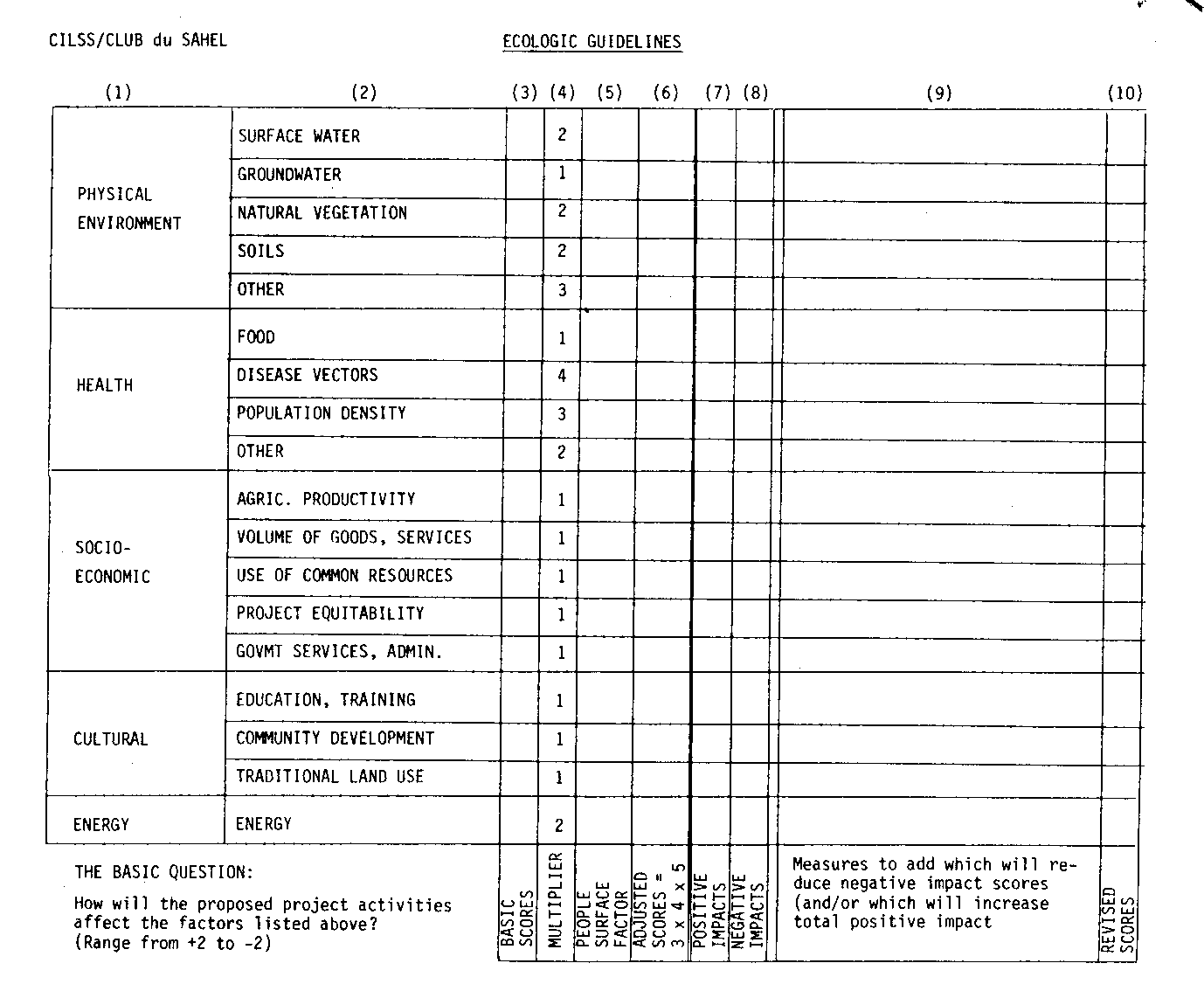
1. In the table on Page 5, ask yourself the basic question for
each of the 18 lines (described below) and assign the
following values in Column 3.
Very positive, clear and decisive positive impact .... + 2
Some, but limited positive impact .................... + 1
No effect, not applicable, no impact ................. 0
Some definite, but limited negative impact ........... - 1
Very specific or extensive negative impact ........... - 2
2. A brief explanation of the factors in columns 1 and 2:
Surface Water runoff: peak and yields. How does the project
activity affect runoff? How does it affect the peaks (flood
discharges)? How does it affect the amount of water that
will flow (yield)?
Groundwater: Its quantity, recharge rates, etc. Also, does
the project alter its chemical composition?
Vegetation: Accent on natural vegetation. Will natural
cover be reduced (bad) or increased (good)? How will natural
regeneration be affected? Will there be additional (or fewer)
demands on trees, bushes, grass, etc.?
Soils: Will the project increase or drain soil fertility? Where
land surfaces are affected by the project, is "optimal" land
use affected favorably or adversely? Will erosion be more or
less likely?
Other: Basic questions dealing with improvement or
deterioration of factors such as wildlife, fisheries, natural
features. Also, does the project follow some existing overall
natural resource management plan?
Food: Will people have more food and/or a more complete
diet?
Disease vectors: A very important point and one that is
often overlooked: Will the project create more standing
water? Will the project increase (or create) fast flowing
water? How will it affect existing water courses?
Population density: How much will population density
increase as a result of the activities? What contamination
conditions will be altered? How? Will more health care
services be required?
Other: Toxic chemical, exposure to animal borne diseases,
etc.
Agricultural productivity: Per capita food production
(staples or cash crops), yields.
Volume of goods or services: Will the project provide more
goods (food, firewood, water, etc.) or less?
Common resources: (Water, pasture, trees, etc.) Will the
project require people to use more or less water, pastures,
etc.? Will it eliminate any of these resources now available?
Will it restrict access to these resources?
Project equitability: How are benefits distributed? Who will
profit from these activities? Special segments of the
population? How "fairly" will the benefits be shared.
Government services, administration: Will the project
demand more work, "coverage" of government services? Will
it cause an additional load on the administration: more
people, recurrent costs, etc.?
Education and training: How will it affect existing
education/training facilities? Strain or support? Or will it
provide alternates? What about traditional learning (bush
schools, etc.)?
Community Development: Will it encourage it, or will it
affect already ongoing efforts? If so, is this good or bad?
Traditional land use: Will it restrict existing use, harvesting,
grazing patterns? Many projects promote "better" land use
but at the (social) cost of some one or some group being
restricted from using land, vegetation, water the way they
have been used to.
Enerqy: How will the project affect the demand for (or
supply of) firewood? Will it increase dependence on fossil
fuels?
3. Column 4: This is an arbitrary number based on experience.
4. Column 5: Choose an adjustment factor between 1.0 and 5.0
depending on whether a large number of people and/or large
areas are affected. If a large segment of the population is
affected (say: over 1,000 people) use a factor of 2.5. If
1,000 hectares or more are involved, use 2.5 also. If both,
large numbers of people and extensive area are affected,
combine the two: use up to 5.0. Never use a factor less
than 1.0.
This step is necessary because some activities may help a
handful of people, but at the same time have some adverse
affect over large areas. By assigning such area/people
factors to each of the 18 lines, proper "weight" will be given
to these conditions.
5. Compute the adjusted score by multiplying columns 3, 4, and
5. Enter result in column 6. Make sure to carry positive and
negative signs.
6. In Column 7: list all impacts that are positive.
7. In Column 8: list all impacts that are negative.
8. Now take another look at Column 8. Here you'll find a
summary of the negative aspects of your proposed activity.
Beginning with the largest values (scores), determine what
measures you can incorporate into your project, what
alternate approaches can be followed to reduce these
negative values, one by one. This may not always be possible,
but try to modify your plans so that the sum of all negative
impacts will be as small as possible. (Tabulate the new,
improved scores in Column 10)
Modify, adjust, redesign your project so that the total of all
"negative impacts" is as small as possible. This is the essence of
"ecologically sound project design."
APPENDIX C
TROPICAL CLIMATES
There are three principal types of tropical climates: the wet
or humid equatorial climate, the dry tropical climate, and one
that is alternately wet and dry. <see map>
esex128.gif (600x600)

Wet or humid equatorial climate is found in a band of approximately
5 degrees north and south of the equator. It is characterized
by heavy rainfall (75-120 inches of rain per year), constant
heat and high humidity. This includes the Amazon and Congo
Basins; West Africa south of the Sahel; parts of Kenya, Tanzania,
and Madagascar; Malaysia; Indonesia; Papua New Guinea; and
many of the Pacific Islands.
Dry tropical climates occur in two "belts" approximately
15-30 degrees north and south of the Tropics of Cancer and
Capricorn, which are characterized by hot arid weather and
deserts. This is true of most of North Africa, Saudi Arabia, Iran
and Pakistan, and parts of Australia, Peru and Chile.
Climates that alternate between wet and dry seasons are
found in between the wet equatorial band and the dry tropical
belts. These areas are found in south and southeast Asia, Africa,
the grassy plains of Venezuela, and eastern Brazil. The length of
the rainy season and the amount of rainfall vary considerably
among these areas and also yearly in a given area.
Rainfall
A major problem in the tropics generally is the amount of
rainfall: there is often too much or too little rainfall. Heavy
rains, especially in steep areas, crush soil structure, seal off
underlying soil from the air, leach out necessary soil nutrients
(wash them away) or push them too far into the ground for plant
roots to reach them.
To assess rainfall, one should take into account the total
amount of rain per year, and the variability and intensity of the
rainfall. Variability indicates whether sufficient water will be
available to generate power when it is needed, or whether the
seasonal demand for crop residues could be met. For instance,
even though the total annual rainfall in Santo Domingo,
Dominican Republic, is about the same as Katmandu, Nepal (1400
millimeters per year), the rain in Katmandu is far more concentrated
in certain months.
Soil Erosion
The rate of soil erosion also differs between regions, due to
the amount and intensity of rainfall, the type of soil and the
steepness of the area. Soils in the tropics are generally less
fertile than in moist, temperate areas because they contain less
organic material (humus) in which nutrients are stored. These
soils can less afford to lose organic material from harsh rains.
When vegetative cover is removed, bare, exposed soil rises in
temperature hastening the oxidation and disappearance of humus.
Shifting agriculture is a major means by which farmers in the
humid tropics maintain crop production: as poor soils are worn
out, they move to other areas.
Some exceptions are found in alluvial and volcanic soils, and
in forest soils of tropical mountains that escape the greater heat
of low altitudes and may be rich in humus. The steep rivers in
these mountains carry rich alluvial soil from other areas that
enriches the farmland. The same is true in parts of Uganda and
the Sudan. Volcanic soil is found in various parts of the world.
Insolation and Wind
Insolation varies regionally and seasonally. The angle of the
sun varies in the regions away from the equator, and the amount
of effective sunlight available depends on cloud cover. This may
be quite important if the need for solar energy coincides with the
rainy season.
In some places, relatively infrequent wind gusts require
windmills that can withstand a wide range of wind speeds. In
other areas, such as some islands in the Caribbean, windmills must
be able to turn under a relatively slow but constant wind.
All these features together contribute to an ecosystem that
is relatively fragile. The risk of long-term damage from any large
project may be lessened through careful planning and subsequent
monitoring.
APPENDIX D
BIBLIOGRAPHY
Addresses for obtaining these publications are listed in Appendix
E, Sources of Information.
Arnold, J.E.M. "Fuelwood and Charcoal in Developing Countries."
Unasylva, Vol. 29, No. 118. 1979.
Bassan, Elizabeth (Ed.). Global Energy in Transition:
Environmental Aspects of New and Renewable Sources
for Development. New York: UNIPUB. 1981.
Briscoe, John. The Political Economy of Energy Use in Rural
Bangladesh. Monograph. Environmental Systems Program,
Harvard University. 1979.
Cecelski, Elizabeth, et.al. Household Energy and the Poor
in the Third World. Washington, D.C.: Resources for
the Future. 1979.
Chatterji, Manas (Ed.). Energy and Environment in the
Developing Countries. New York: John Wiley
and Sons. 1981.
Darrow, Ken, et al. Appropriate Technology Sourcebook
Vols. I and II. San Francisco: Volunteers in Asia. 1981.
deLucia, Russell J., Henry D. Jacoby, et al. Energy Planning
for Developing Countries: A Study of Bangladesh.
Baltimore: Johns Hopkins University Press. 1982.
East West Center. Rural Energy to Meet Development Needs:
Issues and Methods. Boulder, Colorado: Westview Press.
1983.
El-Hinnawi, Essam. The Environmental Impacts of Production
and Use of Energy. Dublin: Tycooly Press. 1981.
Environment Liaison Centre. Address List of Non-Governmental
Organizations Working in the Field of Energy. Nairobi:
ELC. 1981.
Evans, Ianto and Michael Boutette. Lorena Stoves: Designing
and Testing Wood-Conserving Cookstoves. Stanford,
California: Volunteers in Asia. 1981.
Ffolliott, Peter F. and John L. Thames. Environmentally Sound
Small-Scale Forestry Projects: Guidelines for Planning.
New York: CODEL. 1983.
French, David. The Economics of Renewable Energy Systems
for Developing Countries. Washington, D.C.:
U.S. Agency for International Development. 1979.
Holland, R. et al. "Community Load Determination, Survey
and System Planning", in Small Hydro-Electric Powers.
National Rural Electric Cooperative Association.
Hoskins, Marilyn with Fred R. Weber. Household Level
Appropriate Technology For Women. Washington, D.C.:
U.S. Agency for International Development. 1981.
Hoskins, Marilyn. Women in Forestry for Local Community
Development: A Programming Guide. Office of Women
in Development, USAID, Washington, D.C. 1979.
Kamarck, Andrew M. The Tropics and Economic Development.
Washington, D.C.: The World Bank. 1976.
Lichtman, Robert. Biogas Systems in India. Arlington, Virginia:
Volunteers in Technical Assistance. 1983.
National Academy of Sciences. Diffusion of Biomass Energy
Technologies in Developing Countries. Washington, D.C.:
National Academy Press. 1982.
National Academy of Sciences. (two parts). Energy for Rural
Development: Renewable Resources and Alternative
Technologies for Developing Countries. Washington, D.C.:
National Academy Press. 1976 and 1981.
National Academy of Sciences. Firewood Crops: Shrub and Tree
Species for Energy Production. Washington, D.C.:
National Academy Press. 1980.
National Academy of Sciences. Methane Generation from
Human, Animal and Agricultural Wastes. Washington, D.C.:
National Academy Press. 1977.
Odum, Eugene P. Ecology. New York: Holt, Rinehart and
Winston. 1975.
Santo Pietro, Daniel (Ed.). An Evaluation Sourcebook for PVOs.
New York: American Council of Voluntary Agencies
for Foreign Service. 1983.
Sivard, Ruth L. World Energy Survey. Virginia: World
Priorities. 1981.
Smil Vaclav and William E. Knowland. Energy in the Developing
World: The Real Energy Crisis. Oxford: Oxford University
Press. 1989.
Tinker, Irene. Women, Energy and Development.
Washington, D.C.: Equity Policy Center. 1982.
Van Buren, Ariane QQ. A Chinese Biogas Manual. London.
Intermediate Technology Publications Ltd. 1979.
VITA/ITDG. Wood Conserving Cook Stoves: A Design Guide.
Arlington, Virginia: Volunteers in Technical
Assistance. 1980.
NOTE: The Intermediate Technology Development Group,
Volunteers in Asia, and VITA publish many how-to books for
contructing specific technologies including solar cookers, solar
stills, biogasplants, cookstoves, windmills, waterwheels, hydraulic
rams, and dams. For addresses see Appendix E, Sources of
Information.
APPENDIX E
SOURCES OF INFORMATION
References can be obtained from:
American Council of Voluntary Agencies for Foreign Service
200 Park Avenue South
New York, NY 10003
USA
CODEL
79 Madison Avenue
New York, NY 10016 - 7870
USA
Environment Liaison Centre
P.O. Box 72461
Nairobi, Kenya
Equity Policy Center
2001 S Street, N.W., #420
Washington, DC 20009
USA
Harvard University
Environmental Systems Program
Cambridge, Massachusetts
USA
Holt Reinhart and Winston
521 5th Avenue
New York, NY 10175
USA
Intermediate Technology Development Group
9 King Street
London WC2E 8HN
United Kingdom
Johns Hopkins University Press
Baltimore, Maryland 21218
USA
John Wiley and Sons, Inc.
605 Third Avenue
New York, NY 10016
USA
National Academy of Sciences
2101 Constitution Avenue, N.W.
Washington, DC 20418
USA
Oxford University Press
Walton Street
Oxford OX2 60P England
Resources for the Future
1755 Massachusetts Avenue NW
Washington, DC 20
USA
Tycooly International Publishing, Ltd.
6 Crofton Terrace
Dun Laoghaire
County Dublin, Ireland
Dublin, Ireland
U.S. Agency f or International Development
Washington, DC 20523
USA
VITA
1600 Wilson Boulevard, Suite 500
Arlington, Virgnia 22209 USA
Tel: 703/276-1800 . Fax: 703/243-1865
Internet: pr-info[at]vita.org
Volunteers in Asia
Box 4543
Stanford, California 94305
USA
UNIPUB
345 Park Avenue South
New York, NY 10010
USA
Westview Press
5500 Central Avenue
Boulder, Colorado 80301
USA
The World Bank
1818 H Street, N.W.
Washington, DC 20433
USA
World Priorities
Box 1003
Leesburg, Virginia 22075
USA
BIOGRAPHICAL NOTES
Elizabeth A. Bassan, Author
During the preparation of this manual, Elizabeth Bassan was
working with the Sierra Club International Earth Care Center in
New York City. Following that post, she joined the staff of the
American Council of Voluntary Agencies in Foreign Service in
1982. Ms. Bassan is currently in Nairobi, Kenya on free lance
consultancies.
Ms. Bassan took her training in International Affairs at Columbia
University. Her experience includes paralegal work, organizing
and participating in international conferences involving private
development groups, and editing conference publications, notably,
Global Energy in Transition: Environmental Aspects of New and
Renewable Sources for Development (UN Conference on New and
Renewable 5ources of Energy, 1981)
Timothy S. Wood, Ph D, Technical Editor
Timothy Wood recently returned from two years in West Africa as
Technical Coordinator of the Sahel Regional Improved Woodstoves
Program with CILSS/VITA. He is currently Director of the
Environmental Studies Program and Associate Professor of
Biological Sciences at Wright State University in Dayton, Ohio.
Dr. Wood was trained in biology and ecology at University of
Colorado in Boulder. His professional interests concentrate on
controlled combustion of biomass for efficient production of
useful heat energy, environmental impact of development projects
in economically disadvantaged regions of the world, and sound
technological solutions to environmental problems in these areas.
Dr. Wood has contributed his services to the CODEL Environment
and Development Program since 1980 when he served as a
resource person f or a CODEL t raining workshop at Lake Mohonk,
N.Y. He remains closely associated with VITA as a VITA Volunteer
and consultant in his field.
========================================
========================================
SMALL-SCALE
ENERGY PROJECTS
GUIDELINES FOR PLANNING
by
Elizabeth Ann Bassan
Timothy S. Wood, Ph. D.
Technical Editor
Coordination in Development (CODEL)
Volunteers in Technical Assistance (VITA)
VITA
1600 Wilson Boulevard, Suite 500
Arlington, Virgnia 22209 USA
Tel: 703/276-1800 . Fax: 703/243-1865
Internet: pr-info@vita.org
CODEL
Environment and Development Program
79 Madison Avenue
New York, New York 10016
Illustrations by Linda Jacobs
Cover Design by Susann Foster Brown
CODEL/VITA 1985
ISBN No. 0-86619-171-2
TABLE OF CONTENTS
Preface
Chapter I
USES AND USERS OF THIS MANUAL
What is the purpose of this manual?
What does the manual provide?
Who should use this manual?
Chapter II
ECOLOGY FOR SUSTAINABLE ENERGY DEVELOPMENT
What are ecosystems and biological communities?
How does an ecosystem work?
Producers
Consumers
Decomposers
Non-living environment
How are energy and the environment related?
What is energy flow?
What is a nutrient cycle?
What is the hydrologic (water) cycle?
What are limiting factors?
What is renewability?
Energy, ecology, and the tropics
What are environmental effects?
Chapter III
SOCIOECONOMIC CONSIDERATIONS OF ENERGY USE
Energy use in developing countries
Reaching participant groups
Social, cultural, and economic aspects of energy
What is the role of women in energy production?
Energy and general welfare
Factors affecting the adoption of energy technologies
Who pays for environmental problems?
Chapter IV
ENERGY PLANNING FOR SUSTAINABLE DEVELOPMENT
Why plan?
Special considerations in meeting energy needs
What is end use?
How efficiently is energy used?
Measuring energy output
Wind
Solar
Water
Forests and vegetation
Crop residues
Animal residues
Chapter V
ULIPUR, BANGLADESH: A CASE STUDY
How were socioeconomic data collected?
How were data collected on energy use?
How to use the energy flow diagram
Summing up
Chapter VI
A PROCESS FOR PLANNING ENERGY PROJECTS
Community participation
Environmental and socioeconomic guidelines
Steps in the planning process
1 Collect information
Community profile--socioeconomic
characteristics
Natural resources--ecological
characteristics
Energy use patterns
2 Identify energy needs and constraints
3 Define project objectives
4 Develop alternative designs
5 Compare alternatives and select one alternative
6 Implement project
7 Monitor project
8 Evaluate project
Chapter VII
ENERGY SOURCES AND ENVIRONMENTAL
CONSIDERATIONS
Solar energy
Drying
Cooking
Electricity generation
Solar ponds
Wind
Water (Hydropower)
Biomass - Fuelwood
- Biogas
- Ethanol
Animal traction
Chapter VIII
MATCHING ENERGY SOURCES WITH ENERGY USES
Household energy
Cooking
Heating
Lighting
Food processing
Energy for agriculture
Irrigation
Land preparation, crop management,
and harvesting
Chapter IX
SUMMARY
Appendixes
A. ENERGY CONVERSION TABLE
B. ECOLOGICAL MINI GUIDELINES
C. TROPICAL CLIMATES
D. BIBLIOGRAPHY
E. SOURCES OF
GUIDELINES FOR PLANNING SERIES
Environmentally Sound Small-Scale Agricultural Projects, 1979
(Also in Spanish and French)
Environmentally Sound Small-Scale Water Projects, 1981
(Also in Spanish)
Environmentally Sound Small-Scale Forestry Projects, 1983
(Translations in Spanish and French in process)
Can be ordered from:
VITA Publications
1815 North Lynn Street, Suite 200
Arlington, Virginia 22209 USA
Preface
This manual is the fourth volume of the Guidelines for
Planning Series. The series was originally suggested by
representatives of private development agencies to provide
paratechnical information for their field staff and counterpart
personnel in Third World countries for use in planning
environmentally sound small-scale projects. Titles of other
volumes in the series are listed on the opposite page.
The CODEL Environment and Development Committee has
guided the development of the Guidelines for Planning Series.
CODEL acknowledges the contribution of the Committee to this
volume. Those members who reviewed drafts of the manual are
indicated by an asterisk.
Sr. Jean Marie O'Meara, S.H.C.J., Chairperson
* Ms. Elizabeth Enloe, Church World Service
Mr. George Gerardi, Hermandad
* Rev. John L. Ostdiek, O.F.M., Franciscan Missionary
Union of Chicago
Mr. Ragnar Overby, The World Bank
Ms. Agnes Pall, International Division, YMCA(**)
Mr. C. Anthony Pryor, U.S. Agency for International
Development
* Sr. Renee Roach, Medical Mission Sisters
Mr. A. Keith Smiley, Mohonk Consultations on the
Earth's Ecosystem
In addition, a number of reviewers offered substantive
comments, which assisted with the preparation of the final copy:
Mr. Thomas Carouso, Partnership for Productivity
Ing. Guillermo Duarte-Monroy, Sistemas
Agroenergeticos Integrados
Mr. Gary Eilerts, formerly Appropriate Technology
International
(**) Deceased August, 1983
Dr. Peter Ffolliott, University of Arizona
Mr. Jack Fritz, National Academy of Sciences
Dr. Gary Garriott, Volunteers in Technical Assistance
Ms. Marilyn Hoskins, Virginia Polytechnic Institute
and State University
Dr. Clarence Kooi, US Agency for International
Development/West Africa
Sr. Caroline Mbonu, Handmaids of the Holy Child
Mr. Mark Ward, Africa Bureau, US Agency for
International Development (AID)
Margaret Crouch, VITA publications office, has served as
liaison with CODEL and technical adviser to CODEL for several
of the volumes in the series. CODEL takes this opportunity to
thank Ms. Crouch for her past assistance and special contributions
to this volume.
Ms. Molly Kux, AID Office of Forestry, Environment, and
Natural Resources, has encouraged and supported the preparation
of each of the volumes in the series. She has played an important
role in assisting with identifying authors and reviewers and personally
reviewing the books. Mr. Albert Printz, AID Environmental
Coordinator, reviewed and commented on the text.
CODEL acknowledges with thanks the continued support and
encouragement for the Environment and Development Program
from both Ms. Kux and Mr. Printz.
The AID Office of Private and Voluntary Cooperation has
supported the development of the CODEL Environment and
Development Program. CODEL gratefully acknowledges the
contribution of that office and the support of Mr. Paul Bisek,
Project Officer, for the Program as a whole.
CODEL is pleased to publish this booklet written by Elizabeth
Bessan in collaboration with Dr. Timothy Wood, Technical Editor.
During the preparation of this volume Ms. Bassan served with the
Sierra Club International Earth Care Center and subsequently
with the American Council of Voluntary Agencies in Foreign
Service. Dr. Timothy Wood recently spent two years in West
Africa as a consultant for VITA, returning to his former position
as Director of Environmental Studies, Wright State University,
Dayton, Ohio. Brief biographies of the author and technical
editor can be found at the end of the book.
Ms. Wynta Boynes, American Council of Voluntary Agencies
in Foreign Service, did an excellent job of editing the text.
Finally, CODEL acknowledges with thanks the cooperative
services of Ms. Rosa Marsala, Ms. Gwen Dantzler, and Ms. Betty
Wynn of the Unified Information System, of the Support Agency
of the Presbyterian Church (U.S.A.).
We welcome comments from readers of the book. A questionnaire
is enclosed for your convenience. Please share your
reactions with us.
Rev. Boyd Lowry, Executive Director, CODEL
Ms. Helen L. Vukasin and Sr. Mary Ann Smith
Environment and Development Program, CODEL
ABOUT CODEL
Coordination in Development (CODEL) is a private, not-for-profit
consortium of 38 development agencies working in developing
countries. CODEL funds community development activities that
are locally initiated and ecumenically implemented. These
activities include health, agriculture, water, appropriate
technology, and training projects, among others.
The Environment and Development Program of CODEL serves the
private and voluntary development community by providing
workshops, information, and materials designed to document the
urgency, feasibility, and potential of an approach to small-scale
development that stresses the interdependence of human and
natural resources. This manual is one of several materials
developed under the Program to assist development workers in
taking the physical environment into account during project
planning, implementation, and evaluation. For more information,
contact CODEL Environment and Development Program at
79 Madison Avenue, New York, New York 10016 USA.
ABOUT VITA
Volunteers in Technical Assistance (VITA) is a private nonprofit
international development organization. It makes available to
individuals and groups in developing countries a variety of
information and technical resources aimed at fostering self-sufficiency:
needs assessment and program development support;
by-mail and on-site consulting services; information systems
training; and management of field projects. VITA promotes the
use of appropriate small-scale technologies, especially in the area
of renewable energy. VITA's extensive documentation center and
worldwide roster of volunteer technical experts enable it to
respond to thousands of technical inquiries each year. It also
publishes a quarterly newsletter and a variety of technical
manuals and bulletins. For more information, contact VITA at
1815 N. Lynn Street Suite 200, Arlington, Virginia 22209 USA.
Chapter I
USES AND USERS OF THIS MANUAL
What is the purpose of this manual?
The purpose of this manual is to help development workers
and others to become aware of the environmental factors that
should be considered in planning small-scale energy projects that
are environmentally sound and therefore more likely to be
sustained.
Environmentally sound planning includes the physical environmental
factors as well as the socioeconomic and cultural factors.
This approach helps assure the protection of the renewable
natural resources that supply most of the energy used in the Third
World.
Traditional sources--dung, crop and forest residues, fuelwood,
and human and animal energy--make up a very significant amount
of the energy used in developing countries. Estimates of how
much traditional fuels are used vary, largely because of the
difficulty in measuring non-commercial fuel use. Recent
estimates indicate that in Asia these fuels account for about 65
percent of total energy use, in Africa, about 85 percent, and in
Latin America, about 20 percent. This masks the enormous
variation both between and within countries.
It is not likely that the situation will change dramatically in
the near future. Because of supply and cost factors many energy
specialists doubt that developing countries will make the
transition to fossil fuels as has occurred in developed countries.
From an environmental point of view, this may be good. For
development, the challenge is to provide energy essential for
socioeconomic development, and to promote resource use that
will allow for sustainable, reliable supplies of energy.
Traditional, renewable fuels have long been considered the
most environmentally sound. Practice has shown that this is true
if they are not used beyond their ability to replace themselves.
Environmental damage occurs when "renewable" resources are
treated as a product that is used faster than it can be replaced.
This can damage the ecological system, leading to soil erosion and
degradation, loss of watersheds, increased flooding, and desertification.
This destroys the ability of the land to produce.
Agricultural productivity and energy availability--that is, having
food to cook and fuel with which to cook--depend on the ecological
well-being of the physical environment.
Energy is critical to development. Energy is necessary for
cooking and for pursuing productive activities that generate
income and provide employment. This is as true of the twigs and
leaves for village fires as for the relatively small amounts of
fossil fuels that represent the life-blood of market town activities.
Energy can improve the quality of life by providing drinking
water, light, and heat. It can be used in devices that lead directly
to added income, or free up time that can be used for other
purposes.
When planning projects that involve the use of energy, there
is a tendency to deal with energy and environmental questions in
isolation and so to ignore their relationships to other issues. In
examining these questions, planners must consider the relevant
social and economic factors as well as the technical. Finally,
they should appraise administrative and/or implementing
capabilities. For regardless of the size of the effort, good energy
planning requires more than merely a technology, a source of
funds, and sound development intentions. The purpose of this
manual then, is to aid development workers in thinking through
how to use natural resources for energy in a way that maintains
ecological well-being--the lifeline for survival.
What does the manual provide?
It provides:
* an introduction to ecological concepts, their relevance to
energy development, and their interaction with the
broader socioeconomic environment in which energy
development takes place
* a guide to planning small-scale energy projects in which
environmental costs and benefits are incorporated
* guidelines for making an informed decision on the most
enviroamentally sound energy project alternative
* an overview of the environmental considerations in using
various energy sources
* background information for choosing an environmentally
sound strategy to provide for specific energy end-uses, in
households, agriculture, small-scale industry, and
transportation
* a useful reference to commonly used energy and
environmental terms
* a look at alternative solutions to addressing energy
development within the broader framework of environmental
and economic considerations.
Who should use this manual?
This manual was prepared for development workers and
project planners in Third World countries who are assisting the
urban and rural poor to plan and implement small-scale energy
projects. It has been written for those who lack technical training
in the area of energy, but require some general guidelines for
planning projects that will help to meet pressing energy needs and
at the same time protect and even increase the renewable
resources.
Chapter II
ECOLOGY FOR SUSTAINABLE ENERGY DEVELOPMENT
Ecology is the study of the relationships among all living
things and their surroundings, or environment. Generally the
environment is thought to include such things as land, vegetation,
climate, shelter and animals. In this manual a concept of human
environment is expanded to include cultural, economic, social, and
political factors.
This chapter will introduce a few ecological principles that
are important to the planning of sound energy projects. A more
detailed treatment of ecological processes can be found in any
basic ecology text.
What are ecosystems and biological communities?
A central theme of ecology is the concept of an ecosystem.
Common examples include forests, mangrove swamps, grasslands,
and oceans. The plants and animals in an ecosystem form biological
communities. Members of the communities are like interwoven
threads of a fabric, each performing an important role that
helps the whole community to function. Some of the "threads"
may be energy and minerals that combine in complex ways to
form a "food web." Other "threads" may involve activities that
aerate and fertilize the soil, help the soil retain moisture,
pollinate flowers, and aid in seed dispersal, to name just a few.
Although no two ecosystems are identical, all have the same
fundamental structure. Two basic processes of all ecosystems
are: (1) the one-way flow of energy, and (2) the cyclical flow of
mineral nutrients. These processes are strongly influenced by
such physical factors as sunlight, water, and temperature. Energy
is expended and nutrients are recycled through eating. Eating
links all plants and animals to each other. The way in which the
linking takes place is called a "food chain."
How does an ecosystem work?
Ecosystems tend to be self-regulating. In well-functioning
ecosystems processes of growth and decomposition occur at a rate
and in a manner to maintain a balance or equilibrium. A
development project that introduces a new component to the
ecosystem (for example, waterpower) or diverts resources useful
to the ecosystem (for example, organic wastes) may change the
balance or equilibrium. Sometimes a new equilibrium can be
quickly achieved. In other cases, the ability of the ecosystem to
foster growth is changed.
There are four "actors" in any ecosystem through which
energy and nutrients flow:
1. Producers -- green plants such as algae in a pond, grass in
a field, or trees and undergrowth in a forest. The
producers make life possible through their ability to
convert radiant energy from the sun to chemical energy
using carbon dioxide and water. The process is called
photosynthesis. Other living things, including people, can
use this energy for food and fuel. About 100 billion tons
of organic matter are produced annually through
photosynthesis. Eventually, most of this is changed back
to carbon dioxide and water. Some is left temporarily in
vegetation, and some becomes cell tissue in people and
other animals.
2. Consumers--animals (including people) that eat plants
and/or other animals. Part of what is eaten becomes
energy stored in cell tissue. The energy is used for
growth, movement, reproduction, and the maintenance of
the body (respiration, digestion, etc.).
3. Decomposers--bacteria and fungi. These produce
enzymes that break down dead plant and animal material.
This releases essential nutrients, which may be reused by
producers. It may also provide organic materials that
bind soil particles and thus help protect the soil from
erosion.
4. Non-Living Environment--basic elements, combinations of
elements, and climate. Basic elements include carbon,
phosphorus, nitrogen, and sulphur, among others. Combinations
of elements include proteins, carbohydrates, and
fats. The climate, which affects the rate of growth and
decomposition, includes temperature, moisture, and
sunlight.
As noted, the components of an ecosystem are complex and
interwoven. Each performs an essential role that fosters the
growth of the living parts and maintains the entire system. And
changes in one component will affect not only its own functions,
but also its relationship with the others--and the functioning of
the system as a whole.
How are energy and the environment related?
In less advantaged countries much of the energy consumed is
derived from organic matter, such as crop residues, animal dung,
trees, and shrubs. These same materials may also be used for
fertilizer or construction. They may be needed by plants and
animals for food, nutrients, and shelter. Such competition for
resources can have a far-reaching impact that may not be
apparent immediately.
A more obvious environmental impact occurs whenever any
energy resources are exploited and used by man. Inevitably,
water, air, and soil pollution are the result. Currently in many
developing countries, for example, wood for charcoal is being cut
faster than it can be replaced. Proper management techniques,
such as timely replanting, more efficient charcoal production
methods, and controlled harvest rates, are not being adequately
practiced. Exploiting the wood energy resource can become an
important contributing cause of deforestation.
The results of deforestation include exposing soils to direct
sunlight, heavy rains, and nutrient loss. Soils become dry, compacted,
and unproductive. Soil erosion leads to huge silt deposits
in streams, creating dry stream beds and reducing the effectiveness
of dams and irrigation channels. As the wood supply diminishes,
the price of fuelwood increases, either in cash amounts or
in the time and effort required to bring it in from more distant
areas. Eventually, people may begin to use alternative fuels such
as cow dung, which precludes its use as an important soil
conditioner and fertilizer.
The purpose of understanding ecology in relation to development
projects is to project the effect a proposed project may
have on an ecosystem, to learn what mitigating measures may be
required, and to monitor changes in the ecosystem as the project
is implemented.
This manual addresses the conflicts between the uses of
energy and the natural resources that provide energy. We are as
concerned with the impact energy use may have on the environment
as with the impact that environmental degradation may
have on the potential energy supply. Development planners who
can see beyond the technical limitations of energy technologies to
view the relationship between economic development and
resource management will have developed one additional method
for assessing project feasibility and promoting economically
viable, sustainable projects.
What is energy flow?
All life depends on energy to grow and reproduce. The
ultimate source of energy on earth is the sun, which transmits its
energy in the form of radiation. Green plants make life possible
because they are able to convert radiant solar energy to a
chemical form, using carbon dioxide and water. This process is
called photosynthesis. Chemical energy is passed along as food to
plant-eating animals, such as some insects, birds, rodents, wild
and domestic animals, and people. These animals use much of the
energy for their own activities, then transfer the rest--again as
food--to predators or to decomposing bacteria and fungi. (See
diagram page 8.)
esed1x8.gif (540x540)
The diagrams on the following pages show how solar energy is
esed2110.gif (486x486)
photosynthesis. Smaller and smaller amounts of energy are passed
along from the plants to others in the food chain. This is because
a lot of food energy is used in heat-producing activities, and this
heat energy is dissipated into space. Only a small amount of the
initial energy is stored in chemical form, which becomes food in
the food chain.
All forms of energy undergo the processes of conversion and
dissipation like that just described for solar energy. These two
characteristics of energy are the first and second laws of
thermodynamics: (1) energy cannot be created nor destroyed, but
only converted to other forms, and (2) as energy flows through an
ecosystem, it is degraded and eventually dissipated into heat, a
non-usable form. This means that a continuous supply of solar
energy is required to support life.
What is a nutrient cycle?
The cyclic flow of nutrients involves both living and nonliving
parts of ecosystems. (See diagram on page 8.) The decomposers
play a major role in recycling nutrients by breaking down
dead plant and animal material. This makes essential elements
available to the soil and to plants. Such elements as carbon,
calcium, nitrogen, phosphorus, and sulfur are passed in this way.
No living thing can survive without the basic elements.
Removing plant material takes away an important source of
nutrients, and will eventually decrease the fertility of the soil.
Care must be taken to assure that sufficient ground cover is left.
Unlike energy, the minerals essential to life may be used over
and over, constantly recycled within the ecosystem. In land-based
ecosystems, minerals are taken from the soil by plant roots.
Later they may be passed from plants to grazing animals and then
to a chain of predators or parasites. Eventually they are returned
to the soil through the action of decomposers, such as bacteria
and fungi.
Mineral recycling is seldom perfect, and in fact can be
seriously disrupted. For example, wood or cow dung will
eventually decompose if left alone, and the nutrients they contain
will return to the soil. When wood or cow dung is collected and
burned for fuel, however, all of the minerals are released in
smoke or ashes. This represents a net loss of nutrients from areas
where the fuel was taken, and the soil there may become less
fertile. With the nutrient cycle thus broken, the ability of the soil
to support plant and animal life is reduced.
What is the hydrologic (water) cycle?
Another important ecological cycle is the water, or
hydrologic, cycle. Not only is water necessary for life, it also
helps distribute nutrients. Powered by solar energy, the
hydrologic cycle is the movement of water from the surface of
the earth to the atmosphere and back to the earth again.
As can be seen from the diagram below, forests and other
esed4x13.gif (486x486)
vegetation play very important roles in the hydrologic cycle.
Vegetation acts to help slow down and control the flow of water
to an open body of water. This keeps nutrients within an area,
and prevents flooding and soil erosion. Land clearing can
significantly affect the process, and may eventually decrease
agricultural productivity.
What are limiting factors?
To thrive in any given situation, plants and animals must have
the basic materials for reproduction and growth. These include
sunlight, water, a wide variety of minerals, shelter, and protection
from parasites and predators. When any one of these factors
is present only in amounts approaching the minimum needed for
survival, it is known as a limiting factor.
For example, the number of plants and animals that can be
supported in a fertile flood plain is greater than in an arid upland
of the same area because more water, nutrients, and better soils
are available. Nutrients are continually brought into flood plains
from upland regions, and flood plain farmers benefit from this
transfer of resources. <see image>
esed5x15.gif (486x486)
However, if the amount of any particular nutrient were
reduced below a critical level, the productivity of the flood plain
would suffer, even if all other conditions remained the same. This
nutrient would be the limiting factor.
Limiting factors will vary from one place to another and
from year to year. Temperature, the amount and intensity of
rainfall, soil characteristics, sunlight, and availability of nutrients
vary constantly. These variations determine the types of species
and number of individual plants and animals that can live in a
given area.
The amount of living material an ecosystem produces can be
altered, by natural and human interventions. Natural causes
include things like violent storms, earthquakes, or drought.
Humans can supplement a limiting material, for example, by
adding water or fertilizer. However, unintended or unavoidable
human interventions also can decrease the amount an ecosystem
can produce. For instance, if plant materials that normally fall to
the ground and decompose to enrich the soil are instead gathered
for fuel, soil fertility will decline.
Often, biological potential and productivity can be improved
by adjusting the availability of limiting factors. For example,
agricultural production can often be increased by adding whatever
is missing or in limited supply to the area. This addition might be
fertilizers, organic matter, water, or pest management.
The limiting factors should be considered in any project in
which energy may be derived from biomass sources that may have
agricultural uses. For example, obtaining energy by burning
agricultural residues diverts the amount of nutrients that can be
returned to the soils. When nutrients are the limiting factor, this
practice may have serious effects on long-term agricultural
productivity. However, if these nutrients are not a limiting
factor because agricultural productivity is relatively high and
there is an excess of agricultural residues, then use of these
residues for energy can be extremely beneficial to people who
need fuel.
When considering limiting factors, remember:
* Satisfying the most obvious limiting factor may not solve
the problem. In fact, satisfying one limiting factor may
reveal yet another. For example, when nitrogen is lacking
in a corn field, farmers may add a nitrogenous fertilizer.
They may find that crop growth then is limited by a lack
of phosphorus.
* Changing existing conditions by altering the limiting
factors may upset the relationships among organisms.
Changes in the system may favor organisms that
previously were less competitive. These changes can be
beneficial for energy production. The degree of adverse
impact can be affected by the natural resource
management planning in the original project design.
What is renewability?
Resources are renewable if they can reproduce themselves
(for example, plants) or if they are unlimited in supply (for
example, wind and sunlight). All plant-based resources have the
ability to reproduce. However, their reproduction depends on the
presence of suitable soil, sunlight, water, and favorable temperature.
These limiting factors must be maintained if the resource
is to remain renewable.
An ecosystem can be degraded in several ways that will
hinder its ability to provide the conditions necessary for its parts
to reproduce. For example, dung plays a major role in recycling
nutrients when left on the soil. When burned as dung cakes for
fuel, many of its nutrients are lost. Although dung is renewable,
its use as energy may affect its alternative use to improve soil
fertility. If the soil is less fertile, less fodder will be produced.
This will eventually also reduce the production of dung.
One way to avoid this would be to use the dung in biogas
digesters, where sludge by-product can be an excellent fertilizer.
The availability of other renewable energy sources should also be
investigated. Perhaps another energy source would relieve the
need to use as much dung for fuel. <see image>
esed6x18.gif (393x540)
Renewability also depends on how much time one has for
planning.
For example, population growth and development pressures
may require that the natural capacity for renewability of trees be
supplemented with forest management practices. The time for
planning must be sufficient for forest growth.
Energy, ecology, and the tropics
Ecological differences occur among tropical arid, tropical
moist, temperate, or other types of climate. These variations
affect the availability of energy resources and the environmental
impact of their use. We cannot cover the range of possible
variations of ecosystems and energy resources in this manual.
Some of the major regional systems that might affect tailoring
the discussion in this manual to your particular surroundings are
examined in Appendix C.
In general, solar radiation in the tropics is more abundant and
harsh. Rainfall is usually more variable and concentrated.
Natural rates of soil erosion are higher. The growth of plants is
faster (except in the more arid areas) and often not interrupted
seasonally. Differences [within the tropics are due to: the quantity
and seasonal variation of rainfall; soil characteristics and
erosion potential; insolation (the rate of delivery of solar radiation);
and wind patterns. These characteristics of the tropics as
related to the subject matter of this manual are further explored
in Appendix C.
What are environmental effects?
Environmental effects are changes in the environment caused
by human activities or natural processes. Determining the potential
effects of a particular project requires looking at economic,
cultural, and social factors, in addition to those factors that make
up the natural environment. Some of these factors are explored
in Chapter VI. The development planner as well as the ecologist
needs to be concerned with determining the amount of pressure
that populations, communites, and ecosystems can withstand
without being seriously damaged.
Small-scale energy projects can have both positive and
negative effects. The impact of any project may be smaller or
much larger than the scope of the project itself. Changes caused
by a project may not be seen for several years. It is important to
know current energy use patterns in an area to determine how
development projects may help solve the problems of acquiring
and using energy. It is also important to find the relationships
between current energy sources and the natural resource base of
the project area. Once those linkages are known the planner must
decide whether:
* small-scale energy projects will relieve shortages in local
energy supply
* the potential source of energy (flowing streams, fuelwood,
etc.) has other uses that would compete with energy
production
* the uses competing with energy production can be
provided for in some other way without additional
pressure on the ecosystem
* small-scale energy projects in the area will have negative
environmental effects
* environmental damage that may limit energy supply can
be halted by developing projects that improve the
management of natural resources
Charcoal production provides a useful example of the way
energy production can adversely affect the environment, and the
way environmental quality can affect energy production. The
increased use of charcoal, especially in urban areas, is often one
of the few ways that large numbers of people can cope with rising
petroleum prices.
In many places (Haiti, for example), wood for charcoal is
being culled beyond a sustainable point. Trees are being cut down
faster than they can grow back. The result is fewer trees, and
therefore less wood for charcoal-making.
At the same time, deforestation leaves the soil unprotected
from hard rain, leading to nutrient loss and soil erosion. As the
environmental quality declines, the ability of the ecosystem to
grow trees at all is undermined, further reducing the wood
available for charcoal-making.
This illustrates the interrelationship between the effects on
the environment and the balance of the ecosystem as energy is
produced and used.
The link between the well-being of people and the availability
of energy is very strong. This is especially evident in places
where energy is scarce and great efforts or large proportions of
income are spent to obtain it. Examination of the relationships
between natural resources, energy, and economics will help to
find the options for dealing with shortages. Increasing energy
sources is only one possible solution. Others may include
institutional changes, improvements in marketing, or the
promotion of soil and water conservation practices. In all cases,
however, natural resource implications must be realized and
provisions made for careful advance planning and long-term
subsequent monitoring.
Chapter III
SOCIOECONOMIC CONSIDERATIONS OF ENERGY USE
Energy, the capacity to do work, is the motive force underlying
all activity. Like a tool, it is always used to do something
else--to cook food, light a room, supply power to a piece of
equipment, operate a factory. Like any tool, it has little value
except when in use.
How energy is used by people and communities and for what
it is used vary by region, culture, and income group. Determining
how and for what energy is used, as well as what it could be used
for, and who controls the sources are critical steps in energy
planning. In most communities, women can play a central role in
developing answers to these questions.
There is also a whole range of variables that need to be
recognized. Some of these are:
-- who determines access to energy
-- where energy is produced
-- where energy is consumed
-- use patterns to which people presently conform
-- myths
-- demographic trends
This chapter will explore some of these issues.
Energy use in developing countries
Developing countries produce and use energy, especially from
renewable energy resources, in different ways. <see image> Some villages
esed7x23.gif (437x437)
mostly use crop residues. Other villages are more dependent on
fuelwood. Still other villages depend heavily on dung, charcoal,
and biogas. This is because the resources that provide energy are
available in different amounts around the world. Also, because
the resources that provide energy can be used for a variety of
other purposes, people may choose differently on the final use of
a resource.
DAILY ENERGY USE PER CAPITA: AN INDIAN VILLAGE (population, 500)
Activities (Kilocalories/per capita/day)
Energy Agriculture Domestic Lighting Transport Manufacturing Total
Sources (mostly
cooking)
Human Labor 370 250 -- 50 10 670
Animal Power 840 0 0 160 0 1000
Fuelwood, Dung 0 4220 0 0 470 4690
Agric. Wastes ___ ____ ___ ___ ___ ____
Total
Non-Commercial 1210 4470 0 210 480 6360
Oil 50 0 260 0 0 310
Coal 0 90 0 0 0 90
Electricity 90 0 40 0 0 130
___ ___ ___ ___ ___ ____
Total
Commercial Energy 140 90 300 0 0 530
Total 1350 4560 300 210 480 6890
Percentage that is
Non-commercial 89% 98% 0% 100% 100% 92%
Source: Holland, et al (1980).
In general, however, energy use in developing countries,
especially in rural areas, relies heavily on `traditional'
sources--human and animal energy, fuelwood and wood scraps,
charcoal, dung, and crop residues. This is true for about 200
million people.
The table opposite shows energy use in an Indian village,
which is one example of how energy is used in the developing
world. In this village, human labor, animal power, fuelwood, dung,
and agricultural wastes provide 92 percent of the energy. The
bulk of this, or 70 percent, is for cooking.
Reaching participant groups
The table opposite does not show how energy is distributed
among income groups. Since energy projects affect particular
groups in different ways, this is important information for helping
the group with which you are working--the participant group--and
for ensuring that other groups are not adversely affected. This
information will also help avoid environmental damage, since
groups that are hurt might be forced to collect energy sources
beyond a sustainable point.
For example, when biogas digesters were widely distributed
in India, middle-income groups benefited, but poorer groups were
often worse off than before. The poorer families did not own
enough cattle to produce the dung necessary for the digesters.
These same families had relied on free dung for fuel. When the
biogas digesters were introduced, dung suddenly became valuable
and could no longer be collected for free. This forced the poor to
find other energy sources or to reduce their energy consumption.
Finding other sources of energy often resulted in the over
utilization of resources. Making do with less energy can also
result in nutritional and health problems.
Information on the use of energy by families and income
groups was collected in a study of the village of Ulipur, in
Bangladesh (Briscoe, 1979). This study (discussed in detail in
Chapter V) illustrates that when the socioeconomic structure of a
community leaves some families in poverty, those families may
create environmental problems in the struggle to survive.
Social, cultural, and economic aspects of energy
The way energy is obtained and used in households, for
farming, and in small-scale industries is related to social,
cultural, and economic considerations. There is often an
imbalance among these considerations. For instance, the use of
human waste in biogas digesters often depends more on cultural
traditions, social organization, and living patterns than economic
considerations. There may be taboos against using human wastes,
in which case a central latrine or carting human wastes to a
central point may be unacceptable.
Cultural habits affecting the use of energy are sometimes
related to environmental factors. In some places, especially hot,
humid areas, smoke from indoor cookstoves is perceived to be a
good thing because it discourages harmful insects. In such areas,
stoves with chimneys should be coupled with housing improvements
or stove adaptations to keep insects away. In other places,
especially in highland areas, where respiratory ailments and eye
inflammation from smoke are more of a problem than insects,
stoves with chimneys can be an improvement.
The value of a new technology is often closely related to its
ability to suit or adapt to sociocultural habits. For instance,
Lorena (sand and clay) stoves in some parts of Honduras were
altered to suit particular cooking styles and fuelwood lengths to
the point of sacrificing energy efficiency. (NAS, 1982) The
economic and environmental benefits--using less wood--were less
important to the users than maintaining customary cooking
styles. Apparently, even the most efficient wood-burning stoves
can be rejected (and environmentally problematic) if they cannot
be adapted to local cooking practices.
Similarly, social, cultural, and economic factors may help
explain the differences in experience with biogas in China and
India. The rural Chinese are more willing to sacrifice private gain
for the good of the community. Technology is viewed as useful
when it serves community needs. Consequently, biogas digesters
are widely used in a collective way, thereby benefiting the whole
community.
In contrast, where a rigid caste system still exists in parts of
India, and energy-producing resources are controlled by a small
group, individuals work for private gain. Technical solutions are
sometimes given high priority even when benefits are marginal
In this case, biogas digesters are acquired by a few wealthy
families for private use partly for the satisfaction of using
something new and "modern."
The social, cultural, and economic factors create boundaries
within which energy technologies and projects must be developed.
For example, stoves need to be adapted to the requirements of
cooking styles (e.g., frying, simmering, and boiling), and to
accommodate to the kind of fuel used. Where new charcoal
stoves were introduced in Upper Volta, women used these stoves
for cooking small amounts of food quickly, but for large amounts
of slow-cooked foods the women continued to use the traditional
three-stone fire (NAS, 1982). This may have been to obtain the
right kind of heat, or because charcoal is too expensive for
extended usage. Both considerations would be important in
designing an acceptable energy project.
What is the role of women in energy production?
Women are key people in the collection and use of energy in
developing countries. However, this does not mean that women
are therefore in control of the sources of energy. Up to 85
percent of non-commercial energy sources in developing countries
are used in households for cooking, heating, and lighting. It is the
women who usually fetch water, collect wood, prepare grains and
vegetables, make the fire, and cook the food.
Recent surveys have been made of the expenditure of energy
by men as compared with women in various parts of the world.
The following table indicates that in subsistence economies
women work longer hours than men, and, in most cases, spend a
substantial amount of their working hours on processing and
preparation of food, gathering fuel, and carrying water.
Introducing energy projects to reduce the use of human energy in
these activities will have a substantial impact but will affect men
and women differently.
The greater contribution of women to survival tasks that
draw directly on local resources means that women have a special
understanding of the extent, potential, and changes in the natural
resources in their area. Other activities that bring women into
constant contact with their environment include raising
vegetables and fruit in home gardens, raising small animals that
graze nearby, assisting in home construction, preparing a variety
of medicines, as well as fashioning tools, handicrafts, cloth, and
dyes from local vegetation and other local materials. Where
fertile land has been replaced by deserts or where soil has been
degraded in both semi-arid and humid regions, there is a serious
shortage of resources to sustain these activities.
TIME SPENT ON RURAL ACTIVITIES BY WOMEN AND MEN
Country Average hours of Food for human Firewood Water
work/day (in hrs.) consumption
Female Male Female Male Female Male Female Male
(in hours) (in hrs) (in hrs) (in minutes) (in minutes) (in minutes)
JAVA 11.1 8.7 2.7 hrs. 6.26 min. 5.25 12.5 - -
NEPAL 10.8 7.5 3.0 27 minutes 22.8 14.4 40.2 4.2
hours
UPPER
VOLTA 9.8 7.55 2.2 10.0 6.0 2.0 38.0 -
hours minutes
INDIA 9.69 5.68 3.65 18.0 39 34 74 2.4
hours minutes
Source: Tinker (1982) based on time-budget studies by following: Java: White, 1976; Nepal:
Achrya and Bennett, 1981; Upper Volta: McSweeney, 1980; India: A. K. Reddy, 1980.
Tinker provides additional data based on fuelwood-gathering studies, which frequently
indicate longer times due to shorter period, seasonality, and other factors.
South India - daily - men .72, women .84, children .6 = 2.16 hours/day
Tanzania - weekly - 12 hours on the average
Kenya - daily - 1/2 - 1 hour/day
Tinker has observed the critical fuel crisis is in urban not rural areas.
A social forester described the situation in a Senegalese
village where much of the surrounding wood was cleared for
raising groundnuts, a cash crop (Hoskins, 1979). The distance and
time required to collect wood increased. More people were drawn
into the activity to decrease the number of trips and leave enough
time for all the other household work. Women began to use other
fuels and more crop residues. They used green wood even though
they knew it gave less heat and would damage the forest resource
over time. They began to use dung even though they were aware
that it was needed to fertilize their gardens. They were also
forced to purchase wood.
Clearing land for cash crops forced a change in fuel sources
and uses that affected many aspects of daily living in the
Senegalese village. Less fuel and more time spent gathering
meant that the quality and quantity of food changed. To save
fuel, women switched from cooking two hot meals a day to one a
day, or one every other day. They also turned to rapidly-cooked
foods and to serving raw food. Fewer vegetables were served
because the women had less time to tend their gardens and also
found that their gardens grew less food--they complained of loss
of ground cover that had provided natural fertilizers. Buying
fuelwood left less money to buy food. Changes in diet affect
health and nutrition, which affect the life-long productivity of
people.
When developing energy projects, it is important that women
participate from beginning to end. Their unique knowledge of the
available natural resources is essential to a good project. Only
they truly know their needs, the time they can devote to a
project, whether it will benefit them (an absolute necessity for
continued participation), and whether project ideas are
compatible with environmental, social, cultural, and ownership
conditions in their community.
Energy and general welfare
Fuel availability affects many other facets of life, such as
education and employment. Children may be kept home from
school because mothers cannot both travel the longer distances
necessary to collect fuel and also take care of other household
tasks. Income-producing activities such as pottery-making and
processing food for sale must be abandoned where fuel becomes
too expensive. As land becomes cleared of vegetation, soils
degrade, ponds silt up, and valuable plants are lost. When plants
are lost, traditional medicines based on this vegetation are lost.
When the soil is less fertile, home gardens have lower yields.
When ponds and lakes silt up, fish do not reproduce. Without
nearby forage, small animals cannot be raised. All of these
factors affect the ability of an area to sustain life.
Factors affecting the adoption of energy technologies
The political as well as the social, economic, and cultural
characteristics of a society affect whether new energy technologies
are feasible and will be accepted. These characteristics are
often more influential in the adoption or rejection of an energy
technology than technical soundness.
A National Academy of Sciences study of the primary factors
affecting the acceptance of biomass-related technologies found
the following conditions to be most important (NAS, 1982):
How well the technology adjusts to the economic and financial
structures in a society:
* Who owns the resources the technology will use?
* What are the sources of capital for financing a
technology and who has access to them, either directly
or indirectly?
* What is the economic rate of return?
* Is the economic rate of return greater for this use
than for alternative uses of this resource?
* What are attitudes toward risk and how can the risk
involved in adopting a technology be minimized?
Even if a technology is "given" to project participants as
part of the project, a long-term commitment to use the
technology depends on the availability of natural resources to
fuel the technology, financing to maintain and repair it, and
the amount of risk involved in changing. (See also French,
1979.) The economic rate of return for the use as compared
with alternative uses should be considered, although other
factors such as social value may outweigh the economics.
How compatible the technology is to the existing organization of
work:
* What is the division of labor within the family or
social unit (by age, sex, ethnic group, etc.) affected?
* How will the division of labor be affected by a
proposed technology?
These factors affect whether the people who presently
perform the task involved will be likely to find the
technology beneficial in terms of its effect on time, the
patterns and pace of work, and the social organization
related to this work. A technology that disrupts the division
of labor among men, women, and children is likely to be
resisted, especially if it changes the access of sex or income
groups to productive resources.
How well the technology can be integrated with the existing social
structure and value system:
* What social customs, moral values, and religious
beliefs determine the way energy is used?
* How can change accommodate these customs?
Traditional lifestyles and ways of thinking can be
threatened by new energy technologies. For example,
displacing the traditional three-stone stove in the Sahel
requires sensitivity to it as a symbol of harmony between a
husband and wife.
How well the technology adapts to the local political system and the
decision-making process:
* How are decisions made and enforced in the
community?
* How are disputes settled?
Obviously, the answers to these questions will define a
hierarchy in the community that in itself may reinforce the
poverty of a participant group. Knowledge of the system may for
this reason be all the more important, because open conflict
between a participant group and the local political structure may
be too great a risk for the participant group. Minimizing the
conflict will help mobilize the support of participants.
There are many examples of the relevance to the political
structure of an energy project. A successful agroforestry project
depends on the structure that assures the land-tenure system; a
charcoal project depends on those who set prices and regulate
distribution. Those that control the credit structure will affect
the viability of almost all energy projects.
This is not an exhaustive list of the various factors that
influence the adoption of an energy technology, nor are each of
the factors listed necessarily of equal importance. You may find
other factors in your community and some may be more important
than others. (This discussion has not included the environmental
factors that affect the adoption of energy technologies since t his
is covered elsewhere in the booklet.)
Who pays for environmental problems?
Individuals or groups that misuse resources may not be those
that experience the consequences. Some individuals may realize
that they are engaged in practices that lead to degradation of
resources that will directly or indirectly decrease land productivity
over a period of time, but continue with the same practices
in order to survive from day to day. When degradation of
resources does not affect the people who cause this degradation
or when poverty allows no other alternative, it is difficult to
modify environmentally unsound practices.
In many areas, energy resources are collected free of charge,
often on public lands. This includes crop residues, twigs, wood
scraps, and dung. When this collection adversely affects
resources, it is the community as a whole that bears the cost, not
the individual. A charcoal-production example illustrates this.
Charcoal-makers often use inefficient, inexpensive kilns, and
migrate in search of wood. The incentive for them to invest in
more efficient kilns is minimal because they do not bear the costs
of the deforestation they may be causing.
Environmental problems or benefits generated by one group
may be experienced by another group. For example, siltation
results from the dispersal of topsoil and nutrients from land (often
due to deforestation). The most direct and dramatic effect is to
alter downstream watersheds. Reforestation to remedy that
problem may be perceived locally as loss of land, but it can result
in benefits to downstream farmers.
The interrelationships within and between ecosystems are
responsible for the fact that those who cause environmental
degradation may be different from those affected. Remedies,
however, usually require a change in the practices of people who
initiate the act that triggers a chain reaction in the ecological
setting. It is important to develop acceptable incentives for
change. When the poor are forced by socioeconomic circumstances
both to cause and suffer from environmental degradation,
income-producing activities are needed to modify practices.
One example of a project that is providing income-producing
activities is located in the Horn of Africa. Training, seeds, and
materials are offered to individual refugees to encourage them to
grow tree seedlings. The seedlings of a prescribed height are
purchased from the trainees. Thus the project provides both
income potential and the opportunity to assist in reducing the
environmental degradation to which the large numbers of refugees
are inadvertently contributing.
Chapter IV
ENERGY PLANNING FOR SUSTAINABLE DEVELOPMENT
Energy planning for sustainable development is a process for
devising projects that use natural resources to meet local energy
needs in a way that is socially and culturally acceptable, environmentally
sound, and economically feasible. The purpose of such
planning is to avoid the pitfalls of energy projects that are not accepted
by the people meant to benefit from them, that use inappropriate
technologies, that ignore the environmental constraints
of the natural resource base to provide energy and other resources
in the future, and that are not economically feasible.
Why plan?
The planning process can serve a variety of purposes:
* Identify potential community problems.
* Help community develop solutions.
* Uncover difficulties and benefits that might arise through
a given solution.
* Set up a system for adjusting to unforeseen effects that
may occur.
Good planning creates a consensus among those affected by
the problem and the solution--the participant group. It is
essential that this group participate in the entire planning
process. This is particularly critical for small-scale energy
projects since they are very localized and draw upon resources
that local people use and know intimately, and that directly
affect their day-to-day survival. Because the value of energy is
in the work it can perform, the tasks must be defined by those
who will benefit from the work to be done.
Ineffective planning may cause environmental problems by
not taking into account new pressures on resources that the
project itself can create. For example, dung used for fuel may be
diverted from its use as fertilizer and deprive the soil of nutrients.
Energy diverted from other uses for an income-generating
project such as food processing may require gathering more
energy resources than are locally available on a sustainable basis.
Poor planning may also hurt the poorer groups, by reducing their
access to various energy sources.
Special considerations in meeting energy needs
Energy needs are for heat, light, and mechanical power.
Supplying these needs can be accomplished in several ways:
* Managing and increasing the supply of energy sources.
This can be accomplished by tree planting on marginal
lands, managing or creating village woodlots, or introducing
integrated home gardening approaches to farmers.
Additional energy based on the wind, the sun, and water
can be developed. In situations where the supply of a
resource is being depleted by non-energy use activities,
the planner could attempt to introduce actions that
reduce this loss. Deforestation losses as a result of
agricultural expansion are an example. <see image>
esed8x37.gif (437x437)
* Developing new conversion technologies: Conversion
technologies include solar and wind devices, small-scale
hydro installations, and biogas digesters. These
technologies can open up new sources of energy or
increase the efficiency of tapping existing sources.
* Improving the efficiency of end-use devices: The
efficiency of devices that utilize energy can often be
improved substantially. Cookstoves are a good example.
esed9x38.gif (393x437)
By developing more efficient designs, less energy is
required. The overall impact on energy consumption from
the introduction of more efficient stoves and which
models are more efficient are still being studied. This
will be discussed more fully in a later chapter.
Simple improvements in household and agricultural
implements also fall into this category. While often
overlooked, such improvements can greatly decrease the
amount of time and human energy used.
* Reducing energy losses and economic costs that result
from transporting and transmitting energy supplies. In
many cases the energy is consumed in the process of
converting the energy source to its end use.
The diagram on the following page indicates the relationship
ese10390.gif (486x486)
Which ways are chosen to meet energy needs depends on a number
of factors. In the planning process, development workers and
communities can collaborate to assess present energy needs and
supply resources available for development, and suitable technologies.
Decisions will be influenced by what is socially and economically
feasible, environmentally sound, and culturally acceptable.
In planning, the different uses of potential energy sources
should be examined carefully. This will bring to light whether
shortages will be created in using a resource for energy. The following
diagram and set of questions summarize this process for
one important source of energy, plant derived materials, commonly
called biomass.
* What biomass resources are available in your community?
* How much biomass is used?
* Flow is biomass allocated for these different uses?
* What are the competing uses for the resource?
* How will increasing its use as fuel affect competing uses?
* Will increasing its use as fuel mean that the supply of
biomass will be collected beyond its ability to regenerate,
and thus create environmental problems?
* What social or economic groups will be affected by
changes in the supply or price of energy?
* Are there ways to overcome the environmental and social
problems of using more biomass for fuel by creating
additional sources, developing appropriate conversion
technologies, and/or improving end-use devices? Should
other alternatives be considered?
Clearly, the answers to many of these questions can only be
found by talking with people in the community, especially the
women and the poor.
What is end use?
Energy is a means to a specific end: to pump water, cook
meals, move material. Such tasks are called end uses. Devices
that utilize energy are called end-use devices.
One energy source may be able to provide for several end
uses. For example, wood can be used to cook a meal, to fire a
brick kiln, or to provide light. Each activity involves different
costs that determine whether the use of wood is economically
feasible. Each use may have different impacts on the
environment, if the quantity of wood required or the manner of
collection differs. The precise environmental impact will vary
with the availability of wood and the condition of the forest
ecosystem. It must be viewed within the broader context of all
the activities which affect the natural resource base. <see image>
ese11x42.gif (600x600)
One end use may be powered by a number of energy sources.
For instance, transportation can be obtained from vehicles
powered by animals, petroleum-based liquid fuels, electricity, or
even gasifiers. Each alternative energy source has different
costs, and its use has different impacts on the natural resource
base. While similar work can be accomplished, vehicles--and the
quality of transportation provided--will vary with the different
energy sources. <see image>
ese12x43.gif (600x600)
How efficiently is energy used?
When one form of energy is converted to another form there
is always some energy lost as heat. The relative amount of
energy loss may be expressed as a "conversion efficiency," in
which the smaller the loss, the greater the efficiency.
Technically, the efficiency of energy conversion can be
measured by comparing the amount of useful work done by the
amount of energy required to do it. Stated differently,
Energy Efficiency = Useful Energy Output
--------------------
Energy Input
Since output is never as great as input, this value will always be
less than 1 (a fraction).
One of the main reasons to measure energy efficiency is to
determine areas where research can be done to increase the
effective use of energy from a fuel source. It also permits the
planner to measure the effectiveness of alternative technologies
if and only if those measurements reflect actual use in the home
or industry.
Large losses always occur when heat is transformed into
mechanical energy. This happens, for example, in the internal
combustion engine or when hot steam is used to turn an electric
generator. On the other hand, moving water to generate electricity
involves little heat so overall conversion losses are relatively
small.
Matching energy sources and technologies with their use (that
is, being energy efficient) is economically and environmentally
sound. Mismatching energy sources and uses is not only energy
inefficient, but if the resource is essential to the ecosystems, the
use of an inappropriate source may have a negative effect.
Energy efficiency is only one factor in the selection of
energy technologies. The ease of transport, storage and use of
the resource; the availability and cost of the end-use devices
needed to use the fuel; the amount of government subsidy;
cultural taboos; and considerations of cleanliness, smoke content,
or other factors all help determine the final selection.
Unfortunately, these other factors often overwhelm any
consideration of energy efficiency. This has encouraged, for
example, the use of electricity for heating water, or the use of
diesel fuel to power irrigation pumps when lower quality and less
costly (both to the environment and the consumer) energy sources,
such as solar water heaters or windmills, may have been more
appropriate.
In matching energy sources with uses, there may still be
negative effects on the environment. For example, while
methane from a biogas digester is a good source of cooking fuel,
methane production has a by-product that is difficult to dispose of
and that may cause environmental problems.
Measuring energy output
How does one measure energy? How does one measure
different kinds of energy so that they can be compared? Can the
energy stored in a tree be measured in the same way as the
energy available from a water mill? It is a very important
problem, because understanding the linkages between energy,
natural resources, and utilization requires that energy be
measured and evaluated correctly.
Several energy sources can be compared by converting them
into common units such as Btu's and joules (See Appendix A
Energy Conversion Table). For example, it is relatively easy to
compare gasoline with natural gas with vegetable oil.
Technologies like hydroelectric generators or photovoltaic cells
can also be compared.
It is difficult, however, to measure sources of energy that are
not readily converted into standard units of measurement, such as
biomass or human and animal energy. Clearly, there will also be
problems in comparing these sources with conventional sources.
This poses a real problem at the community level where one is
looking at all kinds of energy sources and uses in a community and
trying to compare dissimilar things. For example, some produce
heat, some produce mechanical energy, and some produce electricity.
In some situations measurement can more appropriately be
made in terms of the time required to perform certain tasks.
What type of energy data and what level of data should the
community planner collect? Following are some general points to
help make such decisions:
1. It is constructive to be as thorough as possible. Find out
what data already exist. Data from other surveys on
agriculture, public health, forestry, or transport might
help to fill in some of the gaps. There is no universal
standard regarding what constitutes sufficient data. The
best standard is to ask yourself continually whether these
data are useful for the purpose at hand.
2. Collect information that allows the planner to:
-- identify the supply or sources of energy
-- quantify the interrelations between the energy
sources, the people who use those energy supplies and
the environment they live within
-- determine how the energy is being used, the pattern of
energy use, pathways of energy flow in the
community, and factors that affect present and future
energy use.
3. Try to use measurements that allow comparison between
energy sources that might substitute for one another, or
between end uses that employ similar energy sources. For
instance, in comparing the use of charcoal as a replacement
for fuelwood, try to calculate both in terms of the
amount of wood involved.
4. Testing the efficiency of end-use devices such as
cookstoves requires considerable planning and attention to
detail. An international committee of woodstove
technicians has recently formulated a series of three
provisional standard testing methods for wood-burning
cookstoves, including water-boiling, controlled cooking,
and actual field performance tests. Copies of the test
procedures are available from VITA (See Appendix E,
Sources of Information).
In all cases, testing should take place under the conditions
in which the device will be used, as well as in the
laboratory. This should include testing with the kind of
fuel to be used, along with the people who will use it and
the uses for which it will be required. Testing under
laboratory conditions alone may have little practical
relevance. For example, wood cut and prepared in ways
people who use a device are unlikely to follow may not
indicate the same efficiency as a cookstove tested under
field conditions.
The following section outlines some of the problems in
measuring particular sources and offers some suggestions on how
to avoid mistakes that are often made.
Wind: Wind is extremely site-specific and varies with the
terrain, season, and range of wind force. Data should be collected
at the potential project sites, particularly for electricity generating
applications. General data for a region, (for example,
information collected at a local airport or weather station) may
be helpful but should be supported by site-specific information.
Solar: Seasonal variation caused by cloud cover should be
noted. Data should be collected during the season when the
energy will be required for the end use. It is not necessary to
gather data directly on the project site, as with wind. General
data for the area are sufficient.
Water: Three mistakes are commonly made in gathering
information on water availability for hydropower:
* gathering data only for part of the season (even if the site
has reasonably even rainfall, the river or stream's watershed
may not)
* not calculating alternative demand for the water adequately,
particularly where, as with irrigation, it is an
intermittent but critically important demand
* not estimating sedimentation rates accurately (sedimentation
quickly cuts hydro capacity, and therefore blocks its
renewability).
Forests and vegetation: Be careful not to equate fuelwood
with logs. In rural areas, most wood that is burned is scrap, twigs,
or dead wood. Estimates of wood resources and cookstove
efficiencies based on tree trunks and large limbs have resulted in
grossly inaccurate estimates of wood resources and the potential
savings of wood from improved cookstoves.
Similarly, the word "forest" should be used with care.
Fuelwood often comes not from forests but from the borders of
farmers' fields, from grazing land, shrubs, and from pruned
high-value trees in fields around garden plots.
Estimating the rate of fuelwood consumption can be
difficult. In urban areas, where wood is purchased, it may be
sufficient to find out how much money various families spend for
a bundle of wood, and how often they must purchase it. It would
then be necessary to measure the average weight of such bundles.
In regions where fuelwood is gathered freely, consumption
estimates may be made by weighing the wood supply at the
beginning and end of each day. Naturally, it is important always
to measure fuelwood use from families representative of the
regional population, allowing for market days, religious
observances, and any other events that can affect the daily
amount of wood consumed. Other useful information includes
other uses for fuelwood besides cooking daily meals. When the
results are expressed in terms of weight of wood consumed, it is
important also to note the species composition, relative age of
the tree, whether the tree was cut live or fallen, and average
moisture content.
Crop residues: Estimates of crop residues should include a
careful calculation of seasonal variation. In some areas of West
Africa, for instance, fuelwood surveys were inaccurate because
the method of data collection ignored the four to five months of
the year when rice straw and other crop residues were substituted
for wood. If possible, the net flow of crop residues should be
estimated, and some determination made of the present use of
these materials in recycling nutrients back to the soil.
Animal residues: Dung supply can be crudely estimated by
calculating the number of animals owned, or available, near the
project site. However, there may be considerable differences
depending on the health of the animals, the feed, and other
variables. Some observation and data collection are essential,
especially on the location of the dung (is it distributed over a wide
area, are the animals kept in a closed pen, are they brought in at
night?)
For information regarding specific questions about data
collection write to VITA (See Appendix E, Sources of Information.)
Chapter V
ULIPUR, BANGLADESH: A CASE STUDY(*)
This study shows how energy uses and sources by different
income groups in a village setting are interrelated. The way the
study was put together may prove useful to planners in thinking
through how to present an accurate picture of energy production
and use in a dynamic situation. This is an important part of the
energy planning process, because it provides the basis for seeing
how an energy project may affect the local ecosystem and
different income groups.
Of the 2,300 people in Ulipur, 330 were selected for a
detailed review of their energy use. Two kinds of information
were collected:
* Socioeconomic data: The family structure, resource
ownership patterns, and productivity of the land and
animals.
* Energy use data: What energy is available, and how it is
used by different income groups.
How were socioeconomic data collected?
Field workers talked to families to learn the relationships in
the household, the names and ages of family members, their
sources of employment, and how much they earned.
The field workers asked about the families' animals: how
many they owned and the size of their animals. The researchers
(*) See Briscoe, 1979 and deLucia, 1982.
measured the amount of land owned by each family, and found out
how much was farmed by the family itself, how much was farmed
by non-family members, and how this was arranged. They also
asked how a family was compensated for letting their land be used
by someone else. <see image>
ese15x51.gif (486x486)
The field workers talked to families about what crops were
produced on their land, crop yields, and whether the crops grown
were used for themselves, sold, and/or given to other families.
They asked families the quantity of crop residues and how they
were used.
* Did the family collect them?
* Did they allow others to collect them?
* Did they use them or give them away and to whom?
This information was then analyzed. The villagers were
classified as to whether they were landless, poor, middle-income,
or rich. The field workers found that the rich, comprising only 16
percent of the families, owned 83 percent of the trees, 58 percent
of the crop land, and 47 percent of the cattle (see the table
below). They also found that while families of different income
groups used the same quantity of fuel per person for cooking food,
different types of fuels were used by different income groups.
OWNERSHIP OF FUEL PRODUCING RESOURCES
Families Land Tree Cattle
Number % % % %
Landless 22 45 2 5 5
Poor 11 23 13 5 24
Middle-Income 8 16 27 7 24
Rich 8 16 58 83 47
Total 49 100.0 100.0 100.0 100.0
How were data collected on energy use?
Every two weeks, the field workers went to see the families
to get information about the previous day. They weighed the
cattle dung and talked with the farmer about the use of the
animal on the day before and how much dung was produced during
that activity. They asked how the dung was used or would be
used. They also discussed the type, source, and amount of cattle
fodder used; how much milk the cattle produced; and how much
time was given to care of the cattle.
At the same time, the field workers tried to estimate the
amount of human and animal energy expended during a day. They
talked with the family about the previous day's work. What kind
of work was done and how long did it take? How many people
were involved and how many animals? Was the work done for
their own fields, or did they also spend time working in some
other family's fields? Did they have non-family members working
in their fields?
When they worked for another family, or another family
worked for them, how were the people paid? Did they get cash,
food, or fuel, and how much?
It was also important to determine crop yield. Families were
asked about what had been planted over the last two weeks. They
discussed the use of fertilizers:
* What fertilizers were used?
* Where were the fertilizers obtained?
* How much was used and for which crops?
Together, the farmers and field workers estimated how many
crops were harvested, and talked about how the harvested crops
were used. Were they eaten by the family itself, were some sold,
were some given to non-family members for work or some other
service? The farmers and field workers discussed crop residue use
as well:
* How much did the family use?
* How much was gathered for use by non-family members?
* How much was left in the field or just burned?
Each few months, the field workers spent the whole day with
a family to observe the use of fuel in cooking all the meals of the
day. They weighed the fuel used for each meal, estimated the
amount of food cooked, and counted the people fed.
Other sources of energy and their use were also discussed and
noted. From these pieces of information a picture of the energy
sources available and their use began to emerge, and a table of
annual fuel use in Ulipur could be constructed.
ANNUAL FUEL USE IN ULIPUR
Percent
Crop Residues (from ten crops) 59.2
Animal Residues 2.7
Firewood (including twigs and branches)
From village trees 10.8
From the river 4.4
Purchased 5.2
Subtotal 20.4
Other Fuels
Doinshah (legume) 4.9
Bamboo 3.6
Water Hyacinth 1.6
Other crop residues and leaves 7.6
Subtotal 17.7
TOTAL 100.0
The information collected showed that the rich had access to
almost twice the amount of energy (straw after livestock feed,
jute, dung, and firewood, leaves and twigs) that they needed for
cooking. The landless had access to only about 15 percent of their
fuel needs for cooking. The rest of the energy they needed came
from foraging for firewood, leaves, and twigs on public lands or on
land owned by others. The landless were dependent on the rich
for fuel and food in exchange for labor.
The landed poor, who required all the dung produced by their
cattle (and more) for fertilizer, relied for cooking mostly on rice
straw left over after the livestock were fed. Since the rice straw
did not meet their needs for cooking fuel by about 13 percent, the
poor were forced to bridge this deficit by spending valuable time
foraging for twigs, leaves, and firewood and selling their labor
during peak agricultural periods to the rich in exchange for fuel
and food. They, along with the landless, were dependent on the
rich. Of ten, their own crops suffered.
By looking carefully at the information on the sources of
energy available in Ulipur and the uses they are put to for both
energy and other purposes, the field workers constructed an
energy flow diagram of Ulipur. This diagram masks the seasonal
variation in energy availability, but shows the complex
interrelations among resources as well as many uses each provides.
How to use the energy flow diagram
The energy flow diagram brings out the multiple and competing
uses for particular resources. One is thus able to predict
the effect on the ecological, social, and economic system of the
village of using more of a particular resource for energy.
Suppose that the villagers expressed a need for night-time
lighting and a more efficient cooking system. Suppose also that a
biogas system based on animal waste is proposed. The energy
flow diagram, along with the data on energy use by income, can
help in thinking through the implications of biogas for the
resourse system prior to project design and implementation.
Let's think this through together. <see images>
ese16x56.gif (486x486)
In Ulipur, 62 percent of dung is used for fertilizer, 13 percent
for fuel, and 25 percent is uncollected and probably
uncollectable. The dung used as fertilizer has probably shown
itself over time to be the amount needed to condition and enrich
the soil; using any of this 62 percent of the dung would be likely
to jeopardize agricultural yields. The rich have the use of almost
all of the dung used as fuel.
The distribution of resources implies that the rich would
benefit most from a village biogas digester. They are the primary
group using dung for fuel and so they already have the necessary
raw material. Middle-income and poor families would need to
divert some of the dung presently being used for fertilizer to the
biogas digester. This could diminish crop yield for these two
groups. Also, the use of dung for the biogas digester would
increase the value for what was previously a free or low-cost
good. This would hurt the poor who depend on its being freely
accessible.
The ecological effects could be serious. If the poorer people
decide to use dung for fuel rather than fertilizer, the fertility of
their land could be reduced. A decline in rice production would
reduce other fuel sources since rice straw provides about 75 percent
of cooking fuel and jute stick provides about 15 percent of
it. Less rice straw and jute stick would intensify competition
between using them for energy and for other purposes, since jute
stick is also used for construction, and rice straw to feed livestock.
If livestock are fed less, they produce less dung for use as
fuel or fertilizer, further decreasing crop productivity. The
landless and very small land holders might be forced to get more
firewood, which generates another set of environmental problems.
To address some of these problems at the beginning of a
biogas project, one should ask:
* Would the poorer parts of the community get enough
energy from the biogas digester so that they would not
use for energy dung that is required as fertilizer, or use
crop wastes that can have uses other than energy?
* Would the poor have access to the sludge by-product
produced by the digester that can be used for fertilizer?
* Could the digester, by supporting an income-generating
activity, provide enough income so that there would be
other ways to obtain energy and fertilizer?
Summing up
The work described above in Ulipur was undertaken over the
course of a year. Any village energy project must be preceded by
study or collected knowledge of annual cycles and seasonal
variations that can influence the demand for energy and
availability of resources. The process of talking with community
members in order to gather relevant data about socioeconomic
relationships and resource distribution and use is a necessary one.
Making use of existing data and consulting with others can often
shorten the process but it should never be solely relied on for
information.
Chapter VI
A PROCESS FOR PLANNING ENERGY PROJECTS
Ideally, a planning process follows a logical sequence of
activities, each of which builds on another. It begins with
information gathering and discussions with the participating
community. As community workers and the community interact,
needs, general goals, constraints, and options emerge. Projects
develop as community workers and the community think through
needs and goals, and how to attain them.
It is essential that community workers and local people
devise a variety of approaches that will suit their goals and deal
effectively with any anticipated constraints. From these
alternatives the most suitable one can be selected as the project.
During implementation and operation, the project can be
monitored to ensure it continues to meet its goals and to enable
the community to resolve any problems that may arise. Finally,
once the project is complete, it should be evaluated to determine
if it was successful and to aid in the planning of future projects.
The diagram on page 64 shows the steps involved in the
ese18x64.gif (540x540)
planning process. Each part of the process will be examined in
detail in this chapter, especially as it applies to energy projects.
Community participation and environmental and socioeconomic
guidelines are integral parts of each step in the process and will
be considered first.
Community participation
To establish a successful energy project, the community must
participate fully in all aspects of the project. The project must
address the needs of the community. As a source of invaluable
information about the environment and local practices, the
members of the community must be consulted. If the project is
endorsed by the community it is more likely to meet the needs
and to be adopted.
Communities, however,
ese17x60.gif (353x285)
are groups of individuals,
some of whom may have
conflicting goals. Projects
that address the goals of
those with similar or at
least non-conflicting goals,
should also take into
account the interests of
non-participants in order
to achieve equity.
During the initial
discussions with the community,
local issues of greatest concern will become apparent.
Energy may emerge as a priority, it may be only indirectly related
to the central problem, or it may not be an issue at all. Often
projects fail because they are not directed to local priorities.
For example, a project to prevent desertification and provide
fuelwood in Senegal was devised by foresters without talking with
the villagers. The villagers were asked to plant trees around
their gardens. When no one planted trees, forestry officials
thought the villagers were lazy and ignorant. In later discussions,
it was discovered that the villagers thought the gardens were not
worth additional time because there was not a way to get the
produce to market. To generate interest in improving the
gardens, the need for roads and marketing infrastructure should
also have been considered. One should establish that energy is a
local priority before proceeding to plan an energy project.
Environmental and socioeconomic guidelines
Guidelines suggest those things that should be considered in
designing, implementing, monitoring, and evaluating a project.
Guidelines raise questions that will assist the planner to avoid
pitfalls and to maximize possibilities. Guidelines are different
from goals. For example, a goal might be to provide energy for
lighting a school; a guideline would be to make use of local
resources in providing energy for lighting.
Social, economic, and environmental factors may need to be
weighed against each other to balance the advantages and disadvantages
in these areas. A useful tool for examining relevant
factors in relation to the project is Fred Weber's Ecological Mini
Guidelines, which is included as Appendix B.
For example, economics may determine an energy project's
feasibility, and the environmental benefits it will produce may
make it attractive to development workers. But if the project
does not grow out of community-voiced decisions, or if it cannot
be operated, maintained, and monitored by the community, the
social guidelines may dictate that the project should not be
undertaken.
Below is a short list of some of the environmental and
socioeconomic guidelines for energy planners. The list is not
exhaustive but offers a general framework of the types of
guidelines that may need to be considered in designing a project
that best serves the needs of the community involved.
Environmental Guidelines - Environmental guidelines evaluate the
community energy needs as they relate to the natural resource
system.
* Identify the competing uses for the community's natural
resources. Determine the appropriateness of using each
resource, while considering the effects of its use.
* Use an integrated planning approach that places a high
value on natural resource management. This will allow
the planner the opportunity to develop energy projects
that manage resources rather than simply consume them.
* Consider how the project will maintain or enhance the
ecological productivity of the natural resource base used
to produce energy.
* Consider the need to use natural resources on a long-term,
sustainable basis.
* Think of energy in terms of the purposes for which it will
be used. Integrate energy planning with agricultural
projects when appropriate because the natural resource
system must provide both food and energy.
* Develop energy projects that reduce erosion, maintain soil
fertility, and protect watersheds.
* Develop energy projects that take into account the
seasonal availability of and demand for water, crop
residues, and wood so that use does not exceed supply.
* Maintain or enhance water supply and quality by, for
example, maintaining watersheds or taking care in the
disposal of waste materials.
* Build into the project the length of time necessary to
replenish the resource used for energy, being careful to
consider the demands other than energy that are being
placed on the resource.
* Identify the ecological values in traditional practices and
apply them where possible.
Socioeconomic Guidelines - Socioeconomic guidelines help to
incorporate the energy project into the local cultural and
institutional structure to help ensure proper operation and
maintenance.
* Involve all people who will be affected in all stages of
energy project development.
* Make sure that the use of a natural resource for energy
does not affect its use by the landless and very poor, who
will be worse off and forced to over use other resources
to meet their energy needs.
* Build upon the existing social organization and customs
for environmental rehabilitation and conservation.
* Develop land use strategies that minimize conflicts
between energy and agricultural goals. Integrating energy
projects and food production projects will help.
* Develop energy technologies that provide multiple uses
(such as a biogas system for energy, fertilizer, and waste
management), so that maximum use is made of the
investment and the resources.
* Develop energy sources that are most suited to the task
both in terms of cost and energy quality so that resources
are used efficiently.
* Balance health problems with other benefits in designing
energy conversion devices; for example, smoke from
cookstoves may create respiratory problems but it may
also kill problem insects.
* Design projects that guarantee that the target population
will have control of the energy source or energy end use.
As noted earlier these guidelines are not exhaustive. You
may think of others to add to the list appropriate for project
planning in your area.
Steps in the planning process
1 Collect information
The profile of the community consists of the socioeconomic
organization, the way it produces and consumes energy, and the
status of its natural resources. This information can be a very
helpful planning aid. It should be designed to provide easy-to-use
data on key social, cultural, ecological, and economic characteristics.
The data should be carefully selected and the rationale
for gathering them should be made explicit. Local people are
extremely important in helping to identify relevant energy
relationships as well as in helping to gather and analyze information.
Early discussion with community members will serve to
direct the planner to certain problems, but a good planner will not
form any conclusions regarding needs at this point.
There are two purposes to this step in the planning process.
One is to determine the existing conditions. The second is to
collect information that will permit the planner to quantify the
relationships among energy use, natural resources, and the people
who use the resources.
Often, local people prove to be an invaluable source for such
information. In other cases, however, it may be necessary to
consult technical documents to obtain data on characteristics
such as to the amount of insolation (soler radiation) in an area or
imported energy use. When properly collected, this information
can help save extra project costs.
The data should be organized to provide easy-to-use
information on key social, cultural, ecological, and energy
characteristics. Several types of information that should be
collected are outlined below.
* Community profile--socioeconomic characteristics
-- Who are the people using the resource?
Examples:
Population size, growth rate, diversity, and age
groups
Number of households
-- Who or what affects/controls access to the resource?
Examples:
Land ownership and land tenure system
Indicators of average income per household
(roofing materials, painted or white -- washed
building, number of animals)
Employment information, specifically in-house
and rural industry sources
Available credit mechanisms for energy projects
(credit mechanisms may only be available for
agriculture, check to see if these can be applied
to energy)
-- What is the local management system (actual and potential)?
Examples:
Community structure including leaders, economic
status, etc.
Cultural traditions, attitudes, and perceptions
related to energy sources and natural resources,
and their uses
-- What are the outside forces affecting local resource management?
Examples:
National, regional, and local policies that affect
energy use and supply (laws, taxes, subsidies)
Regional and national energy markets, population
centers
-- What factors affect the energy supply?
Example:
Agricultural practices
-- What are the public health considerations?
* Natural resources--ecological characteristics
-- What are existing uses of natural resources?
Example:
Land use patterns, particularly agricultural land
and forested areas
-- What is the physical environment?
Examples:
Soil: composition, organic content, ground cover,
erosion, use of local fertilizers, and steepness of
slope
Water: local sources, quality, amount and
seasonal variability of rainfall and stream flow,
condition of watersheds, ground water supplies,
and use
Climate: annual temperatures, seasonal floods
and droughts, amount and seasonal variability of
solar insolation (energy that reaches the earth),
maximum and minimum wind velocities, and
seasonal variations
-- What is the biological environment?
Examples:
Flora and fauna: vegetation (stable, changing,
balanced, requirements, and limiting factors for
regeneration), feed and water requirements of
animals
Biological communities in the area: composition,
diversity, stability
Biomass: amount of natural standing forests and
forest residues; amount of trees and shrubs outside
of forests, in open rangelands, around agricultural
fields, in home gardens, along roads;
types of crops grown; crop residues and seasonal
availability
-- How are the natural resources being used or managed?
* Energy Use Patterns
-- What are the energy characteristics of this community?
Examples:
Energy sources: present and future energy
sources in terms of quantity, price, location, and
variability of supply of biomass, biogas, hydro,
organic wastes, agricultural residue
Energy conversion/process pathways: i.e., what
happens to the energy between the source and the
final end use, how is it transported, transmitted,
or converted, etc.
Energy end-use patterns: how is energy being
used, how much is used for cooking, heating,
lighting, rural industrial use, household use, etc.
Organize this information by both cost and the
social classifications (household/industry use,
income, geographic location) identified above
Imported energy: amount, prices, and variability
in supply of electricity, liquid fuels (e.g., gasoline,
kerosene, diesel), gaseous fuels (e.g., propane),
and coal. Measure the time required for energy
collection; Identify the producers and middlemen
for energy and their role in the community
It may not be essential to collect all of these data. The
specific data that are important to the development of an energy
project will often be determined as the development worker and
the community jointly assess community needs.
2 Identify energy needs and constraints
After examining the information identified and collected for
the profile of energy patterns, some further refinements may be
needed before determining the needs of this community and the
constraints on those needs.
The following should be explored about each energy source:
* how much energy is used directly and how much is
converted for use in households, agriculture, small-scale
industry, and transportation (including where the resource
comes from and whether there are seasonal variations in
type and quantity)
* trends in energy consumption patterns, costs/benefits
pricing, energy intensity for particular end-use functions,
and energy-economy relationships
* energy efficiency in key end-use devices
* competing non-energy uses of the natural resources used
for energy: how much is used for food, fodder, fertilizer,
fiber, or construction; by whom
* changes in the demand for, availability of, or access to
resources.
The assessment should also provide information on what
groups of people are using the various energy types, how they are
using it, where the sources are, what the seasonal patterns of
supply and use are, and how much it is costing.
It is essential to determine the factors that are or will affect
future availability of sources. For example, predictions of future
energy needs may be based on observations of declining supply or
increasing costs.
Analysis of the relationships between the energy source,
competing uses of that resource, and the overall stability of
natural resources is often ignored. An adequate analysis of
fuelwood supplies might indicate that the effects of using land for
agriculture would deplete fuelwood sources. And the situation
would grow worse as population increased. Analysis would allow
energy planners to focus on the causes of the problem rather than
designing solutions that address the results of trends.
It is essential to remember that current energy use occurs in
the midst of several interrelated and dynamic socioeconomic and
environmental processes. Too often solutions for energy problems
are based on technological perceptions. This can be avoided by
planning projects that match the management of resources with
the demand for energy that promotes development. The planner
and the community must look at energy needs in this broader
context.
The information will help the community to identify specific
energy problems that can be remedied through small-scale
projects. During the identification process, the community may
find that potential energy sources are not being used for energy or
that certain resources are being over used, which in turn is
resulting in environmental problems.
The socioeconomic analysis will help the development worker
identify the groups that exist in the community, which of them
control access to resources, what outside factors affect access
to those resources, and the costs of those resources. This will
allow the planner and the community to compare the energy needs
of different socioeconomic groups and to predict which group of
people will likely benefit from a proposed project.
An important part of assessing needs is identifying
constraints -- the technical, economic, social, and environmental
factors that restrict efforts to meet local energy needs. This will
allow the planner to identify the factors that will impede or
promote future development efforts in general. For example, if
energy is not available or is inadequate for water lifting for
irrigation, this might be considered a technical constraint.
In Indonesia, subsidies on kerosene acted as an economic constraint
to fuelwood management. As a result of the low price of
kerosene, demand for biomass declined, which in turn contributed
to a lack of management of fuelwood supplies. When the subsidy
was removed, an increase in the demand for biomass led to
increased prices for those resources. Because other fuelwood
supplies were not available, the consumption of crop residues
increased dramatically. People did not begin to plant fuelwood
species to meet the growing demand until the price of fuelwood
increased. Efforts to increase the fuelwood supply while kerosene
was being subsidized would not have succeeded because the
government pricing policy was acting as an economic constraint.
An example of a social constraint can be found in Sri Lanka.
For religious and cultural reasons, dung is not considered acceptable
for use as fuel. And in other countries, researchers have
found that a lack of access to or control of a resource may be a
constraint to efforts to provide energy supplies by encouraging
tree planting. Where villagers do not own the land they farm or
the trees that are on their farms, they have little or no incentive
to manage what they may not be able to use.
Environmental factors can also act as a constraint to energy
supplies. For example, cultivation of marginal lands often uses
the same farming practices that were used on productive soils.
And often, these farming practices are inappropriate for the site.
The clearing of land results in a reduction of potential biomass
energy supplies, increased rates of soil erosion as a result of the
lack of ground cover, and a depletion of nutrients in the soil. This
reduces the amount of water that can be stored in the soil and
increased flooding frequently occurs. The subsequent degradation
of the watershed then seriously threatens the water supplies in
the area, constraining the successful introduction of a hydro
project.
Additional examples of constraints include a poor match of
an energy supply with an end use. This may occur when rural
electrification is proposed for an area where the major energy
need is for cooking. Inadequate supplies of water or wind for
hydro or wind energy projects are examples of technical
constraints. The cost of technologies, pricing policies, and
subsidies can all act as economic constraints to energy supply.
Planners must be aware of the wide range of factors that may
constrain the supply, use, development, and management of
energy resources before they can successfully propose solutions to
alleviate local problems.
3 Define project objectives
The next step is to formulate objectives for a project that
will be undertaken to meet the needs given the highest priority.
Project objectives should serve the needs of the community for
improving the quality of life. Technological solutions should be
secondary in determining objectives. Combining energy development
with natural resource management can contribute to
effective local and regional development. Supplying the energy
needs of a community can have several components and a single
project may be only one of those components. Objectives may be
defined that help solve several problems in a region. For example,
a project that provides electrical energy to a community may
also provide employment, and thus, a guaranteed market for energy
from biomass. This energy could be supplied from fuelwood,
agricultural wastes such as sugar cane by products, industrial
wastes from milling operations such as wood chips and fiber, etc.
Such a project could promote management of biomass sources
that were previously neglected by providing a needed economic
incentive.
Project objectives must be clearly defined: for instance, if
the goal is to increase energy supply, one specific objective may
be to provide seedlings of fast-growing tree species to 123
families. This objective may be further defined by indicating a
plan for training 10 farmers to grow these seedlings. Thus, a
clearly-defined objective not only sets the task precisely but also
provides a standard by which the project can later be eveluated.
The guidelines at the beginning of this chapter can help
determine the requirements for meeting the project's objectives.
For example, if a guideline for developing energy technologies
that provide multiple uses is adopted, the project might include
growing trees that can be used for livestock feed and construction
materials in addition to supplying energy. Such a project might
also have associated environmental benefits by providing erosion
control on steep hillsides.
In another example, community members may voice strong
concern over the need for both erosion control and more fuelwood
while the development worker's assessment of the resource and
climatic conditions may indicate a need for watershed management.
The community and development worker must then decide
which need has a higher priority, given the range of technical,
social, and economic conditions present.
4 Develop alternative designs
Once objectives are defined, alternative designs for implementing
the project can be considered. One of the first steps in
developing designs is to examine each identified need in terms of
the effort required and the kinds of resources necessary to meet
it. In many cases, the development worker may want to seek
some additional assistance if the problems indicate a need for
special knowledge. If one of the alternative designs includes a
small-scale water installation, for example, consultation with
hydropower specialists, water resource managers, and health
specialists may be necessary. In general, a variety of opinions is
always helpful in reviewing decisions in order to identify and deal
with possible problems.
The design of the alternatives should be based on the
community's identified needs. It should be consistent with the
environmental, social, technical, and economic guidelines, as well
as technically feasible or appropriate. Consideration of the
constraints will help to identify conditions that restrict the
present energy situation or may limit the effectiveness of the
project.
5 Compare alternatives and select one alternative
Evaluations of possible projects can be made at various
stages in the planning process. In the early phases of designing a
project, an inventory of local and non-energy technologies that
meet identified needs can be matched against the technical
resources available at the project site. Many inappropriate
technical solutions can be eliminated at this planning stage based
on the constraints already identified. These might include an
inadequate supply of a resource (wind, water), excessive costs,
lack of technical skills, etc. For those solutions that are feasible,
an analysis of the benefits and costs of a project should be made.
The analysis is based on a comparison of the alternative designs
and uses criteria derived from the previously-mentioned
guidelines. These can be summarized as:
* Economic and financial analysis: a thorough evaluation of
the costs and benefits of a project from the viewpoint of
the community and its individuals should be conducted.
This should address the long term concerns of a project's
ability to be sustained: will the project succeed in the
absence of economic support from outside the community?
* Analysis of technical feasibility: a thorough evaluation of
the technical application of a given technology must be
conducted at this stage. The most critical question to be
asked at this stage is whether or not the alternative
energy solutions are appropriate to meet project
objectives. Additional questions include whether the
technology is proven or if it is still experimental, can it
be adapted to the local conditions, are the raw materials
available, can parts be located if needed, etc.
* Assessment of social and cultural impacts: technologies
that require substantial changes in the social, legal, and
cultural institutions in a project area will often be found
unacceptable and end in failure. However, the planner
should not assume that a new technology will not be
readily adapted because of social and cultural reasons.
SAMPLE BENEFITS/COSTS
DATE___________ ANALYSIS CRITERIA PROJECT DESCRIPTION________
ECONOMIC RETURNS
Self-Sufficiency. Rank high a project which can be shown to lead
to jobs, skills, training, improved markets or other economic gains which
are returned directly to the community and can be shown to increase local
self-sufficiency. Move toward the lower end of the scale if a project must
rely on continued subsidy and/or it becomes less clear that the economic
gains will be returned to the community.
Funding Availability. Rank high a project where funds are available
quickly and easily (perhaps from local sources). Move toward the middle for
projects where some funding is available but additional funds must be
sought. Use the lower end of the scale in cases where funding is not
readily available and a long time lag seems likely.
Net Profit. Rank high a project where careful calculation of
economic factors indicates that the product or project will bring in more
than it cost. Move lower on the scale as the project's economic
profitability appear less clear.
TECHNICAL RESOURCES
Local Techical Support. If the project requires involvement of
change agents, technical support groups, extension services, and these are
available, rank high. Move toward the opposite end of the scale as
availability and access to such support becomes less clear and/or difficult.
Technology Availability. Rank as high a situation where the
technology exists and seems adaptable to the situation. Move toward the
lower (costs) end as the technology requires more extensive commitments to
research and development. Rank high situations where technology makes
maximum use of local human and material resources. Move lower toward the
opposite end as resources must be obtained from outside sources and this
could cause delays and/or failure to use local resources adequately.
Technical Impact. Rank high a project in which the technology or
project once launched can be maintained by local residents--this implies
training in upkeep and repair and arrangements for replication. Move lower
on the scale in situations where provision for these activities has not
been made. Rank high a project which introduces a technology which seems
to require little change in everyday life. Move toward the lower end as
the technology seems to require alterations in lifestyles, culture,
traditional patterns, etc.
SOCIAL AND CULTURAL ENVIRONMENT
Community-expressed Need. Rank high a project based on
community-expressed need. Move toward the opposite end as community
involvement in need identification becomes less clear.
Social Returns. Rank high projects which can be shown to bring
cultural and social gains to the community. Move toward lower end as social
and cultural gains become less clear and/or the effects of the effort seem
likely to be socially or culturally descriptive. Rank high a project which
enables residents to participate with least risk. Move toward the lower end
of the scale as it becomes clear that participants run more risk, i.e., as
their investment demands a level of commitment which would have serious
consequences were the project to fail. Assume for project feasibility that
the smaller the degree of change required in local custom, the easier it
will be to get the project underway. Rank as high projects which require
little change; move lower as more change is required.
NATURAL ENVIRONMENT
Relevance to Guidelines. Rank as high a project which meets all or
most of the guidelines for an ecologically sustainable
activity. Move lower as the project fails to meet these guidelines.
Use of Alternative Control Methods. Rank high a project which makes
maximum use of biologically sound control measures; move lower as the
project must rely on chemical control methods.
Alternative Design #1 (Costs) 1 2 3 4 5 6 7 8 9 10 (Benefits)
- +
economic returns ___________________________________________
technical resources ___________________________________________
social/cultural ___________________________________________
physical environment ___________________________________________
Alternative Design #2
economic returns ___________________________________________
technical resources ___________________________________________
social/cultural ___________________________________________
physical environment ___________________________________________
* Assessment of environmental impacts: the proposed
alternatives should be evaluated to determine if they will
have any direct negative impacts on the environment.
Will the projects have negative secondary effects? Often
indirect effects can be far greater than primary ones.
Extensive checklists exist that the planner should use to
determine actual impacts. Few projects properly
estimate the economic costs of environmental damage
and this should be done at this stage. Projects should also
contain a plan to mitigate such damages. Properly
planned projects may result in improved management of
natural resources, which will have significant long-term
benefits to the community.
Each of these criteria should be considered in relation to
each of the project designs. In addition, there are some general
points that should be considered:
* What are both the long-term and the short-term effects
of the project?
* Will meeting one criterion mean that another cannot be
met, thus making the project infeasible (e.g., will making
the project economically viable have negative effects on
the environment).
* Is another viable alternative for meeting the community's
needs lacking?
* What would be the effects if no action were taken?
Consideration of all of the above will assist in making a
choice among alternative designs.
A sample benefit/cost analysis is offered on the preceding
pages. It is intended to help project planners compare alternatives
according to the four basic criteria: economic returns,
technical resources, social and cultural, considerations, and
environmental concerns.
The alternative designs are evaluated and measured for each
of the four criteria by using a simple scale numbered from 1 to
10. The lower end (left) of the scale represents costs or negative
effects; the upper end (right) represents benefits or positive
effects. The five-point mark in the middle of the scale represents
a situation where benefits and costs are evenly balanced. The
four ratings are then averaged to give a total average for the
design. Alternative designs can then be compared to select the
design that appears most beneficial.
There is no magic about this measuring system. It is
relatively easy to use. It allows alternatives to be reviewed: Will
modifying parts of an alternative change its rating? Development
workers will probably want to adapt the system to fit a particular
situation
6 Implement project
Community participation should be an integral part of
implementing a project. Whenever possible, the use of local
materials and local technicians and craftspeople should be
encouraged. In this way, future maintenance is not likely to be
beyond the community's resources. Community pride, developed
through commitment to the project, successful participation by
individual community members, and receipt of valued benefits, is
the best guarantee for continued maintenance and long-term
benefits.
7 Monitor project
A plan to monitor the project should be incorporated into the
original design. This will allow the development worker and the
community to make any needed corrections in the project design
and assist project implementation. Furthermore, projects may
have environmental effects that must be monitored. It is difficult
to predict all effects because environmental interactions are
often more complex than anticipated. For example, the changes
brought about by an energy project may not be immediately
apparent; the successful achievement of a project's energy
objectives may mask environmental degradation or other negative
effects. Therefore, it is important to continue to monitor the
project after it has been implemented.
A simple program of measuring change can be set up to
identify trends that may be harmful First, it is necessary to
collect and maintain relevant data for evaluating and monitoring
the effects of a project. For example, for a hydroelectric
project, it would be necessary to keep information on such factors
as water quality, flooding, siltation, land displacement, aquatic
life, etc. Such data can then be used to help identify the maintenance
procedures necessary for the project's continued
operation. Unforseen benefits may be encouraged, such as
improved health conditions from flood control measures. Negative
trends may be corrected before the problems become too
severe, such as the planting of trees around the project site that
cannot be used for fodder and whose planting would decrease the
food available to livestock.
8 Evaluate project
Evaluating the project provides information about what the
project achieved and, in particular, whether it met the objectives
and needs initially established by the community and the development
planner. These evaluations also allow development workers
to share experiences with each other and provide much-needed
information on the activities of private voluntary agencies.
Examining, analyzing, and reporting on the environmental,
technical, economic, social and other causes of success and
failure foster improved future planning and programming
decisions. This is particularly important in a new field of work
such as energy development.
The special character of the activities of private
development organizations requires complementary evaluation
techniques that are appropriate for projects involving the poor.
These projects are usually low-cost, highly participatory,
innovative and place particular emphasis on process as well as
quantitative results. In tailoring an evaluation to fit your
particular circumstances, the Evaluation Sourcebook (Santo
Pietro, ed., 1982) could be very helpful.
VITA is a repository for information that may be helpful for
your needs. Through VITA you may make information on your
projects available to others.
Chapter VII
ENERGY SOURCES AND ENVIRONMENTAL CONSIDERATIONS
The environmental concerns associated with a variety of
small-scale energy sources are discussed here. The points made
are intended only as guidelines, since specific environmental
benefits and costs depend largely on local conditions.
Although human energy is not discussed directly in this
section, the substantial contribution of human energy has been
stressed throughout this manual Specific energy technologies
may affect human health, use of time, and income as well as
cultural and behavioral patterns. Perhaps the greatest challenge
is to find technologies that reduce the time needed to complete a
task, maintain or increase income, and are adaptable to
socio-cultural norms. Women's needs and chores are a special
case. The nutritional and health status of people will directly
affect the amount of work they can accomplish. Since natural
resource degradation reduces agricultural productivity and
therefore the amount of food available to fuel human energy, the
uses of specific sources of energy should be carefully evaluated in
terms of their impact throughout the agricultural resource system.
Solar energy
The sun is the ultimate source of clean and abundant energy.
For thousands of years it has been used directly by people to dry
food and clothes, to warm homes and courtyards, or to evaporate
water from salt ponds. <see image>
ese19x83.gif (437x437)
Indirectly, solar energy makes the wind and water move.
Intercepted by green plants on land and sea, it becomes the source
of energy for all life on earth. This energy is released whenever
people burn wood, coal, or petroleum products.
Solar energy has the potential for providing even more than
this. Converted to electricity by photovoltaic cell, it can be
used to supply power to motors, refrigerators, lights,
communications equipment, and the like. When concentrated or
"trapped," solar rays can generate high temperatures for rapid
drying, cooking, and baking.
Most developing countries lie in a belt between 30[degrees]N and 30[degrees]S
of the equator, where the average solar power is 700-800 watts
per square meter, or six kilowatt-hours per day with eight hours
of sunshine. If it were possible to capture even half of the energy
falling in one day on one square meter of surface, it would be
sufficient to cook food for an entire family plus do the work of
three adults.
However, the great abundance and versatility of solar energy
carry certain limitations. The most obvious is that solar energy is
directly available only during daylight hours when skies are not
overcast. For use at other times, the energy must be stored,
either in chemical form in batteries, or as retained heat in water,
rocks, or other such materials.
Another limitation of solar energy is that by the time it
reaches the earth, it is very diffuse and must be trapped or
concentrated. Usually this can be done by using durable
transparent or highly reflective surfaces and a certain amount of
space. Even with the most efficient photoelectric cells it would
take over 10 square meters of collector surface to power a small
water pump or grain mill. If the energy is to be used for cooking
or baking, a minimum area of 1.5 square meters may be required.
The use of solar energy generally has no adverse impact on
the environment at the local community level. To the extent that
solar devices may reduce the consumption of fossil fuels, dung, or
fuelwood their use has measurable environmental benefits.
However, since solar energy can be used in so many different
ways, it may be helpful to consider briefly some of its possible
functions.
Drying: Low-frequency heat radiation from the sun passes
easily through a transparent window of a box. Once inside,
however, the heat rays change and are unable to pass back out of
the same window. This is how solar heat energy is "captured."
A solar food dryer is essentially a box with at least one
ese20x85.gif (437x437)
transparent side where solar energy raises the inside temperature
and sets up a ventilating convection current of air. Fruit, grain,
vegetables, and fish can be dried inside. Food is traditionally
dried by exposing it directly to the sunlight in the open air. A
solar food dryer will do the same job more rapidly, using less
space, and with much less spoilage. Moreover, there is less
interference from flies, birds, and other animals.
A solar dryer requires a large amount of transparent glazing
material. Plastic sheeting stretched over wooden frames is probably
the least expensive and most adaptable material. However,
most plastics eventually lose much of their transparency and
become yellow and brittle under long exposure to the sun's rays.
Glass does not yellow with age, of course, but it is often very
expensive in poor countries. Glass is also heavy and fragile. <see image>
ese21x86.gif (437x437)
Cooking: At present, cooking with solar energy appears
suitable only for food that can be baked or simmered for long
periods without much attention. Breads, beans, rice, many
sauces, and cereals may be adapted readily to solar cooking. Most
disc reflector stoves (not solar ovens) require frequent adjustment
of focus throughout the day. Foods that require frying, stirring,
or other manipulation are difficult to prepare with solar heat.
The use of solar energy for cooking has not been widely
accepted by women in poor countries. There are many reasons for
this:
* Unwillingness to cook in the hot sun with the bright glare
of a reflector.
* Fear of the intense heat at the focal point, which can
cause burns and eye damage.
* Restriction of cooking time to bright daylight hours.
* Stove designs that limit pot size and make it awkward to
stir or manipulate the pot contents.
* Stoves that are unstable and easily damaged by winds,
domestic animals, and curious children.
* Lack of replacement parts, repair skills, and facilities.
* Initial cost of solar appliances.
Electricity generation: The technology for converting solar
energy to electricity continues to make rapid progress.
Photovoltaic cells are now available with conversion efficiencies
of 18 percent at a price that continues to decline.
Maintenance of a photovoltaic system is limited to regular
cleaning of the panel surfaces. However, the cleaning must be
carried out by trained individuals designated to maintain the
system.
A National Aeronautics and Space Administration (NASA)
pilot project in Upper Volta demonstrates the benefits of
photovoltaics to a rural village. The system was installed in 1975
and later expanded. Early technical and design problems have
been resolved, and the village now has a reliable source of
electricity. The use of this energy is governed by a local
cooperative organization The power runs a grain mill, water
pump, small refrigerator, and (with rechargeable batteries) a few
electric lights.
Income from the mill is sufficient to acquire spare parts and
maintain the system. One indirect benefit has been evening
reading instruction made possible by the electric lights.
The NASA project was quite expensive, but, as a pilot
project, shows the potential for photovoltaics in a rural setting
when they become more economically feasible. However, rural
electrification through photovoltaics is still several decades
away. The advantages of simplicity and reliability must be
matched with further improvements in conversion efficiency, a
longer functional life of the solar cells, and above all reduced
costs.
According to one source, there have been some negative
environmental effects of this project. Due to the ease of lifting
water for animals, herders tended to remain in the village for
longer periods. This change in herding practices resulted in some
overgrazing. With less fodder available around the village, the
raising of small animals by some women was negatively affected.
More cattle damage to crops was also reported. Because the
water system installed was a lifting rather than a delivery system,
women spent as much time carrying water as before the system
was installed, but, with the new system, had to wait in line behind
the herders.
Solar ponds: A solar pond is a very large solar heat collector
that operates on the same principle as the solar food dryer.
However, instead of trapping heat rays under a transparent
window, the heat is trapped under several layers of salt water.
The pond has fresh water on the surf ace and very salty water at
the bottom, with a salinity gradient in between.
This system can generate heat to temperatures as high as
100[degrees], which is high enough to be used directly (water heating, for
example). In some parts of the Middle East the energy is often
used with a special engine (Rankine cycle) for pumping water or
generating electricity.
Solar ponds can create serious environmental damage; their
design and construction require assistance from those skilled and
experienced in this technology. Large amounts of salt are
required, and a leak in the bottom of the pond could seriously
contaminate ground water supplies. Also, the steeply sloping
sides could lead to accidental drownings of people and animals.
Because of the high temperatures, objects sinking to the bottom
cannot be easily retrieved without special equipment. The hot
brine of a solar pond corrodes many metals. Finally, water
evaporated from the pond surface must be replaced by water from
other sources.
Wind
There is nothing new about harnessing the energy of the
winds. Since ancient times wind has been used for sailing boats,
lifting water, and threshing grain. More recently, it has been used
to generate electricity. Properly designed, maintained and
located to match specific tasks, wind machines can provide years
of reasonably reliable service.
In developing countries a water-pumping wind machine is
ese22x90.gif (437x437)
particularly suitable, both for irrigation pumping and for supplying
potable water. When water is pumped from the ground, the well
can be closed and protected from contamination. On the
Philippine island of Higatangan, 1,600 people depend on water
pumped by two wind machines, each with rotors three meters in
diameter. In Africa, several Malian fishing villages use wind
irrigation systems to increase yields in vegetable gardens,
providing a diversity of income and food supply sources.
One limitation to any
wind machine is that it
runs only when the wind is
blowing. A steady breeze
day after day is uncommon
in most parts of the world.
Before considering wind
power at a particular site,
it is important to know the
short- and long-term patterns
of local winds. A
wind-powered irrigation
system has little value if
the air is calm when water
is needed most. The same
is true of grain mills and
any other wind-powered
device.
Compared to other renewable energy systems, wind machines
have more moving parts, which are exposed to much stress, not to
mention rain and dust. Months of spinning and vibrating can
loosen important components or cause parts to become worn. A
regular program of surveillance and maintenance is essential to
keep the machine operating well. Spare parts must be on hand,
along with someone who knows how to make necessary repairs.
The Third World is littered with the relics of wind machines that
have failed simply for lack of replacement parts and maintenance.
Certain precautions are important to avoid possible
environmental effects from wind machines. For example:
* There is a danger with wind-driven water pumps of
pumping more water than is needed for irrigation,
livestock, or domestic uses. This wastes water and may
also create an unhealthy situation around the pump. An
automatic shut-off mechanism solves the problem.
Moreover, as with any newly installed water system,
overgrazing near the water supply can be a serious
problem.
* In most cases, wind machines should be mounted on a
tower at least 40 feet off the ground and 15-20 feet above
any nearby obstruction, such as a building or tree. This
makes the mechanism highly visible, difficult to service,
and dangerous if it topples. Mounting the machine on a
roof is likely to cause vibration noise and apply unwanted
stress to the roof.
* The rotor must be equipped with an automatic feathering
device to protect the machine from winds exceeding its
design capacity. There should also be protection from
lightning damage.
* Vertical-axis machines generally require a larger site than
comparably sized horizontal-axis devices because of the
wider spread of supporting guy wires.
* When using lead-acid batteries for storing excess
electricity, it is important to keep them well ventilated
to avoid the accumulation of explosive hydrogen and
oxygen gases.
Water (Hydropower)
Under certain conditions it is possible to gain useful energy
from flowing water. Hydropower for mechanical or electrical
energy is produced when the pressure of flowing water is directed
at a waterwheel, turbine, or hydraulic ram. Waterwheels, which
produce powerful mechanical energy at slow speeds, are best
suited for applications such as grinding grain or lifting water.
Water used to produce electrical power is generally applied at
high pressure to a specially-made turbine, which can be as small
as 10 centimeters in diameter. Hydraulic rams are essentially
automated water pumping devices that use the kinetic energy of
water flowing in a pipe to lift the water higher than the source.
Small rivers and streams can provide the energy source for
small-scale applications. Called micro- or mini-hydro, depending
on the amount of power generated, such applications function
either with or without a dam, depending on local topography. The
most environmentally sound way to tap this resource is to take
advantage of naturally occurring gradients that do not require
construction of a dam. This will also be the cheapest option. It
requires a relatively steep stream gradient and good year-round
flow.
No-dam hydropower production requires diverting some water
ese23x93.gif (540x540)
from the stream and passing it through a channel to the power
converting device. This channel may be open, as in the case of
most water wheels, or it may be a closed pipe, which is typical for
hydraulic turbines. The channel does not slope downward as much
as the stream, so that after a short distance the water level in the
channel is higher than that in the corresponding section of stream.
This difference in height is called the "head". The maximum
power to be derived from the water depends on the size of the
head and on the maximum rate of flow through the channel
No-dam hydro projects have a minimum of environmental drawbacks,
since they divert water flow along short sections of the
stream and do not flood the land.
In areas where the stream flows gently and a long channel is
not practical, it is tempting to create a head over a short distance
by constructing a dam across the stream. This creates a reservoir
of water that may have many beneficial uses, such as for
irrigation.
However, dams both large and small are widely viewed as
environmentally problematic. They should be undertaken only
with skilled professional help. Even with such assistance all the
problems will not be immediately apparent. Some of the problems
that may be encountered include:
* Inundation, or flooding, of the land behind the dam may
cause loss of plant and animal life, increase in soil erosion
around the reservoir, reduced land available for food
production; changes in water temperature that can affect
quality of the water.
* Alteration of the normal flow of the stream will reduce
availability of nutrients and sediment downstream for
crops and for fish life. It can also threaten fish
migrations and hinder navigation.
* Increased incidence of water-borne diseases is a common
effect of the creation of a large body of still water that
creates a vector for disease.
* Insufficient attention to geology and topography of the
area may result in a real threat to public safety as the
dam may not be able to withstand the force of the moving
water.
A special note is appropriate concerning the environmental
impact of hydraulic rams. With few moving parts, hydraulic rams
are generally reliable and effective. However, they are also very
noisy, sounding a loud "Clack!" every 1-2 seconds. This can be
extremely annoying to people living close by.
Biomass
The importance of biomass (fuels derived from organic
materials such as trees, crop residue, and dung) as a staple fuel in
developing countries can hardly be overstated. More than 200
million people depend on wood to meet their basic energy needs,
mostly for cooking and heating. <see image> The only other reasonable, i.e.,
ese24x95.gif (437x437)
less costly, alternative for them is to burn animal dung, straw, or
other agricultural wastes.
Fuelwood: With the population of the Third World increasing
by over three percent per year, the consumption of fuelwood has
never been greater. At the same time, overgrazing, heavy
timbering, climatic changes, and the expanding demands of
agriculture are rapidly destroying the world's remaining forests.
Fuelwood, which in the past had always been considered
"renewable," is now being consumed as a finite resource.
The increasing scarcity of fuelwood causes much hardship
among the poor. In the capital cities of the Sahel, for example,
people often pay more for wood than for the food they cook. In
rural areas the cost of wood is measured in the time and effort it
takes to collect it. For the most part, wood is seen as a public
resource that anyone may take, and yet no one is responsible for
its replacement. This is a familiar dilemma wherever the earth's
resources are involved.
Most people burn wood by necessity rather then by choice.
While smoke from the fire may repel unwanted insects, it also
irritates the eyes and damages the lungs. It blackens pots,
utensils, and whole kitchen interiors. The burning characteristics
of wood include distinct "flaming" and "coaling" phases that
complicate attempts to use the heat efficiently. These disadvantages
are made even worse whenever dry wood becomes damp.
The practice of burning charcoal for domestic energy is often
seen as an unnecessary squandering of fuelwood. Converting wood
to charcoal sacrifices as much as 80 percent of the original
energy. On the other hand, where long distances are involved, it
may actually be more energy efficient to make and transport
charcoal than to haul the original quantity of wood. Moreover,
when cooking, it is possible to use heat more efficiently from
glowing charcoal than from a flaming wood fire. So, whether it is
better to use charcoal or raw wood depends on at least three
factors: where the fuel comes from, how it is transported, and
how it is used.
For many people in rural areas, trees and shrubs have other
uses besides providing energy. They are a source of fodder for
domestic animals, especially in dry seasons when grasses are less
available. Often leaves are a staple in local foods, or they are
important ingredients of medicinal teas and drugs. Fibers for
basketry and cord, large fronds for roofing, and straight poles for
construction are also derived from trees.
Trees and shrubs play a dominant role in land-based
ecosystems in land-based ecosystems. Their leaves and branches
shade the soil and cushion the impact of heavy rain. Roots hold
the soil and help retain water. Roots and leaves provide the soil
with important organic material and scarce minerals. Decaying
organic material creates a favorable soil structure that helps
absorb water and resist erosion. Trees and shrubs can create
windbreaks, reducing wind velocity at ground level and helping
retain soil moisture.
With widespread deforestation these important functions are
ese25x97.gif (437x437)
lost. The changes this brings vary according to local climate,
topography, and other factors. In general, the results include an
increasingly harsh environment, with increased soil erosion,
degraded soils, silted waterways, and possibly lowered water
tables. Especially alarming is the loss of soil fertility and reduced
food production.
One long-term solution to deforestation is an intensive
program of forest management. Many local species, when
properly cultivated, can develop sustained yields much greater
than unmanaged forests. Village woodlots and large-scale tree
plantations using fast-growing species are other possible methods
of increasing wood supplies and maintaining the ecosystem.
Additional benefits of new trees may include forage for domestic
animals, nectar for bees, nitrogen fixation for increasing soil
fertility, and the full range of soil and water conservation
functions. Information on sustainable forestry projects can be
found in Environmentally Sound Small-Scale Forestry Projects by
Peter Ffolliott (published by Codel/VITA, 1983).
On a short-term basis, much can be done to reduce the rate
of domestic fuelwood consumption. Cooking over an open fire or
on a poorly designed stove can waste energy. Reductions in
fuelwood consumption can be achieved in a number of ways:
* Shield the open fire from drafts and breezes so that the
flames will lick the pot directly.
* Protect fuelwood from moisture so that it burns dry and
yields the highest possible heat energy.
* Cover all cooking pots with well-fitting lids.
* Arrange to have pots seated at the proper distance from
the fuel bed (that distance being roughly equivalent to
half the maximum pot diameter).
* Where possible regulate the draft if using a stove.
* Soak dry beans or grains overnight to reduce cooking
time. Even better, soak them in a tenderizing solution,
such as that derived from papaya fruit.
* Use a haybox (an insulated, heat-retaining box) to cook
foods requiring long simmering. Or use a haybox to keep
noon leftovers hot so no reheating is needed in the
evening.
* Extinguish the fire the moment the food is cooked.
* Take advantage of retained heat by cooking over a simple,
enclosed stove for warming water, drying wood, or
keeping food hot after the fire is out. For more
discussion on fuelwoods see Ffolliott, 1983.
Biogas: Using plant and organic wastes to generate clean,
combustible gas can be an attractive prospect in some situations.
Biogas production can also yield a quality fertilizer and soil
conditioner, which the Chinese report has boosted crop production
as much as 130 percent. In some areas biogas production has
reduced the incidence of hookworm and other parasites by
providing safe disposal of human feces. <see image> Finally, the substitution
ese26x99.gif (540x540)
of biogas for wood or dung fuels may have other valuable health
and environmental benefits.
Biogas is a mixture of 60-70 percent methane plus carbon
dioxide, water, and often hydrogen sulfide gas. One popular use is
for night-time lighting, where a bright lantern may consume only
0.7 cubic meters (2.5 cubic feet) of gas per hour. For cooking, a
single 5-10 centimeter (2-4 inch) burner consumes 0.2-0.4 cubic
meters (8-16 cubic feet) per hour. Refrigeration consumes
slightly over one unit volume of biogas per unit volume of
refrigerated space per hour. When substituted for diesel fuel,
biogas burns very cleanly, with 7 cubic meters providing the
energy equivalent of 4 liters of fuel (250 cubic feet per gallon
fuel). In China, a fuel of 70 percent biogas and 30 percent diesel
oil is said to provide power to some 150 small-scale electrical
generators.
Like wind and hydropower, biogas production is practical only
when certain conditions are met. In addition to a proper digester,
there must be:
* A steady, year-round supply of organic material that
provides the proper balance of carbon and nitrogeru Fresh
manure from one cow can yield 0.17 cubic meters (6 cubic
feet) of gas per day. The same amount of gas can be
generated from the fecal wastes of nine adult people or
30 large chickens.
* An adequate supply of water sufficient for a 6:1 ratio
with dry organic solids fed into the digester. A biogas
unit using cow manure, for example, initially requires at
least 3.5 liters of water for every 0.1 cubic meter of gas
produced (1 gallon per cubic foot). Once the digester is
operating effectively, much of the liquid overflow
(supernatant) can be recycled in place of fresh water.
* The daily services of a responsible person knowledgeable
in digester operation. There are two types of digesters:
those able to accept a small continuous flow of input and
those requiring a single large quantity of material (batch
loaded). A continuous--feed system requires monitoring
digester performance, preparing and adding raw
materials, and disposing of the supernatant and sludge. A
batch-loaded digester requires less daily attention, but
demands much labor whenever the batch is changed.
In China, household and village biogas systems have been
built and used with some success. However, recent reports
indicate a number of problems. Experience may differ in regions
where water is scarce or where livestock roam freely and
distribute their manure around the countryside. Often a biogas
generator is more effectively installed in an institutional setting
than in a village or household. In Africa, biogas operations have
been used at schools, hospitals, military installations, and prisons.
Although biogas digestion is widely regarded primarily as an
energy-producing technology, it can also play a major role in
sewage disposal, agricultural production, fish farming, and
livestock maintenance. It may be that biogas digestion has its
greatest potential in integrated applications where energy
production is but one part of a larger system.
Sludge from biogas systems is rich in readily available plant
esex101.gif (486x486)
nutrients. Where fish culture is feasible, a limited quantity of
sludge may be used to support algae and insects, which are then
fed to the fish. A more common use for digested sludge is to
improve soil fertility. For maximum benefit, it is advisable to
mix sludge with the soil while it is still very fresh. Sludge loses
much of its effectiveness when it stands. If necessary, sludge
may be stored in a pit or large container and then covered to
minimize exposure. This will probably be necessary because
fertilizing is seasonal but sludge is produced continuously.
The operation of a biogas digester presents several potential
environmental problems. With proper planning and operation
these can be minimized:
* Special precautions are required if human or hog wastes
are to be used. People and pigs share similar fecal-borne
parasites and pathogens, and although few of these
survive the digestion process, more study is required on
the safety of handling digested sludge. Some authorities
warn against applying sludge to soil where root and
vegetable crops are cultivated. In any case, raw fecal
wastes should always be considered extremely hazardous.
If the digester is built close to lavatories or livestock
sheds, the excrement may be deposited directly without
unnecessary handling.
* Disposal of liquid overflow (supernatant) from the
digester may occasionally present a problem. Normally
this liquid is clear and odorless, and also has some value
as dissolved fertilizer. If water is scarce, the supernatant
may be recycled into the digester with new organic
feedstock. Otherwise, it can be used to water plants or
moisten composting materials. With an improperly
working digester the supernatant may be dark and
extremely offensive. If not recycled, this liquid should
probably be buried or mixed with soil in an isolated spot.
* As with natural gas, precautions must be taken to prevent
leaks of biogas into the air. Surveillance is very
important, since biogas normally is odorless and difficult
to detect. In a closed room, leaking gas can lead to
asphyxiation or explosion.
* In areas where manure or dung is considered a free
community resource, the installation of biogas digesters
may cause unwanted changes in local economics. If
manure suddenly becomes valuable it may become a
marketable commodity, and will no longer be available to
the very poor. The question of who stands to lose or gain
from an energy project is one that deserves attention in
the initial planning phases.
Ethanol: The production of ethanol (or ethyl alcohol) is based
on small-scale technologies that have existed for centuries for
making beers and spirits. As a fuel, ethanol can be burned
directly in modified spark-ignition internal combustion engines. It
may also be dehydrated and mixed with gasoline for a high-octane
fuel. Ethanol is a valuable raw material in chemical and
pharmaceutical industries, so its production can foster a
profitable small industry.
Ethanol can be made from a wide variety of plants containing
abundant sugars or starches. Sugar cane, sweet sorghum, corn,
and cassava are most often used. The plant material is crushed
or softened by soaking, fermented, and finally distilled to isolate
the alcohol. The fermentation and distillation phases require considerable
energy inputs, and it is debatable from an energy standpoint
whether the whole process results in a net gain or a net loss.
Equally important is the issue of using nutritious food to
manufacture a liquid fuel. If energy crops are substituted for
food crops, the result could be higher food prices and less
available food. If, however, ethanol is produced from surplus or
spoiling crops there is no competition with human food. Also,
solid residues from ethanol production may be fed to livestock as
a high-protein dietary supplement.
The disposal of liquid residues, which may amount to 12-13
times the volume of the final product must be considered. "Thin
stillage," as it is called, has a strong odor and high acid content,
and contains may organic solids and solubles. Land application of
thin stillage could be harmful to many kinds of soils, especially
those with high clay content. Stillage should not be disposed of in
areas where it may flow into or contaminate lakes and streams.
Finally, significant amounts of water are used in the production
of ethanol. For every unit volume of ethanol produced, about
16 volumes of water are needed for generating steam, cooling,
and preparing mashes. This demand for water must be evaluated
against available supplies and alternative uses.
Animal traction
Approximately 335 million draft animals provide about 150
million horsepower for at least 200 million people in two thirds of
the world. This source of energy is rarely given much attention,
but its contribution to economic activity, especially in rural
areas, is very significant.
In various parts of the world bullocks, oxen, buffaloes, horses,
camels, llamas, donkeys, and elephants are integral to energy
systems supporting agriculture and transportation. In agriculture
they are essential for plowing, harvesting, threshing, and lifting
water. Animals transport farm produce, other commodities, and
people. For short distances with lengthy loading and unloading
times they are cost-competitive with trucks, and can often travel
on terrain where trucks cannot. <see image>
esex105.gif (353x486)
Draft animals would live longer and perform much better
with simple improvements in the design of carts and harnesses.
Too often the harness pulls against the animal's neck instead of
its shoulders. Not only is this debilitating to the animal, but it
also prevents it from applying its full weight to the task. Other
improvements include better herding, feed, and husbandry
practices.
Draft animals need not compete with people for their food.
Usually they can stay healthy on a diet of natural vegetation and
water. Environmental problems can result from overgrazing. A
solution, if the animal is penned or tethered, is to provide a daily
ration of water and fodder; this requires human energy to bring
the water and fodder. The use of animals that combine assistance
with farming and dairy products production is another solution.
Chapter VIII
MATCHING ENERGY SOURCES WITH ENERGY USES
Energy is a means to a specific end. It helps pump water,
cook meals, and plow soil. Not all forms of energy perform these
tasks equally well. This chapter analyzes specific tasks requiring
energy ("end uses") and discusses major factors in selecting the
most appropriate way to provide energy for use in households and
agriculture.
Because of the enormous amount of time spent by people in
rural areas on survival as well as income-producing tasks, the
effect of using specific energy technologies and sources on time
and income, especially as it relates to the work of women, should
be carefully considered.
Household energy
In households, energy is used to prepare food, heat water,
provide space-heating and light, and carry out a variety of other
tasks. In many countries it represents well over 90 percent of all
energy used.
Cooking: Probably no household task is performed as
regularly as cooking food. However, the energy requirements of
cooking are as varied as the food itself. Cooking may include
baking, frying, boiling, simmering, roasting, or steaming,
sometimes demanding high heat, sometimes low, or else one
followed by the other.
Perhaps the most universal cooking task is the cooking of
rice, beans, or grains. Here water is brought to a boil, and then
the mixture is simmered for up to several hours. Simmering
essentially means holding the mixture at a temperature close to
boiling. Once that temperature is attained, little additional
energy is needed beyond whatever is necessary to replace heat
lost to the environment.
What sources of energy are most appropriate for cooking
beans, grains, or rice? In a well-insulated box, solar energy can
easily maintain the temperature of boiling water, although
bringing the mixture to its initial boil may take some time. A
charcoal fire starts out relatively cool and gradually builds up
heat, which is just the opposite of what is needed. Even though
millions of women cook beans or rice over charcoal, they usually
waste the excess heat produced during simmering. A properly
managed wood fire begins with hot flames licking the pot, later
settling down to a bed of coals that produce a low, even heat--and
this is exactly the energy pattern required. Greater control of
the fire is possible with biogas, so the cook need use no more
energy than is necessary for the task.
Actually, since little or no additional energy is needed for the
simmer phase, a pot of boiling rice or beans may be removed from
its source of energy and placed in a heavily insulated box where
all the heat is trapped. This "haybox cooker" concept has been
successfully used for hundreds of years in Europe, although in
most developing countries acceptance of this idea has been slow.
In many parts of the world, the task of cooking does not make
the most efficient use of all available energy. Perhaps this is
because energy efficiency is not the only factor important for the
cook when selecting fuel. Besides a predominant concern with
cooking performance, other considerations in selecting fuel may
include:
* price or availability of the fuel
* tendency of fuel to smoke excessively
* convenience.
In the Gambia, women who work in rice fields are interested
in cooking systems that work rapidly so that they can spend as
little time as possible in the kitchen. In Burundi, many women
have rejected smokey peat in favor of smokeless charcoal even
though charcoal costs much more. In parts of western Niger, the
women could burn twisted grasses or millet stalks, but they prefer
smokey cow dung because the fire requires less attention. The
needs and preferences vary widely, and yet they must be
considered when energy for cooking is being discussed.
Sometimes the women in an area will use a fuel simply
because it is traditional. There has been no conscious choice, and
the cooks may be unaware of the relative merits of any
alternatives.
Compared to almost any other fuel, biogas for cooking is the
cleanest and easiest to control. Yet a number of problems exist.
Collecting human and animal waste for the digester may be
impossible where there are social taboos against the handling of
wastes. Families may not have enough livestock to provide the
necessary amount of dung. With community biogas plants there
may be problems in the equitable distribution of the gas among
community members. Also, there is the expense not only of the
digester but also of the individual stoves or heating elements to
replace the traditional system. Biogas systems require training
for proper maintenance of the system.
Heating: In some parts of the developing world, homes
require heat, at least during certain seasons. While not always as
significant a problem as in the temperate regions, space heating
can be an important need. It can often be met by the heat
produced from the cooking fire.
Most efficient cookstoves enclose the fire and minimize the
transfer of heat to the surroundings. A stove specifically
designed for both cooking and body heating can be one solution.
Otherwise, if a family adopts a fuel-efficient cookstove it may be
obliged also to acquire additional energy for personal warmth.
In Korea, the traditional "ondol" system is one that
successfully combines the functions of cooking and space heating.
Unfortunately, it uses coal as a fuel, and the widespread use of
this stove in Seoul is believed to contribute heavily to the high
incidence of tuberculosis and other respiratory ailments and
carbon monoxide poisoning.
Lighting: For most rural people night-time lighting is
provided by the moon, stars, or occasionally a flickering wood fire
or kerosene lamp. However, women who cook after dark or inside
a dark kitchen depend on light, often from the cooking fire. If the
traditional fire is replaced by a fuel-efficient cookstove, very
little light will escape and it will be necessary to find other
sources of illumination.
Kerosene lamps (or "paraffin lamps" in British English) are
widely used in urban areas where there' is no electricity.
However, the price of kerosene is very high and rising steadily.
Biogas can produce a very bright light when burned in a lamp
with a mantle. Electricity also gives very satisfactory lighting.
Neither of these systems provides portable lighting, however.
And both are costly.
While light is often desirable in rural settings, it usually
carries no direct economic or survival benefits. For this reason,
it may be best considered a possible side-benefit of energy
production where the primary use is more directly linked to basic
needs and income generation.
Food processing: Food processing includes husking, grinding,
oil extraction, pickling, drying, and refrigeration or freezing.
These last two require significant amounts of energy.
Refrigeration and freezing, once begun, place a continuous drain
on energy resources until the food is either consumed or spoiled.
This makes it an expensive process, and in many areas priority for
refrigeration will go to medicines rather then food. Energy for
refrigeration can come from electricity generated in any number
of ways. Biogas is also highly appropriate for refrigeration.
For large-scale drying of foods, a solar dryer can be
extremely practical. The drying is more even, more rapid, than
most traditional methods, and the food is protected from insects,
dogs, and other animals. See page 85 for further details on solar
food drying.
Energy for agriculture
Energy is used in all phases of agriculture. From land
clearing and management, to crop production, harvesting,
processing, and transport to market, considerable work is
required. In most areas of developing countries, much of the
energy for agriculture is from human labor, animal power, and the
cycling of nutrients in natural biological processes.
A well-functioning ecosystem is critical for dependable and
sustainable yields. Many heavily used energy sources play a major
role in maintaining the well-being of the agricultural ecosystem,
such as crop residues and dung gathered from fields, or trees
planted around or near fields. In planning projects, the
competition between using these resources for energy and using
them for their value in protecting soil and maintaining the water
supply must be considered.
In some areas, large amounts of energy are added to the
natural system (effectively changing the limiting factors) to
increase yields. This includes chemical fertilizers, pesticides, and
highly mechanized farming techniques. This can damage the
ecosystem, especially on marginal lands. Energy intensive
agriculture in such areas as the Sierra Madre of Mexico or the
drought-prone plains of the Sahel can lead to serious erosion and
other unwanted problems, making the land even less productive
than before.
However, one should take advantage of the impressive impact
that small infusions of well-placed energy for fueling appropriate
technologies can have on crop yields. For example, if water is the
limiting factor and is intermittent in supply, a wind-powered
irrigation pump may be an answer.
Irrigation: Irrigation is the application of water to crops to
increase their productivity. It may be used, for example, to
lengthen the growing season or to cultivate in arid regions where
natural rainfall is insufficient. Under some circumstances,
irrigation can bring parasitic diseases and may ultimately impair
soil fertility. While these issues are beyond the scope of this
book, they should not be ignored.
Pumping water for irrigation usually differs significantly
from pumping water for domestic use; this needs to be considered
when seeking an appropriate technology. For example:
* Water for irrigation is usually required in larger volumes,
so the pumps are usually more powerful and they operate
uninterrupted for hours at a time.
* Pumping for irrigation directly affects agricultural
production and hence income, while pumping domestic
water usually has no direct financial benefits. Thus,
farmers may be willing to invest more money or effort
into installing irrigation systems. This is already evident
from the large number of diesel-powered irrigation pumps
seen throughout the Third World.
* Irrigation pumping is usually not required year-round. The
pumps may actually be idle for months at a time.
* Reliability in meeting the demand for water is an
essential feature of any irrigation system. It is wise to
have back-up equipment and spare parts in case of
mechanical breakdowns.
A range of energy sources can be exploited to pump water for
irrigation. The best choice of technology depends, of course, on
the specific circumstances, especially local farming practices.
Here are a few guidelines:
Wind power can be successful in pumping water. For
irrigation, it is suitable only as long as there is a reliable
breeze at the right time. You may construct a large tank
or above-ground reservoir to store water for calm days, but
the evaporation losses and high cost in this solution must
be carefully weighed against possible benefits.
Electric pumps operated by a photovoltaic system are worth
considering. There is never any fuel to store or carry to the
pump site, which is a great advantage if the system is far
from a town or village. Because of the large initial cost of
equipment, a photovoltaic system is probably most suitable
where there is a long irrigation season with the likelihood of
a high profit from the harvest. You should purchase only
equipment that has been proven reliable in thorough field
testing.
Biogas may be used in some instances, to run the motors of
irrigation pumps. Alternatively, a mixture of 70 percent
biogas and 30 percent diesel fuel has been tried. It is
convenient to have the sludge and supernatant produced close
to where they will be applied to the soil. A possible
disadvantage is the large size of digesters and great volumes
of raw materials needed to provide adequate amounts of
biogas. A single batch digester may be inadequate for even a
short irrigation season, so either multiple batch digesters or
continuous feed operations are required. Given the
importance of reliability, biogas technology should be
considered for irrigation only where it has already been
successfully used locally for other functions.
Ethanol, diesel fuel, gasifier engines, and other organic fuel
systems may all be appropriate in specific situations. Here
the major issues are fuel transport and storage, energy
efficiency, cost effectiveness, and environmental impact. As
always, the long-term effects must be considered, for they
are ultimately more important than any short-term gains.
Animal traction is sometimes well-suited for small irrigation
systems. Proven schemes are available for using various
types of draft animals to lift a continuous stream of water a
vertical distance of 1-30 meters. The technology is relatively
simple and reliable. When irrigation water is no longer
needed, the same animals may be put to work transporting
the harvest, cultivating the land, or performing other
functions. This technology does require training and handling
animals, and the availability of fodder in dry seasons.
Land preparation, crop management, and harvesting: In
traditional western agriculture, these end uses depend on farm
machinery such as tractors, plows, planting implements, and
threshers. Before such tools are adopted for small-scale tropical
agriculture, you must be sure they are appropriate for local
conditions. Great erosion damage can result from plowing on hilly
terrain where the soil structure is poor. Even on flat land,
farmers may find that a heavy rain can wash away soil to the
lowest depth of plowing. When using energy in agriculture, much
environmental damage can be avoided by proper timing of all
activities and a wise selection of suitably scaled machinery.
For small-scale agriculture, animal traction still provides the
best low-cost energy in many situations. The animals must be fed
and cared for, properly harnessed, and given only work that does
not exceed their strength and endurance. The manure is an added
benefit when properly applied to the soil or used in a biogas
digester. If there is inadequate fodder, however, soil may be
degraded by the animals eating the ground cover.
Another option is the use of a hand tractor powered by
compressed biogas or any of the liquid fuels, such as gasoline,
diesel, or ethanol. Small gasifier engines may soon be proven
practical for hand tractors, although this will considerably
increase their weight. Also, there is some work currently
underway to develop dual-fuel engines to take advantage of
seasonal fuel availability.
There is increasing interest in having energy to supply power
to machinery that comes directly from the land itself. This
entails the use of crop residues, such as rice husks or animal
wastes, or the production of fuelwood or ethanol feedstock. It is
possible to integrate the production of these energy resources
with other uses of agricultural land. On the other hand, growing
or using local resources to provide energy may actually conflict
with food production.
Chapter IX
SUMMARY
There are no cookbook recipes for successful energy projects;
different communities and local conditions require adaptation in
approach and design of a project. However, there are basic
concepts and considerations that should be an integral part of
planning and carrying out environmentally sound small-scale
energy projects. Below is a list of the "ingredients" covered in
this manual:
* Environmentally sound energy projects can help maintain
a balance in resource use, thereby contributing to the
regeneration of resources. This can lead to long-term
availability of renewable resources, the basis for
sustainable energy development.
* Energy is produced and used in different ways. The local
ecosystem, particularly those factors such as climate and
soil fertility, affects the productivity of renewable
resources. Socioeconomic structures and cultural values
affect a community's choice of technologies for producing
energy and the use the community will make of available
energy.
* Traditionally women have played a key role in the
collection and use of energy sources in the Third World.
Energy projects that ignore the knowledge and experience
of women may increase rather than lessen the time and
effort required to obtain energy from various sources.
* The planning process requires information about the
community and data on the physical environment.
Socioeconomic information on the needs and use of energy
for families and for different income groups helps
development workers to predict better answers to the
following questions:
-- How will a proposed project affect the local
ecosystem?
-- How will it affect various income groups involved in
the project?
-- How can a particular technology or new energy source
effectively be introduced to assure implementation?
-- How might traditional attitudes and practices in
carrying out the project affect the physical
environment?
Useful information about the natural environment or local
ecosystem is available from local people and sources.
Additional technical information can be collected from
government offices and other sources.
* Community participation together with guidelines that
include environmental, social, cultural, economic and
technological considerations form the basis for decision
making and reaching participant groups. Members of the
community that will benefit from the project, especially
women, should be involved in all levels of project
planning, implementation and evaluation. Talking with
participants is the best way to learn about local attitudes
and values, community priorities, and other factors that
influence energy use and acceptability of change and new
technologies.
* The planning process helps explore present problems and
avoid future problems related to energy use and
production. Examining ways to meet the energy needs of
a particular community involves several factors:
-- Feasibility of developing additional energy sources or
improving production of present sources or both
-- Benefits and costs of developing new conversion
technologies
Improving the efficiency of current energy "end uses"
(tasks/devices for which energy is needed, such as
improved stoves where they are shown to be effective).
* Planners can compare and measure various energy sources
and end uses by: collecting information as described
above; considering multiple uses of an energy source; and
properly testing the efficiency of end-use devices under
local conditions.
* Matching energy uses with the appropriate energy sources
should be based on environmental considerations that
minimize negative effects on the availability and growth
of resources.
Development workers should find it useful to explore these
points further within the context of the local community and the
specific environmental setting in which they are working.
Development workers of community-based organizations with an
established relationship with the people of the community have a
special role to play in the area of sustainable development
projects. In these cases, implementing and monitoring projects
that meet real needs is more likely. One further step that would
be helpful is to share and exchange information about experiences
in the process of planning energy projects. Through talks,
workshops, and publications and other documentation, the lessons
learned can benefit the work of other groups and communities.
APPENDIX A
ENERGY CONVERSION TABLE
UNITS OF ENERGY
1 Kilocalorie (kcal) warms 1 kilogram (2.2 lbs) water 1[degrees]
Centigrade (1.8 F).
1 British Thermal Unit (Btu) warms 1 pound of water 1 degree
Fahrenheit.
1 foot-pound (ft-lb) lifts 1 pound 1 foot.
1 joule (J) lifts 1 kilogram 10.2 centimeters (4 in.).
1 kilowatt-hour (KWH) is energy used at the rate of 1000 watts
for one hour.
UNITS OF POWER
1 watt (W) = 1 joule per second
1 kilowatt (KW) = 1000 watts
1 Megawatt (MW) = 1000 kW
1 horsepower (hp) = 33,000 ft-lbs per minute
1 Quad - [10.sup.15] Btu (a million million Btu)
TO CONVERT TO MULTIPLY BY
Btu's cal 252
Btu's ft-lbs 787
Btu's joules 1055
Btu's kWH 0.000293
cals. ft-lbs 3.080
cals. joules 4.184
kcals Btu's 3.97
kcals kWH 0.00116
ft-lbs Btu's 0.0013
ft-lbs joules 1.356
ft-lbs kWH 0.000000377
ft-lbs cals. 0.3247
joules Btu's 0.0009
joules cals 0.239
joules ft-lbs 0.737
joules kWH .00000028
kWH Btu's 3413
kWH ft-lbs 2,631,000
kWH joules 3,570,000
kWH kcals. 859
horsepower watts 746
horsepower kcal/day 15,412
watts horsepower 0.00134
watts kcal/day 20.66
kcal/day horsepower 0.000065
kcal/day watts 0.048
APPENDIX B
ECOLOGICAL MINI GUIDELINES
FOR
SMALL-SCALE/COMMUNITY DEVELOPMENT PROJECTS
by
Fred R. Weber(*)
The following short-form version of the CILSS/Club du Sahel
Ecologic Guidelines has been developed to meet the needs of
development workers at the community level. The original
version is available at cost ($5.00) from the CODEL Environment
and Development Program. This paper was prepared by Fred R.
Weber as a result of discussions with private development
agencies at CODEL workshops on environment and development
in 1980.
The guidelines assist in analysis of proposed activities and a
design that will minimize negative impacts. It is to be used for
small-scale projects under $250,000. The general approach is the
same as for the complete CILSS/Club du Sahel Ecologic
Guidelines. Methods and procedure, however, have been
condensed in a form that is less time consuming and can be
carried out by project design personnel not formally trained or
experienced in environmental analysis.
You are encouraged to adapt the guidelines to your project.
CODEL welcomes comments on the usefulness of this tool and
reports on your experience in utilizing it.
(*) Fred R. Weber, a long time VITA Volunteer, is a forester and
engineer who has worked for many years with private development
agencies in West Africa. He is the author of many books,
including the classic resource Reforestation in Arid Lands
(VITA, 1977).
Introduction to the Guidelines
Begin with any project in the community development area:
wells construction, school gardens, poultry raising, village
woodlots, access roads, and so forth. Any community activity
will, in one form or another, affect the environment somehow.
Especially if "environment" is regarded in its broadest form, not
only the physical aspects are affected but also health, economics,
social, and cultural components.
The objective of this exercise is to try to predict as far as
possible the various effects the proposed activity will have in both
negative and positive terms. A project normally is designed with
specific results in mind. An attempt is made to provide well
defined, "targeted" inputs to bring about some improvement to
the people in the field. What is less clear is the nature and extent
of incidental consequences these activities might bring about that
are less desirable, in fact often adverse or negative.
In reality, more often than not, the good will have to be
taken with some bad. Choices often involve trade-offs. The trick
then consists of developing a system where these trade-offs
ultimately are as favorable as possible in terms of the people
involved.
INSTRUCTIONS
In order to identify areas where possible adverse effects may
occur, the basic question that should always be asked is:
HOW WILL PROPOSED PROJECT ACTIVITIES AFFECT _____?
If we insert in this question the components that together
make up the environment, we will get answers (and possible
warning flags) for those situations where otherwise negative
consequences "inadvertently" may result.
Explanation of Columns <see chart>
esex127.gif (600x600)
1. In the table on Page 5, ask yourself the basic question for
each of the 18 lines (described below) and assign the
following values in Column 3.
Very positive, clear and decisive positive impact .... + 2
Some, but limited positive impact .................... + 1
No effect, not applicable, no impact ................. 0
Some definite, but limited negative impact ........... - 1
Very specific or extensive negative impact ........... - 2
2. A brief explanation of the factors in columns 1 and 2:
Surface Water runoff: peak and yields. How does the project
activity affect runoff? How does it affect the peaks (flood
discharges)? How does it affect the amount of water that
will flow (yield)?
Groundwater: Its quantity, recharge rates, etc. Also, does
the project alter its chemical composition?
Vegetation: Accent on natural vegetation. Will natural
cover be reduced (bad) or increased (good)? How will natural
regeneration be affected? Will there be additional (or fewer)
demands on trees, bushes, grass, etc.?
Soils: Will the project increase or drain soil fertility? Where
land surfaces are affected by the project, is "optimal" land
use affected favorably or adversely? Will erosion be more or
less likely?
Other: Basic questions dealing with improvement or
deterioration of factors such as wildlife, fisheries, natural
features. Also, does the project follow some existing overall
natural resource management plan?
Food: Will people have more food and/or a more complete
diet?
Disease vectors: A very important point and one that is
often overlooked: Will the project create more standing
water? Will the project increase (or create) fast flowing
water? How will it affect existing water courses?
Population density: How much will population density
increase as a result of the activities? What contamination
conditions will be altered? How? Will more health care
services be required?
Other: Toxic chemical, exposure to animal borne diseases,
etc.
Agricultural productivity: Per capita food production
(staples or cash crops), yields.
Volume of goods or services: Will the project provide more
goods (food, firewood, water, etc.) or less?
Common resources: (Water, pasture, trees, etc.) Will the
project require people to use more or less water, pastures,
etc.? Will it eliminate any of these resources now available?
Will it restrict access to these resources?
Project equitability: How are benefits distributed? Who will
profit from these activities? Special segments of the
population? How "fairly" will the benefits be shared.
Government services, administration: Will the project
demand more work, "coverage" of government services? Will
it cause an additional load on the administration: more
people, recurrent costs, etc.?
Education and training: How will it affect existing
education/training facilities? Strain or support? Or will it
provide alternates? What about traditional learning (bush
schools, etc.)?
Community Development: Will it encourage it, or will it
affect already ongoing efforts? If so, is this good or bad?
Traditional land use: Will it restrict existing use, harvesting,
grazing patterns? Many projects promote "better" land use
but at the (social) cost of some one or some group being
restricted from using land, vegetation, water the way they
have been used to.
Enerqy: How will the project affect the demand for (or
supply of) firewood? Will it increase dependence on fossil
fuels?
3. Column 4: This is an arbitrary number based on experience.
4. Column 5: Choose an adjustment factor between 1.0 and 5.0
depending on whether a large number of people and/or large
areas are affected. If a large segment of the population is
affected (say: over 1,000 people) use a factor of 2.5. If
1,000 hectares or more are involved, use 2.5 also. If both,
large numbers of people and extensive area are affected,
combine the two: use up to 5.0. Never use a factor less
than 1.0.
This step is necessary because some activities may help a
handful of people, but at the same time have some adverse
affect over large areas. By assigning such area/people
factors to each of the 18 lines, proper "weight" will be given
to these conditions.
5. Compute the adjusted score by multiplying columns 3, 4, and
5. Enter result in column 6. Make sure to carry positive and
negative signs.
6. In Column 7: list all impacts that are positive.
7. In Column 8: list all impacts that are negative.
8. Now take another look at Column 8. Here you'll find a
summary of the negative aspects of your proposed activity.
Beginning with the largest values (scores), determine what
measures you can incorporate into your project, what
alternate approaches can be followed to reduce these
negative values, one by one. This may not always be possible,
but try to modify your plans so that the sum of all negative
impacts will be as small as possible. (Tabulate the new,
improved scores in Column 10)
Modify, adjust, redesign your project so that the total of all
"negative impacts" is as small as possible. This is the essence of
"ecologically sound project design."
APPENDIX C
TROPICAL CLIMATES
There are three principal types of tropical climates: the wet
or humid equatorial climate, the dry tropical climate, and one
that is alternately wet and dry. <see map>
esex128.gif (600x600)
Wet or humid equatorial climate is found in a band of approximately
5 degrees north and south of the equator. It is characterized
by heavy rainfall (75-120 inches of rain per year), constant
heat and high humidity. This includes the Amazon and Congo
Basins; West Africa south of the Sahel; parts of Kenya, Tanzania,
and Madagascar; Malaysia; Indonesia; Papua New Guinea; and
many of the Pacific Islands.
Dry tropical climates occur in two "belts" approximately
15-30 degrees north and south of the Tropics of Cancer and
Capricorn, which are characterized by hot arid weather and
deserts. This is true of most of North Africa, Saudi Arabia, Iran
and Pakistan, and parts of Australia, Peru and Chile.
Climates that alternate between wet and dry seasons are
found in between the wet equatorial band and the dry tropical
belts. These areas are found in south and southeast Asia, Africa,
the grassy plains of Venezuela, and eastern Brazil. The length of
the rainy season and the amount of rainfall vary considerably
among these areas and also yearly in a given area.
Rainfall
A major problem in the tropics generally is the amount of
rainfall: there is often too much or too little rainfall. Heavy
rains, especially in steep areas, crush soil structure, seal off
underlying soil from the air, leach out necessary soil nutrients
(wash them away) or push them too far into the ground for plant
roots to reach them.
To assess rainfall, one should take into account the total
amount of rain per year, and the variability and intensity of the
rainfall. Variability indicates whether sufficient water will be
available to generate power when it is needed, or whether the
seasonal demand for crop residues could be met. For instance,
even though the total annual rainfall in Santo Domingo,
Dominican Republic, is about the same as Katmandu, Nepal (1400
millimeters per year), the rain in Katmandu is far more concentrated
in certain months.
Soil Erosion
The rate of soil erosion also differs between regions, due to
the amount and intensity of rainfall, the type of soil and the
steepness of the area. Soils in the tropics are generally less
fertile than in moist, temperate areas because they contain less
organic material (humus) in which nutrients are stored. These
soils can less afford to lose organic material from harsh rains.
When vegetative cover is removed, bare, exposed soil rises in
temperature hastening the oxidation and disappearance of humus.
Shifting agriculture is a major means by which farmers in the
humid tropics maintain crop production: as poor soils are worn
out, they move to other areas.
Some exceptions are found in alluvial and volcanic soils, and
in forest soils of tropical mountains that escape the greater heat
of low altitudes and may be rich in humus. The steep rivers in
these mountains carry rich alluvial soil from other areas that
enriches the farmland. The same is true in parts of Uganda and
the Sudan. Volcanic soil is found in various parts of the world.
Insolation and Wind
Insolation varies regionally and seasonally. The angle of the
sun varies in the regions away from the equator, and the amount
of effective sunlight available depends on cloud cover. This may
be quite important if the need for solar energy coincides with the
rainy season.
In some places, relatively infrequent wind gusts require
windmills that can withstand a wide range of wind speeds. In
other areas, such as some islands in the Caribbean, windmills must
be able to turn under a relatively slow but constant wind.
All these features together contribute to an ecosystem that
is relatively fragile. The risk of long-term damage from any large
project may be lessened through careful planning and subsequent
monitoring.
APPENDIX D
BIBLIOGRAPHY
Addresses for obtaining these publications are listed in Appendix
E, Sources of Information.
Arnold, J.E.M. "Fuelwood and Charcoal in Developing Countries."
Unasylva, Vol. 29, No. 118. 1979.
Bassan, Elizabeth (Ed.). Global Energy in Transition:
Environmental Aspects of New and Renewable Sources
for Development. New York: UNIPUB. 1981.
Briscoe, John. The Political Economy of Energy Use in Rural
Bangladesh. Monograph. Environmental Systems Program,
Harvard University. 1979.
Cecelski, Elizabeth, et.al. Household Energy and the Poor
in the Third World. Washington, D.C.: Resources for
the Future. 1979.
Chatterji, Manas (Ed.). Energy and Environment in the
Developing Countries. New York: John Wiley
and Sons. 1981.
Darrow, Ken, et al. Appropriate Technology Sourcebook
Vols. I and II. San Francisco: Volunteers in Asia. 1981.
deLucia, Russell J., Henry D. Jacoby, et al. Energy Planning
for Developing Countries: A Study of Bangladesh.
Baltimore: Johns Hopkins University Press. 1982.
East West Center. Rural Energy to Meet Development Needs:
Issues and Methods. Boulder, Colorado: Westview Press.
1983.
El-Hinnawi, Essam. The Environmental Impacts of Production
and Use of Energy. Dublin: Tycooly Press. 1981.
Environment Liaison Centre. Address List of Non-Governmental
Organizations Working in the Field of Energy. Nairobi:
ELC. 1981.
Evans, Ianto and Michael Boutette. Lorena Stoves: Designing
and Testing Wood-Conserving Cookstoves. Stanford,
California: Volunteers in Asia. 1981.
Ffolliott, Peter F. and John L. Thames. Environmentally Sound
Small-Scale Forestry Projects: Guidelines for Planning.
New York: CODEL. 1983.
French, David. The Economics of Renewable Energy Systems
for Developing Countries. Washington, D.C.:
U.S. Agency for International Development. 1979.
Holland, R. et al. "Community Load Determination, Survey
and System Planning", in Small Hydro-Electric Powers.
National Rural Electric Cooperative Association.
Hoskins, Marilyn with Fred R. Weber. Household Level
Appropriate Technology For Women. Washington, D.C.:
U.S. Agency for International Development. 1981.
Hoskins, Marilyn. Women in Forestry for Local Community
Development: A Programming Guide. Office of Women
in Development, USAID, Washington, D.C. 1979.
Kamarck, Andrew M. The Tropics and Economic Development.
Washington, D.C.: The World Bank. 1976.
Lichtman, Robert. Biogas Systems in India. Arlington, Virginia:
Volunteers in Technical Assistance. 1983.
National Academy of Sciences. Diffusion of Biomass Energy
Technologies in Developing Countries. Washington, D.C.:
National Academy Press. 1982.
National Academy of Sciences. (two parts). Energy for Rural
Development: Renewable Resources and Alternative
Technologies for Developing Countries. Washington, D.C.:
National Academy Press. 1976 and 1981.
National Academy of Sciences. Firewood Crops: Shrub and Tree
Species for Energy Production. Washington, D.C.:
National Academy Press. 1980.
National Academy of Sciences. Methane Generation from
Human, Animal and Agricultural Wastes. Washington, D.C.:
National Academy Press. 1977.
Odum, Eugene P. Ecology. New York: Holt, Rinehart and
Winston. 1975.
Santo Pietro, Daniel (Ed.). An Evaluation Sourcebook for PVOs.
New York: American Council of Voluntary Agencies
for Foreign Service. 1983.
Sivard, Ruth L. World Energy Survey. Virginia: World
Priorities. 1981.
Smil Vaclav and William E. Knowland. Energy in the Developing
World: The Real Energy Crisis. Oxford: Oxford University
Press. 1989.
Tinker, Irene. Women, Energy and Development.
Washington, D.C.: Equity Policy Center. 1982.
Van Buren, Ariane QQ. A Chinese Biogas Manual. London.
Intermediate Technology Publications Ltd. 1979.
VITA/ITDG. Wood Conserving Cook Stoves: A Design Guide.
Arlington, Virginia: Volunteers in Technical
Assistance. 1980.
NOTE: The Intermediate Technology Development Group,
Volunteers in Asia, and VITA publish many how-to books for
contructing specific technologies including solar cookers, solar
stills, biogasplants, cookstoves, windmills, waterwheels, hydraulic
rams, and dams. For addresses see Appendix E, Sources of
Information.
APPENDIX E
SOURCES OF INFORMATION
References can be obtained from:
American Council of Voluntary Agencies for Foreign Service
200 Park Avenue South
New York, NY 10003
USA
CODEL
79 Madison Avenue
New York, NY 10016 - 7870
USA
Environment Liaison Centre
P.O. Box 72461
Nairobi, Kenya
Equity Policy Center
2001 S Street, N.W., #420
Washington, DC 20009
USA
Harvard University
Environmental Systems Program
Cambridge, Massachusetts
USA
Holt Reinhart and Winston
521 5th Avenue
New York, NY 10175
USA
Intermediate Technology Development Group
9 King Street
London WC2E 8HN
United Kingdom
Johns Hopkins University Press
Baltimore, Maryland 21218
USA
John Wiley and Sons, Inc.
605 Third Avenue
New York, NY 10016
USA
National Academy of Sciences
2101 Constitution Avenue, N.W.
Washington, DC 20418
USA
Oxford University Press
Walton Street
Oxford OX2 60P England
Resources for the Future
1755 Massachusetts Avenue NW
Washington, DC 20
USA
Tycooly International Publishing, Ltd.
6 Crofton Terrace
Dun Laoghaire
County Dublin, Ireland
Dublin, Ireland
U.S. Agency f or International Development
Washington, DC 20523
USA
VITA
1600 Wilson Boulevard, Suite 500
Arlington, Virgnia 22209 USA
Tel: 703/276-1800 . Fax: 703/243-1865
Internet: pr-info[at]vita.org
Volunteers in Asia
Box 4543
Stanford, California 94305
USA
UNIPUB
345 Park Avenue South
New York, NY 10010
USA
Westview Press
5500 Central Avenue
Boulder, Colorado 80301
USA
The World Bank
1818 H Street, N.W.
Washington, DC 20433
USA
World Priorities
Box 1003
Leesburg, Virginia 22075
USA
BIOGRAPHICAL NOTES
Elizabeth A. Bassan, Author
During the preparation of this manual, Elizabeth Bassan was
working with the Sierra Club International Earth Care Center in
New York City. Following that post, she joined the staff of the
American Council of Voluntary Agencies in Foreign Service in
1982. Ms. Bassan is currently in Nairobi, Kenya on free lance
consultancies.
Ms. Bassan took her training in International Affairs at Columbia
University. Her experience includes paralegal work, organizing
and participating in international conferences involving private
development groups, and editing conference publications, notably,
Global Energy in Transition: Environmental Aspects of New and
Renewable Sources for Development (UN Conference on New and
Renewable 5ources of Energy, 1981)
Timothy S. Wood, Ph D, Technical Editor
Timothy Wood recently returned from two years in West Africa as
Technical Coordinator of the Sahel Regional Improved Woodstoves
Program with CILSS/VITA. He is currently Director of the
Environmental Studies Program and Associate Professor of
Biological Sciences at Wright State University in Dayton, Ohio.
Dr. Wood was trained in biology and ecology at University of
Colorado in Boulder. His professional interests concentrate on
controlled combustion of biomass for efficient production of
useful heat energy, environmental impact of development projects
in economically disadvantaged regions of the world, and sound
technological solutions to environmental problems in these areas.
Dr. Wood has contributed his services to the CODEL Environment
and Development Program since 1980 when he served as a
resource person f or a CODEL t raining workshop at Lake Mohonk,
N.Y. He remains closely associated with VITA as a VITA Volunteer
and consultant in his field.
========================================
========================================