INDUSTRY PROFILE #10
LIQUEFIED
PETROLEUM GAS
Prepared By
Jon I. Voltz
Reviewed By
Glenn H. Dale
John P. Hyde
Published By
VITA
1600 Wilson Boulevard, Suite 500
Arlington, Virginia 22209 USA
Tel: 703/276-1800 . Fax: 703/243-1865
Internet: pr-info@vita.org
Liquid Petroleum Gas
ISBN: 0-86619-297-2
[C]1988, Volunteers in Technical Assistance
INDUSTRY PROFILES
Introduction
This Industry Profile is one of a series briefly describing small or medium-sized industries. The
Profiles provide basic information for starting manufacturing plants in developing nations.
Specifically, they provide general plant descriptions, financial, and technical factors for their
operation, and sources of information and expertise. The series is intended to be useful in
determining whether the industries described warrant further inquiry either to rule out or to
decide upon investment. The underlying assumption of these Profiles is that the individual
making use of them already has some knowledge and experience in industrial development.
Dollar values are listed only for machinery and equipment costs, and are primarily based on
equipment in the United States. The price does not include shipping costs or import-export taxes,
which must be considered and will vary greatly from country to country. No other investment
costs are included (such as land value, building rental, labor, etc.) as those prices also vary.
These items are mentioned to provide the investor with a general checklist of considerations for
setting up a business.
IMPORTANT
These profiles should not be substituted for feasibility studies. Before an investment is made in
a plant, a feasibility study should be conducted. This may require skilled economic and
engineering expertise. The following illustrates the range of questions to which answers must
be obtained:
* What is the extent of the present demand for the product, and how is it now being
satisfied?
* Will the estimated price and quality of the product make it competitive?
* What is the marketing and distribution plan and to whom will the product be
sold?
* How will the plant be financed?
* Has a realistic time schedule for construction, equipment, delivery, obtaining
materials and supplies, training of personnel, and the start-up time for the plant
been developed?
* How are needed materials and supplies to be procured and machinery and
equipment to be maintained and repaired?
* Are trained personnel available?
* Do adequate transportation, storage, power, communication, fuel, water, and
other facilities exist?
* What management controls for design, production, quality control, and other
factors have been included?
* Will the industry complement or interfere with development plans for the area?
* What social, cultural, environmental, and technological considerations must be
addressed regarding manufacture and use of this product?
Fully documented information responding to these and many other questions should be
determined before proceeding with implementation of an industrial project.
Equipment Suppliers, Engineering Companies
The services of professional engineers are desirable in the design of industrial plants even though
the proposed plant may be small. A correct design is one that provides the greatest economy in
the investment of funds and establishes the basis of operation that will be most profitable in the
beginning and will also be capable of expansion without expensive alteration.
Professional engineers who specialize in industrial design can be found be referring to the
published cards in various engineering magazines. They may also be reached through their
national organizations.
Manufacturers of industrial equipment employ engineers familiar with the design and installation
of their specialized products. These manufacturers are usually willing to give prospective
customers the benefit of technical advice by those engineers in determining the suitability of their
equipment in any proposed project.
VITA
Volunteers in Technical Assistance (VITA) is a private, non-profit, volunteer organization
engaged in international development. Through its varied activities and services, VITA fosters
self-sufficiency by promoting increased economic productivity. Supported by a volunteer roster
of over 5,000 experts in a wide variety of fields, VITA is able to provide high quality technical
information to requesters. This information is increasingly conveyed through low-cost advanced
communication technologies, including terrestrial packet radio and low-earth-orbiting satellite.
VITA also implements both long- and short-term projects to promote enterprise development and
transfer technology.
LIQUEFIED PETROLEUM GAS
PREPARED BY: Jon I. Voltz
REVIEWED BY: John P. Hyde
Glenn H. Dale
PRODUCT DESCRIPTION
1. The Product
Liquefied petroleum gas (LPG) is a class of petroleum products
produced from natural gas or as a by-product from refined crude
oil. Types of LPG available in the United States and elsewhere
are commercial grade propane, butane, butane-propane mixed, and
HD-5 (a propane for engine fuel).
2. The Facility
This profile describes two plants, operating with three shifts
for 52 weeks per year. The smaller has an annual manufacturing
capacity of 2,220,000 barrels; the larger has an annual capacity
of 4,440,000 barrels.
The methods of LPG recovery fall into four general classifications:
(1) absorption, (2) absorption plus turbo-expander, (3)
adsorption, and (4) compression. Absorption uses liquid such as
naphtha or kerosene to recover LPG from gas. The rate of recovery
can be increased by reducing the temperature. As a result, oil
absorption plants often use refrigeration in the process.
LPG is distilled from the absorption oil by heating the oil. It
is possible to recover virtually 100 percent of the propane and
butane by maintaining a temperature of -40[degrees]C and by controlling
the oil rate. The recovered LPG is fractionated into separate
components such as propane and butane and must be further
purified to remove hydrogen sulfide, organic sulfur compounds,
and water in order to meet specifications. Among the purification
processes are: amine and caustic treatment, solid bed dehydration,
and molecular sieve absorption.
Absorption is used in both lean recovery (recovery of gases low
in LPG content, such as propane) and heavier recovery. An oil
absorption plant is relatively easy to operate and maintain, but
it requires more energy than the turbo-expander process.
The turbo-expander process recovers propane and butane by a
combination of compression and refrigeration, followed by expansion
of the gas through a turbine. When the gas expands, it cools
to about -100[degrees]C. The turbo-expander process is used when it is
desirable to recover ethane. The process requires less energy but
more skill to maintain and operate than the absorption process.
The absorption and turbo-expander processes are the two most
practical commercial ways of recovering LPG, and are used in this
profile.
GENERAL EVALUATION
The success of this industry depends to a great extent on the
availability of natural gas. Marketwise, the sales potential for
LPG should be good, particularly in areas or homes where natural
gas by direct pipeline or other cheaper fuels are not available
locally. The fixed capital requirements are fairly moderate in
comparison with the annual estimated profits, and only one
skilled worker is needed.
1. Outlook
A. Economic
The economics is good if the natural gas from which much of LPG
is manufactured is higher in the components of LPG. However,
available natural gas is becoming leaner in ethane and heavier
products. Rich gas is defined as containing more than 5.0 gallons
of LPG components plus/1000 cu. ft. per day of produced gas.
B. Technical
Most developments in LPG plants are in the acid gas removal and
water removal section of the plants.
2. Manufacturing Equipment Flexibility
Most plants can produce butane and propane, but the plants may
not have adequate equipment to produce the purity required or to
obtain the necessary recoveries.
3. Knowledge Base
The following information is required: The estimated production
rate of the field over a period of years, the components of the
gas with time, the hydrogen sulfide and carbon dioxide content,
nitrogen content and the field pressure. For plant design, a
knowledge of thermodynamics is required.
4. Quality Control
Chromatographic analysis, a technique used to identify and
separate LPG from the gas stream, is very important. It is also
used to test for and remove impurities from the LPG as well as
fractionate the recovered LPG into its separate components.
5. Constraints and Limitations
Ethane, propane, and butane are commodities used for fuel and
chemical manufacturing. Seasonal changes in demand may occur. The
products are explosive and most products for fuels contain odorants
for detection. Plants must remove and handle the hazardous
hydrogen sulfide with care.
MARKET ASPECTS
1. Users
LPG is used in homes, restaurants, hotels, etc. (mostly as
utility gas), industrial plants, refineries, chemical manufacturing,
and as engine fuel.
2. Suppliers
The source of LPG is about 2/3 from natural gas (mostly ethane
and butane) and 1/3 from refineries.
3. Sales Channels and Methods
The product is sold in bulk to distributors for sale to ultimate
users. consumers include homes, restaurants, hotels, trailers,
camps, boats, farms, and industrial plants.
4. Geographic Extent of Market
Production capacity may limit this product to domestic consumption,
but the possibility exists for export. (The U.S. LPG
Industry exports about 500 million gallons a year. In 1986 the
industry exported to 47 countries, with Mexico getting the most.)
5. Competition
Sales of LPG are competitive where piped natural gas, wood for
fuel, or other cheaper fuels are not readily available.
6. Market Capacity
An accurate estimate of market potential cannot be made unless a
comprehensive survey of sales potential is undertaken, because so
many variable factors come into play.
PRODUCTION AND PLANT REQUIREMENTS
Requirements Annual Output:
Barrels
2,220,000 4,440,000
1. Infrastructure, Utilities Small Plant Medium Plant
Plant size (cu. ft. per day) 50,000,000 100,000,000
Utilities
Investment Equipment
Materials
Labor
2. Major Equipment & Machinery Small Plant Medium Plant
(units)
Tools & Machinery
towers 3
accumulator tanks 3
vent tank
lean oil tank
surge tank
heat exchangers 2
condensers 2
coolers 3
recompressor
pumps 4
steam generator
water cooler
piping and valves
Support equipment & parts
pickup truck
(*) TOTAL ESTIMATED COST
of equipment & machinery $25,000,000 $40,000,000
completely installed
(*) Cost of major equipment only would be about 40 percent of the
above.
(*) Based on $US 1987 prices. The costs provided are estimates and
are given only to provide a general idea for machinery costs.
They are not intended to be used as absolute prices. Costs still
need to be determined on a case by case basis. In addition, the
costs are for production grade purities only and do not include
costs for extra purification systems.
3. Materials & Supplies Small Plant Medium Plant
Raw Materials
natural gas (cu. ft. 18,250 36,500
Supplies
lubricants & hand tools
absorber oil
maintenance & spare parts
office supplies
gas, oil & truck maintenance
Packaging
Normally not much done. Perhaps
a small amount in steel cylinders.
4. Labor Small Plant Medium Plant
Skilled 2/shift
Semiskilled 2/shift
Unskilled 2
Indirect
supervisor/manager 1
chemist 1
office 1
truck driver 1
PROCESS DESCRIPTION
The diagram below shows a generalized flow scheme for LPG recovery.
lpgx6.gif (540x540)
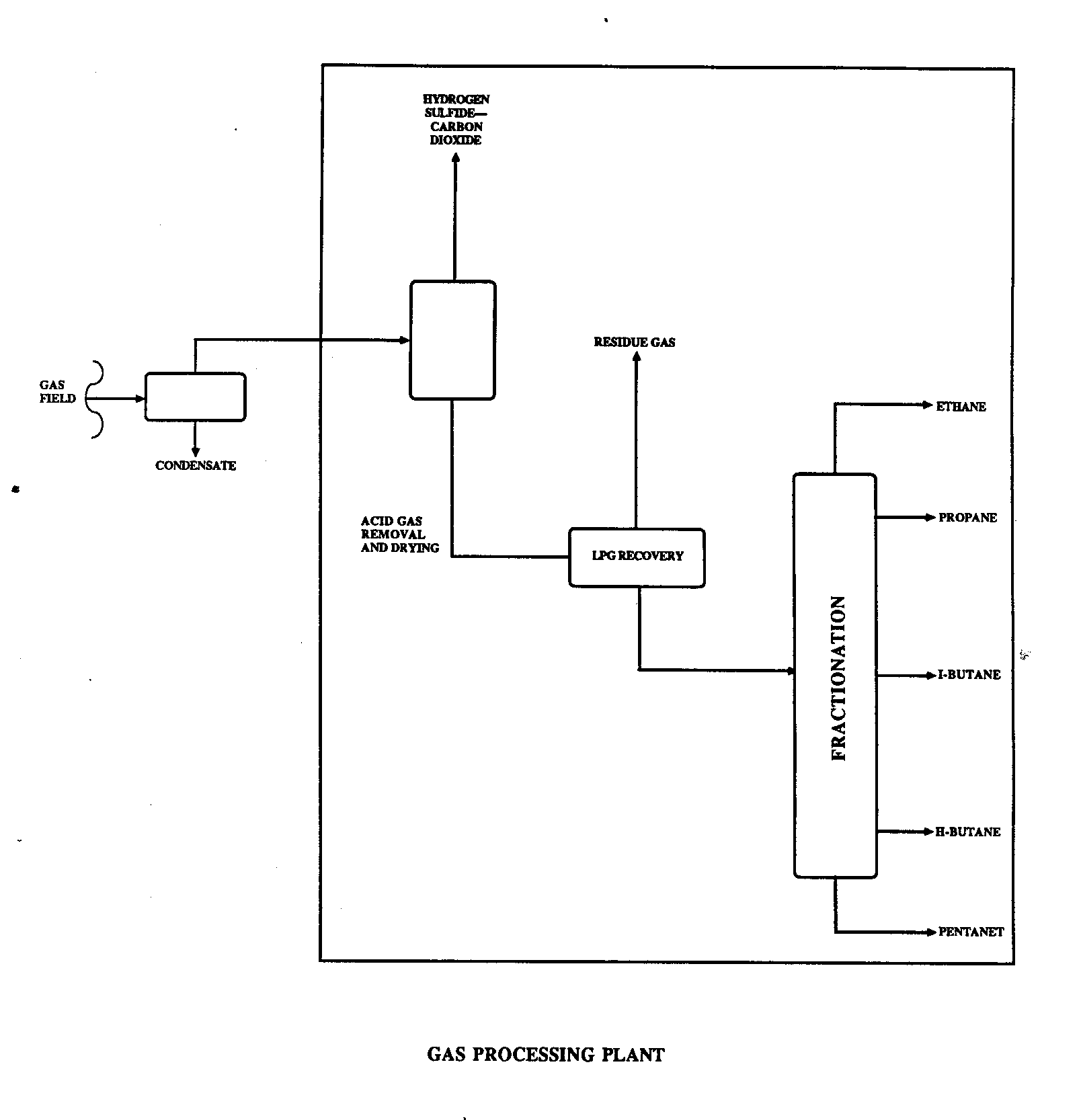
The natural gas containing the LPG is first treated to
remove the acid gases: hydrogen sulfide, carbon dioxide, and
carbonyl sulfide. The gas is then sent through a process to
remove the water content. Very low water contents are required
for cryogenic processes.
The next part of the process is LPG recovery, which includes
absorption (refrigerated absorption), turbo-expander (cascade
refrigeration), adsorption, and compression.
The final section of an LPG plant is the fractionation facility.
The products to be produced and their purity will determine the
size of this facility. For example, if n-butane is to be produced
as a specialty, polymerization grade solvent, extensive fractionation,
and adsorption processes may be required.
The final section of an LPG plant is the fractionation facility. The products to be produced
and their purity will determine the size of this facility. For example, if n-butane is to be
produced as a specialty, polymerization grade solvent, extensive fractionation, and
absorption processes may be required.
REFERENCES
Unless otherwise stated, these addresses are in the United
States.
1. Technical Manuals & Textbooks
Adams, J.L. and Boyer, W.C., What Makes a Good NGL Unit? Vol. 60,
No. 5, Hydrocarbon Processing, May 1981, pp. 108-112.
Crum, F.S., Use J-T Plants for LPG Recovery (Joule-Thompson
Adiabatic Expansion - Alternate to Expander and Refrigeration),
Vol. 160, No. 5, Hydrocarbon Processing, May 1981, pp. 113-117.
Kaura, M. L., Plot Plans Must Include Safety, Vol. 59, No. 7,
Hydrocarbon Processing, July 1980, pp. 183-194.
Kensell, W.W., How to Pick a Treating Plant, Vol. 58, No. 8,
Hydrocarbon Processing, August 1979, pp. 143-145.
Encyclopedia of Chemical Technology, Vol. 14, 3rd. Edition, John
Wiley and Sons, New York, 1981.
Engineering Data Book, Ninth Edition, Gas Processor Supplier's
Association, Tulsa, Oklahoma, 1972.
Liquefied Petroleum Gas Specifications and Test Methods, Gas
Processor Association, GPA Publ. 2140-75, Tulsa, Oklahoma.
ASTM Standard D 1835-76, Part 24, American Society for Testing
and Materials, Philadelphia, Pennsylvania, 1978.
Storage and Handling of Liquefied Petroleum Gases, National Fire
Protection Association, NFPA 58, Boston, Massachusetts, 1979.
Design and Construction of LP-Gas Installations at Marine
Terminals, Natural Gas Processing Plants, Refineries and Tank
Farms, API Standard 2510., 4th Edition, American Petroleum
Institute, Washington, D.C., December, 1978.
LP Gas Market Facts, National LP-Gas Association, Oak Brook,
Illinois, 1977.
Process Economics Program Report No. 135, Oct. 1979, SRI International,
Menlo Park, California 94025. This report includes plant
designs for turbo-expander, cascade refrigeration, and refrigerated
absorption.
2. Periodicals
Oil and Gas Journal
1301 W. 22nd Street
Oak Brook, Illinois 60521 USA
Weekly Propane Newsletter
P.O. Box 5000, Suite 331
Delmar, California 92014 USA
3. Trade Associations
National LP-Gas Association
1301 W. 22nd Street
Oak Brook, Illinois 60521 USA
National Petroleum Refiners Association
1899 L Street, NW
Washington, D.C. 20036 USA
4. Equipment Suppliers, Engineering Companies
AMETEK
Heat Transfer Division
P. 0. Box 534004
Grand Prairie, Texas 75053 USA
Eastern Tank Fabricators, Inc.
74 Plandome Road
Manhasset, New York 11030 USA
Atlas Copco Comptec, Inc.
Department A
20 School Road
Voorheesville, New York 12186 USA
5. Directories
Thomas Register
Thomas Publishing Company
One Penn Plaza
New York, New York 10001 USA
6. VITA Venture Services
VITA Venture Services, a subsidiary of VITA, provides commercial
services for industrial development. This fee-for-service
includes technology and financial information, technical assistance,
marketing, and joint ventures. For further information,
contact VITA.
`INDUSTRY PROFILE SERIES'
VITA is pleased to present this series of industrial profiles.
These Profiles provide basic information for starting manufacturing
plants in developing nations. Specifically, they provide general
plant description, financial, and technical factors for their
operation, and sources of information and expertise. Dollar values
are listed only for machinery and equipment costs, and are
primarily based on equipment in the United States. The price does
not include shipping costs or import-export taxes, which must be
considered and will vary greatly from country to country. No other
investment costs are included (such as land value, building rental,
labor, etc.) as those prices also vary.
The series is intended to be useful in determining whether the
industries described warrant further inquiry either to rule out or
to decide upon investment. The underlying assumption of these
Profiles is that the individual making use of them already has some
knowledge and experience in industrial development.
These profiles should not be substituted for feasibility studies.
Before an investment is made in a plant, a feasibility study should
be conducted. Each profile contains a list of questions to which
answers must be obtained before proceeding with implementation of
an industrial project.
All profiles are available in English only. They are priced at
$9.95 each. You may take advantage of the introductory offer and
order any three Profiles for just $25.00 or order the entire set of
nineteen Profiles for a bargain price of only $150.00.
BAKED, LEAVENED BREADS
Richard J. Bess
Describes a small bakery operating with a single shift and
producing 100 tons of baked products a year. It also describes a
medium-sized plant operating on the same basis but producing 250
tons of baked goods a year.
(IP #19) 6pp.
BLUE JEANS
Edward Hochberg
Describes one plant operating with one shift and making 15, 000
dozens of blue jeans a year, and another that produces 22,000
dozens a year.
(IP #6) 8pp.
DIMENSION HARDWOOD
Nicolas Engalichev
Describes a medium-sized mill operating with one shift that
produces 4,500 cubic meters of dimension hardwood per year. Some
information is also provided for a mill twice as large.
(IP #16) 8pp.
FISH OIL AND FISH MEAL
S. Divakaran
Describes two plants. The first is a 20-ton per day plant operating
with an eight-hour shift and producing 8,000 tons of fish meal and
4,000 tons of fish oil a year. The second is a 40-ton plant
operating an eight-hour shift and producing 8,000 tons of fish oil
and 16,000 tons of meal per year.
(IP # 8) 8pp.
GLASS CONTAINERS (BATCH PROCESS)
William B. Hillig
Describes small batch production plants with a work force of 10 to
50 people that produce 500 to 25,000 containers per day.
(IP #18) 8pp.
GLUCOSE FROM CASSAVA STARCH
Peter K. Carrell
Describes a plant that can operate 250 days a year on a three-shift
continuous basis and produce 2,500 tons of glucose syrup.
(IP #17) 8pp.
LIQUID PETROLEUM GAS
Jon I. Voltz
Describes two plants, operating with three shifts for 52 weeks per
year. The smaller has an annual manufacturing capacity of 2,220,000
barrels; the larger plant has an annual capacity of 4,440,000
barrels.
(IP #12) 8pp.
MEN'S DRESS SHIRTS
Edward Hochberg
Describes one small plant operating with one shift and manufacturing
15,000 dozen men's dress shirts a year. It also describes a
larger plant running a single shift and manufacturing 22,000 dozen
shirts a year.
(IP #13) 8pp.
MEN'S WASH AND WEAR PANTS
Edward Hochberg
Describes one plant operating with one shift and producing 15,000
dozens pairs of pants a year, and another that produces 22,000
dozens a year.
(IP # 4) 8pp.
MEN'S WASH AND WEAR SHIRTS
Edward Hochberg
Describes a plant operating with one shift, manufacturing 15,000
dozen men's wash and wear shirts a year, and another that manufactures
22,000 dozen shirts a year.
(IP # 5) 7pp.
MEN'S WORK SHIRTS
Edward Hochberg
Describes one plant operating with one shift and manufacturing
15,000 dozen men's shirts a year. It also describes a larger plant
running a single shift and producing 22,000 dozen shirts a year.
(IP # 2) 8pp.
PAINT MANUFACTURING
Philip Heiberger
Describes a small plant that will serve local needs, mainly in the
trade-sales sector. Its output may exceed 4,000 liters per week
(L/wk).
(IP #14) 10pp.
PORTABLE METALLIC STOVE
Andre Charette
Describes a facility that accommodates two workers, a work table,
and storage of materials and products. The hammer and chisel method
permits production of five stoves daily. The tooling-aids permits
production of up to 25 units daily.
(IP #10) 9pp.
PORTLAND CEMENT
Dave F. Smith & Alfred Bush
Describes a small plant producing 35,000 metric tons of cement a
year.
(IP # 9) 10pp.
ROUGH-SAWN LOGS
Nicolas Engalichev
Describes plants (sawmills) operating with one shift that can
produce 10,000 and 30,000 cubic meters (cu m) of product per year.
(IP #15) 8pp.
SMALL CERAMICS PLANT
Victor R. Palmeri
Describes a small plant operating with one shift and producing
16,000 pieces a year. It also describes a medium-sized plant
running a single shift producing about 80,000 units a year.
(IP #11) 8pp.
STARCH, OIL, AND FEED FROM SORGHUM GRAIN
Peter K. Carrell
Describes a small plant operating with three shifts on a seven-day
work schedule and processing about 200 tons of sorghum a day. Two
shifts are down per week for maintenance. This facility may be
considered a heavy industry because of the emission from the boiler
and dryers and the noise from its high speed machinery.
(IP # 1) 8pp.
UNFERMENTED GRAPE JUICE
George Rubin
Describes a plant operating with one shift and producing 125,000
gallons of grape juice a year, and another that produces 260,000
gallons a year.
(IP # 7) 8pp.
WOMEN'S BROADCLOTH DRESSES
Edward Hochberg
Describes a plant operating with one shift and manufacturing 72,000
women's dresses a year (1,440/week, 288/day). It also describes a
larger plant-running a single-shift and producing
104,000 dresses a year.
(IP # 3) 8pp.
========================================
========================================
LIQUEFIED
PETROLEUM GAS
Prepared By
Jon I. Voltz
Reviewed By
Glenn H. Dale
John P. Hyde
Published By
VITA
1600 Wilson Boulevard, Suite 500
Arlington, Virginia 22209 USA
Tel: 703/276-1800 . Fax: 703/243-1865
Internet: pr-info@vita.org
Liquid Petroleum Gas
ISBN: 0-86619-297-2
[C]1988, Volunteers in Technical Assistance
INDUSTRY PROFILES
Introduction
This Industry Profile is one of a series briefly describing small or medium-sized industries. The
Profiles provide basic information for starting manufacturing plants in developing nations.
Specifically, they provide general plant descriptions, financial, and technical factors for their
operation, and sources of information and expertise. The series is intended to be useful in
determining whether the industries described warrant further inquiry either to rule out or to
decide upon investment. The underlying assumption of these Profiles is that the individual
making use of them already has some knowledge and experience in industrial development.
Dollar values are listed only for machinery and equipment costs, and are primarily based on
equipment in the United States. The price does not include shipping costs or import-export taxes,
which must be considered and will vary greatly from country to country. No other investment
costs are included (such as land value, building rental, labor, etc.) as those prices also vary.
These items are mentioned to provide the investor with a general checklist of considerations for
setting up a business.
IMPORTANT
These profiles should not be substituted for feasibility studies. Before an investment is made in
a plant, a feasibility study should be conducted. This may require skilled economic and
engineering expertise. The following illustrates the range of questions to which answers must
be obtained:
* What is the extent of the present demand for the product, and how is it now being
satisfied?
* Will the estimated price and quality of the product make it competitive?
* What is the marketing and distribution plan and to whom will the product be
sold?
* How will the plant be financed?
* Has a realistic time schedule for construction, equipment, delivery, obtaining
materials and supplies, training of personnel, and the start-up time for the plant
been developed?
* How are needed materials and supplies to be procured and machinery and
equipment to be maintained and repaired?
* Are trained personnel available?
* Do adequate transportation, storage, power, communication, fuel, water, and
other facilities exist?
* What management controls for design, production, quality control, and other
factors have been included?
* Will the industry complement or interfere with development plans for the area?
* What social, cultural, environmental, and technological considerations must be
addressed regarding manufacture and use of this product?
Fully documented information responding to these and many other questions should be
determined before proceeding with implementation of an industrial project.
Equipment Suppliers, Engineering Companies
The services of professional engineers are desirable in the design of industrial plants even though
the proposed plant may be small. A correct design is one that provides the greatest economy in
the investment of funds and establishes the basis of operation that will be most profitable in the
beginning and will also be capable of expansion without expensive alteration.
Professional engineers who specialize in industrial design can be found be referring to the
published cards in various engineering magazines. They may also be reached through their
national organizations.
Manufacturers of industrial equipment employ engineers familiar with the design and installation
of their specialized products. These manufacturers are usually willing to give prospective
customers the benefit of technical advice by those engineers in determining the suitability of their
equipment in any proposed project.
VITA
Volunteers in Technical Assistance (VITA) is a private, non-profit, volunteer organization
engaged in international development. Through its varied activities and services, VITA fosters
self-sufficiency by promoting increased economic productivity. Supported by a volunteer roster
of over 5,000 experts in a wide variety of fields, VITA is able to provide high quality technical
information to requesters. This information is increasingly conveyed through low-cost advanced
communication technologies, including terrestrial packet radio and low-earth-orbiting satellite.
VITA also implements both long- and short-term projects to promote enterprise development and
transfer technology.
LIQUEFIED PETROLEUM GAS
PREPARED BY: Jon I. Voltz
REVIEWED BY: John P. Hyde
Glenn H. Dale
PRODUCT DESCRIPTION
1. The Product
Liquefied petroleum gas (LPG) is a class of petroleum products
produced from natural gas or as a by-product from refined crude
oil. Types of LPG available in the United States and elsewhere
are commercial grade propane, butane, butane-propane mixed, and
HD-5 (a propane for engine fuel).
2. The Facility
This profile describes two plants, operating with three shifts
for 52 weeks per year. The smaller has an annual manufacturing
capacity of 2,220,000 barrels; the larger has an annual capacity
of 4,440,000 barrels.
The methods of LPG recovery fall into four general classifications:
(1) absorption, (2) absorption plus turbo-expander, (3)
adsorption, and (4) compression. Absorption uses liquid such as
naphtha or kerosene to recover LPG from gas. The rate of recovery
can be increased by reducing the temperature. As a result, oil
absorption plants often use refrigeration in the process.
LPG is distilled from the absorption oil by heating the oil. It
is possible to recover virtually 100 percent of the propane and
butane by maintaining a temperature of -40[degrees]C and by controlling
the oil rate. The recovered LPG is fractionated into separate
components such as propane and butane and must be further
purified to remove hydrogen sulfide, organic sulfur compounds,
and water in order to meet specifications. Among the purification
processes are: amine and caustic treatment, solid bed dehydration,
and molecular sieve absorption.
Absorption is used in both lean recovery (recovery of gases low
in LPG content, such as propane) and heavier recovery. An oil
absorption plant is relatively easy to operate and maintain, but
it requires more energy than the turbo-expander process.
The turbo-expander process recovers propane and butane by a
combination of compression and refrigeration, followed by expansion
of the gas through a turbine. When the gas expands, it cools
to about -100[degrees]C. The turbo-expander process is used when it is
desirable to recover ethane. The process requires less energy but
more skill to maintain and operate than the absorption process.
The absorption and turbo-expander processes are the two most
practical commercial ways of recovering LPG, and are used in this
profile.
GENERAL EVALUATION
The success of this industry depends to a great extent on the
availability of natural gas. Marketwise, the sales potential for
LPG should be good, particularly in areas or homes where natural
gas by direct pipeline or other cheaper fuels are not available
locally. The fixed capital requirements are fairly moderate in
comparison with the annual estimated profits, and only one
skilled worker is needed.
1. Outlook
A. Economic
The economics is good if the natural gas from which much of LPG
is manufactured is higher in the components of LPG. However,
available natural gas is becoming leaner in ethane and heavier
products. Rich gas is defined as containing more than 5.0 gallons
of LPG components plus/1000 cu. ft. per day of produced gas.
B. Technical
Most developments in LPG plants are in the acid gas removal and
water removal section of the plants.
2. Manufacturing Equipment Flexibility
Most plants can produce butane and propane, but the plants may
not have adequate equipment to produce the purity required or to
obtain the necessary recoveries.
3. Knowledge Base
The following information is required: The estimated production
rate of the field over a period of years, the components of the
gas with time, the hydrogen sulfide and carbon dioxide content,
nitrogen content and the field pressure. For plant design, a
knowledge of thermodynamics is required.
4. Quality Control
Chromatographic analysis, a technique used to identify and
separate LPG from the gas stream, is very important. It is also
used to test for and remove impurities from the LPG as well as
fractionate the recovered LPG into its separate components.
5. Constraints and Limitations
Ethane, propane, and butane are commodities used for fuel and
chemical manufacturing. Seasonal changes in demand may occur. The
products are explosive and most products for fuels contain odorants
for detection. Plants must remove and handle the hazardous
hydrogen sulfide with care.
MARKET ASPECTS
1. Users
LPG is used in homes, restaurants, hotels, etc. (mostly as
utility gas), industrial plants, refineries, chemical manufacturing,
and as engine fuel.
2. Suppliers
The source of LPG is about 2/3 from natural gas (mostly ethane
and butane) and 1/3 from refineries.
3. Sales Channels and Methods
The product is sold in bulk to distributors for sale to ultimate
users. consumers include homes, restaurants, hotels, trailers,
camps, boats, farms, and industrial plants.
4. Geographic Extent of Market
Production capacity may limit this product to domestic consumption,
but the possibility exists for export. (The U.S. LPG
Industry exports about 500 million gallons a year. In 1986 the
industry exported to 47 countries, with Mexico getting the most.)
5. Competition
Sales of LPG are competitive where piped natural gas, wood for
fuel, or other cheaper fuels are not readily available.
6. Market Capacity
An accurate estimate of market potential cannot be made unless a
comprehensive survey of sales potential is undertaken, because so
many variable factors come into play.
PRODUCTION AND PLANT REQUIREMENTS
Requirements Annual Output:
Barrels
2,220,000 4,440,000
1. Infrastructure, Utilities Small Plant Medium Plant
Plant size (cu. ft. per day) 50,000,000 100,000,000
Utilities
Investment Equipment
Materials
Labor
2. Major Equipment & Machinery Small Plant Medium Plant
(units)
Tools & Machinery
towers 3
accumulator tanks 3
vent tank
lean oil tank
surge tank
heat exchangers 2
condensers 2
coolers 3
recompressor
pumps 4
steam generator
water cooler
piping and valves
Support equipment & parts
pickup truck
(*) TOTAL ESTIMATED COST
of equipment & machinery $25,000,000 $40,000,000
completely installed
(*) Cost of major equipment only would be about 40 percent of the
above.
(*) Based on $US 1987 prices. The costs provided are estimates and
are given only to provide a general idea for machinery costs.
They are not intended to be used as absolute prices. Costs still
need to be determined on a case by case basis. In addition, the
costs are for production grade purities only and do not include
costs for extra purification systems.
3. Materials & Supplies Small Plant Medium Plant
Raw Materials
natural gas (cu. ft. 18,250 36,500
Supplies
lubricants & hand tools
absorber oil
maintenance & spare parts
office supplies
gas, oil & truck maintenance
Packaging
Normally not much done. Perhaps
a small amount in steel cylinders.
4. Labor Small Plant Medium Plant
Skilled 2/shift
Semiskilled 2/shift
Unskilled 2
Indirect
supervisor/manager 1
chemist 1
office 1
truck driver 1
PROCESS DESCRIPTION
The diagram below shows a generalized flow scheme for LPG recovery.
lpgx6.gif (540x540)
The natural gas containing the LPG is first treated to
remove the acid gases: hydrogen sulfide, carbon dioxide, and
carbonyl sulfide. The gas is then sent through a process to
remove the water content. Very low water contents are required
for cryogenic processes.
The next part of the process is LPG recovery, which includes
absorption (refrigerated absorption), turbo-expander (cascade
refrigeration), adsorption, and compression.
The final section of an LPG plant is the fractionation facility.
The products to be produced and their purity will determine the
size of this facility. For example, if n-butane is to be produced
as a specialty, polymerization grade solvent, extensive fractionation,
and adsorption processes may be required.
The final section of an LPG plant is the fractionation facility. The products to be produced
and their purity will determine the size of this facility. For example, if n-butane is to be
produced as a specialty, polymerization grade solvent, extensive fractionation, and
absorption processes may be required.
REFERENCES
Unless otherwise stated, these addresses are in the United
States.
1. Technical Manuals & Textbooks
Adams, J.L. and Boyer, W.C., What Makes a Good NGL Unit? Vol. 60,
No. 5, Hydrocarbon Processing, May 1981, pp. 108-112.
Crum, F.S., Use J-T Plants for LPG Recovery (Joule-Thompson
Adiabatic Expansion - Alternate to Expander and Refrigeration),
Vol. 160, No. 5, Hydrocarbon Processing, May 1981, pp. 113-117.
Kaura, M. L., Plot Plans Must Include Safety, Vol. 59, No. 7,
Hydrocarbon Processing, July 1980, pp. 183-194.
Kensell, W.W., How to Pick a Treating Plant, Vol. 58, No. 8,
Hydrocarbon Processing, August 1979, pp. 143-145.
Encyclopedia of Chemical Technology, Vol. 14, 3rd. Edition, John
Wiley and Sons, New York, 1981.
Engineering Data Book, Ninth Edition, Gas Processor Supplier's
Association, Tulsa, Oklahoma, 1972.
Liquefied Petroleum Gas Specifications and Test Methods, Gas
Processor Association, GPA Publ. 2140-75, Tulsa, Oklahoma.
ASTM Standard D 1835-76, Part 24, American Society for Testing
and Materials, Philadelphia, Pennsylvania, 1978.
Storage and Handling of Liquefied Petroleum Gases, National Fire
Protection Association, NFPA 58, Boston, Massachusetts, 1979.
Design and Construction of LP-Gas Installations at Marine
Terminals, Natural Gas Processing Plants, Refineries and Tank
Farms, API Standard 2510., 4th Edition, American Petroleum
Institute, Washington, D.C., December, 1978.
LP Gas Market Facts, National LP-Gas Association, Oak Brook,
Illinois, 1977.
Process Economics Program Report No. 135, Oct. 1979, SRI International,
Menlo Park, California 94025. This report includes plant
designs for turbo-expander, cascade refrigeration, and refrigerated
absorption.
2. Periodicals
Oil and Gas Journal
1301 W. 22nd Street
Oak Brook, Illinois 60521 USA
Weekly Propane Newsletter
P.O. Box 5000, Suite 331
Delmar, California 92014 USA
3. Trade Associations
National LP-Gas Association
1301 W. 22nd Street
Oak Brook, Illinois 60521 USA
National Petroleum Refiners Association
1899 L Street, NW
Washington, D.C. 20036 USA
4. Equipment Suppliers, Engineering Companies
AMETEK
Heat Transfer Division
P. 0. Box 534004
Grand Prairie, Texas 75053 USA
Eastern Tank Fabricators, Inc.
74 Plandome Road
Manhasset, New York 11030 USA
Atlas Copco Comptec, Inc.
Department A
20 School Road
Voorheesville, New York 12186 USA
5. Directories
Thomas Register
Thomas Publishing Company
One Penn Plaza
New York, New York 10001 USA
6. VITA Venture Services
VITA Venture Services, a subsidiary of VITA, provides commercial
services for industrial development. This fee-for-service
includes technology and financial information, technical assistance,
marketing, and joint ventures. For further information,
contact VITA.
`INDUSTRY PROFILE SERIES'
VITA is pleased to present this series of industrial profiles.
These Profiles provide basic information for starting manufacturing
plants in developing nations. Specifically, they provide general
plant description, financial, and technical factors for their
operation, and sources of information and expertise. Dollar values
are listed only for machinery and equipment costs, and are
primarily based on equipment in the United States. The price does
not include shipping costs or import-export taxes, which must be
considered and will vary greatly from country to country. No other
investment costs are included (such as land value, building rental,
labor, etc.) as those prices also vary.
The series is intended to be useful in determining whether the
industries described warrant further inquiry either to rule out or
to decide upon investment. The underlying assumption of these
Profiles is that the individual making use of them already has some
knowledge and experience in industrial development.
These profiles should not be substituted for feasibility studies.
Before an investment is made in a plant, a feasibility study should
be conducted. Each profile contains a list of questions to which
answers must be obtained before proceeding with implementation of
an industrial project.
All profiles are available in English only. They are priced at
$9.95 each. You may take advantage of the introductory offer and
order any three Profiles for just $25.00 or order the entire set of
nineteen Profiles for a bargain price of only $150.00.
BAKED, LEAVENED BREADS
Richard J. Bess
Describes a small bakery operating with a single shift and
producing 100 tons of baked products a year. It also describes a
medium-sized plant operating on the same basis but producing 250
tons of baked goods a year.
(IP #19) 6pp.
BLUE JEANS
Edward Hochberg
Describes one plant operating with one shift and making 15, 000
dozens of blue jeans a year, and another that produces 22,000
dozens a year.
(IP #6) 8pp.
DIMENSION HARDWOOD
Nicolas Engalichev
Describes a medium-sized mill operating with one shift that
produces 4,500 cubic meters of dimension hardwood per year. Some
information is also provided for a mill twice as large.
(IP #16) 8pp.
FISH OIL AND FISH MEAL
S. Divakaran
Describes two plants. The first is a 20-ton per day plant operating
with an eight-hour shift and producing 8,000 tons of fish meal and
4,000 tons of fish oil a year. The second is a 40-ton plant
operating an eight-hour shift and producing 8,000 tons of fish oil
and 16,000 tons of meal per year.
(IP # 8) 8pp.
GLASS CONTAINERS (BATCH PROCESS)
William B. Hillig
Describes small batch production plants with a work force of 10 to
50 people that produce 500 to 25,000 containers per day.
(IP #18) 8pp.
GLUCOSE FROM CASSAVA STARCH
Peter K. Carrell
Describes a plant that can operate 250 days a year on a three-shift
continuous basis and produce 2,500 tons of glucose syrup.
(IP #17) 8pp.
LIQUID PETROLEUM GAS
Jon I. Voltz
Describes two plants, operating with three shifts for 52 weeks per
year. The smaller has an annual manufacturing capacity of 2,220,000
barrels; the larger plant has an annual capacity of 4,440,000
barrels.
(IP #12) 8pp.
MEN'S DRESS SHIRTS
Edward Hochberg
Describes one small plant operating with one shift and manufacturing
15,000 dozen men's dress shirts a year. It also describes a
larger plant running a single shift and manufacturing 22,000 dozen
shirts a year.
(IP #13) 8pp.
MEN'S WASH AND WEAR PANTS
Edward Hochberg
Describes one plant operating with one shift and producing 15,000
dozens pairs of pants a year, and another that produces 22,000
dozens a year.
(IP # 4) 8pp.
MEN'S WASH AND WEAR SHIRTS
Edward Hochberg
Describes a plant operating with one shift, manufacturing 15,000
dozen men's wash and wear shirts a year, and another that manufactures
22,000 dozen shirts a year.
(IP # 5) 7pp.
MEN'S WORK SHIRTS
Edward Hochberg
Describes one plant operating with one shift and manufacturing
15,000 dozen men's shirts a year. It also describes a larger plant
running a single shift and producing 22,000 dozen shirts a year.
(IP # 2) 8pp.
PAINT MANUFACTURING
Philip Heiberger
Describes a small plant that will serve local needs, mainly in the
trade-sales sector. Its output may exceed 4,000 liters per week
(L/wk).
(IP #14) 10pp.
PORTABLE METALLIC STOVE
Andre Charette
Describes a facility that accommodates two workers, a work table,
and storage of materials and products. The hammer and chisel method
permits production of five stoves daily. The tooling-aids permits
production of up to 25 units daily.
(IP #10) 9pp.
PORTLAND CEMENT
Dave F. Smith & Alfred Bush
Describes a small plant producing 35,000 metric tons of cement a
year.
(IP # 9) 10pp.
ROUGH-SAWN LOGS
Nicolas Engalichev
Describes plants (sawmills) operating with one shift that can
produce 10,000 and 30,000 cubic meters (cu m) of product per year.
(IP #15) 8pp.
SMALL CERAMICS PLANT
Victor R. Palmeri
Describes a small plant operating with one shift and producing
16,000 pieces a year. It also describes a medium-sized plant
running a single shift producing about 80,000 units a year.
(IP #11) 8pp.
STARCH, OIL, AND FEED FROM SORGHUM GRAIN
Peter K. Carrell
Describes a small plant operating with three shifts on a seven-day
work schedule and processing about 200 tons of sorghum a day. Two
shifts are down per week for maintenance. This facility may be
considered a heavy industry because of the emission from the boiler
and dryers and the noise from its high speed machinery.
(IP # 1) 8pp.
UNFERMENTED GRAPE JUICE
George Rubin
Describes a plant operating with one shift and producing 125,000
gallons of grape juice a year, and another that produces 260,000
gallons a year.
(IP # 7) 8pp.
WOMEN'S BROADCLOTH DRESSES
Edward Hochberg
Describes a plant operating with one shift and manufacturing 72,000
women's dresses a year (1,440/week, 288/day). It also describes a
larger plant-running a single-shift and producing
104,000 dresses a year.
(IP # 3) 8pp.
========================================
========================================