SOLAR WATER HEATER
A VITA publication
ABOUT VITA
Volunteers in Technical Assistance (VITA) is a private, non-profit,
international development organization. VITA makes
available to individuals and groups in developing countries a
variety of information and technical resources aimed at fostering
self sufficiency--needs assessment and program development
support, by-mail and on-site consulting services;
information systems training; and management of long-term
field projects. VITA promotes the application of simple,
inexpensive technologies to solve problems and create opportunities
in developing countries.
VITA places special emphasis on the areas of agriculture and
food processing, renewable energy applications, water supply
and sanitation, housing and construction, and small business
development. VITA's activities are facilitated by the active
involvement of VITA Volunteer technical experts from around
the world and by its documentation center containing specialized
technical material of interest to people in developing
countries.
VITA
VOLUNTEERS
IN TECHNICAL
ASSISTANCE
ISBN 0-86619-025-2
Solar Water Heater
Published by
VITA
1600 Wilson Boulevard, Suite 500
Arlington, Virginia 22209 USA
Tel: 703/276-1800 . Fax: 703/243-1865
Internet: pr-info@vita.org
SOLAR WATER HEATER
I. WHAT IT IS AND HOW IT IS USEFUL
II. DECISION FACTORS
Applications
Advantages
Considerations
Cost Estimate
III. MAKING THE DECISION AND FOLLOWING THROUGH
IV. PRE-CONSTRUCTION DECISIONS
The Process
The Thermosyphon Principle
The Thermosyphon Principle at Work
Deciding Quantity
Site Selection
V. CONSTRUCTION NEEDS
Tools
Materials
VI. CONSTRUCTION
The Collector--Flat Galvanized Metal Sheets
The Collector--Corrugated Metal Sheets
Make the Storage Tank
Make the Collector Stand and Storage Platform
Connect the Tank and Collector
VII. OPERATION AND MAINTENANCE
VIII. CONVERSION TABLES
IX. DICTIONARY OF TERMS
X. FURTHER
APPENDIX I. DECISION MAKING WORKSHEET
APPENDIX II. RECORD KEEPING WORKSHEET
Solar Water Heater
I. WHAT IT IS AND HOW IT IS USEFUL
Hot water is not always necessary, and in warm climates it may
be relatively easy to do without. It is, however, more
effective than cold water for many purposes. Even so, in some
areas hot water is not used because fuel is so expensive it is
used only for essential tasks. A solar heater can supply needed
hot water without using up available fuel.
Solar water heaters represent one of the easiest, most
practical applications of solar energy on an individual and
small-scale basis.
Heat from the sun's rays is easily captured. Black-painted
surfaces exposed to the sun will get hotter than those of any
other color. A metal surface painted flat black and placed in
contact with water will heat the water. The black metal plate
is called an absorber.
Once the water is heated, it is kept hot with insulation. The
heated water behind the absorber can be insulated with a
variety of substances such as fiberglass, straw, sawdust, hair,
or polyurethane foam. In some absorber designs a sheet of glass
is placed between the absorber plate and the sun. Glass
transmits the high radiation from the sun that heats the water,
but stops the low-energy infrared radiation that is reradiated
from the hot absorber. It also keeps air from passing over the
absorber causing heat loss. The reduction of the two forms of
heat loss makes glass an ideal insulator. Clear plastics can be
used but their life expectancy is limited.
The solar water heater presented here (see Figure 1 ) can provide
swh1x2.gif (486x486)
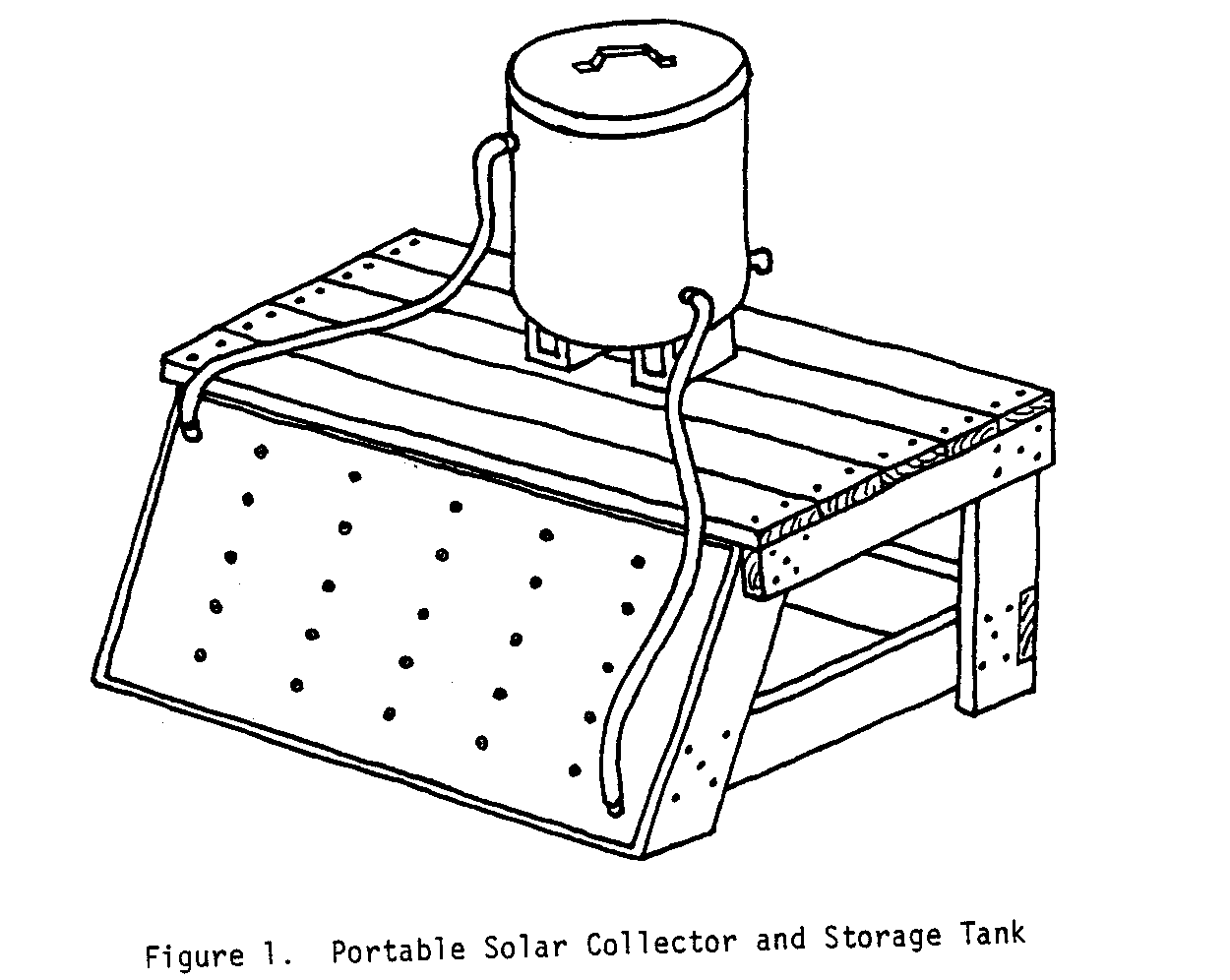
hot water the year round.
This system will heat 70 liters (18-1/2 gallons) of water to
60 [degrees]C (140 [degrees]F) between sunrise and noon on a clear day with an
average outside temperature of 32 [degrees]C (90 [degrees]F). Obviously, water
does not have to be this hot for many purposes: very hot water
can be mixed with cool water to provide water warm enough for
bathing and washing clothes and dishes. This factor should be
taken into account when estimating the amount of water needed
each day.
Building a solar water heater can be a good project for a
school class:
* The heater, assuming access to the right equipment, is not
difficult to build.
* It provides a working demonstration of the principles of
solar technology.
* Students introduced to solar technology and its potential
are familiarized with energy-conserving, non-polluting
technologies.
II. DECISION FACTORS
Applications: * Heating water.
* Washing clothes.
* Personal hygiene.
Advantages: * Easy to build and operate.
* Provides heated water 60 [degrees]C (140 [degrees]F) within
a two-hour period.
* Portable.
* No fuel costs.
Considerations: * Has to be filled manually.
* Life expectancy of two years.
* Heats water only on sunny days. Does not
operate at night.
COST ESTIMATE(*)
$30-$70 (US) including materials and labor.
__________
(*) Cost estimates serve only as a guide and will vary from
country to country.
III. MAKING THE DECISION AND FOLLOWING THROUGH
When determining whether a project is worth the time, effort,
and expense involved, consider social, cultural, and environmental
factors as well as economic ones. What is the purpose of
the effort? Who will benefit most? What will the consequences
be if the effort is successful? Or, if it fails?
Having made an informed technology choice, it is important to
keep good records. It is helpful from the beginning to keep
data on needs, site selection, resource availability, construction
progress, labor and materials costs, test findings, etc.
The information may prove an important reference if existing
plans and methods need to be altered. It can be helpful in pinpointing
"what went wrong." And, of course, it is important to
share data with other people.
The technologies presented in this series have been tested
carefully, and are actually used in many parts of the world.
However, extensive and controlled field tests have not been
conducted for many of them, even some of the most common ones.
Even though we know that these technologies work well in some
situations, it is important to gather specific information on
why they perform properly in one place and not in another.
Well documented models of field activities provide important
information for the development worker. It is obviously important
for a development worker in Colombia to have the technical
design for a kiln built and used in Senegal. But it is even
more important to have a full narrative about the kiln that
provides details on materials, labor, design changes, and so
forth. This model can provide a useful frame of reference.
A reliable bank of such field information is now growing. It
exists to help spread the word about these and other technologies,
lessening the dependence of the developing world on
expensive and finite energy resources.
A practical record keeping format can be found in Appendix II.
IV. PRE-CONSTRUCTION DECISIONS
THE PROCESS
The solar water heater presented here (see Figure 2) was
swh2x9.gif (486x486)

designed, developed, and tested in Afghanistan in the late
1960's. Since that time, this heater has been built and used by
development workers around the world.
There are two main parts to the solar water heater: (1) a heat-absorbing
collector (absorber) that is rather like an envelope
made of metal sheets; and (2) a storage tank that holds the
water for the system. The collector can be made either of flat
galvanized metal sheets or corrugated galvanized metal sheets.
Instructions are included for both types of materials.
THE THERMOSYPHON PRINCIPLE
* The tank, filled with water, is connected to the collector.
* The collector is positioned below the bottom of the tank.
* Water runs through a hose at the bottom of the tank to the
collector.
* The water is heated in the collector.
* Hotter water flows toward the top of the collector.
* Hot water is forced out of the hose at the top of the
collector into the tank by the pressure of the cooler
(heavier) water coming in from the tank.
* The hotter water stays at the top of the tank and cooler
water flows to the collector. The flow established continues
until the water is no longer being heated by the sun. For
example, at night the flow becomes stable and the hot water
remains until it is used or it cools.
THE THERMOSYPHON PRINCIPLE AT WORK
It is important to remember that the storage tank must be
located 46cm (18") or higher above the collector to enable the
thermosyphon principle to work (see Figure 3).
swh3x11.gif (486x486)

If you cannot place this water tank above the collector, a pump
will be needed to move the water from the collector to the
tank, and that will increase expenses.
DECIDING QUANTITY
The quantity of water to be heated is a primary concern. Most
Americans use, on the average, 95 liters (25 gallons) per person
per day. However, for a lifestyle which does not include a
hot shower or bath each day and an automatic clothes washer,
the quantity of water needed is much less. In many areas, 38 to
45-1/2 liters (10 to 12 gallons) per person per day is adequate.
In others, people often are required by circumstances to
"make do" with 7-12 liters (2-3 gallons) of water per day.
Water, in such areas, is so precious even in very small amounts
that whether or not it is hot is of no great importance at
all. (For these areas, a solar distillation unit might be an
important technology to introduce.)
If the water heater is needed for a small infirmary or a
school, make an estimate of the number of gallons required for
each person and for each purpose. The storage tank may need to
be made larger, depending upon this need. Collector size must
also be considered--it directly relates to the quantity of hot
water desired. A good general rule is one square meter (39-1/2"
square) of collector area for 41-1/2 liters (11 gallons) of hot
water desired. In colder climates, one square meter (39-1/2"
square) of collector area may yield only 30 liters (about 8
gallons) per square meter.
SITE SELECTION
Site conditions are important. Collectors should face directly
south. Turning a collector southeast or southwest can affect
its performance by about 20% or more. If hot water is needed by
noon, face the collector to the southeast; if hot water is more
important in late afternoon, face the collector to the
southwest (see Figure 4).
swh4x12.gif (540x540)
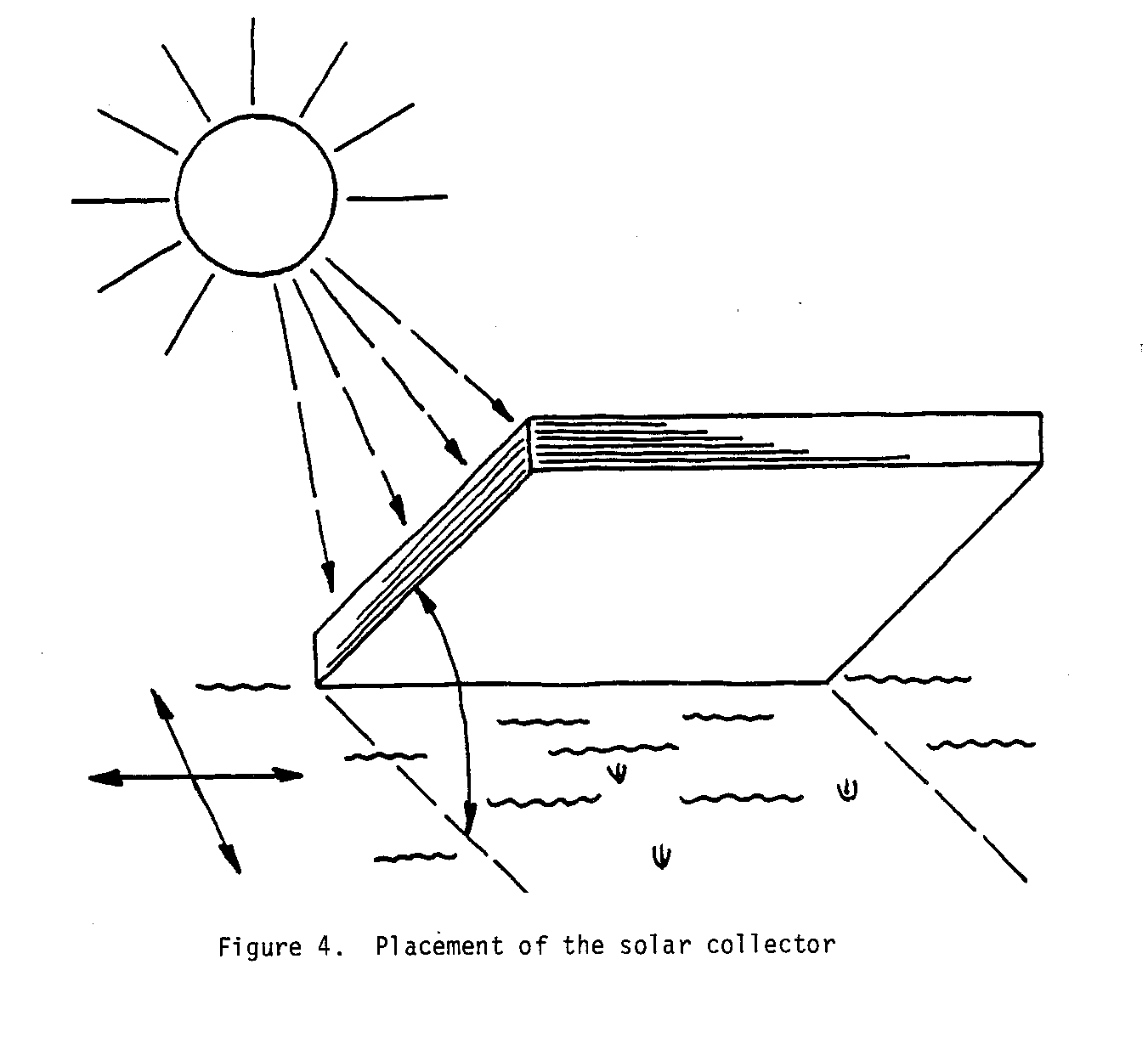
The site should be free from shade. Collectors should be placed
so that they can be tilted from the horizon to an angle equal
to the latitude of the location. (In more temperate climates
the angle should equal the latitude plus 10[degrees]. If the latitude
is unknown, the collector can be placed at a 45[degrees] angle, except
in areas near the equator). The latitude for your area can be
obtained from an atlas or globe.
V. CONSTRUCTION NEEDS
Materials and tools needed for a 90cm X 180cm (35-1/2" X 71")
absorber/collector and a 70-liter (18-1/2 gallon) storage tank
are listed below.
TOOLS
* Metalworking tools: hammer, anvil, soldering equipment,
tinsnips
* Screwdriver
* Drill and 6mm (1/4") drill bit
* Pliers or 6mm (1/4") wrench
MATERIALS
For Flat Sheet Metal Collector
* Galvanized sheet metal: 2 pieces, 90cm X 180cm (35-1/2" X
71") [absorber/collector]
* Galvanized sheet metal pipe: 2 pieces, 2.5cm diam. X 5cm long
(1" X 2")
* Galvanized stove bolts: 28, 6mm diam. X 2.5cm long (1/4" X
1")
* Metal washers: 56, to fit 6mm (1/4") bolts
* Rubber washers: 56, to fit 6mm (1/4") bolts. Inside diam.
3.5mm (1/8"); outside diam. 2cm (3/4"). These can be cut from
heavy truck tire inner tubes.
For Corrugated Metal Collector
* Corrugated metal sheet [galvanized], 122cm X 244cm (48" X
96")
* Galvanized sheet metal pipe: 2 pieces, 1.25cm diam. X 5cm
long (1/2" X 2")
* Galvanized stove bolts: 80, 6mm diam. X 2.5cm long (1/4" X
1")
* Metal washers: 160, to fit 6mm (1/4") bolts
* Rubber washers: 400, to fit 6mm (1/4") bolts. Inside diam.
3.5mm (1/8"); outside diam. 2cm (3/4")--can be cut from heavy
truck tire inner tubes
* Reducer connections: two, to connect 1.25cm (1/2") pipe to
2.5cm (1") hose
Note: Nuts, bolts, washers quantity will vary. Some sheets
have corrugations spaced more closely than others. A
metal sheet with very closely spaced corrugations will
require more fasteners. The figures given here for the
corrugated metal collector are approximate amounts.
For Either Kind of Metal Sheet
* Rubber hose: 2 pieces, 2.5cm (1") diam. [long enough to connect
collector to tank]
* Galvanized sheet metal tank:(*) 70-liter (18-1/2 gallon)
capacity with faucet, removable lid, and 2.5cm (1") hose
connectors (one placed two-thirds from the bottom and one
placed at the bottom)
* Paint: 1 liter (approximately 1 quart), flat black or
homemade mixture of linseed oil and carbon black (charcoal
powder)
* Quantity of mud bricks, straw or other suitable material (for
insulation of absorber and storage tank)
_____________
(*) The best tanks are glass-lined steel tanks or conventional
insulated water heater tanks. Obviously, these are unobtainable
in many areas. One suitable alternative is a 113.5-liter (30-gallon)
drum; it must be painted with rustproof paint or lined
with plastic. Another alternative is to have a blacksmith build
a tank for the project. In most areas, the local blacksmith's
shop would be able to put together such a tank quickly. Be sure
it is watertight.
VI. CONSTRUCTION
THE COLLECTOR--FLAT GALVANIZED METAL SHEETS
* Cut 2cm (3/4") off the length and width of one of the sheets
of galvanized steel, so that it will be 1cm (1/3") smaller
than the other sheet on all four sides (see Figure 5).
swh5x19.gif (540x540)
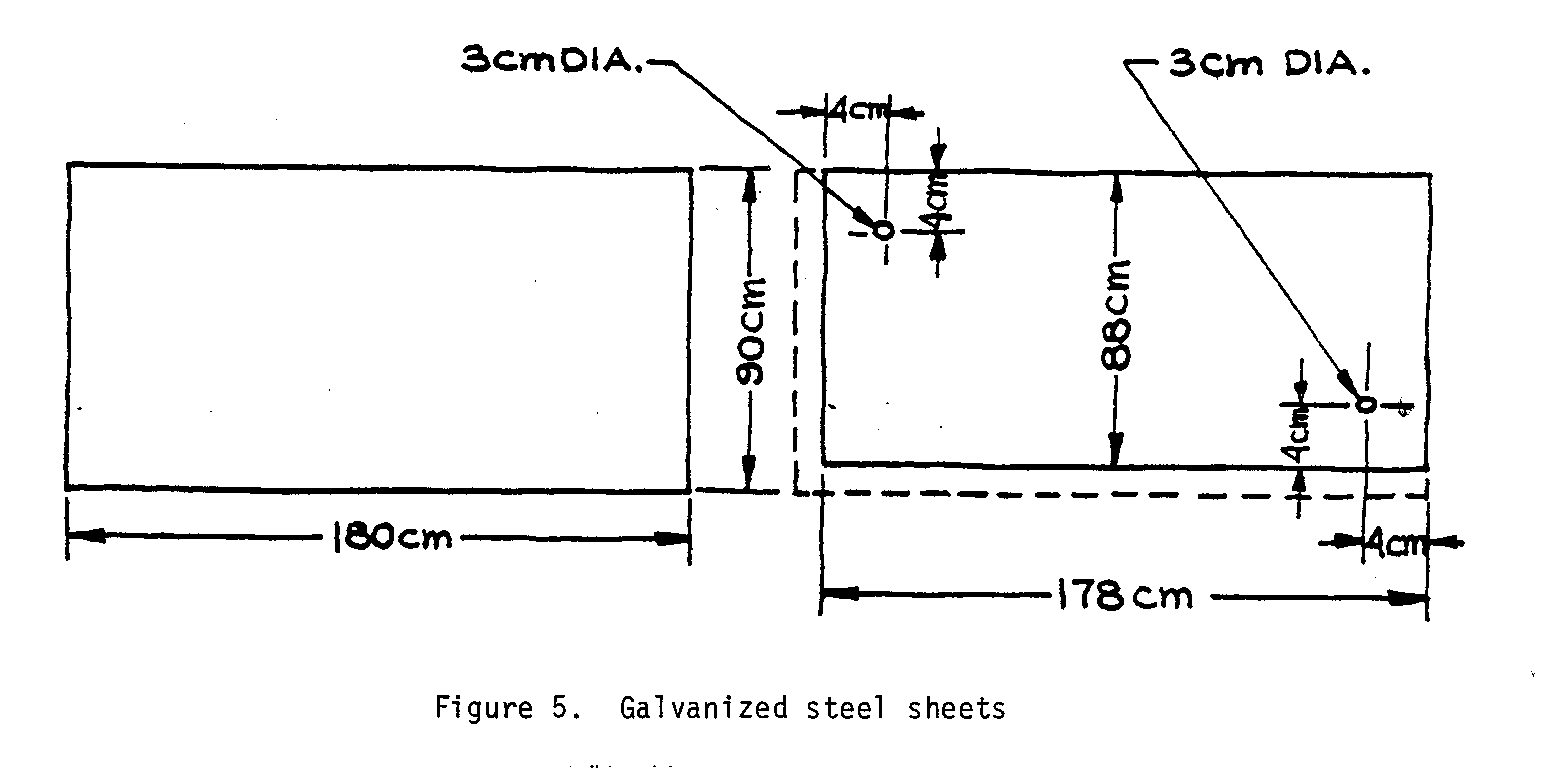
* On the smaller sheet, drill two 3cm (1-1/4") holes for the
two connectors. Drill 4cm (1-1/2") in from the edges (see
Figure 5).
* Place the two galvanized sheets together. Using a hammer and
anvil, fold the 1cm (3/8") overlapping edges (see Figure 6).
swh6x20.gif (270x540)

* Fold the edges 1cm (3/8") again and solder them to make an
airtight seal (see Figure 7).
swh7x20.gif (218x437)

* Drill holes for 6mm (1/4") bolts at regular intervals, like
buttons on a mattress (see Figure 8). Bolts will keep the
swh8x20.gif (540x540)

sheets from being forced apart when the absorber is filled
with water.
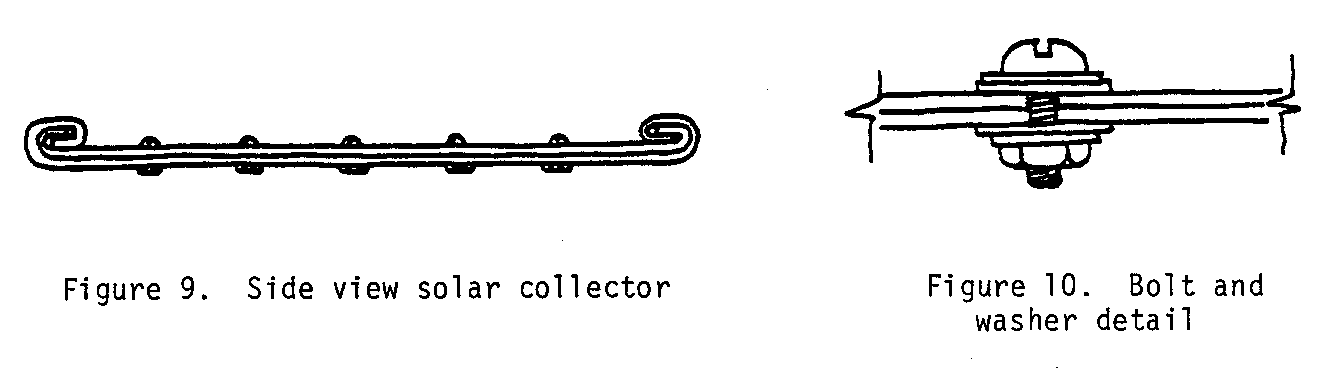
* Place bolts in holes with rubber and metal washers at each
end of the bolts to ensure a watertight seal (see Figures 9 and 10)
swh9x21.gif (270x540)
swh11x21.gif (300x600)

* Use the 2.5cm X 5cm (1" X 2") galvanized sheet metal pipe to
make the connectors. Place the pipe flush with the solar
collector sheet, covering the 3cm (1-1/4") hole. Solder the
pipe to the sheet (see Figure 11).
swh11x21.gif (540x540)
* Paint the front of the heater with black paint so that it
will absorb the sunlight rather than reflect it.
THE COLLECTOR--CORRUGATED METAL SHEETS
* Take two corrugated sheets 122cm X 244cm (48" X 96") and cut
32cm (12-1/2") off the width of both sheets and 64cm (25")
off the length of both sheets. Save the scrap metal.
* Place the two sheets together and drill 6mm (1/4") holes 25cm
(about 10") apart in alternate corrugations (raised sections),
see Figure 12.
swh12x22.gif (486x486)

* Place 6mm X 2.5cm (1/4" X 1") bolts in holes with metal
washer and rubber washer. Separate the two sheets. Place
three or four rubber washers on bottom of each bolt so that
there is approximately 6mm (1/4") space between the two
sheets (see Figure 13).
swh13x23.gif (486x486)

* Attach bolts on undersides of bottom corrugated sheet with
rubber washer, metal washer, and 6mm (1/4") nut. Tighten
until rubber washer begins to spread.
* Cut scrap corrugated sheet into strips to fit corrugations on
each edge of the collector. Bend outside edges over as shown
in Figure 14. This should seal the entire edge when complete.
swh14x24.gif (486x486)
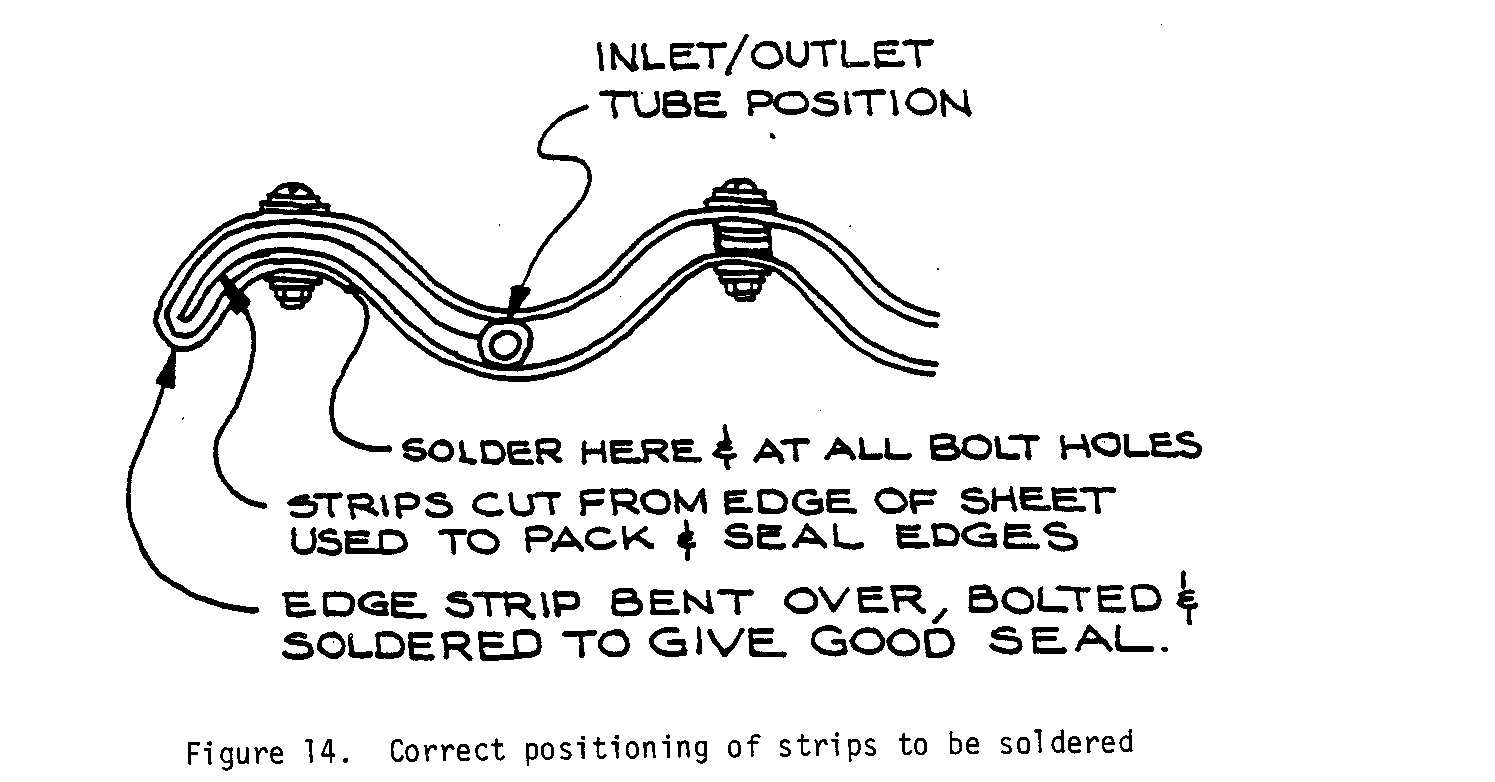
A hammer and anvil can be used to form the strips so
they will fit the edge.
* Drill 6mm (1/4") holes 2.5cm (1") apart along the outside
edges and at every other corrugation on side edges.
* Fasten edges together with 6mm X 2.5cm (1/4" X 1") bolts,
metal washer, and nuts.
* Install water inlet pipe (1.25cm X 5cm [1/2" X 2"l) in bottom
right edge.
* Install water outlet pipe (1.25cm X 5cm [1/2" X 2"]) in top
left edge.
* Solder all outside edges including bolt holes. Solder around
inlet and outlet pipes.
* Attach reducer connections to the inlet and outlet
connections.
* Paint front side of collector flat black to absorb sunlight.
MAKE THE STORAGE TANK
A 114-liter (30-gallon) drum can be used for the storage tank,
or a 70-liter (19-gallon) tank can be made from galvanized
sheet metal. If using an oil drum, make sure that one end can
be lifted off to serve as a lid. Also, be certain the drum is
thoroughly clean.
* Paint the inside with waterproof paint, or line with
plastic. One large piece of plastic draped over the top edge
of the tank will work fine.
* Insulate outside by covering with mud, a mixture of tar and
straw or sawdust, etc.
* Drill holes for inlet and outlet connectors and solder pipe
in place. Holes should be located, for best results, at the
bottom of the tank (inlet to the collector) and about two-thirds
up the side of the tank from the bottom (outlet from
the collector to the tank). If possible, tank should be fitted
with a faucet on the bottom, opposite the cold water
outlet.
MAKE THE COLLECTOR STAND AND STORAGE PLATFORM
* Place so that the face of the collector faces south and is at
a 45[degrees] angle.
* Build a fixed stand. A simple way to raise the absorber is to
build up the back and the sloping sides with mud brick. Prop
up the back with small boards while the bricks are being
laid. Once the bricks are laid, remove the boards and seal
any openings or holes with mud. This will form a dead air
space which will serve as insulation.
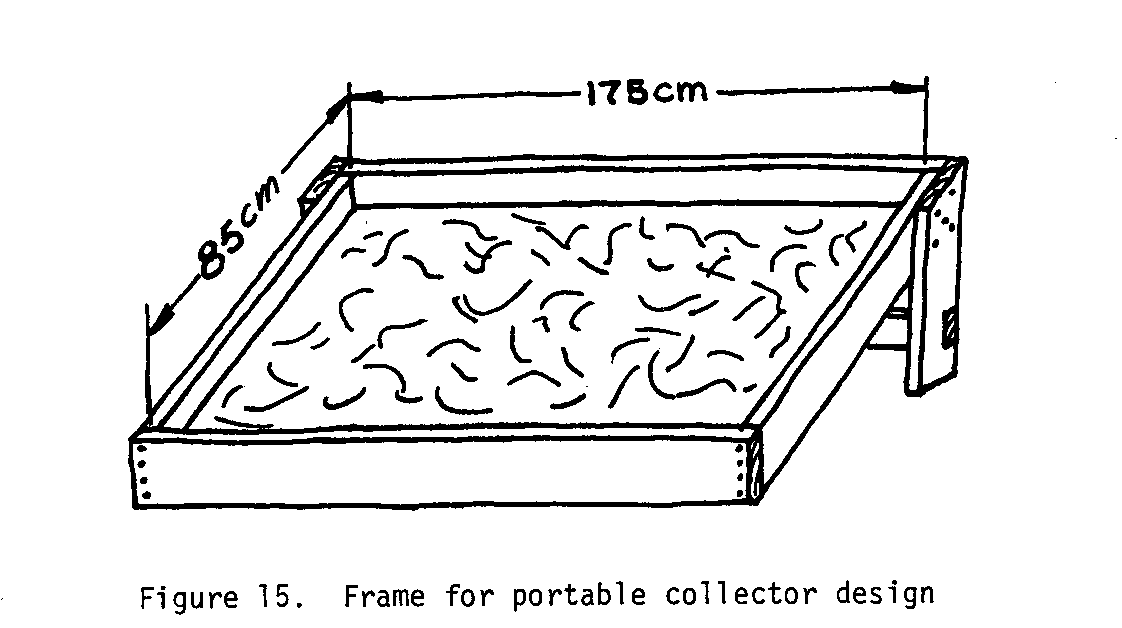
* Or build a portable stand. (A portable stand is usually
cheaper and is easily moved to track the sun.) Substitute a
wooden frame for the mud brick platform. Put insulating
material such as straw or hair directly behind the absorber
as shown in Figure 15.
swh15x26.gif (437x437)
CONNECT TANK AND COLLECTOR
* Attach a section of hose to the lower outlet (cold water) on
the tank and attach it to the lower right (cold water) inlet
on the collector.
* Attach the other section of hose to the upper inlet (hot
water) on the tank and attach it to the upper left (hot
water) outlet on the collector.
Note: If using corrugated sheets, make the inside dimensions
of the frame 90 cm X 180cm.
Figure 16A and Figure 16B are two possible solar collector/tank
swh16260.gif (486x486)
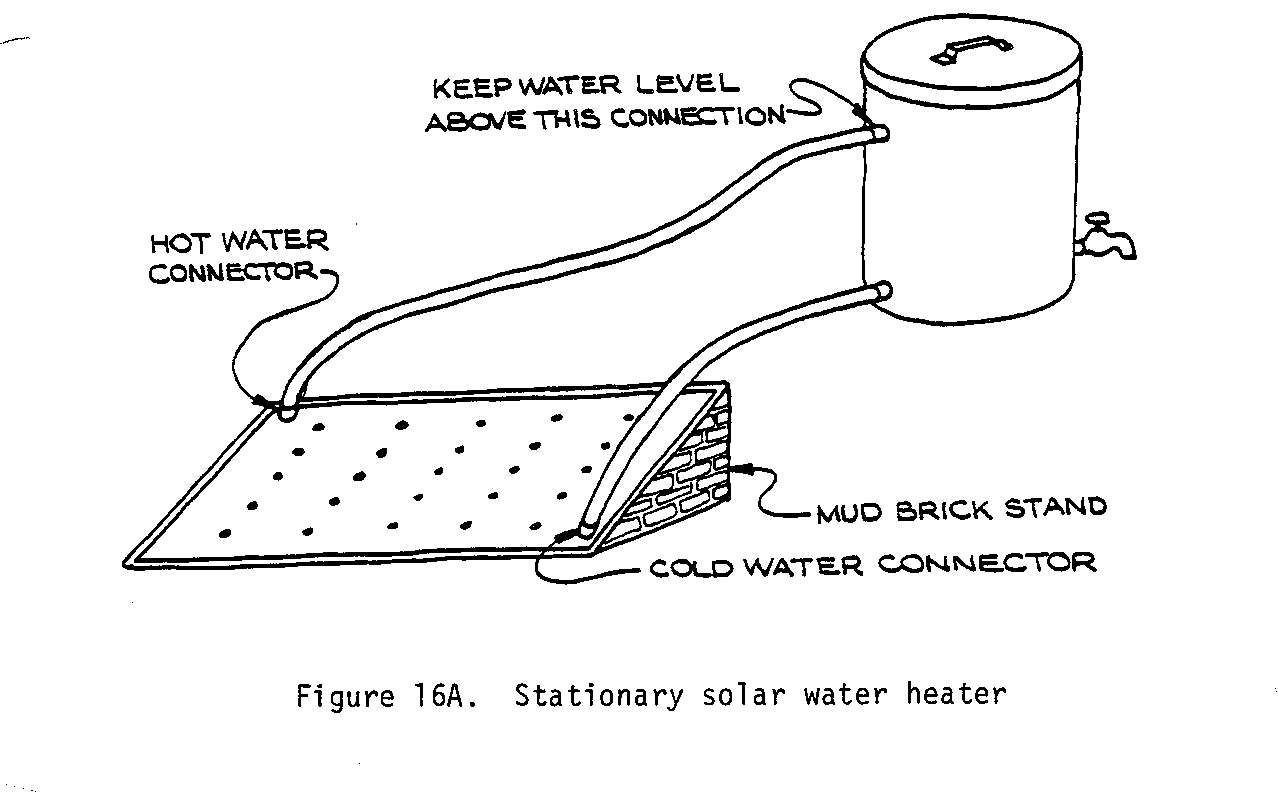
Note: Both systems are placed so that the tops of the collectors
are 46cm (18") below the bottom of the storage
tanks.
VII. OPERATION AND MAINTENANCE
* Remember to keep the collector at a 45[degrees] angle if the latitude
of your area is unknown. Latitude plus 100 in temperate
zones.
* The hot water will rise to the top of the tank. When all of
the water is to be used, it can be drained from the faucet;
when only a small amount of water is needed, the hottest
water can be taken from the top of the tank.
* Whenever water is being heated, the water level should be
kept above the tank's upper hose connector to allow the water
to circulate or the thermosyphon system will not work.
* The water heater works best when the connecting hoses are as
short as possible.
This solar water system is virtually maintenance free. Rubber
hoses may have to be replaced every two or three years. if
metal other than galvanized sheet metal is used, such as
untreated sheet metal, the lifespan of the system will be
shortened considerably due to rust. Once the collector starts
to rust, it must be replaced.
Untreated sheet metal can be painted with several coats of
rustproof paint if it can be obtained. However, you should
check the painted area in six months to make sure it is not
peeling off. It is also helpful to wrap the tank in insulation
materials.
If a 113-liter (30-gallon) drum is used, and lined with plastic,
the plastic liner will have to be checked regularly and
may have to be replaced from time to time depending on the
mineral content of the water supply.
To begin using the solar water heater, make certain the tank is
46cm above the top of the collector. Fill the tank with clean
water. Check for leaks.
VIII. CONVERSION TABLES
UNITS OF LENGTH
1 Mile = 1760 Yards = 5280 Feet
1 Kilometer = 1000 Meters = 0.6214 Mile
1 Mile = 1.607 Kilometers
1 Foot = 0.3048 Meter
1 Meter = 3.2808 Feet = 39.37 Inches
1 Inch = 2.54 Centimeters
1 Centimeter = 0.3937 Inches
UNITS OF AREA
1 Square Mile = 640 Acres = 2.5899 Square Kilometers
1 Square Kilometer = 1,000,000 Square Meters = 0.3861 Square Mile
1 Acre = 43,560 Square Feet
1 Square Foot = 144 Square Inches = 0.0929 Square Meter
1 Square Inch = 6.452 Square Centimeters
1 Square Meter = 10.764 Square Feet
1 Square Centimeter = 0.155 Square Inch
UNITS OF VOLUME
1.0 Cubic Foot = 1728 Cubic Inches = 7.48 US Gallons
1.0 British Imperial
Gallon = 1.2 US Gallons
1.0 Cubic Meter = 35.314 Cubic Feet = 264.2 US Gallons
1.0 Liter = 1000 Cubic Centimeters = 0.2642 US Gallons
UNITS OF WEIGHT
1.0 Metric Ton = 1000 Kilograms = 2204.6 Pounds
1.0 Kilogram = 1000 Grams = 2.2046 Pounds
1.0 Short Ton = 2000 Pounds
UNITS OF PRESSURE
1.0 Pound per square inch = 144 Pound per square foot
1.0 Pound per square inch = 27.7 Inches of water(*)
1.0 Pound per square inch = 2.31 Feet of water(*)
1.0 Pound per square inch = 2.042 Inches of mercury(*)
1.0 Atmosphere = 14.7 Pounds per square inch (PSI)
1.0 Atmosphere = 33.95 Feet of water(*)
1.0 Foot of water = 0.433 PSI = 62.355 Pounds per square foot
1.0 Kilogram per square centimeter = 14.223 Pounds per square inch
1.0 Pound per square inch = 0.0703 Kilogram per square
centimeter
UNITS OF POWER
1.0 Horsepower (English) = 746 Watt 0.746 Kilowatt (KW)
1.0 Horsepower (English) = 550 Foot pounds per second
1.0 Horsepower (English) = 33,000 Foot pounds per minute
1.0 Kilowatt (KW) = 1000 Watt = 1.34 Horsepower (HP) English
1.0 Horsepower (English) = 1.0139 Metric horsepower
(cheval-vapeur)
1.0 Metric horsepower = 75 Meter X Kilogram/Second
1.0 Metric horsepower = 0.736 Kilowatt = 736 Watt
________________
(*) At 62 degrees Fahrenheit (16.6 degrees Celsius).
IX. DICTIONARY OF TERMS
AIRTIGHT--Having no place for air to enter.
ANVIL--A heavy block of iron or steel with a smooth, flat top
on which metals are shaped by hammering.
CORRUGATED--Shaped into folds that have alternating ridges.
DIA.--Diameter. A straight line passing through the center of a
circle and meeting the circumference of the circle at
at each end.
DISTILLATION--A process used to purify saltwater by separating
the water from the salt. The saltwater is boiled into
steams. The steam condenses in a cool receiver, and
cools into pure water.
EQUATOR--A great circle dividing the northern parts of the
earth from the southern parts of the earth.
FIBERGLASS--A composite material consisting of glass fibers in
resin.
GALVANIZED STEEL--Steel that has been coated with zinc to
resist rust.
HORIZON--The line or circle that forms the apparent boundary
between earth and sky.
HYGIENE--THE science of preserving health; the prevention of
illness by keeping clean.
INFRARED--Electromagnetic radiation having wavelengths greater
than visible light and shorter than microwaves.
INTERVALS--The space between points, things, times, etc.
LATITUDE--The angular distance north or south of the equator,
measured in degrees along a meridian.
LIFESPAN--The longest period over which the life of any plant,
animal, or machine may extend. How long something
lives or works.
POLYURETHANE FOAM--A foam made of a thermoplastic or thermosetting
resin.
RADIATION--The process by which energy is given off by one
body, travels through space, water, or something
else, and is absorbed by another body.
RUST--The red or orange coating that forms on the surface of
iron when exposed to air and moisture.
SOLDER--A fusible alloy that joins metal objects without heating
them to the melting point. The solder is applied
in a melted state.
STATIONARY--Permanent, not moveable.
STOVE BOLT--A small bolt, similar to a machine screw but with a
coarser thread.
TEMPERATE ZONE--An area of the earth that is warm in the summer,
cold in the winter, and moderate in the spring
and fall.
THERMOSYPHON--Moving liquid from one place to another by
changes in heat.
TILTED--Leaning, sloping, or slanted; raised at one end.
WATERPROOF--Made or treated with a rubber, plastic, or another
sealing agent to prevent water from entering.
X. FURTHER INFORMATION RESOURCES
Bolwell, A.J. Polyurethane Foam Insulated Solar Hot Water
System. Available from VITA.
Brace Research Institute. How to Build a Solar Water Heater,
Leaflet L-4, 1965, revised 1973. Brace Research Institute,
MacDonald College of McGill University, Ste. Anne de
Bellevue, Quebec, Canada. Very useful, highly detailed plans
for building a low-cost, thermosyphon water heater which uses
materials available almost everywhere, even in developing
countries. This design has been successfully built and used
extensively in Barbados. Highly recommended.
Brooks, F.A. Use of Solar Energy for Heating Water. Available
from VITA.
Brown, R.J. "Domestic and Commercial Solar Water Heating for
Equatorial Areas." Sun at Work, 4th quarter, 1966. I.S.W.
Hart & Co., P. Ltd., Fremantle, Australia.
CSIRO. Solar Water Heaters, Circular #2, 1964. CSIRO, PO Box
26, Highett, Victoria, Melbourne, Australia 3190. Good basic
overview of the theory, design, construction, and economics
of home solar water heating systems. Contains useful
information on the different factors to be considered at
different latitudes. Quite practical; it gives one a good
idea of how a system can be expected to perform.
Czarnecki, J.T. Performance of Exp. Solar Water Heaters in
Australia. CSIRO, PO Box 26, Highett, Victoria, Melbourne,
Australia 3190. Contains detailed test results of combination
solar/electric water heating systems in six Australian
cities. Has useful mathematical formulas and graphs, for the
amount of absorber area needed to collect a given amount of
heat.
Farber, Erich A. Solar Water Heating. University of Florida,
Gainesville, Florida USA.
Fun & Frolic, Inc. "Water Heating." Solar Energy Primer. Fun &
Frolic, Inc., PO Box 277, Madison Heights, Michigan 48071
USA.
Khanna, M.L. Development of Solar Water Heaters in India.
National Physical Laboratory, Pusa, New Delhi, India.
Mathur, K.N., Khanna, M.L., Davey, T.N. and Suri, S.P. Domestic
Solar Water Heater. National Physical Laboratory, Pusa, New
Delhi, India.
Miromit Sun Heaters, Ltd. Miromit Newsletter, No. 7, July 1963.
Miromit Sun Heaters, Ltd., 323 Hayarkon Street, Tel-Aviv,
Israel (POB 6004).
Mother Earth News. "Kenneth Whetzel's Solar Heater." Handbook
of Homemade Power. Mother Earth News, Box 70, Hendersonville,
North Carolina 28739 USA. An extended anecdote about building
and using a simple thermosyphon solar water heating system
from "scrap parts"--sheet metal, copper tubing, plastic, and
small metal tank insulated with styrofoam. Of limited value.
Ridenour, Steven M. "Homemade Solar Water Heaters." Producing
Your Own Power. Rodale Press, Emmaus, Pennsylvania USA. A
good overview of different types of simple collectors, their
construction, and use. Includes designs of thermosyphon,
pressurized and heat transfer systems. Written in simple
language, it also presents the basic principles of solar
water heating systems.
Running Press. Solar Energy--Some Basics, Energy Book #1.
Running Press, 38 South 19th Street, Philadelphia,
Pennsylvania 19103 USA.
Singh, Prof. Deep Narayan. Standardized Typical Designs of
Solar Water Heater Systems for Supplying Hot Water for
Heating and Domestic Purposes for Detached Houses in India.
Bihar College of Engineering, University of Patna, Patna
800005 India.
University of Florida. Solar Energy Studies, Tech. Progress
Report #9, Vol. XIV, No. 2. University of Florida, Gainesville,
Florida USA. Although rather dated, this booklet
contains a good overview of different solar water heaters and
some information on the principles of solar heating, as well
as a section on "presently used" (1960) solar water heating
installations. Also has a section on solar-powered
refrigeration.
APPENDIX I
DECISION MAKING WORKSHEET
If you are using this as a guideline for using the Solar Water
Heater in a development effort, collect as much information as
possible and if you need assistance with the project, write
VITA. A report on your experiences and the uses of this manual
will help VITA both improve the book and aid other similar
efforts.
Volunteers in Technical Assistance
1815 North Lynn Street, Suite 200
Arlington, Virginia 22209 USA
CURRENT USE AND AVAILABILITY
* Note current domestic and agricultural practices which might
have potential for solar application.
* Document days of sunshine, seasonal changes, haze, cloud
cover. Another way of finding the information is to search
out annual rainfall figures and work from there.
* Have solar technologies been introduced previously? If so,
with what results?
* Have solar technologies been introduced in nearby areas? If
so, with what results?
* Are there other current practices which might be enhanced by
improved use of solar energy--for example, salt production?
IDENTIFY APPROPRIATENESS OF THIS TECHNOLOGY
* Is there a choice to be made between a solar technology and
another alternative energy technology? Or, is it important to
do both on a demonstration basis?
* Under what conditions would it be useful to introduce a solar
technology for demonstration purposes?
* If solar units are feasible for local manufacture, would they
be used? Assuming no "funding," could local people afford
them? Are there ways to make the solar technologies "pay for
themselves?"
* Could this technology provide a basis for a small business
enterprise?
NEEDS AND RESOURCES
* What are the characteristics of the problem? How is the
problem identified? Who sees it as a problem?
* Has any local person, particularly someone in a position of
authority, expressed the need or showed interest in solar
technology? If so, can someone be found to help the
technology introduction process? Are there local officials
who could be involved and tapped as resources?
* How will you get the community involved with the decision of
which technology is appropriate for them.
* Based on descriptions of current practices and upon this
manual's information, identify needs which solar technologies
appear able to meet.
* Are materials and tools available locally for construction of
technologies?
* Are there other projects already underway to which a solar
component might be added so that the ongoing project acts as
a technical and even financial resource for the new effort?
For example, if there is a post harvest grain loss project
underway, could improved solar drying techniques be introduced
in conjunction with the other effort?
* What kinds of skills are available locally to assist with
construction and maintenance? How much skill is necessary for
construction and maintenance? Do you need to train people?
Can you meet the following needs?
* Some aspects of this project require someone with experience
in metal-working and/or welding. Estimated labor time
for full-time workers is:
* 8 hours skilled labor
* 8 hours unskilled labor
* Do a cost estimate of the labor, parts, and materials needed.
* How will the project be funded? Would the technology require
outside funding? Are local funding sources available to sponsor
the effort?
* How much time do you have for the project? Are you aware of
holidays and planting or harvesting seasons which may affect
timing?
* How will you arrange to spread knowledge and use of the
technology?
FINAL DECISION
* How was the final decision reached, either to go ahead or not
to go ahead, with this technology?
APPENDIX II
RECORD KEEPING WORKSHEET
CONSTRUCTION
Photographs of the construction process, as well as the finished
result, are helpful. They add interest and detail that
might be overlooked in the narrative.
A report on the construction process should include very specific
information. This kind of detail can often be monitored
most easily in charts (such as the one below). (see report 1)
swhr1450.gif (540x540)

Some other things to record include:
* Specification of materials used in construction.
* Adaptations or changes made in design to fit local
conditions.
* Equipment costs.
* Time spent in construction--include volunteer time as well as
paid labor, full- and/or part-time.
* Problems--labor shortage, work stoppage, training difficulties,
materials shortage, terrain, transport.
OPERATION
Keep log of operations for at least the first six weeks, then
periodically for several days every few months. This log will
vary with the technology, but should include full requirements,
outputs, duration of operation, training of operators, etc.
Include special problems that may come up--a damper that won't
close, gear that won't catch, procedures that don't seem to
make sense to workers, etc.
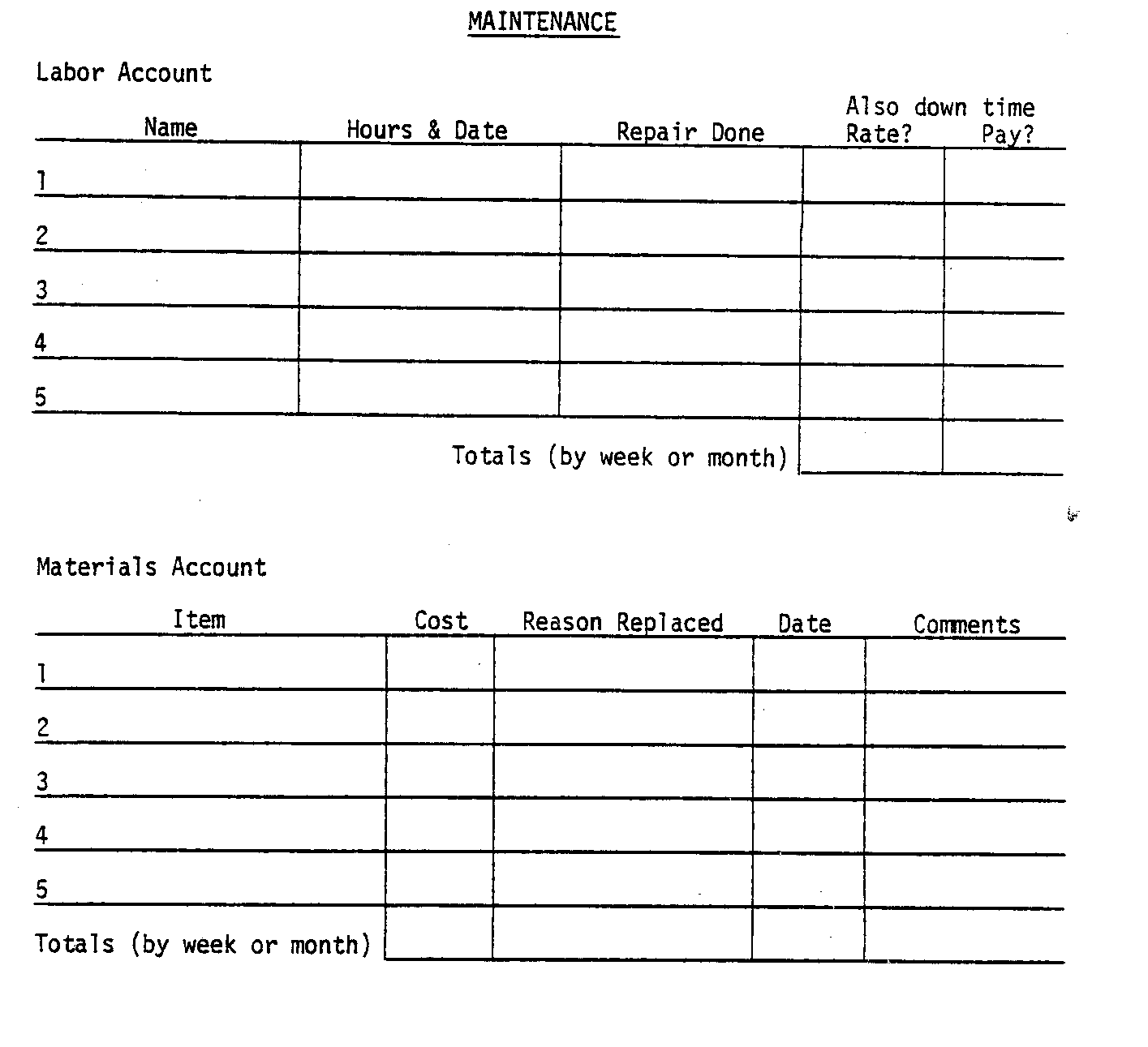
MAINTENANCE
Maintenance records enable keeping track of where breakdowns
occur most frequently and may suggest areas for improvement or
strengthening weakness in the design. Furthermore, these
records will give a good idea of how well the project is
working out by accurately recording how much of the time it is
working and how often it breaks down. Routine maintenance
records should be kept for a minimum of six months to one year
after the project goes into operation. (see report 2)
swhr2.gif (540x540)
SPECIAL COSTS
This category includes damage caused by weather, natural
disasters, vandalism, etc. Pattern the records after the
routine maintenance records. Describe for each separate
incident:
* Cause and extent of damage.
* Labor costs of repair (like maintenance account).
* Material costs of repair (like maintenance account) .
* Measures taken to prevent recurrence.
MANUALS IN THE ENERGY SERIES
This book is one of a series of manuals on renewable energy
technologies. It is primarily intended for use by people in
international development projects. However, the construction
techniques and ideas presented here are useful to anyone
seeking to become more energy self-sufficient. The titles in
the series are:
Helical Sail Windmill
Hydraulic Ram
Making Charcoal: The Retort Method
Overshot Water-Wheel: Design
and Construction Manual
Small Michell (Banki) Turbine:
A Construction Manual
Solar Still
Solar Water Heater
Three Cubic Meter Bio-Gas Plant:
A Construction Manual
For a free catalogue of these and other VITA publications,
write to:
VITA Publications Service
P. 0. Box 12028
Arlington, Virginia 22209 USA
ABOUT VITA
Volunteers in Technical Assistance (VITA) is a private, nonprofit,
international development organization. VITA makes
available to individuals and groups in developing countries a
variety of information and technical resources aimed at fostering
self sufficiency--needs assessment and program development
support; by-mail and on-site consulting services;
information systems training; and management of long-term
field projects. VITA promotes the application of simple,
inexpensive technologies to solve problems and create opportunities
in developing countries.
VITA places special emphasis on the areas of agriculture and
food processing, renewable energy applications, water supply
and sanitation, housing and construction, and small business
development. VITA's activities are facilitated by the active
involvement of VITA Volunteer technical experts from around
the world and by its documentation center containing specialized
technical material of interest to people in developing
countries.
========================================
========================================
A VITA publication
ABOUT VITA
Volunteers in Technical Assistance (VITA) is a private, non-profit,
international development organization. VITA makes
available to individuals and groups in developing countries a
variety of information and technical resources aimed at fostering
self sufficiency--needs assessment and program development
support, by-mail and on-site consulting services;
information systems training; and management of long-term
field projects. VITA promotes the application of simple,
inexpensive technologies to solve problems and create opportunities
in developing countries.
VITA places special emphasis on the areas of agriculture and
food processing, renewable energy applications, water supply
and sanitation, housing and construction, and small business
development. VITA's activities are facilitated by the active
involvement of VITA Volunteer technical experts from around
the world and by its documentation center containing specialized
technical material of interest to people in developing
countries.
VITA
VOLUNTEERS
IN TECHNICAL
ASSISTANCE
ISBN 0-86619-025-2
Solar Water Heater
Published by
VITA
1600 Wilson Boulevard, Suite 500
Arlington, Virginia 22209 USA
Tel: 703/276-1800 . Fax: 703/243-1865
Internet: pr-info@vita.org
SOLAR WATER HEATER
I. WHAT IT IS AND HOW IT IS USEFUL
II. DECISION FACTORS
Applications
Advantages
Considerations
Cost Estimate
III. MAKING THE DECISION AND FOLLOWING THROUGH
IV. PRE-CONSTRUCTION DECISIONS
The Process
The Thermosyphon Principle
The Thermosyphon Principle at Work
Deciding Quantity
Site Selection
V. CONSTRUCTION NEEDS
Tools
Materials
VI. CONSTRUCTION
The Collector--Flat Galvanized Metal Sheets
The Collector--Corrugated Metal Sheets
Make the Storage Tank
Make the Collector Stand and Storage Platform
Connect the Tank and Collector
VII. OPERATION AND MAINTENANCE
VIII. CONVERSION TABLES
IX. DICTIONARY OF TERMS
X. FURTHER
APPENDIX I. DECISION MAKING WORKSHEET
APPENDIX II. RECORD KEEPING WORKSHEET
Solar Water Heater
I. WHAT IT IS AND HOW IT IS USEFUL
Hot water is not always necessary, and in warm climates it may
be relatively easy to do without. It is, however, more
effective than cold water for many purposes. Even so, in some
areas hot water is not used because fuel is so expensive it is
used only for essential tasks. A solar heater can supply needed
hot water without using up available fuel.
Solar water heaters represent one of the easiest, most
practical applications of solar energy on an individual and
small-scale basis.
Heat from the sun's rays is easily captured. Black-painted
surfaces exposed to the sun will get hotter than those of any
other color. A metal surface painted flat black and placed in
contact with water will heat the water. The black metal plate
is called an absorber.
Once the water is heated, it is kept hot with insulation. The
heated water behind the absorber can be insulated with a
variety of substances such as fiberglass, straw, sawdust, hair,
or polyurethane foam. In some absorber designs a sheet of glass
is placed between the absorber plate and the sun. Glass
transmits the high radiation from the sun that heats the water,
but stops the low-energy infrared radiation that is reradiated
from the hot absorber. It also keeps air from passing over the
absorber causing heat loss. The reduction of the two forms of
heat loss makes glass an ideal insulator. Clear plastics can be
used but their life expectancy is limited.
The solar water heater presented here (see Figure 1 ) can provide
swh1x2.gif (486x486)
hot water the year round.
This system will heat 70 liters (18-1/2 gallons) of water to
60 [degrees]C (140 [degrees]F) between sunrise and noon on a clear day with an
average outside temperature of 32 [degrees]C (90 [degrees]F). Obviously, water
does not have to be this hot for many purposes: very hot water
can be mixed with cool water to provide water warm enough for
bathing and washing clothes and dishes. This factor should be
taken into account when estimating the amount of water needed
each day.
Building a solar water heater can be a good project for a
school class:
* The heater, assuming access to the right equipment, is not
difficult to build.
* It provides a working demonstration of the principles of
solar technology.
* Students introduced to solar technology and its potential
are familiarized with energy-conserving, non-polluting
technologies.
II. DECISION FACTORS
Applications: * Heating water.
* Washing clothes.
* Personal hygiene.
Advantages: * Easy to build and operate.
* Provides heated water 60 [degrees]C (140 [degrees]F) within
a two-hour period.
* Portable.
* No fuel costs.
Considerations: * Has to be filled manually.
* Life expectancy of two years.
* Heats water only on sunny days. Does not
operate at night.
COST ESTIMATE(*)
$30-$70 (US) including materials and labor.
__________
(*) Cost estimates serve only as a guide and will vary from
country to country.
III. MAKING THE DECISION AND FOLLOWING THROUGH
When determining whether a project is worth the time, effort,
and expense involved, consider social, cultural, and environmental
factors as well as economic ones. What is the purpose of
the effort? Who will benefit most? What will the consequences
be if the effort is successful? Or, if it fails?
Having made an informed technology choice, it is important to
keep good records. It is helpful from the beginning to keep
data on needs, site selection, resource availability, construction
progress, labor and materials costs, test findings, etc.
The information may prove an important reference if existing
plans and methods need to be altered. It can be helpful in pinpointing
"what went wrong." And, of course, it is important to
share data with other people.
The technologies presented in this series have been tested
carefully, and are actually used in many parts of the world.
However, extensive and controlled field tests have not been
conducted for many of them, even some of the most common ones.
Even though we know that these technologies work well in some
situations, it is important to gather specific information on
why they perform properly in one place and not in another.
Well documented models of field activities provide important
information for the development worker. It is obviously important
for a development worker in Colombia to have the technical
design for a kiln built and used in Senegal. But it is even
more important to have a full narrative about the kiln that
provides details on materials, labor, design changes, and so
forth. This model can provide a useful frame of reference.
A reliable bank of such field information is now growing. It
exists to help spread the word about these and other technologies,
lessening the dependence of the developing world on
expensive and finite energy resources.
A practical record keeping format can be found in Appendix II.
IV. PRE-CONSTRUCTION DECISIONS
THE PROCESS
The solar water heater presented here (see Figure 2) was
swh2x9.gif (486x486)
designed, developed, and tested in Afghanistan in the late
1960's. Since that time, this heater has been built and used by
development workers around the world.
There are two main parts to the solar water heater: (1) a heat-absorbing
collector (absorber) that is rather like an envelope
made of metal sheets; and (2) a storage tank that holds the
water for the system. The collector can be made either of flat
galvanized metal sheets or corrugated galvanized metal sheets.
Instructions are included for both types of materials.
THE THERMOSYPHON PRINCIPLE
* The tank, filled with water, is connected to the collector.
* The collector is positioned below the bottom of the tank.
* Water runs through a hose at the bottom of the tank to the
collector.
* The water is heated in the collector.
* Hotter water flows toward the top of the collector.
* Hot water is forced out of the hose at the top of the
collector into the tank by the pressure of the cooler
(heavier) water coming in from the tank.
* The hotter water stays at the top of the tank and cooler
water flows to the collector. The flow established continues
until the water is no longer being heated by the sun. For
example, at night the flow becomes stable and the hot water
remains until it is used or it cools.
THE THERMOSYPHON PRINCIPLE AT WORK
It is important to remember that the storage tank must be
located 46cm (18") or higher above the collector to enable the
thermosyphon principle to work (see Figure 3).
swh3x11.gif (486x486)
If you cannot place this water tank above the collector, a pump
will be needed to move the water from the collector to the
tank, and that will increase expenses.
DECIDING QUANTITY
The quantity of water to be heated is a primary concern. Most
Americans use, on the average, 95 liters (25 gallons) per person
per day. However, for a lifestyle which does not include a
hot shower or bath each day and an automatic clothes washer,
the quantity of water needed is much less. In many areas, 38 to
45-1/2 liters (10 to 12 gallons) per person per day is adequate.
In others, people often are required by circumstances to
"make do" with 7-12 liters (2-3 gallons) of water per day.
Water, in such areas, is so precious even in very small amounts
that whether or not it is hot is of no great importance at
all. (For these areas, a solar distillation unit might be an
important technology to introduce.)
If the water heater is needed for a small infirmary or a
school, make an estimate of the number of gallons required for
each person and for each purpose. The storage tank may need to
be made larger, depending upon this need. Collector size must
also be considered--it directly relates to the quantity of hot
water desired. A good general rule is one square meter (39-1/2"
square) of collector area for 41-1/2 liters (11 gallons) of hot
water desired. In colder climates, one square meter (39-1/2"
square) of collector area may yield only 30 liters (about 8
gallons) per square meter.
SITE SELECTION
Site conditions are important. Collectors should face directly
south. Turning a collector southeast or southwest can affect
its performance by about 20% or more. If hot water is needed by
noon, face the collector to the southeast; if hot water is more
important in late afternoon, face the collector to the
southwest (see Figure 4).
swh4x12.gif (540x540)
The site should be free from shade. Collectors should be placed
so that they can be tilted from the horizon to an angle equal
to the latitude of the location. (In more temperate climates
the angle should equal the latitude plus 10[degrees]. If the latitude
is unknown, the collector can be placed at a 45[degrees] angle, except
in areas near the equator). The latitude for your area can be
obtained from an atlas or globe.
V. CONSTRUCTION NEEDS
Materials and tools needed for a 90cm X 180cm (35-1/2" X 71")
absorber/collector and a 70-liter (18-1/2 gallon) storage tank
are listed below.
TOOLS
* Metalworking tools: hammer, anvil, soldering equipment,
tinsnips
* Screwdriver
* Drill and 6mm (1/4") drill bit
* Pliers or 6mm (1/4") wrench
MATERIALS
For Flat Sheet Metal Collector
* Galvanized sheet metal: 2 pieces, 90cm X 180cm (35-1/2" X
71") [absorber/collector]
* Galvanized sheet metal pipe: 2 pieces, 2.5cm diam. X 5cm long
(1" X 2")
* Galvanized stove bolts: 28, 6mm diam. X 2.5cm long (1/4" X
1")
* Metal washers: 56, to fit 6mm (1/4") bolts
* Rubber washers: 56, to fit 6mm (1/4") bolts. Inside diam.
3.5mm (1/8"); outside diam. 2cm (3/4"). These can be cut from
heavy truck tire inner tubes.
For Corrugated Metal Collector
* Corrugated metal sheet [galvanized], 122cm X 244cm (48" X
96")
* Galvanized sheet metal pipe: 2 pieces, 1.25cm diam. X 5cm
long (1/2" X 2")
* Galvanized stove bolts: 80, 6mm diam. X 2.5cm long (1/4" X
1")
* Metal washers: 160, to fit 6mm (1/4") bolts
* Rubber washers: 400, to fit 6mm (1/4") bolts. Inside diam.
3.5mm (1/8"); outside diam. 2cm (3/4")--can be cut from heavy
truck tire inner tubes
* Reducer connections: two, to connect 1.25cm (1/2") pipe to
2.5cm (1") hose
Note: Nuts, bolts, washers quantity will vary. Some sheets
have corrugations spaced more closely than others. A
metal sheet with very closely spaced corrugations will
require more fasteners. The figures given here for the
corrugated metal collector are approximate amounts.
For Either Kind of Metal Sheet
* Rubber hose: 2 pieces, 2.5cm (1") diam. [long enough to connect
collector to tank]
* Galvanized sheet metal tank:(*) 70-liter (18-1/2 gallon)
capacity with faucet, removable lid, and 2.5cm (1") hose
connectors (one placed two-thirds from the bottom and one
placed at the bottom)
* Paint: 1 liter (approximately 1 quart), flat black or
homemade mixture of linseed oil and carbon black (charcoal
powder)
* Quantity of mud bricks, straw or other suitable material (for
insulation of absorber and storage tank)
_____________
(*) The best tanks are glass-lined steel tanks or conventional
insulated water heater tanks. Obviously, these are unobtainable
in many areas. One suitable alternative is a 113.5-liter (30-gallon)
drum; it must be painted with rustproof paint or lined
with plastic. Another alternative is to have a blacksmith build
a tank for the project. In most areas, the local blacksmith's
shop would be able to put together such a tank quickly. Be sure
it is watertight.
VI. CONSTRUCTION
THE COLLECTOR--FLAT GALVANIZED METAL SHEETS
* Cut 2cm (3/4") off the length and width of one of the sheets
of galvanized steel, so that it will be 1cm (1/3") smaller
than the other sheet on all four sides (see Figure 5).
swh5x19.gif (540x540)
* On the smaller sheet, drill two 3cm (1-1/4") holes for the
two connectors. Drill 4cm (1-1/2") in from the edges (see
Figure 5).
* Place the two galvanized sheets together. Using a hammer and
anvil, fold the 1cm (3/8") overlapping edges (see Figure 6).
swh6x20.gif (270x540)
* Fold the edges 1cm (3/8") again and solder them to make an
airtight seal (see Figure 7).
swh7x20.gif (218x437)
* Drill holes for 6mm (1/4") bolts at regular intervals, like
buttons on a mattress (see Figure 8). Bolts will keep the
swh8x20.gif (540x540)
sheets from being forced apart when the absorber is filled
with water.
* Place bolts in holes with rubber and metal washers at each
end of the bolts to ensure a watertight seal (see Figures 9 and 10)
swh9x21.gif (270x540)
swh11x21.gif (300x600)
* Use the 2.5cm X 5cm (1" X 2") galvanized sheet metal pipe to
make the connectors. Place the pipe flush with the solar
collector sheet, covering the 3cm (1-1/4") hole. Solder the
pipe to the sheet (see Figure 11).
swh11x21.gif (540x540)
* Paint the front of the heater with black paint so that it
will absorb the sunlight rather than reflect it.
THE COLLECTOR--CORRUGATED METAL SHEETS
* Take two corrugated sheets 122cm X 244cm (48" X 96") and cut
32cm (12-1/2") off the width of both sheets and 64cm (25")
off the length of both sheets. Save the scrap metal.
* Place the two sheets together and drill 6mm (1/4") holes 25cm
(about 10") apart in alternate corrugations (raised sections),
see Figure 12.
swh12x22.gif (486x486)
* Place 6mm X 2.5cm (1/4" X 1") bolts in holes with metal
washer and rubber washer. Separate the two sheets. Place
three or four rubber washers on bottom of each bolt so that
there is approximately 6mm (1/4") space between the two
sheets (see Figure 13).
swh13x23.gif (486x486)
* Attach bolts on undersides of bottom corrugated sheet with
rubber washer, metal washer, and 6mm (1/4") nut. Tighten
until rubber washer begins to spread.
* Cut scrap corrugated sheet into strips to fit corrugations on
each edge of the collector. Bend outside edges over as shown
in Figure 14. This should seal the entire edge when complete.
swh14x24.gif (486x486)
A hammer and anvil can be used to form the strips so
they will fit the edge.
* Drill 6mm (1/4") holes 2.5cm (1") apart along the outside
edges and at every other corrugation on side edges.
* Fasten edges together with 6mm X 2.5cm (1/4" X 1") bolts,
metal washer, and nuts.
* Install water inlet pipe (1.25cm X 5cm [1/2" X 2"l) in bottom
right edge.
* Install water outlet pipe (1.25cm X 5cm [1/2" X 2"]) in top
left edge.
* Solder all outside edges including bolt holes. Solder around
inlet and outlet pipes.
* Attach reducer connections to the inlet and outlet
connections.
* Paint front side of collector flat black to absorb sunlight.
MAKE THE STORAGE TANK
A 114-liter (30-gallon) drum can be used for the storage tank,
or a 70-liter (19-gallon) tank can be made from galvanized
sheet metal. If using an oil drum, make sure that one end can
be lifted off to serve as a lid. Also, be certain the drum is
thoroughly clean.
* Paint the inside with waterproof paint, or line with
plastic. One large piece of plastic draped over the top edge
of the tank will work fine.
* Insulate outside by covering with mud, a mixture of tar and
straw or sawdust, etc.
* Drill holes for inlet and outlet connectors and solder pipe
in place. Holes should be located, for best results, at the
bottom of the tank (inlet to the collector) and about two-thirds
up the side of the tank from the bottom (outlet from
the collector to the tank). If possible, tank should be fitted
with a faucet on the bottom, opposite the cold water
outlet.
MAKE THE COLLECTOR STAND AND STORAGE PLATFORM
* Place so that the face of the collector faces south and is at
a 45[degrees] angle.
* Build a fixed stand. A simple way to raise the absorber is to
build up the back and the sloping sides with mud brick. Prop
up the back with small boards while the bricks are being
laid. Once the bricks are laid, remove the boards and seal
any openings or holes with mud. This will form a dead air
space which will serve as insulation.
* Or build a portable stand. (A portable stand is usually
cheaper and is easily moved to track the sun.) Substitute a
wooden frame for the mud brick platform. Put insulating
material such as straw or hair directly behind the absorber
as shown in Figure 15.
swh15x26.gif (437x437)
CONNECT TANK AND COLLECTOR
* Attach a section of hose to the lower outlet (cold water) on
the tank and attach it to the lower right (cold water) inlet
on the collector.
* Attach the other section of hose to the upper inlet (hot
water) on the tank and attach it to the upper left (hot
water) outlet on the collector.
Note: If using corrugated sheets, make the inside dimensions
of the frame 90 cm X 180cm.
Figure 16A and Figure 16B are two possible solar collector/tank
swh16260.gif (486x486)
Note: Both systems are placed so that the tops of the collectors
are 46cm (18") below the bottom of the storage
tanks.
VII. OPERATION AND MAINTENANCE
* Remember to keep the collector at a 45[degrees] angle if the latitude
of your area is unknown. Latitude plus 100 in temperate
zones.
* The hot water will rise to the top of the tank. When all of
the water is to be used, it can be drained from the faucet;
when only a small amount of water is needed, the hottest
water can be taken from the top of the tank.
* Whenever water is being heated, the water level should be
kept above the tank's upper hose connector to allow the water
to circulate or the thermosyphon system will not work.
* The water heater works best when the connecting hoses are as
short as possible.
This solar water system is virtually maintenance free. Rubber
hoses may have to be replaced every two or three years. if
metal other than galvanized sheet metal is used, such as
untreated sheet metal, the lifespan of the system will be
shortened considerably due to rust. Once the collector starts
to rust, it must be replaced.
Untreated sheet metal can be painted with several coats of
rustproof paint if it can be obtained. However, you should
check the painted area in six months to make sure it is not
peeling off. It is also helpful to wrap the tank in insulation
materials.
If a 113-liter (30-gallon) drum is used, and lined with plastic,
the plastic liner will have to be checked regularly and
may have to be replaced from time to time depending on the
mineral content of the water supply.
To begin using the solar water heater, make certain the tank is
46cm above the top of the collector. Fill the tank with clean
water. Check for leaks.
VIII. CONVERSION TABLES
UNITS OF LENGTH
1 Mile = 1760 Yards = 5280 Feet
1 Kilometer = 1000 Meters = 0.6214 Mile
1 Mile = 1.607 Kilometers
1 Foot = 0.3048 Meter
1 Meter = 3.2808 Feet = 39.37 Inches
1 Inch = 2.54 Centimeters
1 Centimeter = 0.3937 Inches
UNITS OF AREA
1 Square Mile = 640 Acres = 2.5899 Square Kilometers
1 Square Kilometer = 1,000,000 Square Meters = 0.3861 Square Mile
1 Acre = 43,560 Square Feet
1 Square Foot = 144 Square Inches = 0.0929 Square Meter
1 Square Inch = 6.452 Square Centimeters
1 Square Meter = 10.764 Square Feet
1 Square Centimeter = 0.155 Square Inch
UNITS OF VOLUME
1.0 Cubic Foot = 1728 Cubic Inches = 7.48 US Gallons
1.0 British Imperial
Gallon = 1.2 US Gallons
1.0 Cubic Meter = 35.314 Cubic Feet = 264.2 US Gallons
1.0 Liter = 1000 Cubic Centimeters = 0.2642 US Gallons
UNITS OF WEIGHT
1.0 Metric Ton = 1000 Kilograms = 2204.6 Pounds
1.0 Kilogram = 1000 Grams = 2.2046 Pounds
1.0 Short Ton = 2000 Pounds
UNITS OF PRESSURE
1.0 Pound per square inch = 144 Pound per square foot
1.0 Pound per square inch = 27.7 Inches of water(*)
1.0 Pound per square inch = 2.31 Feet of water(*)
1.0 Pound per square inch = 2.042 Inches of mercury(*)
1.0 Atmosphere = 14.7 Pounds per square inch (PSI)
1.0 Atmosphere = 33.95 Feet of water(*)
1.0 Foot of water = 0.433 PSI = 62.355 Pounds per square foot
1.0 Kilogram per square centimeter = 14.223 Pounds per square inch
1.0 Pound per square inch = 0.0703 Kilogram per square
centimeter
UNITS OF POWER
1.0 Horsepower (English) = 746 Watt 0.746 Kilowatt (KW)
1.0 Horsepower (English) = 550 Foot pounds per second
1.0 Horsepower (English) = 33,000 Foot pounds per minute
1.0 Kilowatt (KW) = 1000 Watt = 1.34 Horsepower (HP) English
1.0 Horsepower (English) = 1.0139 Metric horsepower
(cheval-vapeur)
1.0 Metric horsepower = 75 Meter X Kilogram/Second
1.0 Metric horsepower = 0.736 Kilowatt = 736 Watt
________________
(*) At 62 degrees Fahrenheit (16.6 degrees Celsius).
IX. DICTIONARY OF TERMS
AIRTIGHT--Having no place for air to enter.
ANVIL--A heavy block of iron or steel with a smooth, flat top
on which metals are shaped by hammering.
CORRUGATED--Shaped into folds that have alternating ridges.
DIA.--Diameter. A straight line passing through the center of a
circle and meeting the circumference of the circle at
at each end.
DISTILLATION--A process used to purify saltwater by separating
the water from the salt. The saltwater is boiled into
steams. The steam condenses in a cool receiver, and
cools into pure water.
EQUATOR--A great circle dividing the northern parts of the
earth from the southern parts of the earth.
FIBERGLASS--A composite material consisting of glass fibers in
resin.
GALVANIZED STEEL--Steel that has been coated with zinc to
resist rust.
HORIZON--The line or circle that forms the apparent boundary
between earth and sky.
HYGIENE--THE science of preserving health; the prevention of
illness by keeping clean.
INFRARED--Electromagnetic radiation having wavelengths greater
than visible light and shorter than microwaves.
INTERVALS--The space between points, things, times, etc.
LATITUDE--The angular distance north or south of the equator,
measured in degrees along a meridian.
LIFESPAN--The longest period over which the life of any plant,
animal, or machine may extend. How long something
lives or works.
POLYURETHANE FOAM--A foam made of a thermoplastic or thermosetting
resin.
RADIATION--The process by which energy is given off by one
body, travels through space, water, or something
else, and is absorbed by another body.
RUST--The red or orange coating that forms on the surface of
iron when exposed to air and moisture.
SOLDER--A fusible alloy that joins metal objects without heating
them to the melting point. The solder is applied
in a melted state.
STATIONARY--Permanent, not moveable.
STOVE BOLT--A small bolt, similar to a machine screw but with a
coarser thread.
TEMPERATE ZONE--An area of the earth that is warm in the summer,
cold in the winter, and moderate in the spring
and fall.
THERMOSYPHON--Moving liquid from one place to another by
changes in heat.
TILTED--Leaning, sloping, or slanted; raised at one end.
WATERPROOF--Made or treated with a rubber, plastic, or another
sealing agent to prevent water from entering.
X. FURTHER INFORMATION RESOURCES
Bolwell, A.J. Polyurethane Foam Insulated Solar Hot Water
System. Available from VITA.
Brace Research Institute. How to Build a Solar Water Heater,
Leaflet L-4, 1965, revised 1973. Brace Research Institute,
MacDonald College of McGill University, Ste. Anne de
Bellevue, Quebec, Canada. Very useful, highly detailed plans
for building a low-cost, thermosyphon water heater which uses
materials available almost everywhere, even in developing
countries. This design has been successfully built and used
extensively in Barbados. Highly recommended.
Brooks, F.A. Use of Solar Energy for Heating Water. Available
from VITA.
Brown, R.J. "Domestic and Commercial Solar Water Heating for
Equatorial Areas." Sun at Work, 4th quarter, 1966. I.S.W.
Hart & Co., P. Ltd., Fremantle, Australia.
CSIRO. Solar Water Heaters, Circular #2, 1964. CSIRO, PO Box
26, Highett, Victoria, Melbourne, Australia 3190. Good basic
overview of the theory, design, construction, and economics
of home solar water heating systems. Contains useful
information on the different factors to be considered at
different latitudes. Quite practical; it gives one a good
idea of how a system can be expected to perform.
Czarnecki, J.T. Performance of Exp. Solar Water Heaters in
Australia. CSIRO, PO Box 26, Highett, Victoria, Melbourne,
Australia 3190. Contains detailed test results of combination
solar/electric water heating systems in six Australian
cities. Has useful mathematical formulas and graphs, for the
amount of absorber area needed to collect a given amount of
heat.
Farber, Erich A. Solar Water Heating. University of Florida,
Gainesville, Florida USA.
Fun & Frolic, Inc. "Water Heating." Solar Energy Primer. Fun &
Frolic, Inc., PO Box 277, Madison Heights, Michigan 48071
USA.
Khanna, M.L. Development of Solar Water Heaters in India.
National Physical Laboratory, Pusa, New Delhi, India.
Mathur, K.N., Khanna, M.L., Davey, T.N. and Suri, S.P. Domestic
Solar Water Heater. National Physical Laboratory, Pusa, New
Delhi, India.
Miromit Sun Heaters, Ltd. Miromit Newsletter, No. 7, July 1963.
Miromit Sun Heaters, Ltd., 323 Hayarkon Street, Tel-Aviv,
Israel (POB 6004).
Mother Earth News. "Kenneth Whetzel's Solar Heater." Handbook
of Homemade Power. Mother Earth News, Box 70, Hendersonville,
North Carolina 28739 USA. An extended anecdote about building
and using a simple thermosyphon solar water heating system
from "scrap parts"--sheet metal, copper tubing, plastic, and
small metal tank insulated with styrofoam. Of limited value.
Ridenour, Steven M. "Homemade Solar Water Heaters." Producing
Your Own Power. Rodale Press, Emmaus, Pennsylvania USA. A
good overview of different types of simple collectors, their
construction, and use. Includes designs of thermosyphon,
pressurized and heat transfer systems. Written in simple
language, it also presents the basic principles of solar
water heating systems.
Running Press. Solar Energy--Some Basics, Energy Book #1.
Running Press, 38 South 19th Street, Philadelphia,
Pennsylvania 19103 USA.
Singh, Prof. Deep Narayan. Standardized Typical Designs of
Solar Water Heater Systems for Supplying Hot Water for
Heating and Domestic Purposes for Detached Houses in India.
Bihar College of Engineering, University of Patna, Patna
800005 India.
University of Florida. Solar Energy Studies, Tech. Progress
Report #9, Vol. XIV, No. 2. University of Florida, Gainesville,
Florida USA. Although rather dated, this booklet
contains a good overview of different solar water heaters and
some information on the principles of solar heating, as well
as a section on "presently used" (1960) solar water heating
installations. Also has a section on solar-powered
refrigeration.
APPENDIX I
DECISION MAKING WORKSHEET
If you are using this as a guideline for using the Solar Water
Heater in a development effort, collect as much information as
possible and if you need assistance with the project, write
VITA. A report on your experiences and the uses of this manual
will help VITA both improve the book and aid other similar
efforts.
Volunteers in Technical Assistance
1815 North Lynn Street, Suite 200
Arlington, Virginia 22209 USA
CURRENT USE AND AVAILABILITY
* Note current domestic and agricultural practices which might
have potential for solar application.
* Document days of sunshine, seasonal changes, haze, cloud
cover. Another way of finding the information is to search
out annual rainfall figures and work from there.
* Have solar technologies been introduced previously? If so,
with what results?
* Have solar technologies been introduced in nearby areas? If
so, with what results?
* Are there other current practices which might be enhanced by
improved use of solar energy--for example, salt production?
IDENTIFY APPROPRIATENESS OF THIS TECHNOLOGY
* Is there a choice to be made between a solar technology and
another alternative energy technology? Or, is it important to
do both on a demonstration basis?
* Under what conditions would it be useful to introduce a solar
technology for demonstration purposes?
* If solar units are feasible for local manufacture, would they
be used? Assuming no "funding," could local people afford
them? Are there ways to make the solar technologies "pay for
themselves?"
* Could this technology provide a basis for a small business
enterprise?
NEEDS AND RESOURCES
* What are the characteristics of the problem? How is the
problem identified? Who sees it as a problem?
* Has any local person, particularly someone in a position of
authority, expressed the need or showed interest in solar
technology? If so, can someone be found to help the
technology introduction process? Are there local officials
who could be involved and tapped as resources?
* How will you get the community involved with the decision of
which technology is appropriate for them.
* Based on descriptions of current practices and upon this
manual's information, identify needs which solar technologies
appear able to meet.
* Are materials and tools available locally for construction of
technologies?
* Are there other projects already underway to which a solar
component might be added so that the ongoing project acts as
a technical and even financial resource for the new effort?
For example, if there is a post harvest grain loss project
underway, could improved solar drying techniques be introduced
in conjunction with the other effort?
* What kinds of skills are available locally to assist with
construction and maintenance? How much skill is necessary for
construction and maintenance? Do you need to train people?
Can you meet the following needs?
* Some aspects of this project require someone with experience
in metal-working and/or welding. Estimated labor time
for full-time workers is:
* 8 hours skilled labor
* 8 hours unskilled labor
* Do a cost estimate of the labor, parts, and materials needed.
* How will the project be funded? Would the technology require
outside funding? Are local funding sources available to sponsor
the effort?
* How much time do you have for the project? Are you aware of
holidays and planting or harvesting seasons which may affect
timing?
* How will you arrange to spread knowledge and use of the
technology?
FINAL DECISION
* How was the final decision reached, either to go ahead or not
to go ahead, with this technology?
APPENDIX II
RECORD KEEPING WORKSHEET
CONSTRUCTION
Photographs of the construction process, as well as the finished
result, are helpful. They add interest and detail that
might be overlooked in the narrative.
A report on the construction process should include very specific
information. This kind of detail can often be monitored
most easily in charts (such as the one below). (see report 1)
swhr1450.gif (540x540)
Some other things to record include:
* Specification of materials used in construction.
* Adaptations or changes made in design to fit local
conditions.
* Equipment costs.
* Time spent in construction--include volunteer time as well as
paid labor, full- and/or part-time.
* Problems--labor shortage, work stoppage, training difficulties,
materials shortage, terrain, transport.
OPERATION
Keep log of operations for at least the first six weeks, then
periodically for several days every few months. This log will
vary with the technology, but should include full requirements,
outputs, duration of operation, training of operators, etc.
Include special problems that may come up--a damper that won't
close, gear that won't catch, procedures that don't seem to
make sense to workers, etc.
MAINTENANCE
Maintenance records enable keeping track of where breakdowns
occur most frequently and may suggest areas for improvement or
strengthening weakness in the design. Furthermore, these
records will give a good idea of how well the project is
working out by accurately recording how much of the time it is
working and how often it breaks down. Routine maintenance
records should be kept for a minimum of six months to one year
after the project goes into operation. (see report 2)
swhr2.gif (540x540)
SPECIAL COSTS
This category includes damage caused by weather, natural
disasters, vandalism, etc. Pattern the records after the
routine maintenance records. Describe for each separate
incident:
* Cause and extent of damage.
* Labor costs of repair (like maintenance account).
* Material costs of repair (like maintenance account) .
* Measures taken to prevent recurrence.
MANUALS IN THE ENERGY SERIES
This book is one of a series of manuals on renewable energy
technologies. It is primarily intended for use by people in
international development projects. However, the construction
techniques and ideas presented here are useful to anyone
seeking to become more energy self-sufficient. The titles in
the series are:
Helical Sail Windmill
Hydraulic Ram
Making Charcoal: The Retort Method
Overshot Water-Wheel: Design
and Construction Manual
Small Michell (Banki) Turbine:
A Construction Manual
Solar Still
Solar Water Heater
Three Cubic Meter Bio-Gas Plant:
A Construction Manual
For a free catalogue of these and other VITA publications,
write to:
VITA Publications Service
P. 0. Box 12028
Arlington, Virginia 22209 USA
ABOUT VITA
Volunteers in Technical Assistance (VITA) is a private, nonprofit,
international development organization. VITA makes
available to individuals and groups in developing countries a
variety of information and technical resources aimed at fostering
self sufficiency--needs assessment and program development
support; by-mail and on-site consulting services;
information systems training; and management of long-term
field projects. VITA promotes the application of simple,
inexpensive technologies to solve problems and create opportunities
in developing countries.
VITA places special emphasis on the areas of agriculture and
food processing, renewable energy applications, water supply
and sanitation, housing and construction, and small business
development. VITA's activities are facilitated by the active
involvement of VITA Volunteer technical experts from around
the world and by its documentation center containing specialized
technical material of interest to people in developing
countries.
========================================
========================================