TECHNICAL PAPER # 2
UNDERSTANDING STABILIZED
EARTH CONSTRUCTION
By
Alfred Bush
Illustrated By
William C. Neel
Technicall Reviewers
Chris Ahrens
Daniel Kuennen
VITA
1600 Wilson Boulevard, Suite 500
Arlington, Virginia 22209 USA
Tel: 703/276-1800 * Fax: 703/243-1865
Internet: pr-info@vita.org
Understanding Stabilized Earth Construction
ISBN: 0-86619-201-8
[C] 1984, Volunteers in Technical Assistance
PREFACE
This paper is one of a series published by Volunteers in
Technical Assistance to provide an introduction to specific
state-of-the-art technologies of interest to people in developing
countries. The papers are intended to be used as guidelines
to help people choose technologies that are suitable to
their situations. They are not intended to provide construction
or implementation details. People are urged to contact
VITA or a similar organization for further information and
technical assistance if they find that a particular technology
seems to meet their needs.
The papers in the series were written, reviewed, and illustrated
almost entirely by VITA Volunteer technical experts on
a purely voluntary basis. Some 500 volunteers were involved
in the production of the first 100 titles issued, contributing
approximately 5,000 hours of their time. VITA staff
included Leslie Gottschalk as primary editor, Julie Berman
handling typesetting and layout, and Margaret Crouch as
project manager.
Alfred Bush, author of this paper, is a research consultant
in construction systems development. He has published widely
in this field, and often serves as a technical consultant on
housing and development and community planning projects.
Reviewers Chris Ahrens and Daniel Kuennen are also specialists
in the area. Ahrens is an international program adviser
at Warren Wilson College, and Kuennen is a community development
specialist with the University of Delaware Cooperative
Extension Service. Artist William Neel is a certified industrial
instructor, a construction engineer, a professional
draftsman, and a professional technical illustrator.
VITA is a private, nonprofit organization that supports
people working on technical problems in developing countries.
VITA offers information and assistance aimed at helping
individuals and groups to select and implement technologies
appropriate to their situations. VITA maintains an international
Inquiry Service, a specialized documentation center,
and a computerized roster of volunteer technical consultants;
manages long-term field projects; and publishes a variety of
technical manuals and papers.
UNDERSTANDING STABILIZED EARTH CONSTRUCTION
by VITA Volunteer Al Bush
I. INTRODUCTION
Soil is one of the oldest building materials. It has been
used for centuries in all parts of the world. Ancient
temples, fortifications, and pyramids as well as part of the
Great Wall of China were built with soil.
The three traditional methods of soil construction are:
1. adobe block or lumps built up into walls; adobe is sun-dried
soil mixed with stabilizers such as straw or rice
husks to strengthen the soil;
2. wattle and daub: interwoven timber, saplings, or bamboo
daubed with mud; and
3. rammed earth: soil mixed with stabilizers and subjected to
high pressure.
Pure soil--whether molded into a block, i.e., adobe brick, or
cut as a slab, i.e., sod--is technologically suitable for
home and commercial construction. It can be used in combination
with timber frames or stone. No soil additives are used
in this process.
Stabilized soil, a product of scientific research, offers
medium- and high-technology soil options. Unfortunately,
local conditions will determine its applicability to your
situation. Stabilized earth may not be appropriate unless
stabilizing additives, technical assistance, and machinery
are available and affordable. Simple adobe or rammed-earth
may be preferable.
Medium technology can produce soils usable for road beds,
airport runways, shoulders, road surfaces, and storage and
parking areas. Higher technology options include: sub-bases
for concrete pavings, drainage ditches, canals, dike surfaces,
reservoir linings, and multi-story foundations.
Depending on the level of technology available, soil can
serve as a basic resource. It is suitable as a universal
building material. Many types of soil are relatively accessible,
removable, and mixable. High technology increases its
uses.
HIGH OR LOW TECHNOLOGY?
In evaluating soil as a building component consider whether
it
* meets the technical needs of your local production
situation by:
- using local materials, power, and resources
- minimizing the need for imported material
- reducing costly transportation
- ensuring product availability and dependability
* meets social requirements of the local production situation
by:
- using existing or easily transferable skills
- avoiding costly training
- minimizing displacement of labor
- minimizing social/cultural disruption
* meets the economic requirements of the local situation
by:
- reducing dependence on outside resources
- ensuring low-cost alternatives
- requiring limited machinery or capital investment.
For example, in the mountainous country of Colombia, South
America, a technical adviser noted about the use of adobe
pressed blocks that, "It had taken 267 five-hour mule trips
to carry up needed supplies (sinks, roof, cement, etc.) for a
community built schoolhouse. But thanks to the CINVA-Ram
earthen block press, farmers didn't need to haul heavy cement
blocks--saving at least 500 more mule trips!"
BASIC THEORY OF THE TECHNOLOGY
Natural, compacted soil has good insulating and resistant
qualities. It is, however, vulnerable to moisture and the
erosive effects of weather. Additives such as asphalts,
natural cements, and other compounds, including salts,
syrups, oils, and powders, stabilize soil in varying degrees.
Soil durability and strength can also be improved by:
* changing the distribution of grain size--gradation control;
* compacting the soil;
* adding minerals or chemicals; or
* mixing all of the above.
A properly consolidated, well-graded soil that is adequately
moisturized, mixed, and cured will provide a strong, stable,
waterproof, long-lasting, low-maintenance building material.
Soil stabilization depends on soil classification and the
type of structure to be built. Understanding the properties
of various soils will make it easier to select the highest
quality soil possible. Public buildings or highways require a
sophisticated technical approach. Simple structures such as
houses require a less technical approach.
Before using soil as a building material, it is necessary to:
* understand the soil characteristics in general;
* conduct soil tests to ensure that the soil chosen can be
stabilized; and
* stabilize the soil with additives or mixtures to make it
strong, cohesive, waterproof, and weatherproof.
Although some soils have excellent stability against moisture,
few meet all stabilization requirements. The best soil
contains up to 70 percent of coarse gravels and sands, with
the remainder consisting of finer silts, clays, and plastic-like
particles.
The particle size distribution of a soil determines how well
it can be stabilized. A well-graded soil contains the correct
proportions of different-sized particles. The spaces, or
voids, between larger particles are filled by smaller ones.
This is called the void ratio.
Highly technical construction requires a void ratio test.
Other stabilization tests to determine soil composition and
suitability may also be needed. Small, less technical, projects
need only simple tests for good results.
The technical requirements will be reviewed first, followed
by the short, simple procedures, which a builder with less
skills, equipment, and controls can use.
II. SOIL CLASSIFICATION
To determine the suitability of your soil for stabilization
and building, it is necessary to understand soil classification.
Table 1 classifies the world's soils into three categories:
order, suborder, and great soil groups. This table
permits a close study of soils worldwide with similar agricultural
characteristics, climates, topography, and drainage
characteristics. The three categories will help you to understand
your local soil type.
Figure 1 is useful in determining the soil profile. It shows
34p06.gif (600x600)

the breakdown of the soil layers, called horizons, into four
basic levels labeled A, B, C, and D. These levels take us
from the surface layer down to the underlying, or bottom-most
layer (stratum). From the top down, the A and B levels are
layers that have been modified by weathering. The C level has
been unaltered by the soil-forming processes. The A layer is
the topsoil, usually containing most of the organic material;
the B layer is the subsoil; the C layer is the parent material,
or mother soil, containing clay, silt, sand, gravel or
a combination of these, or stone of indefinite thickness; the
D layer is the underlying structure.
Suitable building soil contains the correct percentages of
sand, silt, and clay, as shown in Figure 2. In general, soils
34p07.gif (600x600)

containing less than 20 percent clay are classed as gravel
and sand, loamy sands, sandy loams, and loams; soils containing
20 to 30 percent clay are called clay loams; and soils
containing over 30 percent clay are classed as clay. The clay
fraction is of major importance in earth construction. Clay
binds the larger particles together, making it suitable as a
building material.
The U.S. Department of Agriculture Textural Classification
System grades soils into fractions according to the size of
particles, as follows:
Very coarse sand: 2.0 mm to 1.0 mm (No. 10 sieve to No.
18 sieve)
Coarse sad: 1.0 mm to 0.5 mm (No. 18 sieve to No. 35
sieve)
Medium sand: 0.5 mm to 0.25 mm (No. 35 sieve to No.
60 sieve)
Fine sand: 0.25 mm to 0.1 mm (No. 60 sieve to No.
140 sieve)
Very fine sand: 0.1 mm to 0.05 mm (No. 140 sieve to No.
20 sieve)
Table 1. Soil Classification in the Higher Categories
Order Suborder Great Soil Groups
Zonal 1. Soils of the cold zone Tundra soils
soils 2. Light-colored soils or arid Desert soils
regions Red desert soils
Sierozem
Brown soils
Reddish-brown soils
3. Dark-colored soils of semiarid, Chestnut soils
subhumid, and humid grasslands Reddish chestnut soils
Chernozem soils
Prairie soils
Reddish prairie soils
4. Soils of the forest-grassland Degraded chernozem
transition Noncalcic brown or
Shantun brown soils
5. Light-colored podzolized soils of Podzol soils
the timbered regions Gray wooded or
Gray podzolic soils(*)
Brown podzolic soils
Gray-brown podzolic soils
Red-yellow podzolic soils(*)
6. Lateritic soils of forested warm- Reddish-brown lateritic soils(*)
temperature and tropical regions Yellowish-brown lateritic soils
Laterite soils(*)
Intrazonal 1. Halomorphic (saline and alkali) Solonchak or
soils soils of imperfectly drained arid Saline soils
regions and littoral deposits Solonetz soils
Soloth soils
2. Hydromorphic soils of marshes, Humic-glei soils(*)
swamps, seep areas, and flats (includes wiesenboden)
Alpine meadow soils
Bog soils
Half-bog soils
Low-humic-glei(*) soils
Planosols
Groundwater podzol soils
Groundwater laterite soils
3, Calcimorphic soils Brown forest soils (braunerde)
Rendzina soils
Azonal Lithosols
soils Regosols (includes dry sands)
Alluvial soils
* New or recently modified great soil groups.
Source: "Higher Categories of Soil Classification: Order, Suborderr, and Great Soil
Groups," by James Thorp and Guy D. Smith, Soil Science, Vol 67, January to
June 1949, pp. 117-126.
Silt: 0.05 mm to 0.002 mm
Clay: 0.002 mm to 0.0 mm
Table 2 shows soils broken down by particle size (or grain
34p09.gif (600x600)

size).
III. SOIL TESTS
Soil properties must be analyzed and tested to determine the
suitability of soils for stabilization. The properties of
clay vary greatly in their physical and chemical characteristics.
The plastic properties of a clay are measured by gradually
removing water from it. Clay that contains a lot of
water behaves like a liquid. The liquid limit is the moisture
point at which a soil passes from a plastic to a liquid
state. To conduct a liquid limit test:
* Place the soil-water paste in a standard cup. Divide it
into to halves (1.2 cm apart) with a grooving tool.
* Repeatedly strike the bottom of the cup on a hard, flat
surface from a uniform measured height of 1 cm until the
test sample flows from each half together in the groove.
The liquid limit is defined as the water content that
fills the 1.2 cm groove after 25 standard strikes of the
cup.
* Experiment by adding more water to different samples. At
each addition of water the number of strikes of the cup
required to close the groove are recorded. Your results
will vary above or below the 25 standard. The range
should be between 10 and 40 strikes.
Clay crumbles as its moisture content is reduced to its
plastic limit. The plastic limit is the point at which the
soil becomes too dry to be plastic. To determine the plastic
limit of your soil, roll a thread of soil to 3.2 mm in diameter
between the palm of your hand and a dry, flat surface.
The soil thread is at its plastic limit when it crumbles
under this rolling action.
The liquid limit minus the plastic limit of a soil is called
the plasticity index. The plasticity index depends largely on
the amount of clay present. Both the liquid limit and the
plasticity index are affected by the amount of clay and the
type of clay minerals present in a soil. The strength of a
soil increases as the plasticity index increases. However,
high plasticity soils shrink when dry and expand when wet.
Stabilization minimizes these fluctuations.
Sands and sandy soils with little or no clay content have no
plastic limit. Fine-grained soils with a low degree of
plasticity have liquid limits of less than 35 percent; the
clay content of these soils is generally less than 20
percent. Fine-grained soils of medium plasticity have liquid
limits between 35 and 50 percent; these soils usually contain
between 20 and 40 percent of clay. Soils with high plasticity
have liquid limits of more than 50 percent; their clay
content is normally more than 40 percent.
A high liquid limit and plasticity index means soils are
susceptible to water and moisture penetration. They are
difficult to stabilize with cement and need larger amounts of
stabilizer than those with a low liquid limit and plasticity
index. Soils with a high liquid limit and plasticity index
can stabilize with lime. Lime changes the plastic properties
of soil.
Soil Stabilization Tests
Moisture-Density Test
Natural soil contains pore spaces filled partly by air and
water. Compaction can reduce these spaces. A well-compacted
soil is best.
Moisture content can be determined by a simple test:
* Take various soil samples from intended supply sites.
* Dry-mix freshly dug soil separately.
* Place samples in dishes or pans of equal sizes and
weights. Weigh and record each.
* Allow each to dry naturally or place in an oven.
* When dry, re-weigh and record differences of moist and
dry weights. Those with heavier dry weights have high
soil densities. These are best.
Wet Strength Test
A stabilized soil must withstand moisture. Since rain moistens
soil construction materials, it is important that the
wet compressive strength of a stabilized soil be determined.
The wet strength of a stabilized soil is one third of its dry
strength. Strength tests are performed on cured soil blocks,
which are soaked for at least 24 hours. (Note: the normal
curing period is 28 days during which time the specimens are
kept moist.) The test determines the crushing strength of
full-sized blocks.
The soil blocks or bricks can now be tested for compressive
strength. Here is the procedure:
* Place a brick over the supports located two inches from
the ends of the brick.
* Place a two-inch rod midway and parallel to the two supports.
* A load is applied to a maximum of 500 pounds. Compressive
strength should average between 250 and 300 pounds
before rupture.
A simple compression machine can be constructed. Figure 3 is
34p12.gif (600x600)

an example of a modulus that can be used for wet or dry brick
tests.
Soil Mixes for Improved Stabilization
There are many ways to improve the stability of soils. For
example, varying the mineral content by adding crushed limestone
or limestone dust to a granite mixture changes the
chemical attributes of a soil. Limestone increases the pH,
making the soil water resistant. Other materials, such as
hydraulic lime and various salts, produce similar results.
Adding asphalt emulsions (that is, asphalt mixed with water)
and hydraulic and Portland cements to a soil also produces
good results. Stabilizers improve the mechanical and chemical
bond, adding strength and weather resistance to the soil.
Portland cement begins to react immediately when mixed into
wet soils. Lime takes longer than cement to harden. It
attains about one-half the strength of soil-cement mixes.
Unfortunately, cement is more expensive and often unavailable.
Each stabilizer mix must be extensively tested for: (1)
weather and water immersion resistance, and (2) compressive
strength.
Unstabilized Versus Stabilized Soils
Comparative tests of unstabilized and stabilized soils show
that both dry and wet strengths of cement-stabilized soils
are stronger and more water resistant than the best
unstabilized soils.(1) An unstabilized block retains only 20 to
30 percent of its dry strength. A cement-stabilized block
retains 60 to 65 percent of its dry strength. Dry strength
accounts for the stabilizing quality of soil-cement under
wet-dry and freeze-thaw conditions.
Experimentation with other additives has produced mixed
results. Wood shavings and sawdust mixed with Portland cement
have been tested. Stabilization results with sawdust were not
satisfactory; stabilization results with wood shavings are
somewhat better. You may want to field test inexpensive,
available materials using the test methods previously
discussed.
Soil-Cement Tests
A simple procedure is the 7-day compressive strength test for
materials.
Soil-Cement Mixes
Table 3 gives cement quantities by volume and weight for
testing various types of soils. Note that the range in cement
requirements varies from 5 to 14 percent by volume and from 3
to 16 percent by weight for the total range of soil groups,
allowing for variations in the subgroups.
(1) Unstabilized blocks, air-dried to stable weight, vary in
strength between 15 and 25 Kg/[cm.sup.2], or between 220 and 370
lb/[in.sup.2]; when wet (i.e., when they are kept in water for 24
hours), they vary in strength between 0 and 5 Kg/[cm.sup.2], or
between 0 and 75 lb/[in.sup.2], absorbing between 12 and 40 percent
moisture by volume. Cement-stabilized, air-dried block tested
between 25 and 35 Kg/[cm.sup.2] (or between 370 and 520 lb/[in.sup.2]), and
between 15 and 23 Kg/[cm.sup.2] (or between 220 and 340 lb/[in.sup.2]) when
wet, gains between 6 and 12 percent moisture by volume.
Table 3. Cement Requirements of AASHO(a) Soil Groups
Estimated Cement
Usual Range Content and That
in Cement Used in Cement Contents
Requirement Moisture-Density for Wet-Dry and
AASHO(a) (Percent (Percent Test Freeze-Thaw Tests
Soil by by (Percent by (Percent by
Group Volume) Weight) Weight) Weight)
A-1-a 5- 7 3- 5 5 3- 4- 5- 7
A-1-b 7- 9 5- 8 6 4- 6- 8
A-2 7-10 5- 9 7 5- 7- 9
A-3 8-12 7-11 9 7- 9-11
A-4 8-12 7-12 10 8-10-12
A-5 8-12 8-13 10 8-10-12
A-6 10-14 9-15 12 10-12-14
A-7 10-16 13 11-13-15
(a) American Association of State Highway Officials.
Source: Portland Cement Association, Soil-Cement Construction
Handbook. (Chicago, Illinois: Portland Cement
Association, 1956).
Table 4 provides cement content by volume and weight for
miscellaneous materials used in construction.
Table 4. Average Cement Requirements
of Miscellaneous Materials
Estimated Cement
Content and That Cement Contents
Used in for Wet-Dry and
Moisture-Density Freeze-Thaw
Test Tests
Type of (Percent (Percent (Percent
Miscellaneous by by by
Material Volume) Weight) Weight)
Shell soils 8 7 5- 7- 9
Limestone screenings 7 5 3- 4- 5- 7
Red dog 9 8 6- 8-10
Shale or disinte-
grated shale 11 10 8-10-12
Caliche 8 7 5- 7- 9
Cinders 8 8 6- 8-10
Chert 9 8 6- 8-10
Chat 8 7 5- 7- 9
Marl 11 11 9-11-13
Scoria containing
material retained
on the No. 4 sieve 12 11 9-11-13
Scoria not containing
material retained
on the No. 4 sieve 8 7 5- 7- 9
Air-cooled slag 9 7 5- 7- 9
Water-cooled slag 10 12 10-12-14
Source: Portland Cement Association, Soil-Cement Construction
Handbook. (Chicago, Illinois: Portland Cement
Association, 1956).
To test for proper hardness, rapid "pick" and "click" tests
are performed, using 7-day-old water-soaked blocks. Using a
finely pointed object, stab with force at the brick. Measure
the object's penetration. Penetration should be less than
one-fourth of an inch. For the "click" test, hold one brick
in each hand. Slam them together. A sharp sound indicates
hardness. A soft sound indicates softness.
The moisture density test also can be used for stabilized
soils. Greatest compaction occurs at maximum density and
optimum moisture content. This applies equally for hand
tamped or machine-compacted stabilized soils.
<Figure 4>
34p16a.gif (437x437)

34p16b.gif (393x393)

<Figure 5>
Other Soil-Cement Mixes
Soil mixes using cement as a binder are also used in two
other forms. These are: (1) cement-modified soils, and (2)
plastic soil-cement.
Cement-Modified Soils
Cement-modified soils are mixed with substandard granular
soils, and Portland cement to reduce plasticity and to raise
weight-bearing ability. Cement-modified soils are used as
base courses for flexible pavements or as sub-bases for pavements.
These substandard soils with high plasticity indexes
can be stabilized by adding very small percentages of cement,
as shown in Table 5. This produces an increase in bearing
values which are permanent, as shown in Table 6.
Table 5. Permanency of Plastic Index (P.I.) Reduction
of Cement-Modified Granular Soil
Cement Content
(Percent by Volume)
0 3 5
P.I.
Raw soil(a) 14 -- --
Laboratory mixture,
age 7 days -- 4 NP(b)
Laboratory mixture
after 30 cycles freeze-thaw -- 3 NP
Laboratory mixture
after 60 cycles freeze-thaw -- 1 NP
(a) A-2-6(0) soil from Carroll County, Tennessee, USA.
(b) Nonplastic.
Source: Portland Cement Association, Soil-Cement Construction
Handbook. (Chicago, Illinois: Portland Cement
Association, 1956).
Table 6. Permanency of Bearing Values of
Cement-Modified Granular Soil
Bearing Value
Raw soil(a) 43
Laboratory mixture, 2 percent cement
by weight at age 7 days 255
Laboratory mixture, 2 percent cement
by weight after 60 cycles freeze-thaw 258
Laboratory mixture, 4 percent cement
by weight at age 7 days 485
Laboratory mixture, 4 percent cement
by weight after 60 cycles freeze-thaw 574
(a) A-1-b(0) disintegrated granite from Riverside County,
California, USA.
Source: Portland Cement Association, Soil-Cement Construction
Handbook. (Chicago, Illinois: Portland Cement
Association, 1956).
Silty-clay soils have: (1) high water-holding capabilities,
(2) volume change capacities, and (3) low bearing strengths.
They are normally unsuitable for subgrades. Silty-clay soils
require cement mixtures greater than those for granular
soils. By modifying them with cement, they have use:
1. as a modified subgrade for flexible or soil-cement pavements;
2. as a sub-base for concrete paving, which will control
moisture and volume changes in the subgrade; and
3. in stabilizing highway fills, strengthening soft areas in
subgrades, and as backfill material in trenches.
Plastic Soil-Cement
Plastic soil-cement is a thorough mixture of soil, Portland
cement, and water. When mixed, it has a plaster mortar consistency.
Light-textured sandy soils are ideal for these mixtures.
Soil selection is based on 30 percent or less of the
material that passes through a No. 200 mesh sieve. Suitable
cement weight is about four percent greater than similar
soil-cement compacted ones. The density of these mixtures is
about 15 lb per cubic foot (240 Kg/[M.sup.3]) less than the maximum
density of a compacted soil-cement mixture at optimum moisture
content.
To increase surface resistance to water erosion, increase
cement content by two percent.
HIGH-TECHNOLOGY APPLICATION OF SOIL
Equipment Needed for Soil-Cement Construction
An application of soil-cement to road construction is shown
in Figure 6. It identifies the type of equipment used with as
34p20.gif (600x600)

step-by-step operations. Note that the materials are generally
mixed, wetted, compacted, and cured in place.
Due to the varieties of soil, it may be necessary to modify
the soil-cement processing operations outlined in Figure 6.
For example, breaking up a clayey soil is difficult. You can
add an intermediate step of prewetting and mixing some lime
(or .6 to 1.0 percent calcium chloride) into the soil, forming
the mixture into windrows, and letting it stand overnight.
This mix diffuses the moisture throughout the material
by breaking down soil particles. The Portland cement is now
ready to mix with the soil.
Cost/Economics
Soil-cement is an inexpensive road construction material.
Normally, it is 50 percent cheaper than building with comparable
materials. Over 70,000 miles of soil-cement roads in
the United States attest to its cost-effectiveness.
LOW-TECHNOLOGY APPLICATIONS OF SOIL
Housing Construction Equipment
A variety of equipment can be used to construct low-cost
residential houses. Two techniques--rammed-earth construction
and pressed block making--are discussed in this section. Both
techniques require minimal training or equipment. Rammed-earth
construction is less dependent on outside technology
since its major technical material is wooden forms. Pressed
blocks do require importation of either the machine or high-grade
metal for fabrication. Whereas rammed earth cannot be
transported, with care, blocks can be.
Rammed-Earth Construction
Rammed earth walls are made by ramming moist earth into forms
similar to those used for concrete construction. Figure 7
34p21.gif (600x600)

shows a sliding form for rammed earth construction. Earth is
compacted either mechanically or by hand. Figure 8 shows two
34p22.gif (600x600)
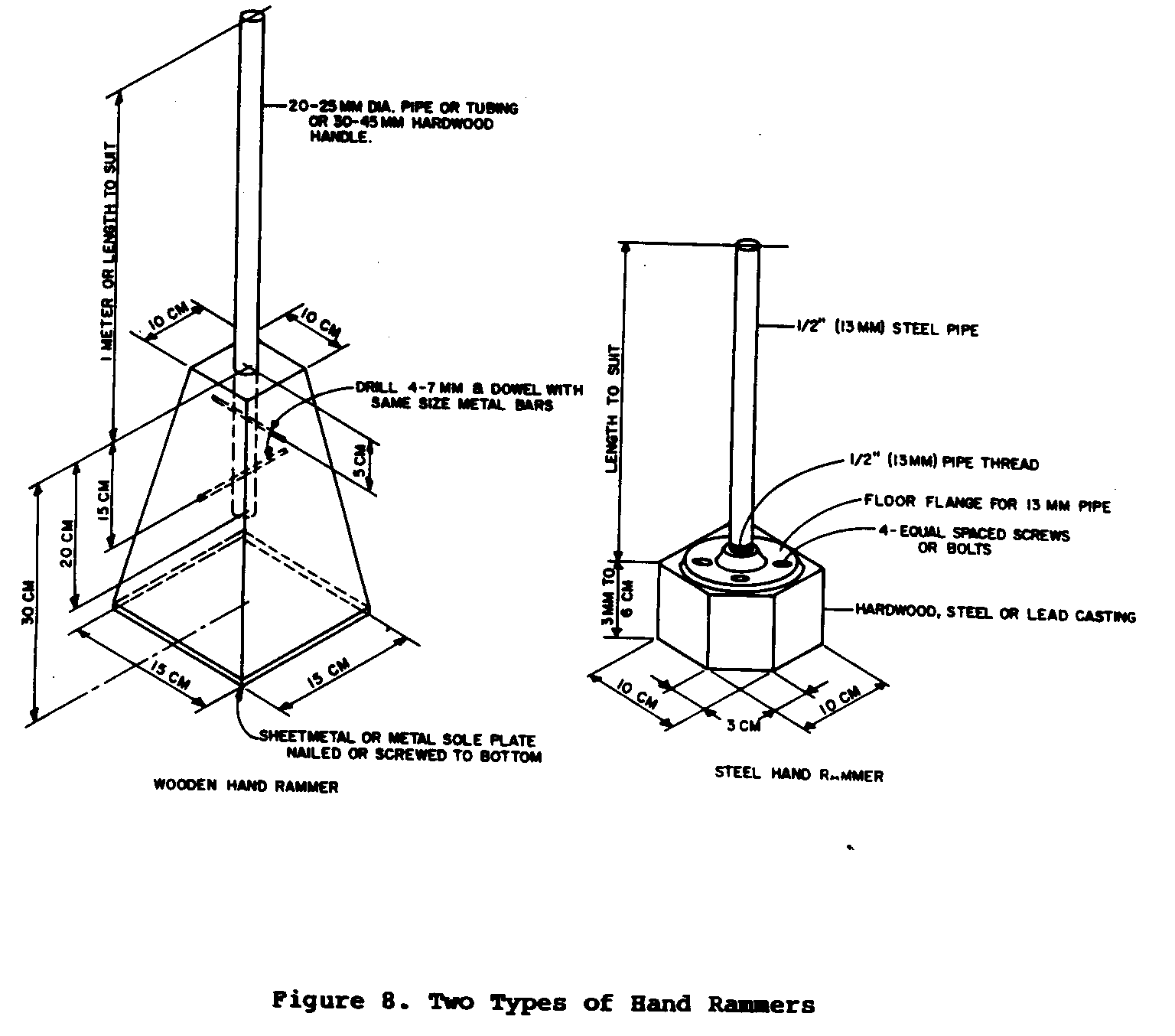
types of hand rammers used to assure proper compaction of
high-quality rammed earth. The sliding form technique can be
adapted for use in residential housing construction by using
special corner and wall-intersection forms.
Pressed Block Making
The CINVA-Ram and similar portable hand-operated machines,
used in many parts of the world, are good examples of an
effective tool for making pressed block. Figure 9 describes
34p23.gif (600x600)

the block-manufacturing process. Children and adults can
learn this simple process in a matter of minutes.
Simple Soil Tests
Optimum Moisture Test
To test the moisture content of soils and soil-cement
mixtures, the thumb-squeeze test is performed, as shown in
Figure 10. The moisture content is correct if the soil breaks
34p25.gif (437x437)

into two pieces upon applying pressure with the thumb.
Cement/Soil Mix Tests
Making blocks from stabilized earth is a simple process, but
it will not be successful unless the soil is properly tested.
It would be a serious mistake to treat this step lightly.
Scarce money and labor could be wasted and the result unsatisfactory.
Soil is a variable and complex building material. Every sample
is different from every other sample. But building blocks
can be made successfully from a wide variety of soils.
The tests described here will tell us:
* how much sand and how much clay is in the soil to be
used (Particle Determination Test and Compaction
Test,); and
* how much cement or lime should be added (Box Test).
Particle Determination Test. This test analyzes the soil to
find the ratio of sand to clay and/or silt:
1. Pass the soil through a 1/4" (6 mm) screen.
2. Pour into a wide-mouth jar enough soil to fill the jar
half full.
3. Fill the jar with water and cover it.
4. Add 2 teaspoons of salt to help the clay/silt particles
settle faster.
5. Shake the jar vigorously for two minutes.
6. Set the jar on a level spot.
The soil should settle in about half an hour. The sand will
settle quickly to the bottom. The clay/silt particles will
settle last. Measure the layers to determine the ratio of
sand and clay/silt, as shown in Figure 11.
34p26.gif (540x540)

Use soil that is at least one-third sand and between 5 and 30
percent clay/silt. If the soil at hand is not suitable, it
can be made suitable by adding sand or clay. Record the
percentages of sand and clay/silt in the soil used. This will
help in deciding which soil makes the best blocks.
Compaction Test. This test indicates the packing quality of
the earth, which depends on the percentage of clay in the
sample.
1. Take a handful of dry, screened earth and moisten it
until it is damp enough to form a ball when squeezed in
the hand, but not so damp that it will leave more than
a slight trace of water on the palm.
2. Drop the ball from a height of about three feet onto
hard ground. If the ball breaks into a few smaller
pieces, the packing quality is good to fair. If it
disintegrates, the quality is poor.
Box Test. The box test is a guide to the proper soil-cement
ratio. It measures the shrinkage of soil which contains no
stabilizer. As shown in Figure 12, the box should have these
34p27.gif (437x437)

inside measurements: 24" x 1-1/2" x 1-1/2" (4 cm x 4 cm x 60
cm).
1. Oil or grease the inside surfaces of the box thoroughly.
2. Pack the box well with moist soil (previously passed
through a 1/4" to 3/8" (6 mm to 10 mm mesh screen). The
soil should be moistened to pack well, but it should
not be muddy.
3. Tamp, especially at the corners.
4. Smooth off the surface with a stick.
5. Place the box in the sun for three days or in the shade
for seven days. It should be protected from rain.
Measure the contraction (shrinkage) by pushing the dried
sample to one end of the box.
Shrinkage Cement to Soil Ratio
Not over 1/2" (15 mm) 1 part to 18 parts
Between 1/2" and 1"
(15 mm - 30 mm) 1 part to 16 parts
Between 1" and 1-1/2"
(30 mm - 45 mm) 1 part to 14 parts
Between 1-1/2" and 2"
(45 mm - 60 mm) 1 part to 12 parts
When lime is used instead of cement use double the amount. Do
not use the soil if it has many cracks (not just three or
four); if it has arched up out of the box; or if it has
shrunk more than 2" (60 mm).
As shown in Table 7, the amount of cement/soil mixture is
calculated by soil volume. If the soil contains 90 percent
sand, then the amount of cement to soil would be 10 percent.
Table 7. Proportioning Cement Stabilizer to Soil Volume
Proportion of Ratio of Amount of
Soil Sand to Soil Cement to Soil Cement to Soil
Content (Percent) (Volume) (Percent)
Sand 90 1:10 10.0
Sand 85 1:16.7 6.0
Sand 75 1:12 8.3
Sand 63 1:11.8 8.5
Sand 36-63 1:11 9.0
Sand <36 1:8.3 12.0
Sand, silt,
and clay
combined >80 1:8.3 12.0
Sand, silt,
and clay
combined <80 1:6.7 15.0
Note that pure sands or pure clays are not suitable for
stabilization with Portland cement. If soil particles lump
together, add a dilute solution of ammonia, soda, salt, or
sodium silicate to the water.
For floor tiles, make a richer soil-cement mix by adding 20
percent of cement to the soil (or 1:5) for greater strength
and resistance to erosion. As discussed in an earlier section
(see "Soil Classification," p. 3) of this paper, be sure to
take the soil from the B or C horizon or below the organic
layer, to ensure adequate stabilization of soil.
The Curing Process
Any building material composed of soil-cement (whether rammed
earth or block pressed) must cure slowly until hard. The
finished block or wall section is moistened daily for at
least one week. While curing, blocks are placed in the shade,
and covered to prevent rapid drying and to protect them from
rain erosion. Since regions accustomed to primitive adobe
construction are unfamiliar with cement curing, a general
tendency will be to sun-cure blocks. This is not appropriate
for cement. A slow curing is needed.
For road surfaces as described in Figure 6, a sealer should be
34p20.gif (600x600)
applied to the finished surface to prevent moisture evaporation.
A low-cost white paint is a good sealer. It reflects
heat and keeps the material cool. Spray paint works well, too.
Cost-Effectiveness of Soil-Cement Blocks
Countless experiences indicate a cost savings of at least 50
percent over conventional methods. For example, in a housing
development proposal submitted to the Government of Indonesia
in 1973, construction costs of soil-cement walls were compared
with those of brick walls, as shown in Table 8. In that proposal,
soil-cement walls were shown to cost less than brick
walls.
STATE-OF-THE-ART EARTH STABILIZATION TECHNOLOGIES
Polymers and latexes are now being added to soil mixes to
further improve the properties of soil-cement. These compounds
provide greater water and freeze-thaw resistance. Inserts have
been developed for the block machines to allow spaces for
structural reinforcement, enabling structures to better withstand
the impact of hurricanes and earthquakes.
III. FUTURE OF THE TECHNOLOGY
NEED FOR FURTHER RESEARCH AND DEVELOPMENT
In September 1981, an international workshop on "Earthen
Buildings in Seismic Areas" was held at the University of New
Mexico, in Albuquerque, New Mexico, USA. At this workshop,
participants identified needs and priorities in response to
the worldwide problem of the susceptibility of earthen buildings
to destruction from earthquakes. The participants noted
the need to:
* establish minimum quality standards, quality control of
materials, and quality production methods;
* establish programs with the aim of reducing the vulnerability
of earthen buildings to earthquakes;
* increase the emphasis on training local building technicians;
* increase the emphasis on documenting effective public information
and housing education techniques;
* develop effective communication tools and training aids for
use in program implementation.
Table 8. Comparative Costs for Construction of Soil-Cement Walls
Versus Brick-Stucco Walls (1973 Rupees)
Type Wall Amount Number of
of Thickness of Soil Bricks/Blocks Cost
Wall (Inches) (Per [m.sup.3]) (Per [m.sup.2]) (Rupees)(a)
Brick-Stucco --
Bricks 80.0 400
Portland Cement
(for mortar joints) 106
Sand
(for mortar joints and stucco) 68
Portland Cement
(for stucco) 40
Labor 142
Total Costs 756
Soil-Cement Wall 6
Blocks 33.3
Soil .195 10
Portland Cement Mix 172
Labor 67
CINVA-Ram Machine 67
Labor and Dozer
(for moving soil) 39
Mortar Mix 92
Labor for Mortar 33
Total Costs 480
Soil-Cement Wall 4
Blocks 21.3
Soil .136
Portland Cement Mix 7
Labor 110
CINVA-Ram Machine 43
Labor and Dozer 43
(for moving soil) 25
Mortar Mix 59
Labor for Mortar 21
Total Costs 308
(a) In 1973, 410 rupees equaled one U.S. dollar.
One of the many papers addressed further research on stabilized
soil-cement for low-cost construction. It emphasized
placing reinforcement (such as bamboo or light steel rods or
cages) into footings and walls. It further suggested the integration
of a mini-mobile industrial system for on-site manufacture
and erection of low-cost buildings, using the CINVA-Ram
machine as the basic tool. Included was a program to
build, test, and analyze a prototype minimum structure that
would include soil-cement-reinforced block lintels, tie-beams,
walls, and foundations.
Roofing is a major expense. The beams and roofing material can
be the most costly items. Ferro-soil-cement structural roof
sections could be a complimentary part of the structure. They
could be built without high-level skills or technology if the
laboratory techniques were developed and tested. The prototype
structure could serve as a model for constructing other low-cost
permanent buildings.
IV. CHOOSING THE APPROPRIATE TECHNOLOGY
In deciding whether to use cement stabilized soils or not, one
must first determine:
* what skills are available;
* what materials are accessible for use;
* what standards have to be met by the local community;
* what tools and equipment are available;
* what the economics of the situation are;
* what the overall objectives are;
- to build as cheaply as possible;
- to employ as many people as possible;
- to develop permanent skills and jobs;
- to provide permanent low-maintenance structures;
* what the anticipated scale for production is;
* what the prevailing customs or personal acceptable standards
of housing and construction are; and
* what organizations are interested in sponsoring mutual-aid
or self-help initiatives.
BIBLIOGRAPHY
Adaska, W.S. et al. "Soil-Cement for Electric Power Plants."
Paper presented at the American Power Conference, Chicago,
Illinois, 22 April 1980.
Ahrens, Chris. Manual for Supervising Self-Help Home
Construction with Stabilized Earth Blocks Made in the
CINVA-Ram Machine. Kanawha County, West Virginia, 1965.
Ahrens, Chris. Stabilized Earth Construction in Cold
Climates. 1976.
Akray, S. Investigation on the Compressive Strength of Various
Stabilized Clay Adobe Bricks. Ankara, Turkey: Middle East
Technical University, 1965.
American Society for Testing and Materials. Annual Book of
ASTM Standards, 12 vols. Vol. 4.08: Soils. Philadelphia,
Pennsylvania: American Society for Testing and Materials,
1984.
American Society for Testing and Materials. Concrete and
Mineral Aggregates. ASTM Part 10. Philadelphia, Pennsylvania:
American Society for Testing and Materials, 1968.
Boatwright, J.H. How to Get Waterproofing Substances from
Plants. Arlington, Virginia: Volunteers in Technical
Assistance, 1977.
Cain, A.; Afshar, F; and Norton, J. "Indigenous Building and
the Third World." Architectural Design 45 (April 1975):
207-24.
California State University. International Institute of
Housing Technology. The Manufacture of Asphalt Emulsion
Stabilized Soil Bricks and Brick Maker's Manual. Fresno,
California: California State University, 1972.
Clough, R.H. A Qualitative Comparison of Rammed Earth and
Sun-dried Adobe Brick. Albuquerque, New Mexico: University
of New Mexico Press, 1950.
Commonwealth Experimental Building Station. "Choice of Soil
and Methods of Construction." SB 13. Earth Wall Construction.
Chatswood, Australia: Commonwealth Experimental
Building Station, 1951-1952.
Commonwealth Experimental Building Station. "Pise (Rammed
Earth)." SB 18. Earth Wall Construction. Chatswood,
Australia: Commonwealth Experimental Building Station,
1951-1952.
Commonwealth Experimental Building Station. "Adobe (Puddled
Earth)." SB 20. Earth Wall Construction. Chatswood,
Australia: Commonwealth Experimental Building Station,
1951-1952.
Commonwealth Experimental Building Station. "Stabilized
Earth." SB 22. Earth Wall Construction. Chatswood,
Australia: Commonwealth Experimental Building Station,
1951-1952.
Fitzmaurice, R. Manual on Stabilized Soil Construction for
Housing. New York, New York: United Nations, 1958.
Germin, A. "The Endurance of Earths as Building Material and
the Discreet But Continuous Charm of Adobe." M.E.T.U.
Journal of the Faculty of Architecture 5 (Spring 1979).
Jones, C.W. Effect of a Polymer on the Properties of
Soil-Cement. Bureau of Reclamation Report REC-OCE-20-18.
Denver Colorado: Bureau of Reclamation, 1970.
Kirkham, U.E. How to Build Your Own Home of Earth. Oklahoma A
and M Engineering Experiment Station Publication 54.
Stillwater, Oklahoma: Oklahoma A and M Engineering
Experiment Station, 1943.
Lunt, M.G. "Stabilized Soil Blocks for Building." Overseas
Building Notes No. 184. Garston, England: Building
Research Station, February 1980.
Mehra, S.R. Use of Rammed Cement Soil in Large Scale Housing
Construction in East Punjab. Bombay, India: Government of
India Press, 1948.
Metalibec Ltd. CINVA-Ram Block Press Manual. New York, New
York: International Basic Economy Corporation, 1959.
Middleton, G.F. Earth Wall Construction. Sydney, Australia:
Commonwealth Experimental Building Station, 1949.
Portland Cement Association. Soil-Cement Construction Handbook.
Chicago, Illinois: Portland Cement Association,
1956.
Portland Cement Association. Soil-Cement Laboratory Handbook.
Chicago, Illinois: Portland Cement Association, 1956.
Portland Cement Association. Soil Primer. Chicago, Illinois:
Portland Cement Association, 1956.
Razani, R., and Behpour, L. Some Studies on Improving the
Properties of Earth Materials Used or the Construction of
Rural Earth Houses in Seismic Regions of Iran. Shiraz,
Iran: Pahlavi University, 1970.
South Dakota State College. Department of Agricultural
Engineering. Rammed Earth Walls for Farm Buildings.
Bulletin No. 277. Brookings, South Dakota: South Dakota
State College, 1938.
Volunteers in Technical Assistance. Making Building Blocks
with the CINVA-Ram Block Press. Arlington, Virginia:
Volunteers in Technical Assistance, 1975.
United Nations. Department of Economics and Social Affairs.
Soil-Cement - Its Use in Building. New York, New York:
United Nations, 1964.
U.S. Agency for International Development. Handbook for
Building Homes of Earth. Action Pamphlet No. 4200.36. By
Lyle A. Wolfskill, Wayne A. Dunlop, and Bob M. Callaway.
Washington, D.C.: Peace Corps, December 1979.
U.S. Department of Agriculture. Building with Adobe and
Stabilized Earth Blocks. Leaflet No. 535. Washington,
D.C.: Government Printing Office, 1968.
U.S. Department of Commerce. National Bureau of Standards.
Methods for Characterizing Adobe Building materials.
Technical Note No. 977. Washington, D.C.: National Bureau
of Standards, June 1978.
U.S. Library of Congress. Division of Bibliography. List of
References on Pise de Terre and Adobe Construction.
Washington, D.C.: U.S. Library of Congress, 1931.
SUPPLIERS
SUPPLIERS OF TEST EQUIPMENT
SoilTest Inc., 2205 Lee Street, Evanston, Illinois 60202,
USA
TestLab/GDI Inc., 130 Buchanan Circle, Pacheco, California
94553, USA
SUPPLIERS OF CINVA-RAM BLOCK-MAKING MACHINES
CARE, 660 First Avenue, New York, NY 10016, USA
Metalibec Ltda., Apartado Aereo 11798, Bogota, Colombia, SA
Schrader Bellows, 200 West Exchange Street, P.O. Box 631,
Akron, Ohio 44309, USA
========================================
========================================
UNDERSTANDING STABILIZED
EARTH CONSTRUCTION
By
Alfred Bush
Illustrated By
William C. Neel
Technicall Reviewers
Chris Ahrens
Daniel Kuennen
VITA
1600 Wilson Boulevard, Suite 500
Arlington, Virginia 22209 USA
Tel: 703/276-1800 * Fax: 703/243-1865
Internet: pr-info@vita.org
Understanding Stabilized Earth Construction
ISBN: 0-86619-201-8
[C] 1984, Volunteers in Technical Assistance
PREFACE
This paper is one of a series published by Volunteers in
Technical Assistance to provide an introduction to specific
state-of-the-art technologies of interest to people in developing
countries. The papers are intended to be used as guidelines
to help people choose technologies that are suitable to
their situations. They are not intended to provide construction
or implementation details. People are urged to contact
VITA or a similar organization for further information and
technical assistance if they find that a particular technology
seems to meet their needs.
The papers in the series were written, reviewed, and illustrated
almost entirely by VITA Volunteer technical experts on
a purely voluntary basis. Some 500 volunteers were involved
in the production of the first 100 titles issued, contributing
approximately 5,000 hours of their time. VITA staff
included Leslie Gottschalk as primary editor, Julie Berman
handling typesetting and layout, and Margaret Crouch as
project manager.
Alfred Bush, author of this paper, is a research consultant
in construction systems development. He has published widely
in this field, and often serves as a technical consultant on
housing and development and community planning projects.
Reviewers Chris Ahrens and Daniel Kuennen are also specialists
in the area. Ahrens is an international program adviser
at Warren Wilson College, and Kuennen is a community development
specialist with the University of Delaware Cooperative
Extension Service. Artist William Neel is a certified industrial
instructor, a construction engineer, a professional
draftsman, and a professional technical illustrator.
VITA is a private, nonprofit organization that supports
people working on technical problems in developing countries.
VITA offers information and assistance aimed at helping
individuals and groups to select and implement technologies
appropriate to their situations. VITA maintains an international
Inquiry Service, a specialized documentation center,
and a computerized roster of volunteer technical consultants;
manages long-term field projects; and publishes a variety of
technical manuals and papers.
UNDERSTANDING STABILIZED EARTH CONSTRUCTION
by VITA Volunteer Al Bush
I. INTRODUCTION
Soil is one of the oldest building materials. It has been
used for centuries in all parts of the world. Ancient
temples, fortifications, and pyramids as well as part of the
Great Wall of China were built with soil.
The three traditional methods of soil construction are:
1. adobe block or lumps built up into walls; adobe is sun-dried
soil mixed with stabilizers such as straw or rice
husks to strengthen the soil;
2. wattle and daub: interwoven timber, saplings, or bamboo
daubed with mud; and
3. rammed earth: soil mixed with stabilizers and subjected to
high pressure.
Pure soil--whether molded into a block, i.e., adobe brick, or
cut as a slab, i.e., sod--is technologically suitable for
home and commercial construction. It can be used in combination
with timber frames or stone. No soil additives are used
in this process.
Stabilized soil, a product of scientific research, offers
medium- and high-technology soil options. Unfortunately,
local conditions will determine its applicability to your
situation. Stabilized earth may not be appropriate unless
stabilizing additives, technical assistance, and machinery
are available and affordable. Simple adobe or rammed-earth
may be preferable.
Medium technology can produce soils usable for road beds,
airport runways, shoulders, road surfaces, and storage and
parking areas. Higher technology options include: sub-bases
for concrete pavings, drainage ditches, canals, dike surfaces,
reservoir linings, and multi-story foundations.
Depending on the level of technology available, soil can
serve as a basic resource. It is suitable as a universal
building material. Many types of soil are relatively accessible,
removable, and mixable. High technology increases its
uses.
HIGH OR LOW TECHNOLOGY?
In evaluating soil as a building component consider whether
it
* meets the technical needs of your local production
situation by:
- using local materials, power, and resources
- minimizing the need for imported material
- reducing costly transportation
- ensuring product availability and dependability
* meets social requirements of the local production situation
by:
- using existing or easily transferable skills
- avoiding costly training
- minimizing displacement of labor
- minimizing social/cultural disruption
* meets the economic requirements of the local situation
by:
- reducing dependence on outside resources
- ensuring low-cost alternatives
- requiring limited machinery or capital investment.
For example, in the mountainous country of Colombia, South
America, a technical adviser noted about the use of adobe
pressed blocks that, "It had taken 267 five-hour mule trips
to carry up needed supplies (sinks, roof, cement, etc.) for a
community built schoolhouse. But thanks to the CINVA-Ram
earthen block press, farmers didn't need to haul heavy cement
blocks--saving at least 500 more mule trips!"
BASIC THEORY OF THE TECHNOLOGY
Natural, compacted soil has good insulating and resistant
qualities. It is, however, vulnerable to moisture and the
erosive effects of weather. Additives such as asphalts,
natural cements, and other compounds, including salts,
syrups, oils, and powders, stabilize soil in varying degrees.
Soil durability and strength can also be improved by:
* changing the distribution of grain size--gradation control;
* compacting the soil;
* adding minerals or chemicals; or
* mixing all of the above.
A properly consolidated, well-graded soil that is adequately
moisturized, mixed, and cured will provide a strong, stable,
waterproof, long-lasting, low-maintenance building material.
Soil stabilization depends on soil classification and the
type of structure to be built. Understanding the properties
of various soils will make it easier to select the highest
quality soil possible. Public buildings or highways require a
sophisticated technical approach. Simple structures such as
houses require a less technical approach.
Before using soil as a building material, it is necessary to:
* understand the soil characteristics in general;
* conduct soil tests to ensure that the soil chosen can be
stabilized; and
* stabilize the soil with additives or mixtures to make it
strong, cohesive, waterproof, and weatherproof.
Although some soils have excellent stability against moisture,
few meet all stabilization requirements. The best soil
contains up to 70 percent of coarse gravels and sands, with
the remainder consisting of finer silts, clays, and plastic-like
particles.
The particle size distribution of a soil determines how well
it can be stabilized. A well-graded soil contains the correct
proportions of different-sized particles. The spaces, or
voids, between larger particles are filled by smaller ones.
This is called the void ratio.
Highly technical construction requires a void ratio test.
Other stabilization tests to determine soil composition and
suitability may also be needed. Small, less technical, projects
need only simple tests for good results.
The technical requirements will be reviewed first, followed
by the short, simple procedures, which a builder with less
skills, equipment, and controls can use.
II. SOIL CLASSIFICATION
To determine the suitability of your soil for stabilization
and building, it is necessary to understand soil classification.
Table 1 classifies the world's soils into three categories:
order, suborder, and great soil groups. This table
permits a close study of soils worldwide with similar agricultural
characteristics, climates, topography, and drainage
characteristics. The three categories will help you to understand
your local soil type.
Figure 1 is useful in determining the soil profile. It shows
34p06.gif (600x600)
the breakdown of the soil layers, called horizons, into four
basic levels labeled A, B, C, and D. These levels take us
from the surface layer down to the underlying, or bottom-most
layer (stratum). From the top down, the A and B levels are
layers that have been modified by weathering. The C level has
been unaltered by the soil-forming processes. The A layer is
the topsoil, usually containing most of the organic material;
the B layer is the subsoil; the C layer is the parent material,
or mother soil, containing clay, silt, sand, gravel or
a combination of these, or stone of indefinite thickness; the
D layer is the underlying structure.
Suitable building soil contains the correct percentages of
sand, silt, and clay, as shown in Figure 2. In general, soils
34p07.gif (600x600)
containing less than 20 percent clay are classed as gravel
and sand, loamy sands, sandy loams, and loams; soils containing
20 to 30 percent clay are called clay loams; and soils
containing over 30 percent clay are classed as clay. The clay
fraction is of major importance in earth construction. Clay
binds the larger particles together, making it suitable as a
building material.
The U.S. Department of Agriculture Textural Classification
System grades soils into fractions according to the size of
particles, as follows:
Very coarse sand: 2.0 mm to 1.0 mm (No. 10 sieve to No.
18 sieve)
Coarse sad: 1.0 mm to 0.5 mm (No. 18 sieve to No. 35
sieve)
Medium sand: 0.5 mm to 0.25 mm (No. 35 sieve to No.
60 sieve)
Fine sand: 0.25 mm to 0.1 mm (No. 60 sieve to No.
140 sieve)
Very fine sand: 0.1 mm to 0.05 mm (No. 140 sieve to No.
20 sieve)
Table 1. Soil Classification in the Higher Categories
Order Suborder Great Soil Groups
Zonal 1. Soils of the cold zone Tundra soils
soils 2. Light-colored soils or arid Desert soils
regions Red desert soils
Sierozem
Brown soils
Reddish-brown soils
3. Dark-colored soils of semiarid, Chestnut soils
subhumid, and humid grasslands Reddish chestnut soils
Chernozem soils
Prairie soils
Reddish prairie soils
4. Soils of the forest-grassland Degraded chernozem
transition Noncalcic brown or
Shantun brown soils
5. Light-colored podzolized soils of Podzol soils
the timbered regions Gray wooded or
Gray podzolic soils(*)
Brown podzolic soils
Gray-brown podzolic soils
Red-yellow podzolic soils(*)
6. Lateritic soils of forested warm- Reddish-brown lateritic soils(*)
temperature and tropical regions Yellowish-brown lateritic soils
Laterite soils(*)
Intrazonal 1. Halomorphic (saline and alkali) Solonchak or
soils soils of imperfectly drained arid Saline soils
regions and littoral deposits Solonetz soils
Soloth soils
2. Hydromorphic soils of marshes, Humic-glei soils(*)
swamps, seep areas, and flats (includes wiesenboden)
Alpine meadow soils
Bog soils
Half-bog soils
Low-humic-glei(*) soils
Planosols
Groundwater podzol soils
Groundwater laterite soils
3, Calcimorphic soils Brown forest soils (braunerde)
Rendzina soils
Azonal Lithosols
soils Regosols (includes dry sands)
Alluvial soils
* New or recently modified great soil groups.
Source: "Higher Categories of Soil Classification: Order, Suborderr, and Great Soil
Groups," by James Thorp and Guy D. Smith, Soil Science, Vol 67, January to
June 1949, pp. 117-126.
Silt: 0.05 mm to 0.002 mm
Clay: 0.002 mm to 0.0 mm
Table 2 shows soils broken down by particle size (or grain
34p09.gif (600x600)
size).
III. SOIL TESTS
Soil properties must be analyzed and tested to determine the
suitability of soils for stabilization. The properties of
clay vary greatly in their physical and chemical characteristics.
The plastic properties of a clay are measured by gradually
removing water from it. Clay that contains a lot of
water behaves like a liquid. The liquid limit is the moisture
point at which a soil passes from a plastic to a liquid
state. To conduct a liquid limit test:
* Place the soil-water paste in a standard cup. Divide it
into to halves (1.2 cm apart) with a grooving tool.
* Repeatedly strike the bottom of the cup on a hard, flat
surface from a uniform measured height of 1 cm until the
test sample flows from each half together in the groove.
The liquid limit is defined as the water content that
fills the 1.2 cm groove after 25 standard strikes of the
cup.
* Experiment by adding more water to different samples. At
each addition of water the number of strikes of the cup
required to close the groove are recorded. Your results
will vary above or below the 25 standard. The range
should be between 10 and 40 strikes.
Clay crumbles as its moisture content is reduced to its
plastic limit. The plastic limit is the point at which the
soil becomes too dry to be plastic. To determine the plastic
limit of your soil, roll a thread of soil to 3.2 mm in diameter
between the palm of your hand and a dry, flat surface.
The soil thread is at its plastic limit when it crumbles
under this rolling action.
The liquid limit minus the plastic limit of a soil is called
the plasticity index. The plasticity index depends largely on
the amount of clay present. Both the liquid limit and the
plasticity index are affected by the amount of clay and the
type of clay minerals present in a soil. The strength of a
soil increases as the plasticity index increases. However,
high plasticity soils shrink when dry and expand when wet.
Stabilization minimizes these fluctuations.
Sands and sandy soils with little or no clay content have no
plastic limit. Fine-grained soils with a low degree of
plasticity have liquid limits of less than 35 percent; the
clay content of these soils is generally less than 20
percent. Fine-grained soils of medium plasticity have liquid
limits between 35 and 50 percent; these soils usually contain
between 20 and 40 percent of clay. Soils with high plasticity
have liquid limits of more than 50 percent; their clay
content is normally more than 40 percent.
A high liquid limit and plasticity index means soils are
susceptible to water and moisture penetration. They are
difficult to stabilize with cement and need larger amounts of
stabilizer than those with a low liquid limit and plasticity
index. Soils with a high liquid limit and plasticity index
can stabilize with lime. Lime changes the plastic properties
of soil.
Soil Stabilization Tests
Moisture-Density Test
Natural soil contains pore spaces filled partly by air and
water. Compaction can reduce these spaces. A well-compacted
soil is best.
Moisture content can be determined by a simple test:
* Take various soil samples from intended supply sites.
* Dry-mix freshly dug soil separately.
* Place samples in dishes or pans of equal sizes and
weights. Weigh and record each.
* Allow each to dry naturally or place in an oven.
* When dry, re-weigh and record differences of moist and
dry weights. Those with heavier dry weights have high
soil densities. These are best.
Wet Strength Test
A stabilized soil must withstand moisture. Since rain moistens
soil construction materials, it is important that the
wet compressive strength of a stabilized soil be determined.
The wet strength of a stabilized soil is one third of its dry
strength. Strength tests are performed on cured soil blocks,
which are soaked for at least 24 hours. (Note: the normal
curing period is 28 days during which time the specimens are
kept moist.) The test determines the crushing strength of
full-sized blocks.
The soil blocks or bricks can now be tested for compressive
strength. Here is the procedure:
* Place a brick over the supports located two inches from
the ends of the brick.
* Place a two-inch rod midway and parallel to the two supports.
* A load is applied to a maximum of 500 pounds. Compressive
strength should average between 250 and 300 pounds
before rupture.
A simple compression machine can be constructed. Figure 3 is
34p12.gif (600x600)
an example of a modulus that can be used for wet or dry brick
tests.
Soil Mixes for Improved Stabilization
There are many ways to improve the stability of soils. For
example, varying the mineral content by adding crushed limestone
or limestone dust to a granite mixture changes the
chemical attributes of a soil. Limestone increases the pH,
making the soil water resistant. Other materials, such as
hydraulic lime and various salts, produce similar results.
Adding asphalt emulsions (that is, asphalt mixed with water)
and hydraulic and Portland cements to a soil also produces
good results. Stabilizers improve the mechanical and chemical
bond, adding strength and weather resistance to the soil.
Portland cement begins to react immediately when mixed into
wet soils. Lime takes longer than cement to harden. It
attains about one-half the strength of soil-cement mixes.
Unfortunately, cement is more expensive and often unavailable.
Each stabilizer mix must be extensively tested for: (1)
weather and water immersion resistance, and (2) compressive
strength.
Unstabilized Versus Stabilized Soils
Comparative tests of unstabilized and stabilized soils show
that both dry and wet strengths of cement-stabilized soils
are stronger and more water resistant than the best
unstabilized soils.(1) An unstabilized block retains only 20 to
30 percent of its dry strength. A cement-stabilized block
retains 60 to 65 percent of its dry strength. Dry strength
accounts for the stabilizing quality of soil-cement under
wet-dry and freeze-thaw conditions.
Experimentation with other additives has produced mixed
results. Wood shavings and sawdust mixed with Portland cement
have been tested. Stabilization results with sawdust were not
satisfactory; stabilization results with wood shavings are
somewhat better. You may want to field test inexpensive,
available materials using the test methods previously
discussed.
Soil-Cement Tests
A simple procedure is the 7-day compressive strength test for
materials.
Soil-Cement Mixes
Table 3 gives cement quantities by volume and weight for
testing various types of soils. Note that the range in cement
requirements varies from 5 to 14 percent by volume and from 3
to 16 percent by weight for the total range of soil groups,
allowing for variations in the subgroups.
(1) Unstabilized blocks, air-dried to stable weight, vary in
strength between 15 and 25 Kg/[cm.sup.2], or between 220 and 370
lb/[in.sup.2]; when wet (i.e., when they are kept in water for 24
hours), they vary in strength between 0 and 5 Kg/[cm.sup.2], or
between 0 and 75 lb/[in.sup.2], absorbing between 12 and 40 percent
moisture by volume. Cement-stabilized, air-dried block tested
between 25 and 35 Kg/[cm.sup.2] (or between 370 and 520 lb/[in.sup.2]), and
between 15 and 23 Kg/[cm.sup.2] (or between 220 and 340 lb/[in.sup.2]) when
wet, gains between 6 and 12 percent moisture by volume.
Table 3. Cement Requirements of AASHO(a) Soil Groups
Estimated Cement
Usual Range Content and That
in Cement Used in Cement Contents
Requirement Moisture-Density for Wet-Dry and
AASHO(a) (Percent (Percent Test Freeze-Thaw Tests
Soil by by (Percent by (Percent by
Group Volume) Weight) Weight) Weight)
A-1-a 5- 7 3- 5 5 3- 4- 5- 7
A-1-b 7- 9 5- 8 6 4- 6- 8
A-2 7-10 5- 9 7 5- 7- 9
A-3 8-12 7-11 9 7- 9-11
A-4 8-12 7-12 10 8-10-12
A-5 8-12 8-13 10 8-10-12
A-6 10-14 9-15 12 10-12-14
A-7 10-16 13 11-13-15
(a) American Association of State Highway Officials.
Source: Portland Cement Association, Soil-Cement Construction
Handbook. (Chicago, Illinois: Portland Cement
Association, 1956).
Table 4 provides cement content by volume and weight for
miscellaneous materials used in construction.
Table 4. Average Cement Requirements
of Miscellaneous Materials
Estimated Cement
Content and That Cement Contents
Used in for Wet-Dry and
Moisture-Density Freeze-Thaw
Test Tests
Type of (Percent (Percent (Percent
Miscellaneous by by by
Material Volume) Weight) Weight)
Shell soils 8 7 5- 7- 9
Limestone screenings 7 5 3- 4- 5- 7
Red dog 9 8 6- 8-10
Shale or disinte-
grated shale 11 10 8-10-12
Caliche 8 7 5- 7- 9
Cinders 8 8 6- 8-10
Chert 9 8 6- 8-10
Chat 8 7 5- 7- 9
Marl 11 11 9-11-13
Scoria containing
material retained
on the No. 4 sieve 12 11 9-11-13
Scoria not containing
material retained
on the No. 4 sieve 8 7 5- 7- 9
Air-cooled slag 9 7 5- 7- 9
Water-cooled slag 10 12 10-12-14
Source: Portland Cement Association, Soil-Cement Construction
Handbook. (Chicago, Illinois: Portland Cement
Association, 1956).
To test for proper hardness, rapid "pick" and "click" tests
are performed, using 7-day-old water-soaked blocks. Using a
finely pointed object, stab with force at the brick. Measure
the object's penetration. Penetration should be less than
one-fourth of an inch. For the "click" test, hold one brick
in each hand. Slam them together. A sharp sound indicates
hardness. A soft sound indicates softness.
The moisture density test also can be used for stabilized
soils. Greatest compaction occurs at maximum density and
optimum moisture content. This applies equally for hand
tamped or machine-compacted stabilized soils.
<Figure 4>
34p16a.gif (437x437)
34p16b.gif (393x393)
<Figure 5>
Other Soil-Cement Mixes
Soil mixes using cement as a binder are also used in two
other forms. These are: (1) cement-modified soils, and (2)
plastic soil-cement.
Cement-Modified Soils
Cement-modified soils are mixed with substandard granular
soils, and Portland cement to reduce plasticity and to raise
weight-bearing ability. Cement-modified soils are used as
base courses for flexible pavements or as sub-bases for pavements.
These substandard soils with high plasticity indexes
can be stabilized by adding very small percentages of cement,
as shown in Table 5. This produces an increase in bearing
values which are permanent, as shown in Table 6.
Table 5. Permanency of Plastic Index (P.I.) Reduction
of Cement-Modified Granular Soil
Cement Content
(Percent by Volume)
0 3 5
P.I.
Raw soil(a) 14 -- --
Laboratory mixture,
age 7 days -- 4 NP(b)
Laboratory mixture
after 30 cycles freeze-thaw -- 3 NP
Laboratory mixture
after 60 cycles freeze-thaw -- 1 NP
(a) A-2-6(0) soil from Carroll County, Tennessee, USA.
(b) Nonplastic.
Source: Portland Cement Association, Soil-Cement Construction
Handbook. (Chicago, Illinois: Portland Cement
Association, 1956).
Table 6. Permanency of Bearing Values of
Cement-Modified Granular Soil
Bearing Value
Raw soil(a) 43
Laboratory mixture, 2 percent cement
by weight at age 7 days 255
Laboratory mixture, 2 percent cement
by weight after 60 cycles freeze-thaw 258
Laboratory mixture, 4 percent cement
by weight at age 7 days 485
Laboratory mixture, 4 percent cement
by weight after 60 cycles freeze-thaw 574
(a) A-1-b(0) disintegrated granite from Riverside County,
California, USA.
Source: Portland Cement Association, Soil-Cement Construction
Handbook. (Chicago, Illinois: Portland Cement
Association, 1956).
Silty-clay soils have: (1) high water-holding capabilities,
(2) volume change capacities, and (3) low bearing strengths.
They are normally unsuitable for subgrades. Silty-clay soils
require cement mixtures greater than those for granular
soils. By modifying them with cement, they have use:
1. as a modified subgrade for flexible or soil-cement pavements;
2. as a sub-base for concrete paving, which will control
moisture and volume changes in the subgrade; and
3. in stabilizing highway fills, strengthening soft areas in
subgrades, and as backfill material in trenches.
Plastic Soil-Cement
Plastic soil-cement is a thorough mixture of soil, Portland
cement, and water. When mixed, it has a plaster mortar consistency.
Light-textured sandy soils are ideal for these mixtures.
Soil selection is based on 30 percent or less of the
material that passes through a No. 200 mesh sieve. Suitable
cement weight is about four percent greater than similar
soil-cement compacted ones. The density of these mixtures is
about 15 lb per cubic foot (240 Kg/[M.sup.3]) less than the maximum
density of a compacted soil-cement mixture at optimum moisture
content.
To increase surface resistance to water erosion, increase
cement content by two percent.
HIGH-TECHNOLOGY APPLICATION OF SOIL
Equipment Needed for Soil-Cement Construction
An application of soil-cement to road construction is shown
in Figure 6. It identifies the type of equipment used with as
34p20.gif (600x600)
step-by-step operations. Note that the materials are generally
mixed, wetted, compacted, and cured in place.
Due to the varieties of soil, it may be necessary to modify
the soil-cement processing operations outlined in Figure 6.
For example, breaking up a clayey soil is difficult. You can
add an intermediate step of prewetting and mixing some lime
(or .6 to 1.0 percent calcium chloride) into the soil, forming
the mixture into windrows, and letting it stand overnight.
This mix diffuses the moisture throughout the material
by breaking down soil particles. The Portland cement is now
ready to mix with the soil.
Cost/Economics
Soil-cement is an inexpensive road construction material.
Normally, it is 50 percent cheaper than building with comparable
materials. Over 70,000 miles of soil-cement roads in
the United States attest to its cost-effectiveness.
LOW-TECHNOLOGY APPLICATIONS OF SOIL
Housing Construction Equipment
A variety of equipment can be used to construct low-cost
residential houses. Two techniques--rammed-earth construction
and pressed block making--are discussed in this section. Both
techniques require minimal training or equipment. Rammed-earth
construction is less dependent on outside technology
since its major technical material is wooden forms. Pressed
blocks do require importation of either the machine or high-grade
metal for fabrication. Whereas rammed earth cannot be
transported, with care, blocks can be.
Rammed-Earth Construction
Rammed earth walls are made by ramming moist earth into forms
similar to those used for concrete construction. Figure 7
34p21.gif (600x600)
shows a sliding form for rammed earth construction. Earth is
compacted either mechanically or by hand. Figure 8 shows two
34p22.gif (600x600)
types of hand rammers used to assure proper compaction of
high-quality rammed earth. The sliding form technique can be
adapted for use in residential housing construction by using
special corner and wall-intersection forms.
Pressed Block Making
The CINVA-Ram and similar portable hand-operated machines,
used in many parts of the world, are good examples of an
effective tool for making pressed block. Figure 9 describes
34p23.gif (600x600)
the block-manufacturing process. Children and adults can
learn this simple process in a matter of minutes.
Simple Soil Tests
Optimum Moisture Test
To test the moisture content of soils and soil-cement
mixtures, the thumb-squeeze test is performed, as shown in
Figure 10. The moisture content is correct if the soil breaks
34p25.gif (437x437)
into two pieces upon applying pressure with the thumb.
Cement/Soil Mix Tests
Making blocks from stabilized earth is a simple process, but
it will not be successful unless the soil is properly tested.
It would be a serious mistake to treat this step lightly.
Scarce money and labor could be wasted and the result unsatisfactory.
Soil is a variable and complex building material. Every sample
is different from every other sample. But building blocks
can be made successfully from a wide variety of soils.
The tests described here will tell us:
* how much sand and how much clay is in the soil to be
used (Particle Determination Test and Compaction
Test,); and
* how much cement or lime should be added (Box Test).
Particle Determination Test. This test analyzes the soil to
find the ratio of sand to clay and/or silt:
1. Pass the soil through a 1/4" (6 mm) screen.
2. Pour into a wide-mouth jar enough soil to fill the jar
half full.
3. Fill the jar with water and cover it.
4. Add 2 teaspoons of salt to help the clay/silt particles
settle faster.
5. Shake the jar vigorously for two minutes.
6. Set the jar on a level spot.
The soil should settle in about half an hour. The sand will
settle quickly to the bottom. The clay/silt particles will
settle last. Measure the layers to determine the ratio of
sand and clay/silt, as shown in Figure 11.
34p26.gif (540x540)
Use soil that is at least one-third sand and between 5 and 30
percent clay/silt. If the soil at hand is not suitable, it
can be made suitable by adding sand or clay. Record the
percentages of sand and clay/silt in the soil used. This will
help in deciding which soil makes the best blocks.
Compaction Test. This test indicates the packing quality of
the earth, which depends on the percentage of clay in the
sample.
1. Take a handful of dry, screened earth and moisten it
until it is damp enough to form a ball when squeezed in
the hand, but not so damp that it will leave more than
a slight trace of water on the palm.
2. Drop the ball from a height of about three feet onto
hard ground. If the ball breaks into a few smaller
pieces, the packing quality is good to fair. If it
disintegrates, the quality is poor.
Box Test. The box test is a guide to the proper soil-cement
ratio. It measures the shrinkage of soil which contains no
stabilizer. As shown in Figure 12, the box should have these
34p27.gif (437x437)
inside measurements: 24" x 1-1/2" x 1-1/2" (4 cm x 4 cm x 60
cm).
1. Oil or grease the inside surfaces of the box thoroughly.
2. Pack the box well with moist soil (previously passed
through a 1/4" to 3/8" (6 mm to 10 mm mesh screen). The
soil should be moistened to pack well, but it should
not be muddy.
3. Tamp, especially at the corners.
4. Smooth off the surface with a stick.
5. Place the box in the sun for three days or in the shade
for seven days. It should be protected from rain.
Measure the contraction (shrinkage) by pushing the dried
sample to one end of the box.
Shrinkage Cement to Soil Ratio
Not over 1/2" (15 mm) 1 part to 18 parts
Between 1/2" and 1"
(15 mm - 30 mm) 1 part to 16 parts
Between 1" and 1-1/2"
(30 mm - 45 mm) 1 part to 14 parts
Between 1-1/2" and 2"
(45 mm - 60 mm) 1 part to 12 parts
When lime is used instead of cement use double the amount. Do
not use the soil if it has many cracks (not just three or
four); if it has arched up out of the box; or if it has
shrunk more than 2" (60 mm).
As shown in Table 7, the amount of cement/soil mixture is
calculated by soil volume. If the soil contains 90 percent
sand, then the amount of cement to soil would be 10 percent.
Table 7. Proportioning Cement Stabilizer to Soil Volume
Proportion of Ratio of Amount of
Soil Sand to Soil Cement to Soil Cement to Soil
Content (Percent) (Volume) (Percent)
Sand 90 1:10 10.0
Sand 85 1:16.7 6.0
Sand 75 1:12 8.3
Sand 63 1:11.8 8.5
Sand 36-63 1:11 9.0
Sand <36 1:8.3 12.0
Sand, silt,
and clay
combined >80 1:8.3 12.0
Sand, silt,
and clay
combined <80 1:6.7 15.0
Note that pure sands or pure clays are not suitable for
stabilization with Portland cement. If soil particles lump
together, add a dilute solution of ammonia, soda, salt, or
sodium silicate to the water.
For floor tiles, make a richer soil-cement mix by adding 20
percent of cement to the soil (or 1:5) for greater strength
and resistance to erosion. As discussed in an earlier section
(see "Soil Classification," p. 3) of this paper, be sure to
take the soil from the B or C horizon or below the organic
layer, to ensure adequate stabilization of soil.
The Curing Process
Any building material composed of soil-cement (whether rammed
earth or block pressed) must cure slowly until hard. The
finished block or wall section is moistened daily for at
least one week. While curing, blocks are placed in the shade,
and covered to prevent rapid drying and to protect them from
rain erosion. Since regions accustomed to primitive adobe
construction are unfamiliar with cement curing, a general
tendency will be to sun-cure blocks. This is not appropriate
for cement. A slow curing is needed.
For road surfaces as described in Figure 6, a sealer should be
34p20.gif (600x600)
applied to the finished surface to prevent moisture evaporation.
A low-cost white paint is a good sealer. It reflects
heat and keeps the material cool. Spray paint works well, too.
Cost-Effectiveness of Soil-Cement Blocks
Countless experiences indicate a cost savings of at least 50
percent over conventional methods. For example, in a housing
development proposal submitted to the Government of Indonesia
in 1973, construction costs of soil-cement walls were compared
with those of brick walls, as shown in Table 8. In that proposal,
soil-cement walls were shown to cost less than brick
walls.
STATE-OF-THE-ART EARTH STABILIZATION TECHNOLOGIES
Polymers and latexes are now being added to soil mixes to
further improve the properties of soil-cement. These compounds
provide greater water and freeze-thaw resistance. Inserts have
been developed for the block machines to allow spaces for
structural reinforcement, enabling structures to better withstand
the impact of hurricanes and earthquakes.
III. FUTURE OF THE TECHNOLOGY
NEED FOR FURTHER RESEARCH AND DEVELOPMENT
In September 1981, an international workshop on "Earthen
Buildings in Seismic Areas" was held at the University of New
Mexico, in Albuquerque, New Mexico, USA. At this workshop,
participants identified needs and priorities in response to
the worldwide problem of the susceptibility of earthen buildings
to destruction from earthquakes. The participants noted
the need to:
* establish minimum quality standards, quality control of
materials, and quality production methods;
* establish programs with the aim of reducing the vulnerability
of earthen buildings to earthquakes;
* increase the emphasis on training local building technicians;
* increase the emphasis on documenting effective public information
and housing education techniques;
* develop effective communication tools and training aids for
use in program implementation.
Table 8. Comparative Costs for Construction of Soil-Cement Walls
Versus Brick-Stucco Walls (1973 Rupees)
Type Wall Amount Number of
of Thickness of Soil Bricks/Blocks Cost
Wall (Inches) (Per [m.sup.3]) (Per [m.sup.2]) (Rupees)(a)
Brick-Stucco --
Bricks 80.0 400
Portland Cement
(for mortar joints) 106
Sand
(for mortar joints and stucco) 68
Portland Cement
(for stucco) 40
Labor 142
Total Costs 756
Soil-Cement Wall 6
Blocks 33.3
Soil .195 10
Portland Cement Mix 172
Labor 67
CINVA-Ram Machine 67
Labor and Dozer
(for moving soil) 39
Mortar Mix 92
Labor for Mortar 33
Total Costs 480
Soil-Cement Wall 4
Blocks 21.3
Soil .136
Portland Cement Mix 7
Labor 110
CINVA-Ram Machine 43
Labor and Dozer 43
(for moving soil) 25
Mortar Mix 59
Labor for Mortar 21
Total Costs 308
(a) In 1973, 410 rupees equaled one U.S. dollar.
One of the many papers addressed further research on stabilized
soil-cement for low-cost construction. It emphasized
placing reinforcement (such as bamboo or light steel rods or
cages) into footings and walls. It further suggested the integration
of a mini-mobile industrial system for on-site manufacture
and erection of low-cost buildings, using the CINVA-Ram
machine as the basic tool. Included was a program to
build, test, and analyze a prototype minimum structure that
would include soil-cement-reinforced block lintels, tie-beams,
walls, and foundations.
Roofing is a major expense. The beams and roofing material can
be the most costly items. Ferro-soil-cement structural roof
sections could be a complimentary part of the structure. They
could be built without high-level skills or technology if the
laboratory techniques were developed and tested. The prototype
structure could serve as a model for constructing other low-cost
permanent buildings.
IV. CHOOSING THE APPROPRIATE TECHNOLOGY
In deciding whether to use cement stabilized soils or not, one
must first determine:
* what skills are available;
* what materials are accessible for use;
* what standards have to be met by the local community;
* what tools and equipment are available;
* what the economics of the situation are;
* what the overall objectives are;
- to build as cheaply as possible;
- to employ as many people as possible;
- to develop permanent skills and jobs;
- to provide permanent low-maintenance structures;
* what the anticipated scale for production is;
* what the prevailing customs or personal acceptable standards
of housing and construction are; and
* what organizations are interested in sponsoring mutual-aid
or self-help initiatives.
BIBLIOGRAPHY
Adaska, W.S. et al. "Soil-Cement for Electric Power Plants."
Paper presented at the American Power Conference, Chicago,
Illinois, 22 April 1980.
Ahrens, Chris. Manual for Supervising Self-Help Home
Construction with Stabilized Earth Blocks Made in the
CINVA-Ram Machine. Kanawha County, West Virginia, 1965.
Ahrens, Chris. Stabilized Earth Construction in Cold
Climates. 1976.
Akray, S. Investigation on the Compressive Strength of Various
Stabilized Clay Adobe Bricks. Ankara, Turkey: Middle East
Technical University, 1965.
American Society for Testing and Materials. Annual Book of
ASTM Standards, 12 vols. Vol. 4.08: Soils. Philadelphia,
Pennsylvania: American Society for Testing and Materials,
1984.
American Society for Testing and Materials. Concrete and
Mineral Aggregates. ASTM Part 10. Philadelphia, Pennsylvania:
American Society for Testing and Materials, 1968.
Boatwright, J.H. How to Get Waterproofing Substances from
Plants. Arlington, Virginia: Volunteers in Technical
Assistance, 1977.
Cain, A.; Afshar, F; and Norton, J. "Indigenous Building and
the Third World." Architectural Design 45 (April 1975):
207-24.
California State University. International Institute of
Housing Technology. The Manufacture of Asphalt Emulsion
Stabilized Soil Bricks and Brick Maker's Manual. Fresno,
California: California State University, 1972.
Clough, R.H. A Qualitative Comparison of Rammed Earth and
Sun-dried Adobe Brick. Albuquerque, New Mexico: University
of New Mexico Press, 1950.
Commonwealth Experimental Building Station. "Choice of Soil
and Methods of Construction." SB 13. Earth Wall Construction.
Chatswood, Australia: Commonwealth Experimental
Building Station, 1951-1952.
Commonwealth Experimental Building Station. "Pise (Rammed
Earth)." SB 18. Earth Wall Construction. Chatswood,
Australia: Commonwealth Experimental Building Station,
1951-1952.
Commonwealth Experimental Building Station. "Adobe (Puddled
Earth)." SB 20. Earth Wall Construction. Chatswood,
Australia: Commonwealth Experimental Building Station,
1951-1952.
Commonwealth Experimental Building Station. "Stabilized
Earth." SB 22. Earth Wall Construction. Chatswood,
Australia: Commonwealth Experimental Building Station,
1951-1952.
Fitzmaurice, R. Manual on Stabilized Soil Construction for
Housing. New York, New York: United Nations, 1958.
Germin, A. "The Endurance of Earths as Building Material and
the Discreet But Continuous Charm of Adobe." M.E.T.U.
Journal of the Faculty of Architecture 5 (Spring 1979).
Jones, C.W. Effect of a Polymer on the Properties of
Soil-Cement. Bureau of Reclamation Report REC-OCE-20-18.
Denver Colorado: Bureau of Reclamation, 1970.
Kirkham, U.E. How to Build Your Own Home of Earth. Oklahoma A
and M Engineering Experiment Station Publication 54.
Stillwater, Oklahoma: Oklahoma A and M Engineering
Experiment Station, 1943.
Lunt, M.G. "Stabilized Soil Blocks for Building." Overseas
Building Notes No. 184. Garston, England: Building
Research Station, February 1980.
Mehra, S.R. Use of Rammed Cement Soil in Large Scale Housing
Construction in East Punjab. Bombay, India: Government of
India Press, 1948.
Metalibec Ltd. CINVA-Ram Block Press Manual. New York, New
York: International Basic Economy Corporation, 1959.
Middleton, G.F. Earth Wall Construction. Sydney, Australia:
Commonwealth Experimental Building Station, 1949.
Portland Cement Association. Soil-Cement Construction Handbook.
Chicago, Illinois: Portland Cement Association,
1956.
Portland Cement Association. Soil-Cement Laboratory Handbook.
Chicago, Illinois: Portland Cement Association, 1956.
Portland Cement Association. Soil Primer. Chicago, Illinois:
Portland Cement Association, 1956.
Razani, R., and Behpour, L. Some Studies on Improving the
Properties of Earth Materials Used or the Construction of
Rural Earth Houses in Seismic Regions of Iran. Shiraz,
Iran: Pahlavi University, 1970.
South Dakota State College. Department of Agricultural
Engineering. Rammed Earth Walls for Farm Buildings.
Bulletin No. 277. Brookings, South Dakota: South Dakota
State College, 1938.
Volunteers in Technical Assistance. Making Building Blocks
with the CINVA-Ram Block Press. Arlington, Virginia:
Volunteers in Technical Assistance, 1975.
United Nations. Department of Economics and Social Affairs.
Soil-Cement - Its Use in Building. New York, New York:
United Nations, 1964.
U.S. Agency for International Development. Handbook for
Building Homes of Earth. Action Pamphlet No. 4200.36. By
Lyle A. Wolfskill, Wayne A. Dunlop, and Bob M. Callaway.
Washington, D.C.: Peace Corps, December 1979.
U.S. Department of Agriculture. Building with Adobe and
Stabilized Earth Blocks. Leaflet No. 535. Washington,
D.C.: Government Printing Office, 1968.
U.S. Department of Commerce. National Bureau of Standards.
Methods for Characterizing Adobe Building materials.
Technical Note No. 977. Washington, D.C.: National Bureau
of Standards, June 1978.
U.S. Library of Congress. Division of Bibliography. List of
References on Pise de Terre and Adobe Construction.
Washington, D.C.: U.S. Library of Congress, 1931.
SUPPLIERS
SUPPLIERS OF TEST EQUIPMENT
SoilTest Inc., 2205 Lee Street, Evanston, Illinois 60202,
USA
TestLab/GDI Inc., 130 Buchanan Circle, Pacheco, California
94553, USA
SUPPLIERS OF CINVA-RAM BLOCK-MAKING MACHINES
CARE, 660 First Avenue, New York, NY 10016, USA
Metalibec Ltda., Apartado Aereo 11798, Bogota, Colombia, SA
Schrader Bellows, 200 West Exchange Street, P.O. Box 631,
Akron, Ohio 44309, USA
========================================
========================================