MAKING CHARCOAL:
THE RETORT METHOD
a VITA publication
ISBN 0-86619-071-6
[C] 1980 Volunteers in Technical Assistance
MAKING CHARCOAL:
THE RETORT METHOD
Published by
VITA
1600 Wilson Boulevard, Suite 500
Arlington, Virginia 22209 USA
Tel: 703/276-1800 * Fax: 703/243-1865
Internet: pr-info@vita.org
This book is one of a series of manuals on renewable
energy technologies. It is primarily intended for use
by people in international development projects. The
construction techniques and ideas presented here are,
however, useful to anyone seeking to become energy
self-sufficient.
CHARCOAL RETORT
I. WHAT IT IS AND WHAT IT IS USEFUL FOR
Cost Estimate
Background
Applications
Retort for Charcoal Production
II. MAKING THE DECISION AND FOLLOWING THROUGH
Discussion
III. PRE-CONSTRUCTION CONSIDERATIONS
Applications
Kiln Design
Site Selection
Preparing Wood for Charring
Materials Needed
Tools Needed
IV. RETORT CONSTRUCTION
Prepare the Oil Drums
Make the Chambers
Make the Covers
Make Trays to Hold the Wood
Make Tar Condensers
Make Gas Escapes
Set up the Retort--Trench Method
Set up the Retort--Elevated Method
Fit the Tar Condensers
Weld the Gas Pipes
Insulate the Retort
V. OPERATION AND MAINTENANCE
How to Use Tar
VI. CONVERSION TABLES
VII. FURTHER
APPENDIX I. DECISION MAKING WORKSHEET
APPENDIX II. RECORD KEEPING WORKSHEET
CHARCOAL RETORT
I. WHAT IT IS AND WHAT IT IS USEFUL FOR
Applications: * Charcoal production
* Lumber drying
* Wood preservative/pest control (by-products)
Advantages: * Easy to build and maintain
* Portable
* Produces a high quality charcoal
* Cuts in half the charcoal production time
* Requires less fuel than other methods
* Produces useful tars as a by-product
Considerations: * Retort must be replaced every two years
* More expensive than traditional methods
COST ESTIMATE
$100 to $600 (US) including materials and labor.(*)
BACKGROUND
A given quantity of charcoal produces approximately twice as much heat as
the same weight of wood. Producing charcoal is relatively simple. When
wood is heated in the absence of air above 270[degrees]C (518[degrees]F), water and other
materials will be driven from the wood without burning. Charcoal is the
substance that remains.
One problem with some traditional methods of charcoal production is that
they are inefficient. It may take almost as much fuel to heat a charcoal
kiln as the kiln will produce. The challenge is to seek better ways of
producing charcoal. Essentially, efforts have revolved around finding
improved methods to heat the wood and to promote destructive distillation
(forcing water and other materials from the wood) without burning large
amounts of wood to ashes. These efforts have resulted in a wide variety
of types of kilns, or ovens, for charcoal production.
In an area where combating deforestation is a major concern, and where
people must walk miles each day to collect firewood, increased availability
__________________
(*)Cost estimates serve only as a guide and will vary from country to country.
of charcoal can make an important contribution to the overall quality of
life. Another benefit of promoting increased use of charcoal, and introducing
technologies related to use of charcoal, is that it may be more
easily accepted on the village level than will some of the more "unusual"
technologies. In most places, charcoal is not an unknown quantity--though
using charcoal wisely may be new. People are more likely to accept the use
of charcoal in an improved stove than something totally unfamiliar (e.g., a
stove powered by solar energy).
It is very important to note that large-scale charcoal production can cause
or add to deforestation problems if not done carefully. Such ventures should
be attempted only after ensuring proper conservation of forests and other
wood supplies. Do not make charcoal if it will waste more trees than are
saved.
APPLICATIONS
For domestic purposes, charcoal is used in cooking and heating. It is popular
for cooking because it burns with very little smoke and with steady heat.
Stoves that use charcoal can be smaller and more efficient than those in
which wood is burned.
Charcoal has a number of industrial and market applications that make it
attractive to the entrepreneur. Charcoal can replace coke or fuel oil, which
in many countries are very expensive and must be imported. Charcoal can also
be used:
* For drying produce or fish.
* As a fuel in the process of manufacturing lime and cement.
* For the extraction of metals, particularly iron, from their ores (iron and
steel made by burning charcoal are generally higher in quality than metal
produced by means of mineral coal).
* For forging.
RETORT FOR CHARCOAL PRODUCTION
The retort is one of the most efficient means of producing good quality charcoal.
Wood is placed in a large steel cylinder (or "retort"). This has a
tightly closed door, and some means to let tar and gases escape. The cylinder
is heated from the outside. No air enters the barrel. When the wood in the
cylinder has been heated to the right temperature, a chemical reaction (called
carbonization) begins that gives off heat and by-products. Little additional
outside heat is necessary.
The retort presented here (see Figure 1) was designed and tested in the West
mc1x3.gif (540x540)

Indies. Based on other retorts used around the world, it can be constructed
from oil drums.
This retort cannot collect the gases that are released during the charcoal
production process. That requires more complicated equipment, which is
not practical in smaller-scale production operations. But the retort can
be made so that the gases become fuel for part of the kiln-firing process,
Or, it can be made to collect the tars from the production process. These
tars can be used for weatherproofing or preventing rust. They can also
provide some protection from termites when applied on fence posts or painted
around the foundations of buildings.
II. MAKING THE DECISION AND FOLLOWING THROUGH
DISCUSSION
When determining whether a project is worth the time, effort, and expense
involved, consider social, cultural, and environmental factors as well as
economic ones. What is the purpose of the effort? Who will benefit most?
What will the consequences be if the effort is successful? Or if it
fails?
Having made an informed technology choice, it is important to keep good
records. It is helpful from the beginning to keep data on needs, site
selection, resource availability, construction progress, labor and materials
costs, test findings, etc. The information may prove an important
reference if existing plans and methods need to be altered. It can be
helpful in pinpointing "what went wrong?" And, of course, it is important
to share data with other people. The technologies presented in this booklet
have been tested carefully, and are actually used in many parts of the
world. However, extensive and controlled field tests have not been conducted
for many of them, even some of the most common ones. Even though we
know that these technologies work well in some situations, it is important
to gather specific information on why they perform properly in one place
and not in another.
Well-documented models of field activities provide important information
for the development worker. It is obviously important for a development
worker in Colombia to have the technical design for a kiln built and used
in Senegal. But it is even more important to have a full narrative about
the kiln that provides details on materials, labor, design changes, and so
forth. This model can provide a useful frame of reference.
A reliable bank of such field information is now growing. It exists to
help spread the word about these and other technologies, lessening the
dependence of the developing world on expensive and finite energy resources.
A practical record keeping format can be found in Appendix Il.
III. PRE-CONSTRUCTION CONSIDERATIONS
APPLICATIONS
Before constructing the retort, consider carefully the probable costs of
building, running, and maintaining it. Weigh these against the probable
output or profit. The record-keeping section has ideas for calculating
monthly production figures.
Retort operation can be a small business. A small crew can operate it on
a regular production schedule. To be a successful business, the retort
should be near a good wood supply and demand for charcoal should be certain.
Costs and profits must be estimated. These factors cannot be discussed
here in detail, but each plays a part in making the business work. There
are many good small business guides available for further help.
A good way to start a retort is to create a community kiln. Local members
share the jobs: bringing the wood, loading, firing, unloading, etc. Each
member then gets part of the output.
KILN DESIGN
The kiln has two chambers. Each chamber has three barrels. An extra
barrel can be used on each chamber if needed. This depends on the supply
of oil drums, wood, and workers.
Another thing to decide is whether to install tar condensers or gas pipes.
The trade-off is not always easy to decide. It is affected greatly by local
conditions. If tar condensers are installed, tar may be collected and used
for several purposes. If they are not installed, gases produced during the
charring process can be used as fuel to finish the process. This lowers the
amount of wood needed to fire the retort. The basic decision is whether it
is more economical to collect tar (with condensers) or to save fuelwood
(with gas pipes).
SITE SELECTION
It is very important to place the kiln near the wood supply. Almost any
wood can be made into charcoal. The most abundant woods for charcoal-making
are in savannas or tropical rain forests. Sometimes wood can be gotten very
cheaply through land clearing or forestry operations. However, such sources
are undependable. Another source is the tops, branches, and trunk sections
from softwoods, hardwoods, and palms. Softwoods usually produce soft, bulky
charcoal. Heavy hardwoods give charcoal that burns longer. This charcoal
is preferred.
In many areas, wood is scarce. If the wood must be brought from far away,
the kiln may not be a good idea. Be careful.
If wood is plentiful, the production site should be near both the wood and
the labor. If possible, choose a site that requires little clearing. The
retort and production area require a large cleared area for easy movement
and safe operation.
If the soil is firm, dig a trench. The fire will be placed there while the
retort remains at ground level. But if the soil crumbles easily, the retort
must be raised on a foundation. The fire will go underneath. Building a
foundation requires extra effort and expense.
PREPARING WOOD FOR CHARRING
Wood should be cut well in advance of the charring process. In drier climates,
cut it three-four weeks before. In tropical climates, allow six weeks.
The wood must be cut beforehand so that it dries out somewhat before the
charring process begins.
The tools required for preparing wood are:
* Axe * Wedges-steel, steel/wood, twisting
* Saws * Sharpening stone
* Machete * Sharpening file
* Hammer--3kg sledge * Saw setting pliers
For wood smaller than 10cm (4") in diameter, it is usually best to use an axe
and machete to fell and cross-cut trees. When working with larger wood, saws
are cheaper and easier. The bush saw is good for wood 10-20cm (4-8") in
diameter. Wood can be split with a hammer and wedge. A twisting wedge is
very useful. By rotating it in the initial opening, it does the complete
job. There is no need for a second wedge.
For most purposes, the wood should be cut in pieces 1-1.5m (about 5') long
and 3-12cm (1-1/4 to 4-3/4") wide. Many producers do not like to make charcoal
from wood smaller than 3cm (1-1/4"). On the other hand, wood wider than
12cm (4-3/4") often makes poor charcoal because the center does not char well.
Split any wood larger than 10cm (4") wide. Rotten wood should be rejected
since it usually makes very poor charcoal.
Cross-cut the wood immediately after felling. It is easier to cut then. The
moisture evaporates much faster from wood cut and split into small lengths.
The moisture lost from the wood is at first proportional to the drying time.
But the drying rate in the tropics slows down considerably after about three
months. This is because there is always some moisture in the tropic air.
Once the drying wood becomes as dry as the air, it will not dry further.
Other methods must be used. Indeed, fungi and insects make further air drying
risky.
MATERIALS NEEDED
* Six or eight oil drums. Each drum should be 79-92cm (31-36") long, 57cm
(22-1/2") across with a capacity of 151-209 liters (40-55 gallons).
* Two smaller oil drums for trays. If these are not used, then use 5.5m
(18') of thin metal sheeting, 91.5cm (36") wide. If four oil drums
instead of three are used lengthwise in the retort chamber, the sheeting
should be 7.5m (24-1/2') long.
* Metal sheeting, 6.5-8mm (1/4-5/16"), to make two covers, each measuring 66cm (26") across.
* Iron bar, 2.15m (7'), with a hook at the end to pull out the trays. Make
it longer if four drums are used to make each chamber.
* 20 spacer reinforcements, each 4.5cm (about 2-1/2") wide, made from scrap
steel that is 6.5mm (1/4") thick.
* Old iron, for the sides and top of the retort.
* 20 bolts, 7cm (2-3/4") or longer X 26mm (1") in diameter. Matching nuts.
* 20 clamps, each 4cm X 6cm X 6.5mm (1-1/2" X 2-1/2" X 1/4").
* Bricks or stones; more are needed if building a foundation.
You must choose between building tar condensers or gas escapes. Tar condensers
let you collect tar. Gas escapes let you use the gas produced
inside the retort as fuel to keep the retort hot. You need different supplies
for each, as listed below:
For Tar Condensers
* Two pieces 8cm (3") galvanized iron pipe, each 3m (9-3/4') long.
* Two pieces 8cm (3") galvanized iron pipe, each 61cm (2') long.
* Two pieces 8cm (3") galvanized iron pipe, each. 2.2m (6-1/2') long.
* Two 8cm (3") galvanized iron pipe "T".
* Bucket or small drum to collect the tar.
For Gas Escapes
* Two pieces 8cm (3") galvanized iron pipe, each 15-23cm (6-9") long.
NOTE: Both iron bar and galvanized iron pipe can often be bought in hardware
stores.
TOOLS NEEDED
* Welding equipment to fasten the oil drums together, and to attach spacer
reinforcements and bolts to the open ends of the oil drums.
* A drill to drill holes in the clamps.
* A wrench to tighten cover nuts.
* A shovel to insulate the retort with soil.
* A metal chisel and hammer to cut the ends from the oil drums.
IV. RETORT CONSTRUCTION
PREPARE THE OIL DRUMS
* Gather six 200-liter (55-gallon) oil drums.
* Check with water for leaks.
* Weld close any leaks. Don't worry about leaks in the bottoms.
* Remove the bottoms of all six drums.
* Remove the tops of only four drums. Two drums need tops. Most oil drums
have bung holes on top. These will later be useful.
* Beat out, as much as possible, any dents.
MAKE THE CHAMBERS
* Weld together two drums that have no tops or bottoms. Then weld these to
one of the two drums that has a top. These three welded drums make one
of the two retort chambers. The total volume of each chamber is about
600 liters (165 gallons). <see figure 2>
mc2x11.gif (486x486)

* Weld together the other three drums in the same way.
* If a longer retort chamber is wanted, weld to the open end an extra drum
with no top or bottom.
MAKE THE COVERS
* Use fairly heavy sheet metal to make
two covers. These covers fit over
the open ends of the chambers. They
should be 9cm larger in circumference
than the drums. <see figure 3>
mc3x12.gif (600x600)

* Weld ten 7cm (2-3/4") bolts with
spacer reinforcements to the open
end of each chamber. These bolts
will hold the covers in place. The
spacer reinforcements act as braces
for the bolts. <see figure 4>
mc4x12.gif (486x486)

MAKE TRAYS TO HOLD THE WOOD
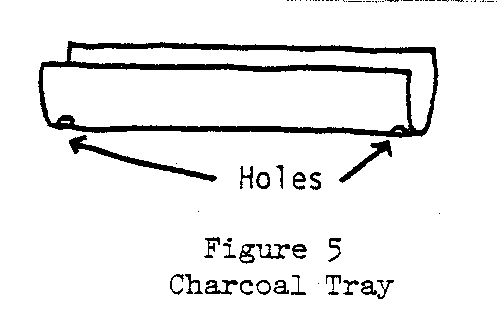
* Make two trays for each chamber from light sheet metal or thin oil drums--total
of four trays.
* Curve the trays to fit the chambers.
* Bore a 2.5cm (1") hole at each end of
the trays. <See figure 5>
mc5x12.gif (393x393)
* Make a hook at one end of the 2.15m (8') iron bar. This bar will be used
pull trays from the retort. <See figure 6>
mc6x12.gif (393x393)

MAKE TAR CONDENSERS (Optional)
If you want to collect tar, make tar condensers. The other choice is to
make gas escapes. Gas escapes allow you to use gas from inside the retort
as fuel to keep the retort hot. To make tar condensers:
* Fit together the 8cm (3") galvanized iron pipe as shown in Figure 7. The
mc7x13.gif (600x600)
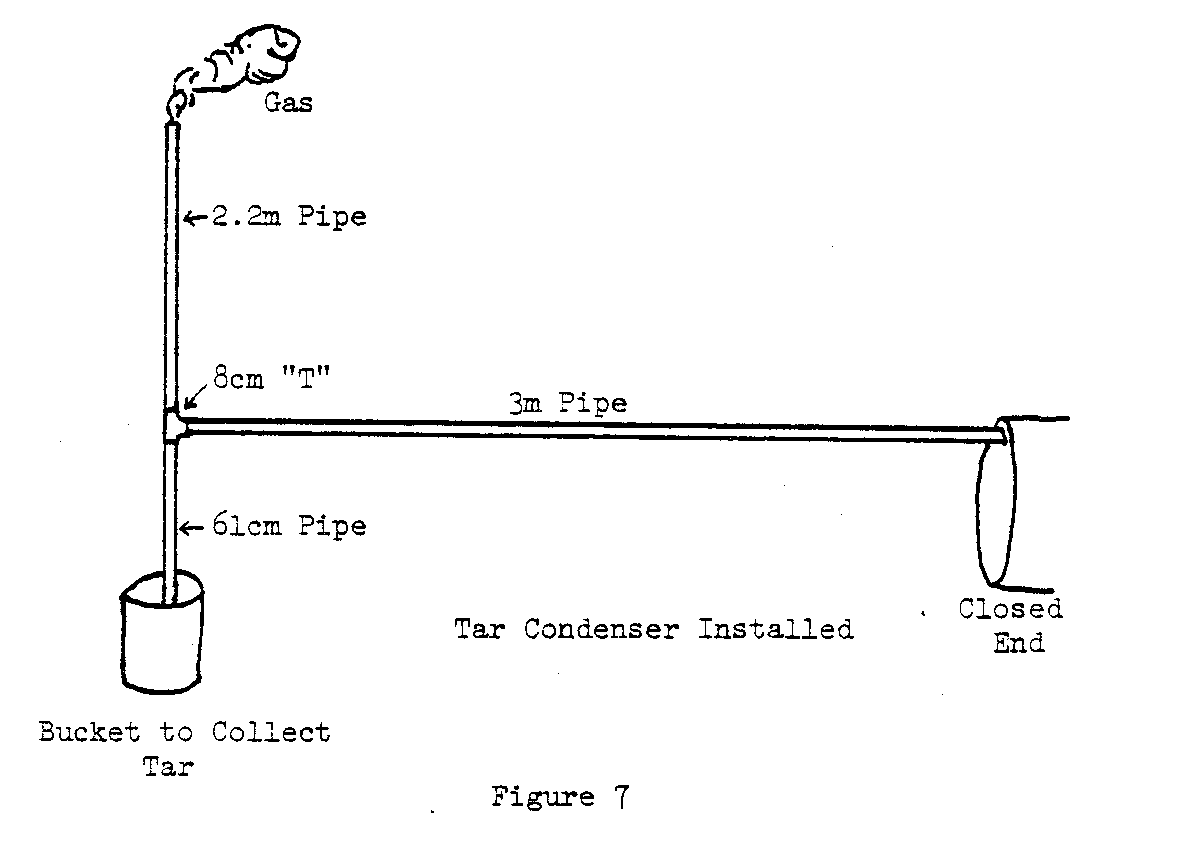
3m (9-3/4') piece connects with the closed end of the retort. The 2.2m
(6-1/2') piece goes upward as a chimney. The 61cm (24") piece goes downward
as a tap for the tar. These three pieces are joined together by one
8cm (3") galvanized iron pipe "T".
* Repeat the entire process for the second retort.
This condenser works as follows:
* The 3m (9-3/4') piece of pipe joins to the hole in the closed end of the
retort.
* Gas from the burning wood enters the pipe.
* The gas goes through the entire condenser.
* Some of the gas condenses and forms tar in the pipes.
* This tar flows down the 61cm (24") piece of pipe into a bucket.
* The gas exits at top through the 2.2m (6-1/2') piece of pipe.
MAKE GAS ESCAPES
* Cut one hole in the bottom of each chamber, near the open end. Each hole
should be 8cm (3") in diameter.
* Cut two pieces of 8cm (3") pipe, each about 15-23cm (6-9") in length. One
piece will be used for each chamber.
* Weld one of the two pieces of pipe to one of the two holes; repeat. <see figure 8>
mc8x14.gif (600x600)

The two pipes act as gas burners. Gas forms inside the chambers and will
start burning about two-three hours after the fire is lighted. Once this
happens, no more wood is needed outside the chambers to keep them hot. The
retort heats itself.
SET UP THE RETORT--TRENCH METHOD
Use this method if the soil is firm. The fire will be placed in the trench.
The retort will be at ground level, above the fire.
Remember to clear a large area of land on which to work. If possible, set
up the retort at the edge of a small gully or depression. Otherwise, dig
an area next to, wider and deeper than, the trench that lets you easily care
for the fire. You should be able to attend the fire easily.
To Make The Trench
* Dig the trench as long as the chambers, 30cm (12") deep X 45cm (18") wide.
* Place the chambers lengthwise on either side of the trench. The chambers
are parallel to, and partly hang over, the trench (see Figure 9).
mc9x15.gif (600x600)

* On the side of each chamber away from the trench, place some stones for
support.
* Cut smoke channels in the ground perpendicular to the chambers. These
channels are 15cm (6") wide and placed approximately midway of each
barrel section [about every 90cm (35-1/2")]. One end touches the chamber;
the other leads away.
SET UP THE RETORT--Elevated Method
Use this method if the dirt is not firm enough for a trench. You will need
extra bricks, stones, or other materials to support the two chambers. The
basic idea is to raise the chambers above the ground and put the fire
beneath them. The fire is at ground level. There are two good ways to do
this:
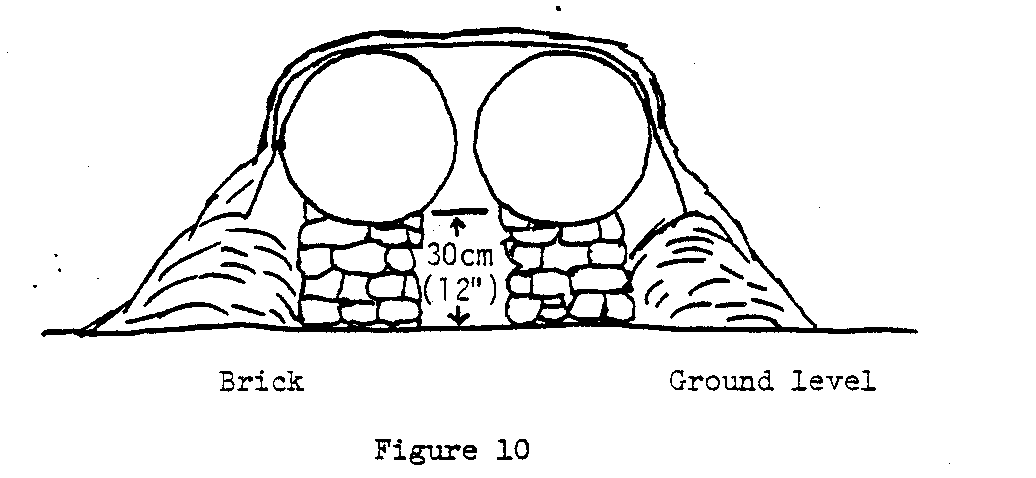
* Make two neat piles of bricks or stones. The piles should be about 90cm
(35-1/2") apart. Rest the chambers on these piles. The joints where the
barrels are welded together must rest on the piles. The bottom of the
chambers should be about 30cm (12") above the ground. The fire is made
in the space under the two chambers. <see figure 10>
mc10x16.gif (486x486)
* Place old railway lines or girders on piles of stones or bricks. Rest the
chambers on these. Put the fire below. <see figure 11>
mc11x16.gif (486x486)

FIT THE TAR CONDENSERS
If you are using tar condensers instead of gas escapes, you must now connect
them to the chambers. There is one condenser for each chamber. Check
whether there is a bung hole on the closed end near the top of the chamber.
If so, screw one condenser into each bung hole. If there is no bung hole,
cut an 8cm (3") hole in the closed end of each chamber. Weld the condenser
in place here.
WELD THE GAS PIPES
If you are using gas escapes instead of tar condensers, you must now connect
them. Weld the gas pipes to holes cut near the open end of each chamber, as
described on page 14.
INSULATE THE RETORT
* Gather some sheets of old iron.
* Place the sheets against the sides and on top of the chambers. This forms
a "house" around the chambers .
* Make one or two holes at the far end of the roof. These will let out the
smoke. <see figure 12>
mc12x17.gif (486x486)

* Pile dirt against the sides of the iron sheets. Put 2-3cm (about 1") of
dirt on top leaving the smoke hole(s) uncovered. The dirt helps keep in
the heat. Don't use too much or the whole retort could break.
V. OPERATION AND MAINTENANCE
* Early in the morning, put the trays in the chambers. Pack in as much wood
as possible.
* Put on the covers. Screw the nuts to the bolts. Do not screw the nuts
too tightly. That may cause the covers or bolts to bend.
* After the retort is closed, build a fire under the chambers. Use small
branches, leaves, bark, and roots. Try not to use good wood that could
be made into charcoal. Make a very strong fire. The flames should touch
the chambers below and at the sides.
* Let the fire burn strongly for two-three hours. Then the gas and tar
will flow quickly through the pipes.
* If you are collecting tar, stoke the fire for two more hours. Put the
bucket in place.
* If you have gas pipes, you do not need to watch for the tar. You also do
not have to stoke the fire. The gases from the pipe will now keep the
fire burning. They will burn until the charcoal is made. When the gases
stop flowing, the fire stops. The charcoal is finished.
* Leave the retort closed overnight to cool.
* The next morning, unbolt the covers. Pull out the trays with the iron
bar.
* Dump the charcoal from the trays. Let it cool for a few hours. If any
part of it starts to burn, sprinkle it with some water.
* Bag the charcoal.
* Pack the chambers with new wood and begin the process from the start.
HOW TO USE TAR
If you install tar condensers, two types of tar will form in the bucket.
heavier tar settles to the bottom; a watery tar is on top.
The heavy tar is like bitumastic paint. It is very sticky and takes a long
time to dry. But this is often not a big problem. This tar can be painted
on fence posts for termite control. It can also be painted on pipes or corrugated
iron to prevent rusting.
The watery tar is too thin to be used for painting. It must be boiled to
make it thicker. Boiling must be done outdoors because the tar smells very
bad.
Once thickened, this tar can be used to paint any type of wood. It dries
quickly with a dull, jet black finish. It protects wood from termites. If
the painted portion is more than 23cm (9") wide, termites will not cross it.
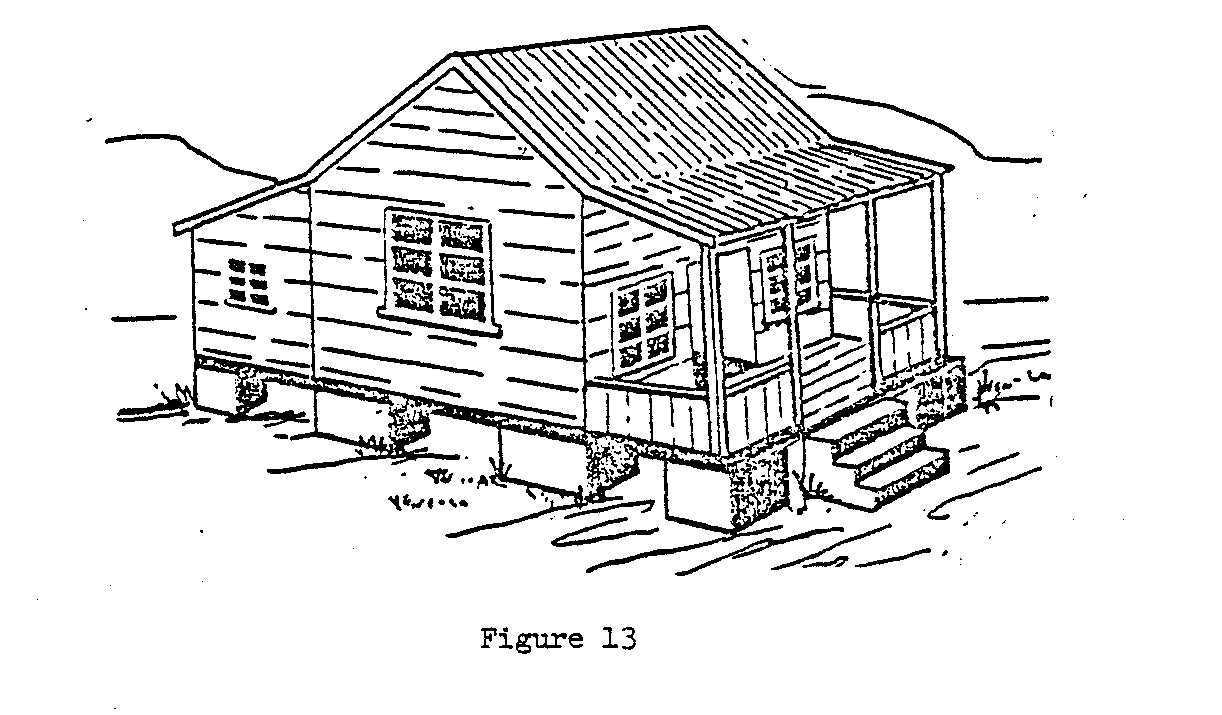
A band painted around the base of a building will protect the foundation
from termites. This makes the tar very valuable in many parts of the world.
Unfortunately, the thickened tar cannot protect trees. It will not soak
through the bark deeply enough. <see figure 13>
mc13x20.gif (486x486)
VI. CONVERSION TABLES
UNITS OF LENGTH
1 mile = 1760 yards = 5280 feet
1 kilometer = 1000 meters = 0.6214 mile
1 mile = 1.607 kilometers
1 foot = 0.3048 meter = 30.5 centimeters
1 meter = 3.2808 feet = 39.37 inches
1 inch = 2.54 centimeters
1 centimeter = 0.3937 inch
UNITS OF AREA
1 square mile = 640 acres = 2.5899 square kilometers
1 square kilometer = 1,000,000 square meters = 0.3861 square mile
1 acre = 43,560 square feet
1 square foot = 144 square inches = 0.0929 square meter
1 square inch = 6.452 square centimeters
1 square meter = 10.764 square feet
1 square centimeter = 0.155 square inch
UNITS OF VOLUME
1.0 cubic foot = 1728 cubic inches = 7.48 US gallons
1.0 British imperial
gallon = 1.2 US gallons
1.0 cubic meter = 35.314 cubic feet = 264.2 US gallons
1.0 liter = 1000 cubic centimeters = 0.2642 US gallons
UNITS OF WEIGHT
1.0 metric ton = 1000 kilograms (kg) = 2204.6 pounds (lb)
1.0 kilogram kg) = 1000 grams (g) = 2.2046 pounds (lb)
1.0 short ton = 2000 pounds (lb)
UNITS OF PRESSURE
1.0 pound per square inch (psi) = 144 pound per square foot
1.0 pound per square inch (psi) = 27.7 inches of water*
1.0 pound per square inch (psi) = 2.31 feet of water*
1.0 pound per square inch (psi) = 2.042 inches of mercury*
1.0 atmosphere = 14.7 pounds per square inch psi)
1.0 atmosphere = 33.95 feet of water*
1.0 foot of water = 0.433 psi = 62.355 pounds per square foot
1.0 kilogram per square centimeter = 14.223 pounds per square inch
1.0 pound per square inch = 0.0703 kilogram per square centimeter
(*)At 62 degrees Fahrenheit (16.6 degrees Celsius)
UNITS OF POWER
1.0 horsepower (English) = 746 watt = 0.746 kilowatt (kw)
1.0 horsepower (English) = 550 foot pounds per second
1.0 horsepower (English) = 33,000 foot pounds per minute
1.0 kilowatt (kw) = 1000 watt = 1.34 horsepower (hp) English
1.0 horsepower (hp) (English) = 1.0139 metric horsepower
(cheval-vapeur)
1.0 metric horsepower = 75 meter X kilogram/second
1.0 metric horsepower = 0.736 kilowatt = 736 watt
VII. FURTHER
Basore, C.A. and Moore, D.C. The Production of Lump Charcoal From Pine
Sawdust Without a Binder. Auburn, Alabama, 1942. Available from VITA.
Chandler, John L. and Wates, Richard B. Making Charcoal the Easy Way.
University College of the West Indies. Available from VITA.
Coconut Research Institute. Coconut Shell Charcoal. Leaflet #6, reprinted
December 1970. Available from VITA.
Food and Agriculture Organization. Coconut Shell Charcoal, paper #63.
FAO, Via delle Termi de Caracalla, 00100 Rome, Italy.
Forest Products Research Institute. Charcoal Making in the Backyard.
Technical Note #55, May 1964. College, Laguna, E-109, Philippines.
Forest Products Research Laboratory. The Construction and Operation of
Charcoal Kilns. Department of Scientific and Industrial Research,
Leaflet #35, May 1944,
Forest Products Research Laboratory. Further Notes on the Manufacture of
Charcoal in Portable Kilns. Department of Scientific and Industrial
Research, Leaflet #124, July 1942. Available from VITA.
Hicok, Henry and Olson, Richard. The Connecticut Charcoal Kiln. Forestry
Department, The Comm. Agric. Exp. Station, 1947. Contains highly
detailed instructions for construction and operation of a fairly small
(one or two cord) cinder block kiln. Also has a discussion of possible
problems and maintenance of the kiln. In addition, there are a few
plans for larger designs, also a short section on uses of charcoal and
costs of production. Available from VITA.
International Labor Organization. Charcoal Making for Small-Scale Enterprises.
Geneva, 1975. Information on the uses of charcoal, making
charcoal and marketing charcoal. Detailed plans for building and using
an improved earth kiln and portable steel kiln. Also has instructions
for record keeping, various aspects of marketing, training for charcoal
makers, and setting up a charcoal-making cooperative. ILO, CH 1211,
Geneva 22, Switzerland.
Lane, Paul H. "Wood Carbonization in Kilns." Forest Products Journal,
Vol. X, No. 7 (July 1960), 344-348. Forest Products Resource Society,
417 North Walnut Street, Madison, Wisconsin USA.
Little, E.C.S. "A Kiln for Charcoal Making in the Field." Tropical Science,
Vol. 14, No. 3 (1972), 261-270. Contains plans for construction and use
of the CUSAB (Charcoal from Useless Scrub and Bush) Kiln. This design is
made of metal, is portable and makes charcoal from small scrub and bush
wood. Unlike other designs, it employs a "continuous feeding system" in
which wood is fed into the burning kiln until full. Tropical Products
Inst., 56/62 Gray's Inn Rd, London, England WC1X8LU.
Loo, Thio Goan. Activated Charcoal/Coconut Shells. Volunteers in Technical
Assistance #25758, 1974. Available from VITA.
Michener, T.S. Press for Charcoal Briquettes. Volunteers in Technical
Assistance #28530, 1977. Available from VITA.
National Science Development Board. Charcoal from Wood. Forest Products
Research and Industries Development Commission. College, Laguna,
Philippines, No. 8, June 1960.
Simmons, Fred. Charcoal From Portable Kilns and Fixed Installations. FAO
Supplement. Contains information on design and use of concrete kilns and
metal kilns. Also has several retort designs, including a section on
retorts for sawmill by-products such as sawdust, shavings and wood chips.
Basically a good detailed review of the state of the art in commercial
charcoal production. Available from VITA.
USDA Forest Service. "Charcoal: Production, Marketing, and Use." Forest
Products Lab Report 2213, July 1961. Goes into great detail on the
designs and operation of large-scale concrete kilns and metal kilns,
charcoal briquetting and comparison of yields of various types of wood.
Would be highly useful for setting up a larger-scale commercial charcoal-making
enterprise. Northeastern Wood Utilization Council, Inc., PO Box
1577, New Haven, Connecticut USA.
Volunteers in Technical Assistance. Manufacture of Charcoal From Wood, 1976.
VITA #26587, 1976.
Willard, R.C. Process of Charcoal Making. Volunteers in Technical Assistance,
1977.
APPENDIX I
DECISION MAKING WORKSHEET
If you are using this as a guideline for using the Charcoal Retort in a
development effort, collect as much information as possible and if you need
assistance with the project, write VITA. A report on your experiences and
the uses of this Handbook will help VITA both improve the book and aid
other similar efforts.
Publications Service
VOLUNTEERS IN TECHNICAL ASSISTANCE
1815 North Lynn Street, Suite 200
Box 12438
Arlington, Virginia 22209-8438 USA
CURRENT USE AND AVAILABILITY
* What kinds of trees are available, and in what quantities?
* Is deforestation a problem? If so, to what extent? If not yet a problem,
will deforestation be a problem if present wood uses continue?
* What are the current major uses of wood in the area? Are present uses
wasteful, inefficient or unhealthy? Include here a look at cookstoves,
heating methods, charcoal production techniques, etc.
* What amount of time is spent gathering wood per week? Who gathers the
wood: men, women, or children? How much does this cost in human terms?
Can wood be purchased? How much does it cost (in dollars)?
* Is charcoal currently used? If so, for what purposes?
NEEDS AND RESOURCES
* What are the characteristics of the problem? Is the local population
aware of the problem/need? How do you know?
* Has any local person, particularly someone in a position of authority,
expressed any interest in better charcoal production methods? If so, can
that person help you? Are there local officials who could be tapped as
resources?
* How will you get the community involved with deciding which technology is
appropriate for them?
* Note possibilities for expanded markets for charcoal if production were
increased and costs lowered. Check with local charcoal users to see
what their opinions of market demand might be.
* Find out what "trash" woods are available, if any. This includes sawdust,
wood chips, etc. left from sawmill operation. It also includes
such tree litter as sticks, branches, and animal dung.
* What local materials are available for use in building improved charcoal
production facilities?
* Are machine shop facilities necessary? If so, are they available locally
for manufacture of wood-conserving technology?
* What kinds of skills are available locally to assist with construction and
maintenance? How much skill is necessary for construction and maintenance?
Do you need to train people? Can you meet the following needs?
* Some aspects of the project require someone with experience in metalworking
and/or welding.
* Estimated labor time for full-time workers is:
* 5 hours skilled labor
* 10 hours unskilled labor
* 3 hours welding
* Do a cost estimate of the labor, parts, and materials needed.
* Would the technology require outside funding? Are local funding sources
available to sponsor the effort? How will the project be funded?
* What is your schedule? When will the project begin? How long will it
take? Are you aware of holidays, planting or harvesting seasons that may
affect timing?
* How will you arrange to spread knowledge and use of the technology?
FINAL DECISION
* How was the final decision reached to go ahead--or not to go ahead--with
this technology?
APPENDIX II
RECORD KEEPING WORKSHEET
CONSTRUCTION
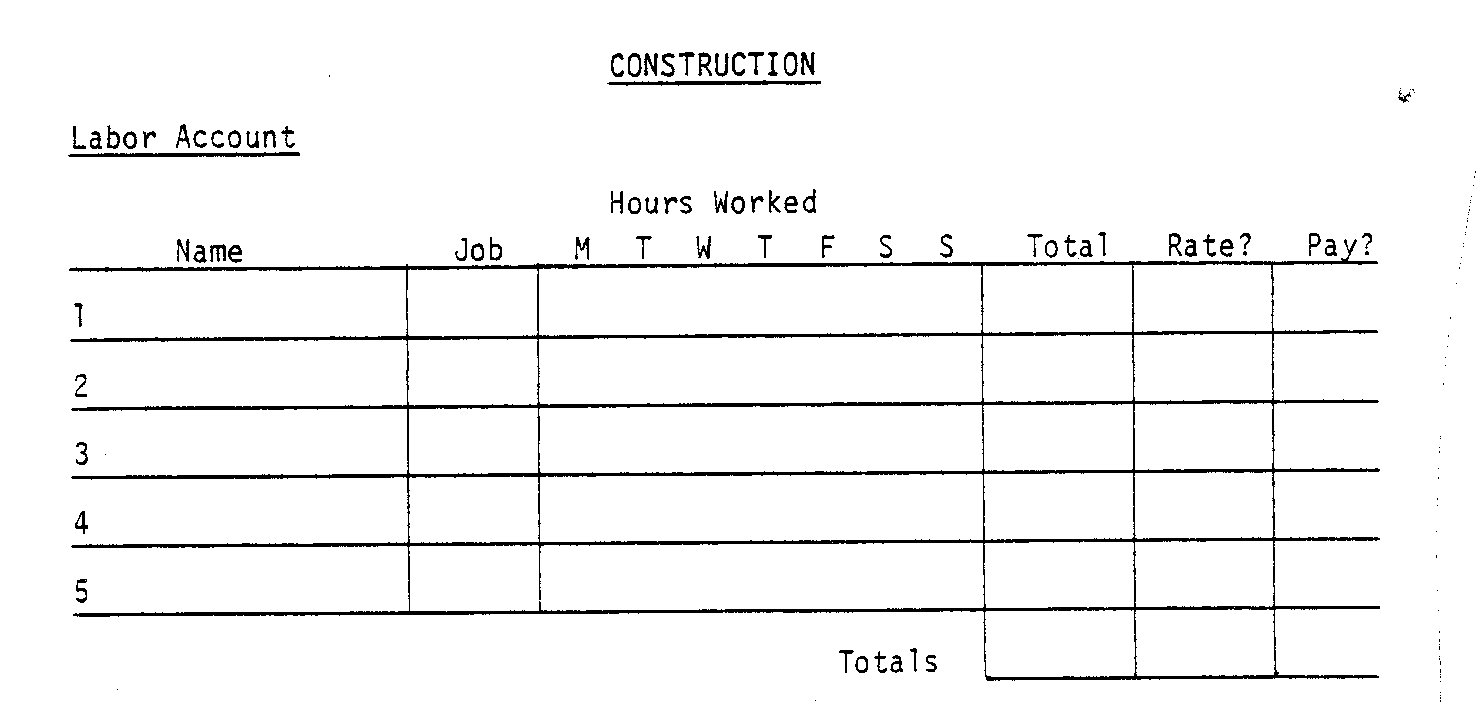
Photographs of the construction process, as well as of the finished product,
are helpful. They add interest and detail that might be overlooked in the
narrative. A report on the construction process should include a lot of
specific information. This kind of detail can often be recorded with photographs,
which lend interest and detail. Specific information can be monitored
most easily in charts (see below). Some other things to record include:
mcxrp10.gif (486x486)
* Specification of construction materials.
* Design changes made to fit local conditions.
* Equipment costs.
* Time spent in construction. Include volunteer time as well as paid labor,
full- and part-time.
* Problems: labor or material shortages, work stoppages, training difficulties,
terrain, transport, etc. <see report 1>
OPERATION
Keep log of operations for at least the first six weeks, then periodically
for several days every few months. This log will vary with the technology,
but should include full requirements, outputs, duration of operation, training
of operators, etc. Include special problems that may come up--a damper
that will not close, gear that will not catch, procedures that do not seem
to make sense to workers, etc.
MAINTENANCE
mcxrp20.gif (486x486)

Many aspects of maintenance can be most easily recorded on a chart. Maintenance
records enable keeping track of where breakdowns occur most frequently
and may suggest areas for improvement or strengthening weakness in the design.
Furthermore, these records will, give a good idea of how well the project is
working out by accurately recording how much of the time it is working and how
often it breaks down. Routine maintenance records should be kept for a minimum
of six months to one year after the project goes into operation.
SPECIAL COSTS
Keep a special set of records to track repair costs of damages that fall
outside routine maintenance. This category includes damage caused by
weather, natural disasters, vandalism, etc. Pattern the records after the
routine maintenance records. Describe for each separate incident:
* Cause and extent of damage.
* Labor costs of repair (like maintenance account).
* Material costs of repair (like maintenance account).
* Measures taken to prevent recurrence.
OTHER MANUALS IN THE ENERGY SERIES
Small Michell (Banki) Turbine:
A Construction Manual
Helical Sail Windmill
Overshot Water-Wheel: Design
and Construction Manual
Wood Conserving Stoves: Two Stove
Designs and Construction Techniques
Three-Cubic Meter Biogas Plant:
A Construction Manual
Hydraulic Ram for Tropical Climates
Solar Water Heater
Solar Grain Dryer
The Dynapod: A Pedal-Power Unit
Animal-Driven Chain Pump
Solar Still
For free catalogue listing these and other VITA publications,
write to:
VITA
1600 Wilson Boulevard, Suite 500
Arlington, Virginia 22209 USA
Tel: 703/276-1800 . Fax: 703/243-1865
Internet: pr-info@vita.org
ABOUT VITA
Volunteers in Technical Assistance (VITA) is
a private, nonprofit, international development
organization. Started in 1959 by a
group of concerned scientists and engineers,
VITA maintains an extensive documentation
center and worldwide roster of volunteer
technical experts. VITA makes available to
individuals and groups in developing countries
a variety of information and technical
resources aimed at fostering self-sufficiency--needs
assessment and program development
support; by-mail and on-site consulting
services; information systems training. It
also publishes a quarterly newsletter and a
variety of technical manuals and bulletins.
VITA
VOLUNTEERS IN TECHNICAL ASSISTANCE
ISBN 0-86619-071-6
========================================
========================================